A museum campus on the Dedinje hill in Belgrade keeps the history of a country that no longer exists, and the entrance you stand at before you go in is the honest opening question of the whole visit: what does it mean that a state can vanish while its grave is still tended. The Museum of Yugoslavia sits on Mihaila Mike Jankovica street, three buildings dedicated to the life of Josip Broz Tito and the record of the federation he led. It is the most visited museum in Serbia, drawing around one hundred and twenty thousand people a year, and its collection runs to more than seventy-five thousand items. Before you buy the campus ticket, it is worth understanding what kind of institution this is, because the entrance is not a threshold into a normal museum. It is a threshold into a place that is still deciding how to remember.
What you are standing in front of
The campus holds three buildings. There is the House of Flowers, the winter garden that became Tito's tomb in nineteen eighty. There is the Twenty-fifth of May Museum, built as a birthday gift to Tito and filled with the gifts of state he received. And there is the collection of diplomatic objects that trace Yugoslavia's role in the wider world. Inside those walls are Tito's personal belongings, artworks that include prints by the Spanish artist Goya, and the accumulated presents of foreign governments and delegations he received over decades of state visits to more than seventy countries. The number that matters most, though, is not the size of the collection. It is the fact that somewhere on this ground there is an actual grave, still visited, for a country that dissolved decades ago.
That is the tension the entrance asks you to hold. You are not here to grieve Yugoslavia, and you are not here to celebrate it. The museum's own framing is careful about this. It presents Yugoslavia as a subject to be studied rather than mourned or condemned, and that posture is the one worth carrying past the ticket desk. It is unusual for a memorial site, and it is deliberate.
The names tell the history
Hear a stop from this walk
The Relay Batons and the Day of Youth
The single most revealing thing about this place is something you cannot see in any exhibit: the institution has changed its name four times, and each change is a small record of a country arguing with its own past. It opened as a single museum in nineteen sixty-two, tracing its lineage to the Twenty-fifth of May Museum of that year. In nineteen eighty-two, two years after Tito's death, it became the Josip Broz Tito Memorial Centre, absorbing collections from the former Museum of the Revolution. In nineteen ninety-six, as the wars of the breakup were still fresh, it was renamed the Museum of the History of Yugoslavia. Then, in twenty sixteen, it settled into its current name, simply the Museum of Yugoslavia.
Read those four names in sequence and you can watch a society's relationship to its socialist past shift in real time. First a museum. Then a shrine to one man. Then a cautious historical framing, the word "history" doing the work of distance. Then, finally, the name of the vanished country itself, neither man nor shrine, just the thing that is gone. The building never moved. Only the way it was allowed to be remembered kept changing. If you understand nothing else about this campus, understand that the entrance sign has been rewritten to match the country's mood, and that is the exhibit before the exhibits.
Why this hill, and why it matters
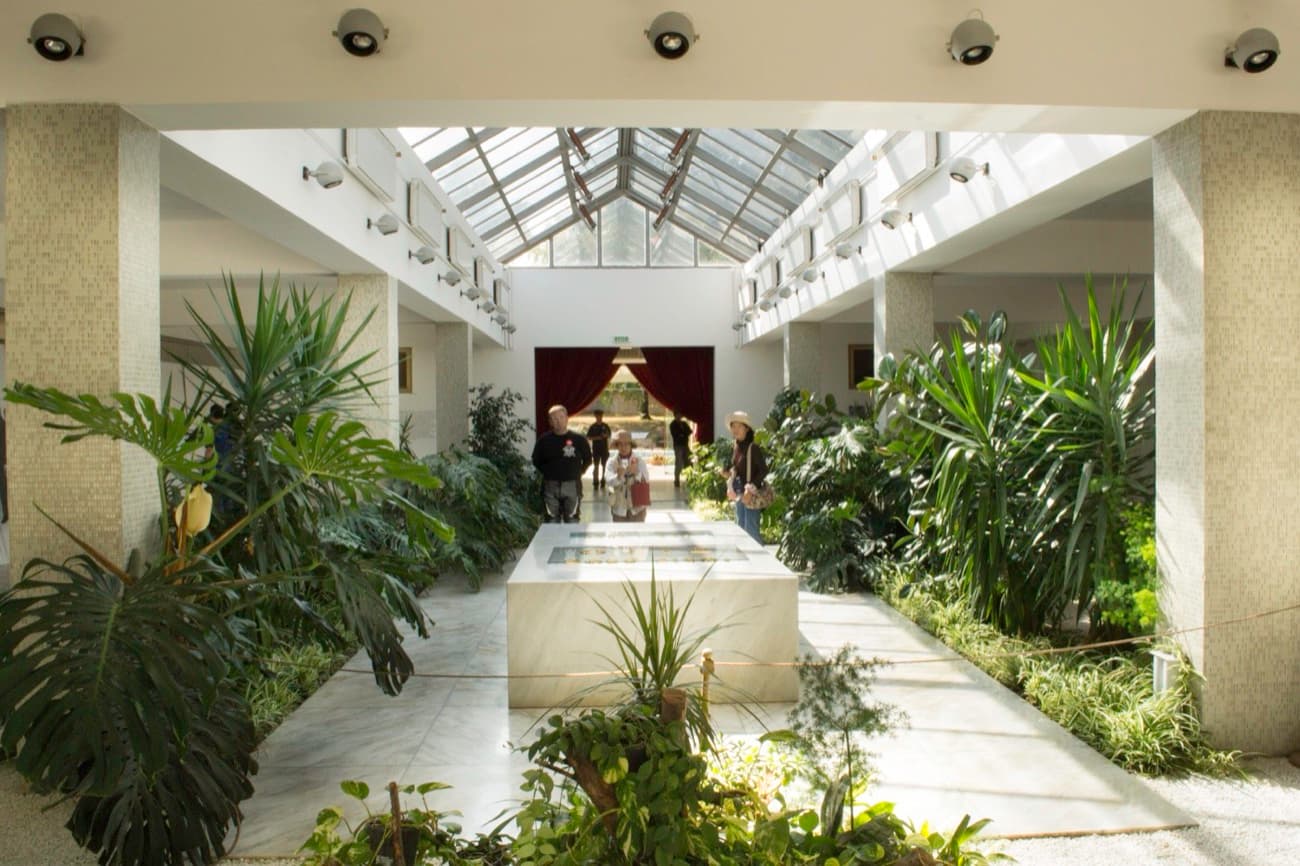
The Dedinje hill has long been an enclave of political power in Belgrade, and the museum sits within that landscape rather than apart from it. Tito lived nearby, and the House of Flowers was raised in nineteen seventy-five as a winter garden near his residence, about nine hundred square metres of glass and green designed by the architect Stjepan Kralj, before it became his tomb by his own wish in nineteen eighty. The proximity is the point. This is not a museum built in a neutral civic quarter and later assigned a subject. It grew directly out of the physical world of the man it commemorates, on the ground where power actually lived.
That is why the Twenty-fifth of May Museum, the campus's founding building, opened as a birthday present. The City of Belgrade built it and gave it to Tito for his seventieth birthday, and it opened on the twenty-fifth of May nineteen sixty-two. That date was Tito's official state birthday, not his actual one, which fell in eighteen ninety-two. A museum given as a gift, to house gifts, opened on a birthday the state had chosen rather than the one nature supplied. The whole logic of a personality cult is compressed into that one arrangement, and it starts the moment you walk through the gate.
The one thing to understand at the entrance
If you take a single idea past the ticket desk, take this. Everything on this campus is an attempt to answer, or at least to sit with, one honest question: what does it mean that people still come to the tomb of a place that is gone. The grave is tended. The country is not. Both of those things are true at once, and the museum does not resolve the contradiction for you. It gives you the objects, the dates, the names, and the four renamings, and it leaves you to do the reckoning yourself.
That restraint is rare, and it is the reason this entrance rewards a pause. A lesser institution would tell you how to feel about Yugoslavia. This one hands you a state to read rather than a verdict to accept. Stand at the gate, hold the question, and let the buildings begin to answer it in their own order.
Walk it in person
This deep dive is the opening stop of a longer walk. The full self-guided audio tour, Tito's Yugoslavia: The City That Still Keeps a Country's Grave, moves from this entrance to the House of Flowers, the birthday museum, the relay batons of the Day of Youth, the gifts of the Non-Aligned Movement, and a quiet, honest closing on the memorial plateau. It covers well under a kilometre on a single campus, so an hour and a quarter at your own pace is plenty. Go on any day except Monday, when the campus is closed, and buy the one combined ticket at the door. For more routes through the city, see our guide to Belgrade walking tours.
Sources
- Museum of Yugoslavia, official site (muzej-jugoslavije.org): street address on Mihaila Mike Jankovica, the campus buildings, and the institution's framing of Yugoslavia as a subject of study.
- Museum of Yugoslavia, Wikipedia: founding in nineteen sixty-two, the sequence of renamings through twenty sixteen, the collection of more than seventy-five thousand items, the Goya prints, and the figure of one hundred and twenty thousand annual visitors.
- House of Flowers (mausoleum), Wikipedia: the nineteen seventy-five winter garden of about nine hundred square metres by Stjepan Kralj and its nineteen eighty conversion to Tito's tomb by his own wish.
- Google Arts and Culture, "The 25 May Museum, architect Mihailo Mika Jankovic": the founding building's origin as a seventieth-birthday gift from the City of Belgrade.
Ready to experience it?
Tito's Yugoslavia: The City That Still Keeps a Country's Grave
60 min · 0.6 km · easy
More from Belgrade
Explore more at your own pace.
Belgrade Travel Guide: How Many Days, Getting Around, Safety and Budget
The Bombed Generalstab: How One Belgrade Ruin Holds the Whole Downtown
The House of Flowers: Why Belgrade Still Keeps Tito's Grave
The Stacked Stone of Kalemegdan: Reading Belgrade's Layered Fortifications
Skadarlija: Reading Belgrade's Bohemian Quarter, Cobblestone by Cobblestone