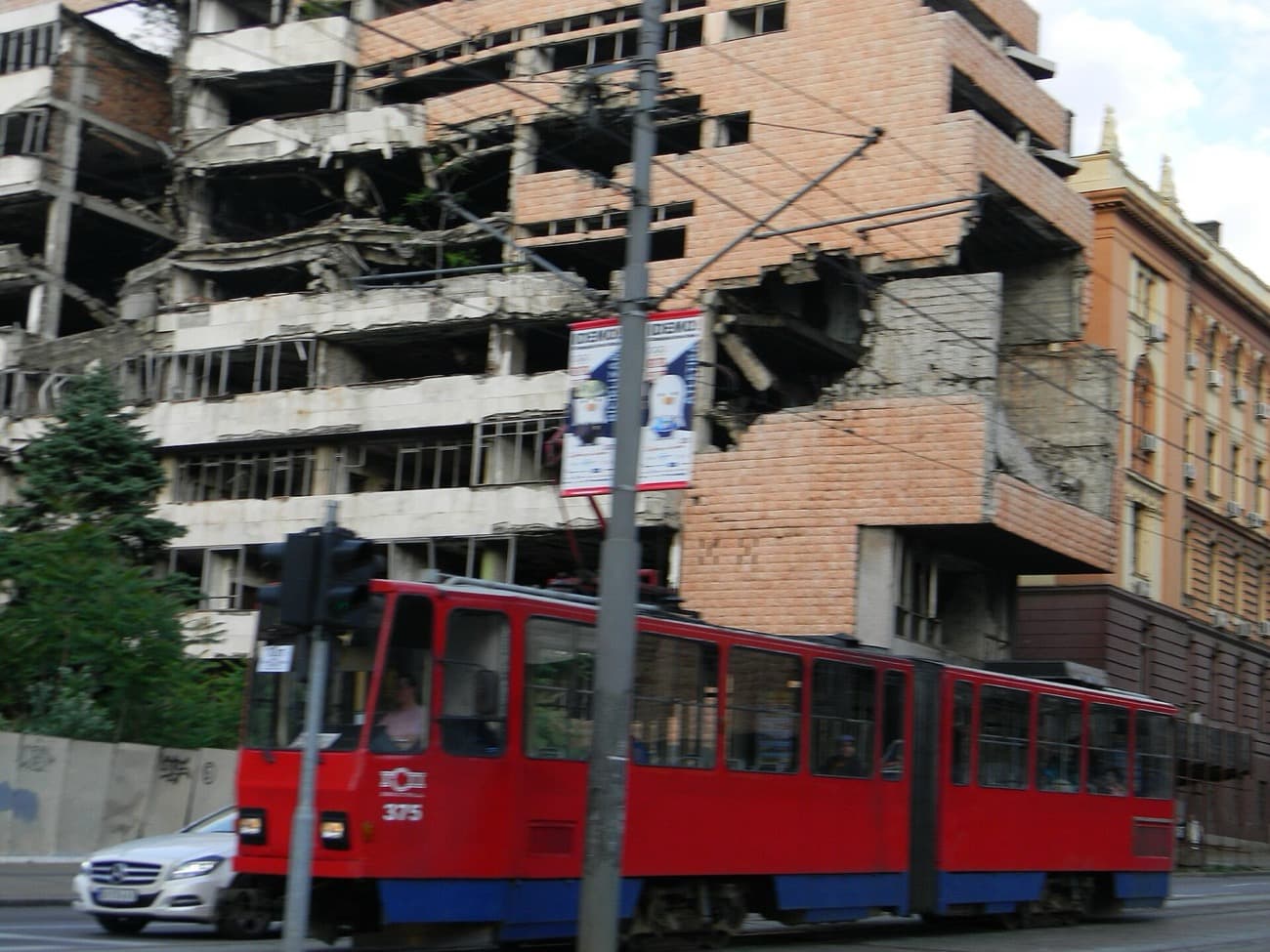
The bombed Generalstab, the former Federal Secretariat of People's Defence in Belgrade's Savski Venac district, is a modernist masterpiece left standing as a preserved ruin after 1999, and it is the clearest single place to read downtown Belgrade as a ridge where five successive states overwrote each other rather than erasing what came before. You do not enter it. You read it from the street. Nemanjina Street runs straight through the middle of it, splitting the structure into two tracts that lean toward each other across the traffic. Look up at those two halves and you are looking at the newest and most contested layer of a downtown that keeps every version of itself stacked in place.
A ruin that was already a monument before it was wounded
Start with what the building was. The architect was Nikola Dobrovic, and it went up between 1955 and 1965, when it was counted among the most admired modern buildings in Yugoslavia. The two halves were not shaped that way by accident. They were designed to evoke the canyon of the Sutjeska river, the site of a major Second World War battle. So before a single bomb fell, this was already a monument in stone to an earlier war, a piece of architecture built as commemoration. That matters, because it tells you how this city thinks. Belgrade does not treat the past as something finished. It builds the past into the fabric of the present and lets the two hold the same address.
Then came 1999. During the NATO bombing, the building was struck twice within about fifteen minutes on the twenty-ninth of April, 1999, and again around midnight on the seventh of May, 1999. It was deserted at the time. It has stood derelict ever since, and in 2005 it was formally protected as a cultural monument and a memorial to the 1999 bombing. A building conceived to remember one war became, forty years later, a wound left open to record another. That doubling, a monument to war that itself became a casualty of war, is the reason this stop anchors the whole walk. It compresses the tour's argument into one façade.
The ridge the ruin sits at the bottom of
Hear a stop from this walk
The RTS Building and the Why Memorial
To understand why the Generalstab lands the way it does, you have to walk down to it, and that is exactly how the Belgrade walking tours route through this downtown are built. The full tour, Downtown Belgrade: Empire to Aftermath, is laid out as a descent, roughly three kilometres and seven stops down a single ridge, north to south and downhill, because the ridge itself is the timeline.
It begins high, on Terazije, the central plateau about a hundred and seventeen metres up, where the money and the empires gathered. The building watching over that square is Hotel Moskva, which opened on the fourteenth of January, 1908, first as a palace named Rossiya, a Russian imperial investment in Vienna Secession style by the architect Jovan Ilkic. That is the empire-and-money layer, the top of the ridge in both elevation and time.
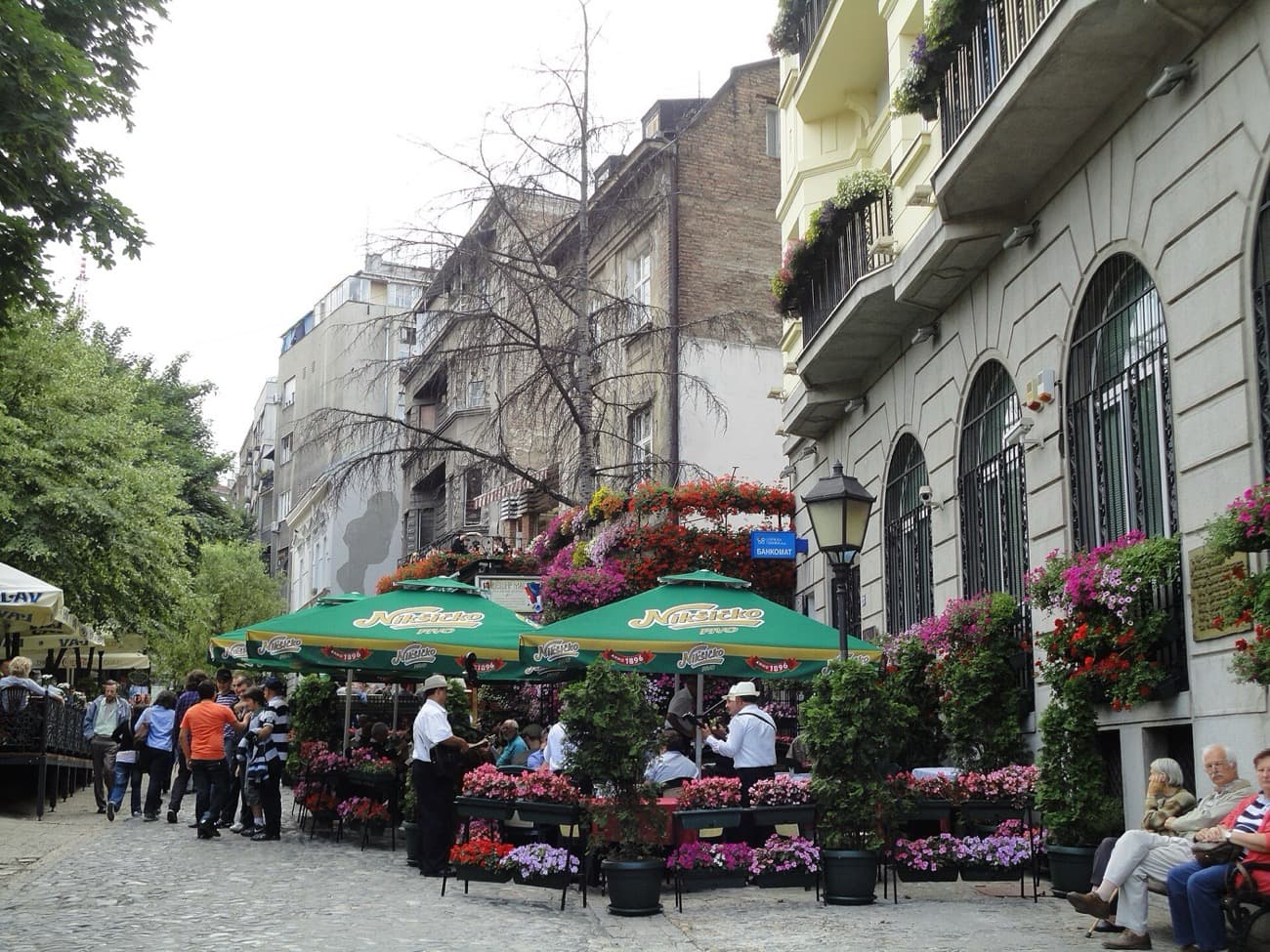
From there the route drops to Republic Square and the bronze figure of Prince Mihailo Obrenovic, cast by the Italian sculptor Enrico Pazzi and raised in 1882 to mark the withdrawal of the last Ottoman garrison from Belgrade in 1867. That is the founding gesture of the modern state, the handshake that replaced the empire on the ridge. A short atmospheric breath follows in Skadarlija, the cobbled bohemian quarter whose main street has kept its name continuously since 1872, twinned with Montmartre in 1977.
Then the state itself: the House of the National Assembly on Nikola Pasic Square, its cornerstone laid on the twenty-seventh of August, 1907, in the presence of King Peter the First, and completed only in 1936 after wars and depression stalled it. This is the building that housed the German high command for Southeastern Europe during the Second World War and stood at the centre of the transition of the fifth of October, 2000. Just past it, Saint Mark's Church in Tasmajdan Park, consecrated in 1948, was deliberately modelled on the medieval Gracanica Monastery in Kosovo, a 1930s building reaching back six centuries, standing over Roman-era quarries that gave the park its name. Roman stone underfoot, a medieval echo overhead, a modern grid bending the church ten degrees to fit.
By the time you reach the Generalstab, you have passed through Ottoman, Habsburg-facing, royal, and socialist Belgrade in sequence. The ruin is where the sequence ends, and it only reads as the final layer if you have felt the ones above it.
Reading the last layer honestly
The stop before the Generalstab, the RTS building and its Why memorial in Tasmajdan Park, sets the register for how this part of the walk is meant to be taken. That memorial is a stone carved with a single word, Zasto, meaning Why, raised by the families of the sixteen broadcaster employees killed when the state television headquarters was struck at two oh six in the morning on the twenty-third of April, 1999. It is a question left standing, not an argument won. The tour names the competing positions on that strike, the NATO account, the Yugoslav account, the ICTY report to the prosecutor, Amnesty International's characterization, and Serbia's own 2002 conviction of the broadcaster's manager, Dragoljub Milanovic, and then declines to rank them.
The Generalstab carries the same discipline into its present. What happens to the ruin next is genuinely unsettled. In May 2024 the government approved a contract worth around five hundred million dollars to convert the site into a luxury hotel. In December 2025 the company withdrew its application, and a criminal investigation followed, including an indictment of the culture minister. Serbian architects and the heritage body ICOMOS have urged that the ruin be conserved. So it stands as a masterpiece and a wound at once, and its fate is being decided now, not settled in the past.
That is the payoff of walking the ridge in order. You arrive at the Generalstab already fluent in how Belgrade layers empire on empire, and you can read a preserved ruin not as a spectacle but as the newest stratum in a city that overwrites and refuses to erase. Save your real time for these last two stops, read them from the street, and give the Why memorial a quiet moment. The whole tour was built to make that moment land.
Sources
- Downtown Belgrade: Empire to Aftermath, Roamer self-guided audio tour. The fact-audited tour transcript and stop research underpinning this article.
- General Staff Building, Belgrade, Wikipedia. Construction dates, architect Nikola Dobrovic, the Sutjeska gorge design, the 1999 strikes, and 2005 monument protection.
- Europa Nostra Statement: Protecting Belgrade's Generalstab. Heritage-body position on conserving the ruin amid the redevelopment dispute.
- NATO bombing of the Radio Television of Serbia headquarters, Wikipedia. The twenty-third of April, 1999 strike, casualty figures, and the contested positions on responsibility.
- The Monument to Prince Mihailo Obrenovic, Tourist Organization of Belgrade. The 1882 statue and the 1867 Ottoman garrison withdrawal it commemorates.
Ready to experience it?
Downtown Belgrade: Empire to Aftermath
95 min · 3.4 km · moderate
More from Belgrade
Explore more at your own pace.
Belgrade Travel Guide: How Many Days, Getting Around, Safety and Budget
The House of Flowers: Why Belgrade Still Keeps Tito's Grave
The Stacked Stone of Kalemegdan: Reading Belgrade's Layered Fortifications
Skadarlija: Reading Belgrade's Bohemian Quarter, Cobblestone by Cobblestone
The Museum of Yugoslavia Entrance: Where Belgrade Still Tends a Vanished Country's Grave