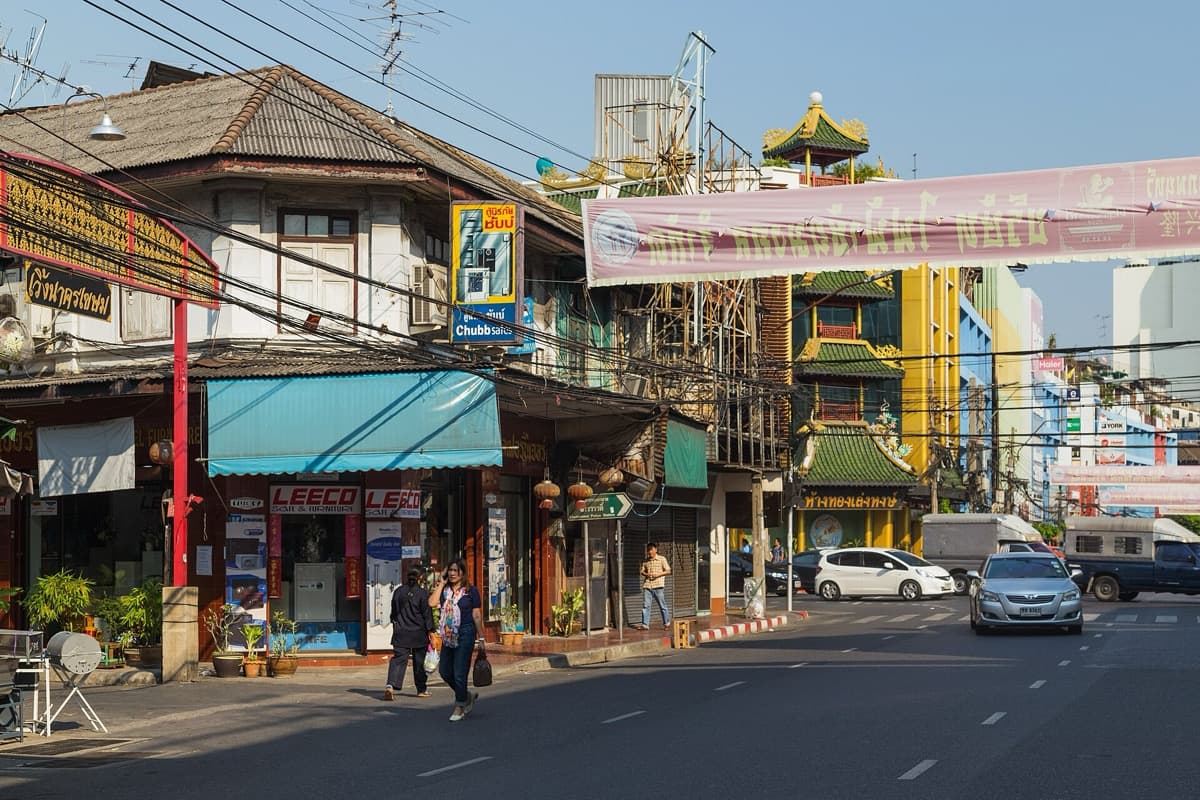
Yaowarat Road is the dazzling surface of Bangkok's Chinatown, and its real story sits one lane back. The gold shops in the windows, the neon that curls along the curve locals call the Dragon Road, the crowds pressing east and west: all of it is the display case. The community that built this district was evicted from the riverbank first, arrived with nothing, and financed a young kingdom from filled-in ground downstream. Walk Yaowarat slowly and every alley branching off it leads to something older and quieter than the avenue itself.
Start with the fact that trips up most visitors: the street the neighborhood is famous for is one of the newer things in it. King Chulalongkorn, Rama the Fifth, ordered Yaowarat cut through this already dense district in late 1891, and it took eight years to build, from 1892 to 1900. It runs about one and a half kilometres in a long curve that locals compare to a dragon. But the Chinese community had been settled on this ground for more than a century by then, relocated here after 1782, when Rama the First took the riverbank for the Grand Palace and moved the people already living there downstream. So when Rama the Fifth laid his modern boulevard, he was carving an avenue across an old immigrant quarter that had been thriving for generations. The grand street is a late chapter written over an early one.
The Gold Is the Surface
There is a reason Yaowarat is called the Golden Road as well as the Dragon Road. It holds the densest concentration of gold shops you will find anywhere. A count reported for the year 2002 found around forty of them along the road, described as the greatest concentration in the world. The gold sold here is Thai gold at ninety-six and a half percent purity, priced by a traditional weight unit that is, confusingly to newcomers, also called the baht. Stand at a shop window and watch the trade happen. It runs on cash and on trust, the way it has for generations.
That surface of visible wealth is the opening note of the whole walk, and it is set even before you reach Yaowarat. The tour begins a few hundred metres east, at Wat Traimit, where a seated Buddha stands three metres tall and weighs five and a half tonnes in solid gold, recognized as the world's largest solid gold sculpture. Here is the detail that makes the point: for roughly two hundred years, nobody knew it was gold. The statue was covered in plaster, and it arrived at the temple in 1935 still wearing that disguise, treated as an ordinary stucco image. Then on the twenty-fifth of May, 1955, workers moving it dropped it, the plaster chipped, and gold showed underneath. Value concealed for two centuries, revealed by accident. That is the neighborhood's whole method in miniature. The dazzle is on top. The real story waits for the plaster to chip.
One Lane Back
Hear a stop from this walk
Talat Noi and the So Heng Tai Mansion: Wealth Lived In
The turn is where the walk changes temperature. Step off the wide road onto Trok Issaranuphap, a lane roughly four metres wide, and you are in Talat Mai. The name means New Market, which is a small joke, because the market is more than two hundred years old. The stalls here hold dried goods, herbs, spices, dried mushrooms, and dried seafood, the raw grammar of a Chinese kitchen. Farther along, past Charoen Krung Road, the goods shift toward incense, paper effigies, and ceremonial sweets made for funerals and festivals. The market grew after the Bowring Treaty of 1855 liberalized foreign trade and Charoen Krung opened the district to more goods and more people. The narrowness is not a flaw to endure. It is the point. This is what commerce looked like before the wide avenue was cut, a nerve running at the pace of two people passing shoulder to shoulder.
One more lane in from the noise sits the community's spiritual anchor, Wat Mangkon Kamalawat, known to nearly everyone as Leng Noei Yi and to Chinese speakers as the Dragon Lotus Temple. It is the largest and most important Chinese Mahayana Buddhist temple in Bangkok, founded in 1871 by the monk Phra Archan Chin Wang Samathiwat, with its Thai name granted by Rama the Fifth. Inside, three traditions braid together in the same courtyards: Buddhist, Taoist, and Confucian worship share the altars, which tells you how completely this community carried its whole world across the water. Admission is free. During the annual Vegetarian Festival, called Kin Jae, the surrounding streets fill with yellow flags and the neighborhood eats without meat for days. On any ordinary morning, it is simply a place to slow down and watch people move through the smoke.
The Founding Street and the House by the River
The oldest thread of all is the easiest to walk past, because it is so tight. Officially it is Soi Wanit One. Everyone calls it Sampeng. When Rama the First took the riverbank in 1782, the Teochew Chinese living there were relocated to this ground, and Sampeng became the first commercial spine of the new quarter. It predates Yaowarat by well over a century. In places it is barely wide enough for two people to pass, and that single detail is the thesis of the walk made physical: a community that was evicted, arrived with nothing, and helped bankroll a kingdom built its first street on a scale you can touch with both hands. Today it is Bangkok's foremost wholesale market, still doing exactly what it was built to do.
The route ends where the story began, at the river, in the quarter called Talat Noi. This was one of Bangkok's earliest ports, the ground where many immigrants first stepped ashore. Its centerpiece is the So Heng Tai Mansion, a nineteenth-century Hokkien courtyard house over two hundred years old, built by Phra Aphaiwanit of the So clan, a Fujian bird's-nest tax farmer who rose into the Thai nobility under Rama the Third. Stand in its teak courtyard and the loop closes. You began at a golden Buddha, wealth the community made and put on display. You end at a family house, the same immigrant wealth turned inward and lived in. One glitters on the avenue. The other has quietly held its ground for two centuries.
That is why Yaowarat rewards a slow, self-directed walk rather than a quick photo. The gold is only the door. To see how the neighborhood actually thinks, you have to turn down the lanes it opens onto, at your own pace, in whatever order pulls you. Browse more Bangkok walking tours or start from the Bangkok city page, then walk the gold mile with the whole story in your ears.
Sources
- Yaowarat Road, Wikipedia. Construction dates under Rama the Fifth, the Dragon and Golden Road names, and the 2002 gold-shop count.
- Golden Buddha (statue), Wikipedia, and Guinness World Records. The five and a half tonne solid gold figure and the 1955 discovery.
- Wat Mangkon Kamalawat, Wikipedia. Founding date, blended Buddhist, Taoist, and Confucian worship, and the Vegetarian Festival role.
- Sampheng and So Heng Tai Mansion, Wikipedia. Sampeng as the founding lane and the Talat Noi courtyard house.
- The Roamer tour "The Golden Mile," fact-audited stop transcripts for Yaowarat, Talat Mai, and Talat Noi.
Ready to experience it?
Chinatown (Yaowarat): The Golden Mile
120 min · 7 km · moderate
More from Bangkok
Explore more at your own pace.
Bangkok Travel Guide 2026: Days, Transport, Season, Safety, and Budget
Bangkok in Layers: A Capital Founded as a Copy, Still Open for Business
Charoen Krung Road: How Siam's First Modern Street Built a Colonial-Looking Quarter That Was Never a Colony
The Emerald Buddha and the Palace: How Bangkok Was Built to Replace a City That Burned
The Golden Buddha of Wat Traimit: The Statue That Hid Its Own Gold for Two Centuries