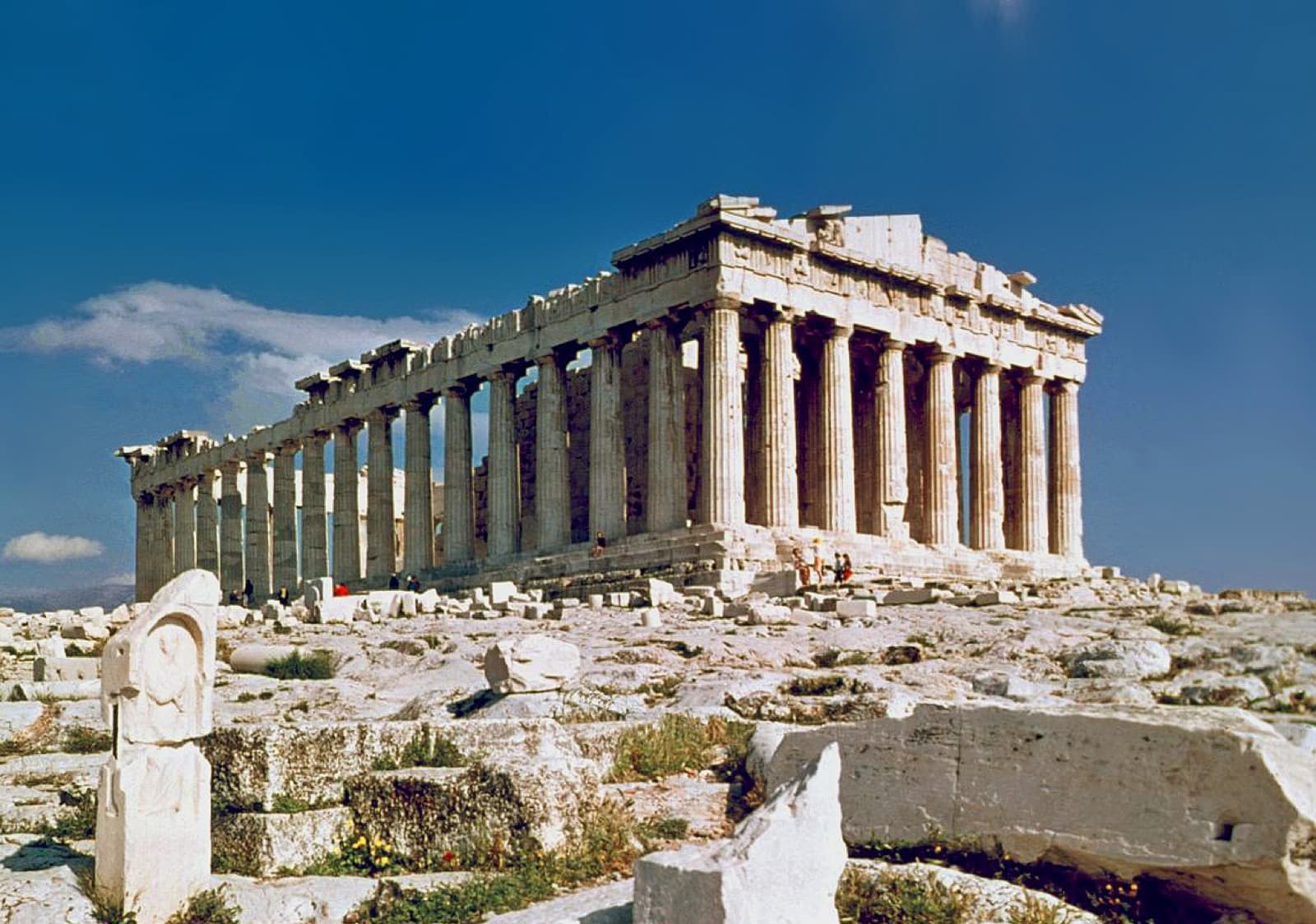
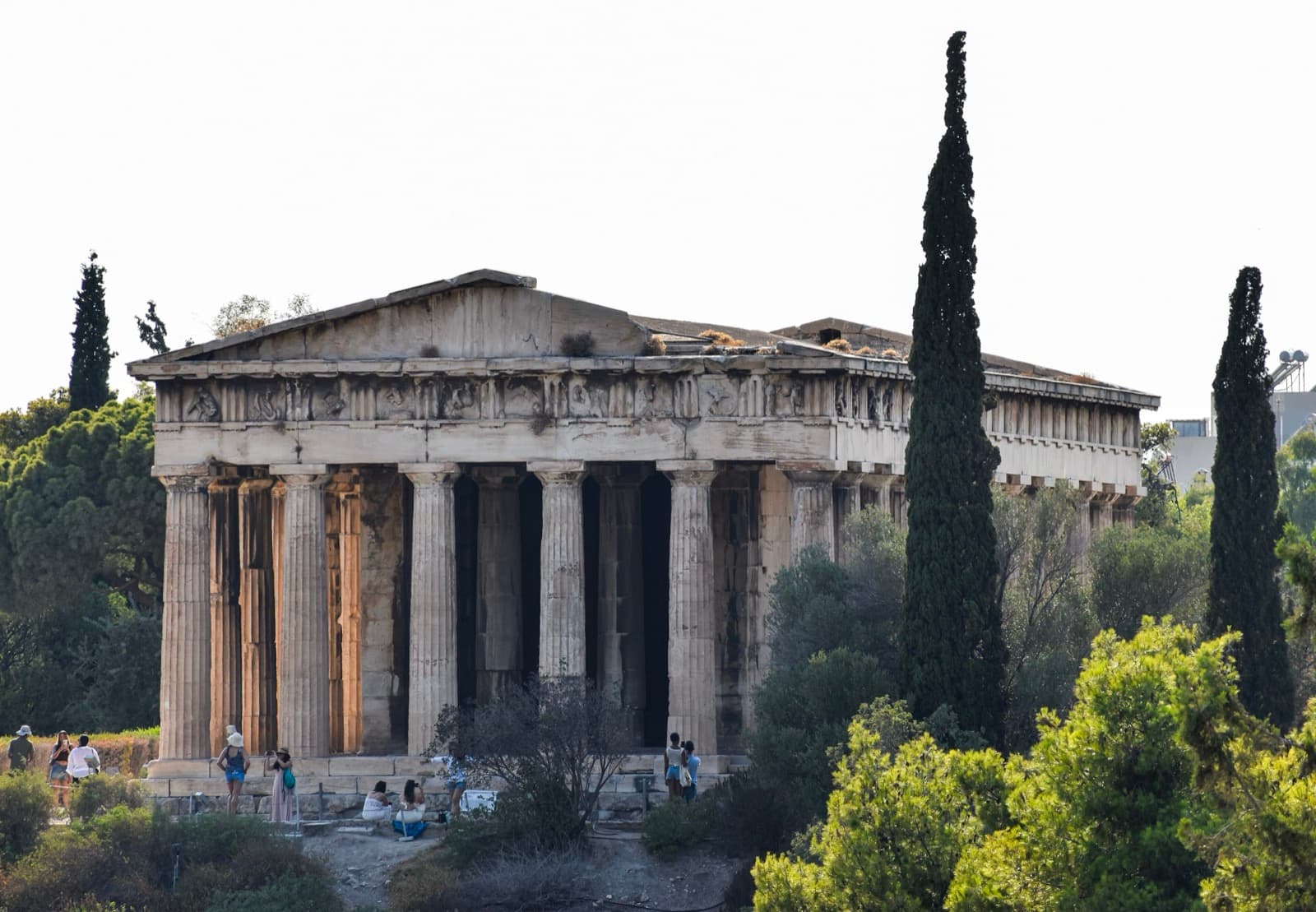
Nearly every ancient building in the Ancient Agora of Athens has been reduced to knee-high foundations, but the Temple of Hephaestus still stands with its columns, walls, and roofline almost complete. It survived because it stopped being a pagan temple and became a Christian church, roofed and maintained for more than a thousand years while its neighbors were quarried for stone and forgotten. That single fact, more than the architecture itself, is the thing to hold in mind while standing in front of it. The temple is not a lucky ruin. It is a building that was never allowed to fall.
What you are looking at
The temple crowns a low hill on the northwestern edge of the Agora called Agoraios Kolonos. Construction started around 449 B C, and the roof was not finished until the Peace of Nicias in the years down to about 415 B C, in the same classical decades that produced the Parthenon on the Acropolis across the valley. It is a Doric temple of the peripteral kind, meaning a continuous colonnade wraps the whole building. Count the columns and you get the classical grammar exactly: six across the short east and west fronts, thirteen down each long side, thirty-four in all. Each is carved with the shallow vertical grooves, the flutes, that catch the light differently as the sun moves.
It was dedicated to two gods, and the choice was practical rather than random. Hephaestus was the divine smith, god of metalworking, craftsmanship, and fire. Athena appeared here in her role as goddess of craft, and a statue of Athena was added to the shrine. The slopes below the temple were once crowded with the workshops of metalworkers and potters, so the smell of forge smoke and wet clay would have drifted up to the god of the forge. The building sat above the trades it protected.
Look closely at the carved panels along the eastern end, the metopes, and at the friezes. The ten metopes on the east side depict the labors of Heracles. Panels on the long north and south sides show the labors of Theseus. That Theseus connection matters for a naming muddle that lasted centuries, which is the next thing worth knowing.
The wrong name that stuck
Hear a stop from this walk
The Areopagus: The Hill of Justice
For a long time this building was not called the Temple of Hephaestus at all. It was called the Theseion, or Theseum, the temple of Theseus. The mistake had a source. A belief current in later centuries held that the bones of the Athenian hero Theseus were buried here, and the metopes showing his labors seemed to confirm it. The name was only corrected in modern times, after inscriptions found within the temple tied it firmly to Hephaestus. You will still see the older name on old maps, in guidebooks, and on the nearby metro station, so do not be confused when you meet it.
The architect is a genuine blank. Several names have been proposed over the years, but with no firm evidence scholars simply refer to the anonymous designer as the Hephaisteion Master. It is a small, honest reminder that even a building this complete does not surrender all its facts.
Why this one and not the others
Here is the heart of it. Walk the rest of the Agora and you will spend your time imagining councils and courts from foundations barely worth photographing. Then you reach this hill and one whole building is still standing. The reason is continuity of use.
From the seventh century until 1834, the Temple of Hephaestus served as the Greek Orthodox church of Saint George Akamates. For that long stretch it was a living place of worship, which meant it was kept roofed, repaired, and defended. A working church does not get its marble carted off for a lime kiln or a new house wall. A working church gets a leak fixed. That routine maintenance, repeated across more than a thousand years, is what carried the building intact through the collapse of the classical city, through Byzantine and Ottoman rule, and into the modern age. The last Divine Liturgy recorded here took place on 21 February 1833, during the celebrations for the arrival of Otto, the first king of the new Greek state. Otto then ordered the building used as a museum, a role it held until 1934 before it was returned to the status of an ancient monument.
This is the pattern worth carrying with you around the rest of Athens and Greece: a great many surviving ancient buildings were not preserved by accident or by sheer stubbornness of stone. They were preserved because later people found a use for them, most often a religious one. The temple next door to this one, the small Church of the Holy Apostles at the southern edge of the Agora, is the only other monument in the Agora that has survived intact since its foundation, which is why the twentieth-century excavators kept it standing when they demolished a whole later neighborhood to dig. Two buildings survived that clearance. Both had been kept alive by worship.
Standing in front of it
Give yourself time to walk the full perimeter. Because so little else in the Agora rises above ankle height, the temple is the one place on the site where you can feel the true scale of a classical building without reconstructing it in your head. Notice how the columns lean very slightly inward and how the platform is not perfectly flat, the deliberate optical refinements the Greeks used so that a large stone building would read as straight and alive rather than rigid. These are the same tricks used on the Parthenon, easier to sense here because the whole structure is intact and you can stand close.
You cannot go inside anymore, and you do not need to. The lesson is on the outside: a temple that outlasted its own religion by becoming useful to the next one. When you are done, turn and look east across the flat ground where the assembly, the council, and the courts once did their work. The best-preserved ancient Greek temple presides over the birthplace of self-government, and you can take both in from this one hill.
The Temple of Hephaestus is the sixth stop on the Ancient Agora audio walk, "Where the Citizens Stood," which reads the whole marketplace as the ground floor of the Western idea of the citizen. You can walk it at your own pace, sitting when a shaded step invites you, and let the audio fill in the councils and courts around you. See more Athens walking tours or start planning from the Athens city page.
Sources
- Temple of Hephaestus, Wikipedia. Confirms the column configuration (Doric peripteral, six by thirteen, thirty-four total), the construction starting in 449 B C with the roof finished by the Peace of Nicias, the Theseion naming error and its correction by inscriptions, the anonymous Hephaisteion Master, the Heracles and Theseus metopes, the church of Saint George Akamates from the seventh century until 1834, the 21 February 1833 last Divine Liturgy tied to Otto's arrival, and the museum role until 1934.
- Church of the Holy Apostles, Athens, Wikipedia. Confirms it is the only monument in the Agora other than the Temple of Hephaestus to survive intact since its foundation.
- Ancient Agora of Athens, Wikipedia. Context for the temple's setting on Agoraios Kolonos and the demolition of the later Vrysaki neighborhood for the excavation.
- Roamer tour, "Where the Citizens Stood" (Ancient Agora), fact-audited transcript. Source for the temple's dedication to Hephaestus and Athena, the surrounding metalworking and pottery workshops, and its long service as the church of Saint George Akamates.
Ready to experience it?
The Ancient Agora: Where the Citizens Stood
85 min · 2 km · moderate
More from Athens
Explore more at your own pace.
Athens: The Ground Floor of the Western City
Anafiotika: The Cycladic Island Village Hiding on the Acropolis Slope
Hadrian's Library: The Roman Wall That Anchors Monastiraki
The Caryatids: The Maidens of the Erechtheion
The Choragic Monument of Lysicrates: A Trophy Case That Changed Architecture