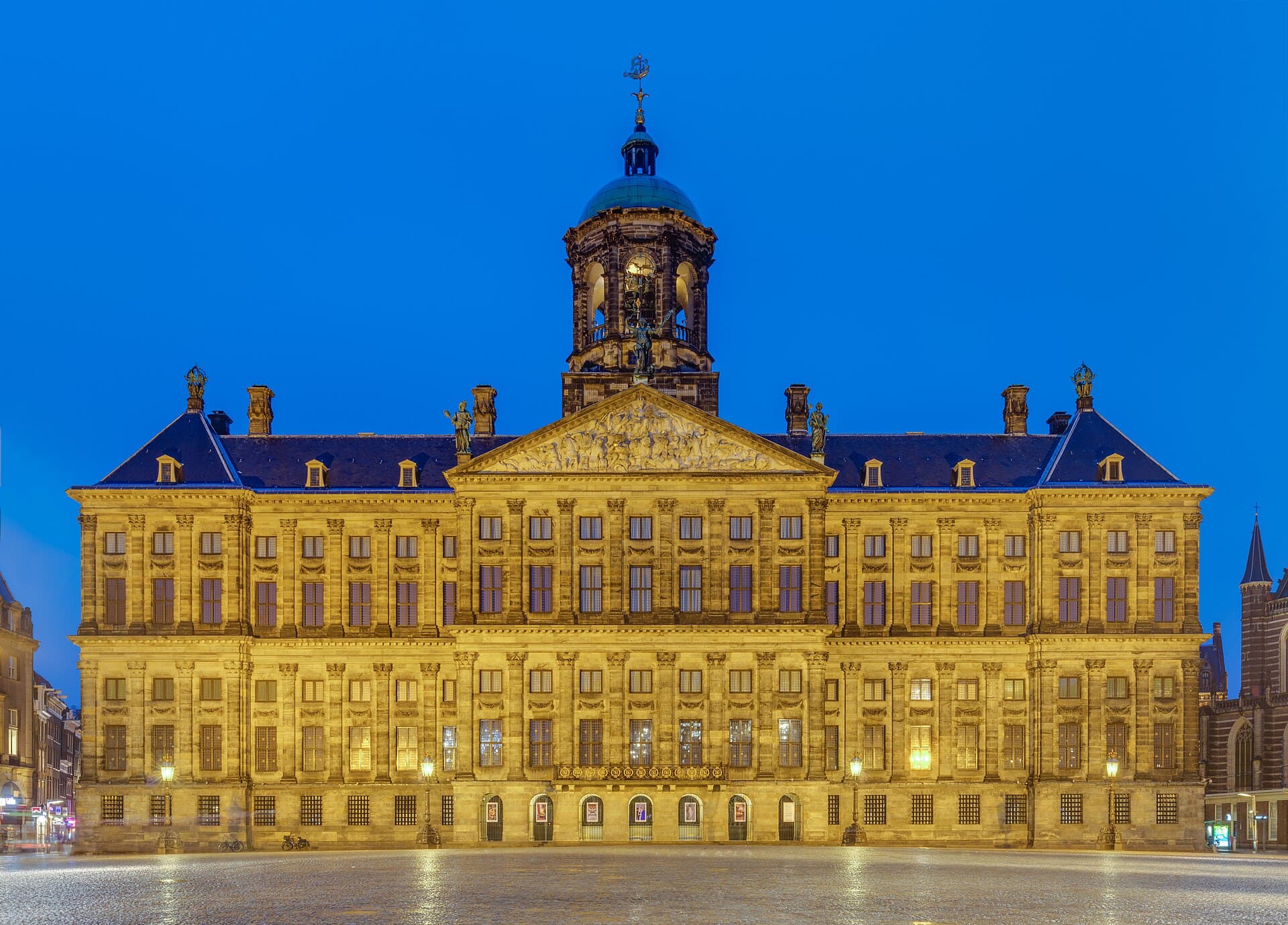
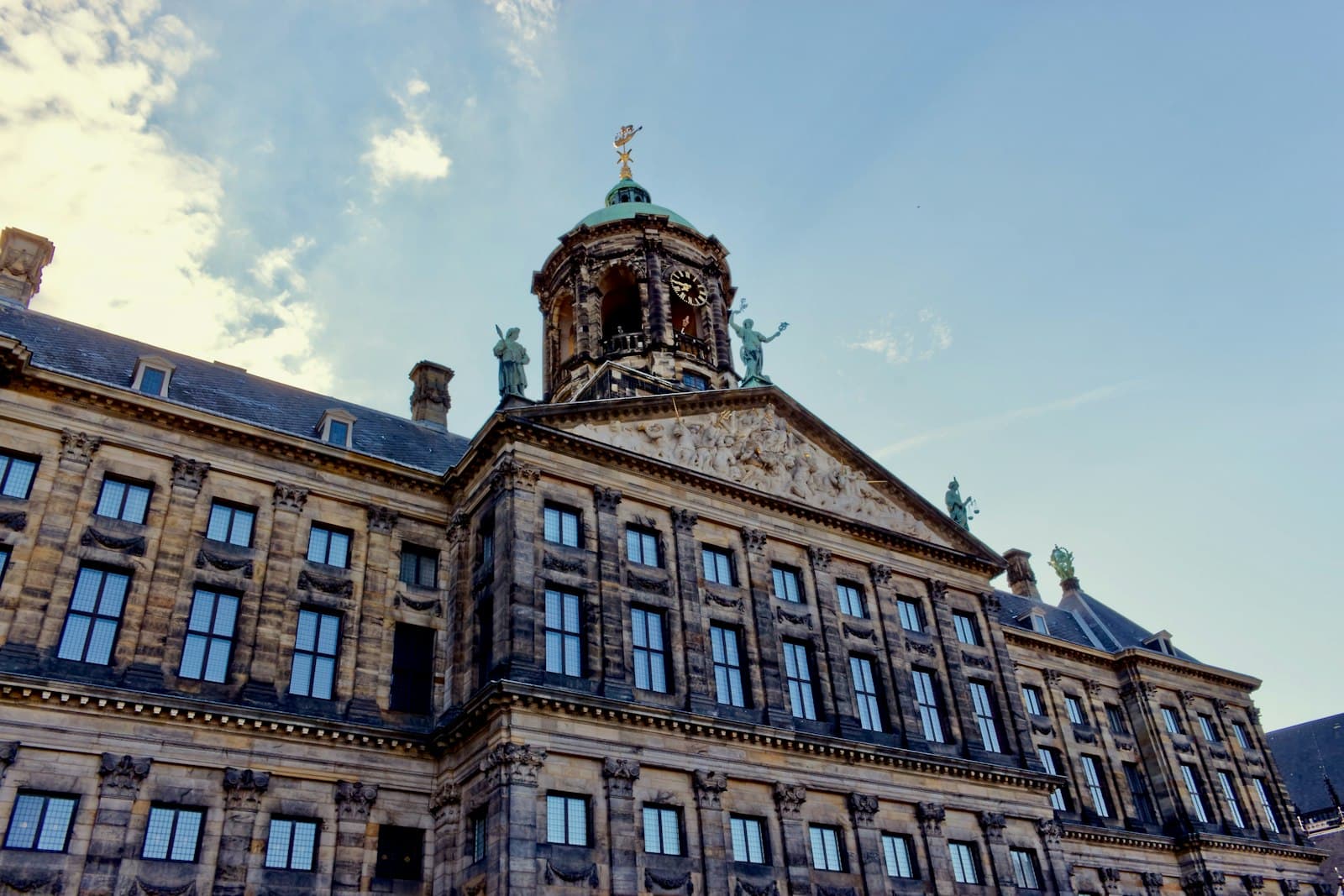
Stand on the west side of Dam Square and look at the long grey mass of the Royal Palace, and you are looking at a building that lied about its own name for a century and a half. It was not built as a palace. It was raised as the Stadhuis, the town hall, the working seat of a merchant city that briefly ran a global trading empire. Construction began in 1648 and finished in 1665, and it opened for civic business as the town hall on the twenty-ninth of July 1655. The palace came later, in 1808, when a foreign king moved in. Everything worth understanding about this building sits in the gap between those two facts: a town hall that a monarch inherited, on a square that started life as a dam across a marsh.
A forest sunk into the mud
Begin with the ground, because the ground is the whole trick. Amsterdam is a drained marsh, and stone this heavy does not simply rest on soft earth. To hold up the town hall, builders drove 13,659 wooden piles down into the mud before a single wall rose. That is not a rounded estimate; it is the count Amsterdammers still recite, and it deserves to be sat with. A whole forest, felled and sharpened and hammered vertically into the ground, so that the city hall would not sink after it.
The scale above the piles was just as deliberate. The floor covers roughly 22,000 square metres, which was never only a practical dimension. It was an argument in stone. A city of merchants, with no king and no ancient dynasty, wanted a building that would say plainly how far its reach extended. The primary architect was Jacob van Campen, with the city master builder Daniël Stalpaert directing the construction alongside him, and van Campen chose a restrained classical style meant to summon the civic dignity of ancient Rome. The message was legible to anyone who knew their history: this republic of traders was the modern heir to the classical world, and its town hall would be its Capitol.
The town hall of a trading world
Hear a stop from this walk
Royal Palace of Amsterdam: the former Stadhuis
To read the building correctly, hold two things in mind at once. This was a place of ledgers, magistrates, and municipal power, not thrones. And it was the administrative heart of a city whose money came from a trade network that spanned oceans. The allegorical decoration inside cast Amsterdam as a centre of world commerce, the point to which the goods of the earth flowed. Much of that seventeenth-century interior survives today, having been extensively renovated between 2005 and 2009.
Among the men who commissioned the town hall was the mayor Nicolaes Tulp, and his name is the thread that ties this stop to the rest of Amsterdam's medieval core. Tulp is the same figure Rembrandt painted in "The Anatomy Lesson of Dr Nicolaes Tulp" in 1632, a dissection scene set in the upper-floor anatomy theatre of the old weigh house on the Nieuwmarkt, a short walk east. That weigh house had begun life as a medieval city gate. One man, two buildings: the civic magistrate who helped raise the grandest town hall in the republic, and the surgeon presiding over a body in a converted gate. The medieval city was small enough that its powerful figures appear again and again, and the town hall was where their authority was formalized.
How a town hall becomes a palace
The name changed because the politics did. In 1808 the town hall stopped being a town hall. Louis Bonaparte, brother of Napoleon and installed as King of Holland, moved his court to Amsterdam and turned the Stadhuis into his royal residence. That single decision is the reason the building is called the Royal Palace today. Its civic function was severed, but the shell of the merchant republic's ambition remained, now furnished for a monarch instead of a magistracy.
It never fully returned to municipal use. The building remains one of three palaces at the disposal of the Dutch monarch, kept for state functions and receptions, and it is open to visitors on most days when it is not in official use. Adult entry runs about twelve to thirteen euros fifty, and under-eighteens go free. Walk the interior and you are moving through a room that was designed to impress foreign merchants and now impresses tourists, its allegories of world trade intact above your head.
The uncomfortable part of the grandeur
There is a harder truth to carry out of this square, and it is worth naming plainly rather than admiring the stonework and moving on. The Golden Age wealth that paid for this building was inseparable from colonial trade and from the slave trade. The classical dignity van Campen designed, the 22,000 square metres of floor, the forest of piles: all of it was funded by a commercial system that reached into places and labour we should not romanticize. The grandeur and its cost sit together in the same walls, and the honest way to see the palace is to hold both at once. A building can be a masterwork of engineering and civic art and also a monument to how the money was made.
That double vision is really the lesson of standing in front of the former Stadhuis. It compresses the whole arc of Amsterdam into one facade. A dam thrown across the little Amstel river around 1270 grew into a fishing hamlet, the hamlet grew into a world port, and the port built itself a town hall so ambitious that a king would later take it for his own. The name Amsterdam tells its founding: Amstel plus dam. This building tells what the dam became.
Walk the medieval core
The Royal Palace is the second stop on Roamer's self-guided audio walk through Amsterdam's medieval core, a route that reads the older city beneath the Golden Age. The tour begins on the dam itself at Dam Square, moves past this palace and the Nieuwe Kerk where Dutch monarchs are invested, and works its way east through the Oude Kerk, the hidden Begijnhof courtyard, the Waag on the Nieuwmarkt, and down to the old harbour canals where the sea trade first came ashore. It runs about three and a half kilometres over two to two and a half unhurried hours, and the stops are short and skippable, so you can linger here at the palace and read the whole story at your own pace. Browse the full set of Amsterdam walking tours or start from the city guide for Amsterdam.
Sources
- Royal Palace of Amsterdam, Wikipedia: construction dates, the opening of the town hall on 29 July 1655, architects Jacob van Campen and Daniël Stalpaert, the 13,659 wooden piles, floor area, the 1808 conversion under Louis Bonaparte, the three palaces at the monarch's disposal, and the 2005 to 2009 renovation.
- Paleis Amsterdam (official site) and I amsterdam: adult admission of roughly twelve to thirteen euros fifty, free entry for under-eighteens, and the palace opening to visitors on most days outside official state use.
- Waag, Amsterdam, Wikipedia: the building's origin as the Sint Antoniespoort city gate, its 1617 conversion to a weigh house, and Rembrandt's "The Anatomy Lesson of Dr Nicolaes Tulp" (1632) set in its upper-floor anatomy theatre.
- Roamer tour "The Dam That Became a City" (amsterdam-dam-square-old-city): the fact-audited transcript for the Royal Palace stop and the medieval-core route.
Ready to experience it?
Dam Square: The Dam That Became a City
95 min · 3.5 km · easy
More from Amsterdam
Explore more at your own pace.
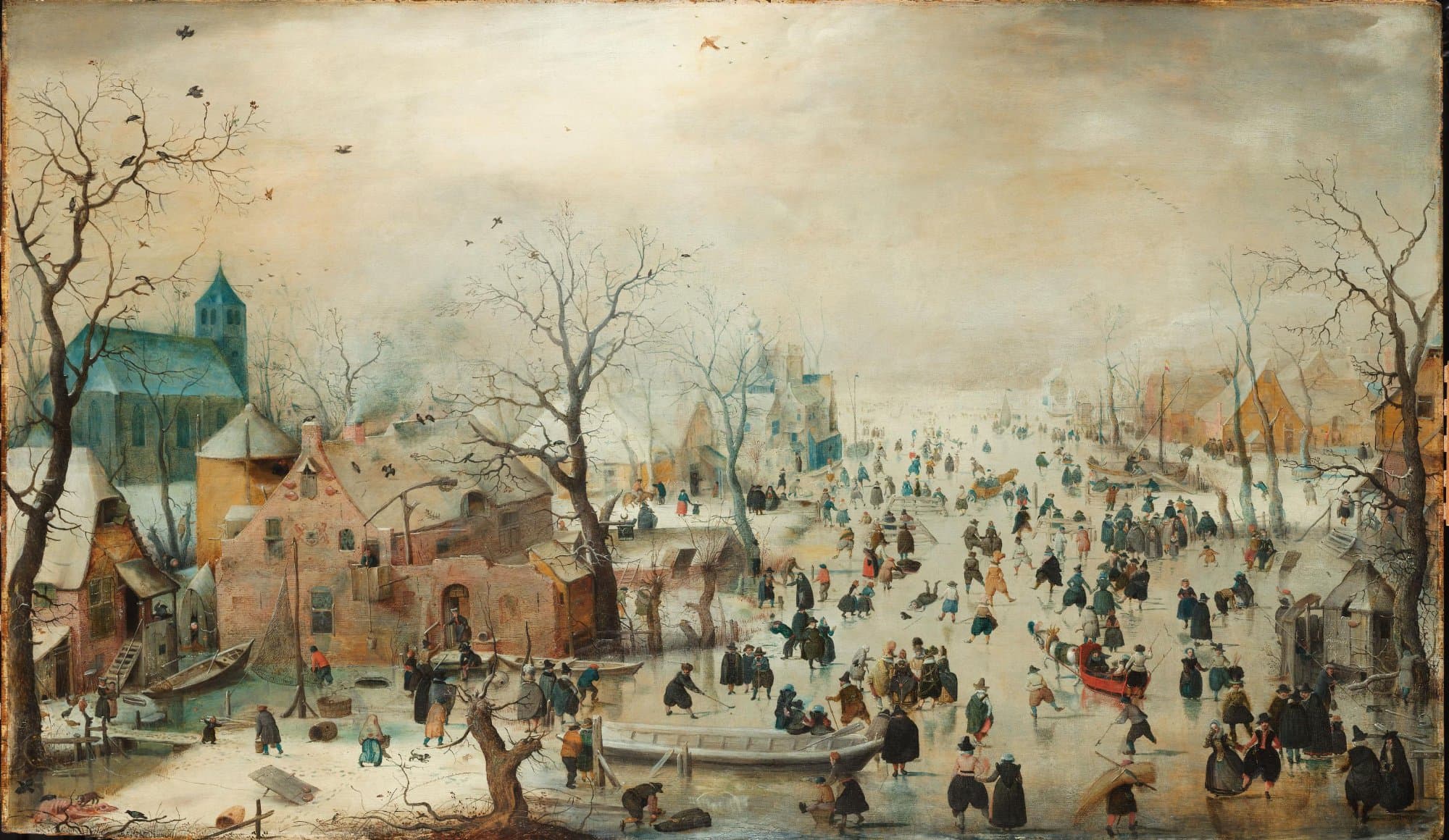
Avercamp's Winter Landscape with Skaters: Hunting the Small Stories
Petronella Oortman's Doll's House: The Miniature Canal House in the Rijksmuseum

Rembrandt's Self-Portrait of 1628: A Young Man and the Back of a Brush
Rijksmuseum: What to See, Room by Room, and a Two-Hour Plan
The Night Watch: Why It Is Called That, and What Was Cut Off