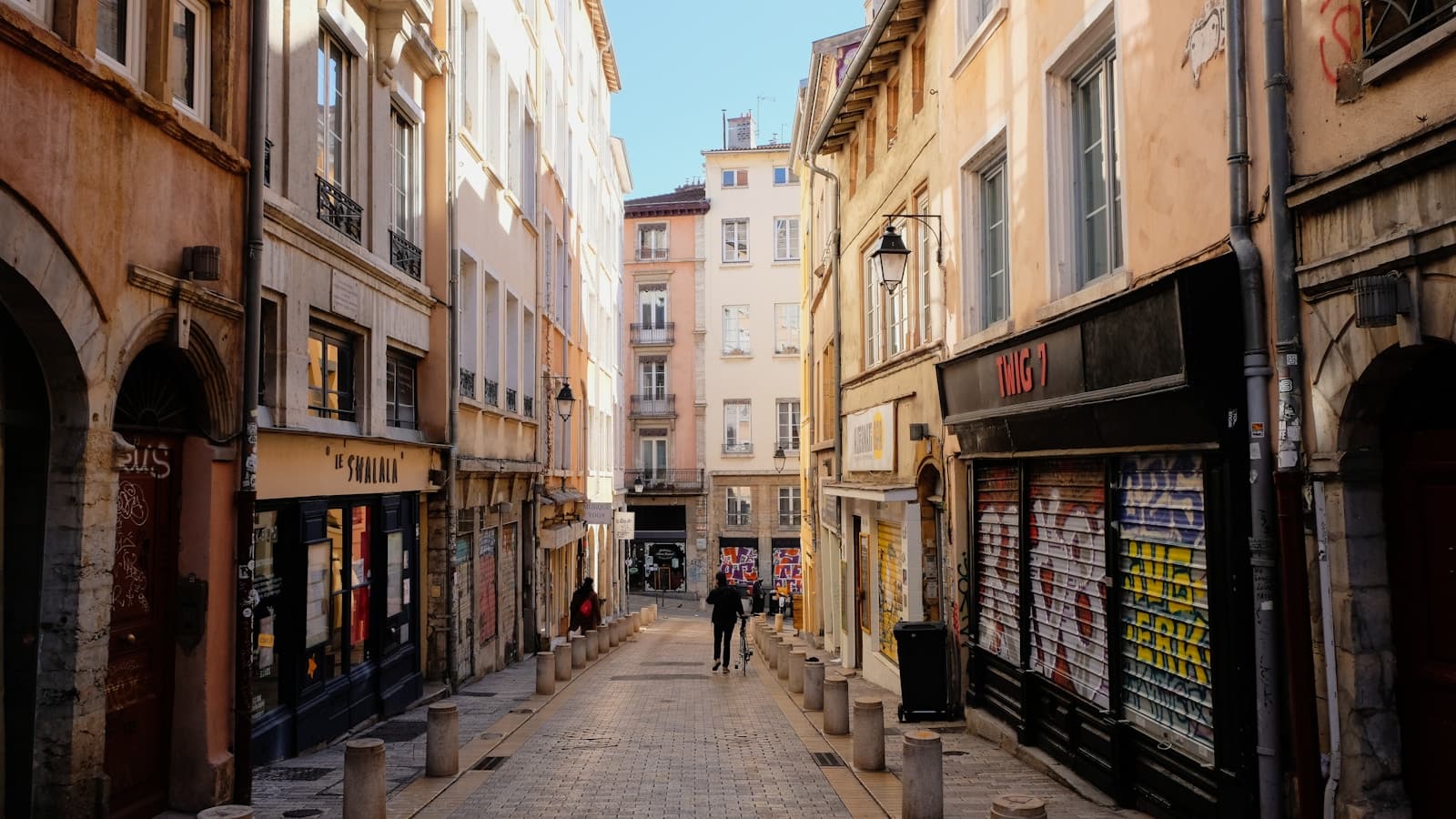
One Lyon hillside, two armed uprisings, one machine. The silk weavers called canuts wove on Jacquard looms that stood about four metres tall, marched twice against the state under a black-flag slogan, and left behind an architecture whose loft windows still measure the loom they housed. About two point three kilometres on the Pentes and the plateau, between eighteen oh four and eighteen thirty-four.
Start · Place Colbert and the Cour des Voraces: The Canut Traboule
DirectionsStops
- 1

Place Colbert and the Cour des Voraces: The Canut Traboule
Place Colbert at the foot of the Pentes, Lyon first arrondissement. The Cour des Voraces at number nine, also called Maison de la République, is a six-floor courtyard stairway built in eighteen forty. Named for the Voraces worker group of the eighteen forty-eight and forty-nine republican insurrections. Used as a passage during the Second World War. Acquired by Habitat et Humanisme in nineteen ninety-five.
- 2

A Maison du Canut: The Building the Loom Designed
A specimen of the canut workshop building on the Pentes, between Place Colbert and the plateau, Lyon first arrondissement. The functional typology that emerged in the first three decades of the nineteenth century to receive the Jacquard loom: approximately four-metre ceilings, tall north-facing windows, robust load floors, workshop above and family below or in the same room.
- 3

Mur des Canuts: The Painted Reminder
Boulevard des Canuts at rue Denfert-Rochereau, Lyon fourth arrondissement. A 1,200-square-metre trompe-l'oeil fresco painted by the Lyon mural cooperative CitéCréation in nineteen eighty-seven, with updates in nineteen ninety-seven and twenty thirteen. Cited by the Office du tourisme de Lyon as the largest painted wall in Europe. Depicts ordinary Croix-Rousse life on a hillside whose canut community had already left.
- 4

Maison des Canuts: The Working Looms
Ten to twelve rue d'Ivry, Lyon fourth arrondissement, on the Croix-Rousse plateau. Founded in nineteen seventy by the Cooptiss cooperative, a body of Lyon silk-weaving artisans formed in nineteen sixty. Cooptiss closed in nineteen ninety-eight; the museum closed in two thousand and three under financial pressure; the city of Lyon retained the collection, a private operator took over, and the museum reopened after a two thousand and four to two thousand and nine redesign that prioritised re-establishing working Jacquard looms.
- 5

Place de la Croix-Rousse: The Square the Canuts Marched From
Main square of the Croix-Rousse plateau, Lyon fourth arrondissement. The bronze statue of Joseph-Marie Jacquard, seventeen fifty-two to eighteen thirty-four, by sculptor Charles Foyatier, was inaugurated on the sixteenth of August eighteen forty. The Croix-Rousse functioned as an independent commune outside Lyon's city tolls until its annexation in eighteen fifty-two. On the twenty-first of November eighteen thirty-one, the canuts marched from this plateau down into Lyon under a black flag.
- 6

Soierie Vivante: The Loom That Still Runs
Atelier Municipal de Tissage at twenty-one rue Richan, Lyon fourth arrondissement, operated by the Soierie Vivante association. Founded in nineteen ninety-three to preserve the canut weaving heritage. Holds working pre-Jacquard and Jacquard-era hand looms in a working canut workshop on the plateau. Confirm drop-in policy and opening hours on the day of the visit.
- 7

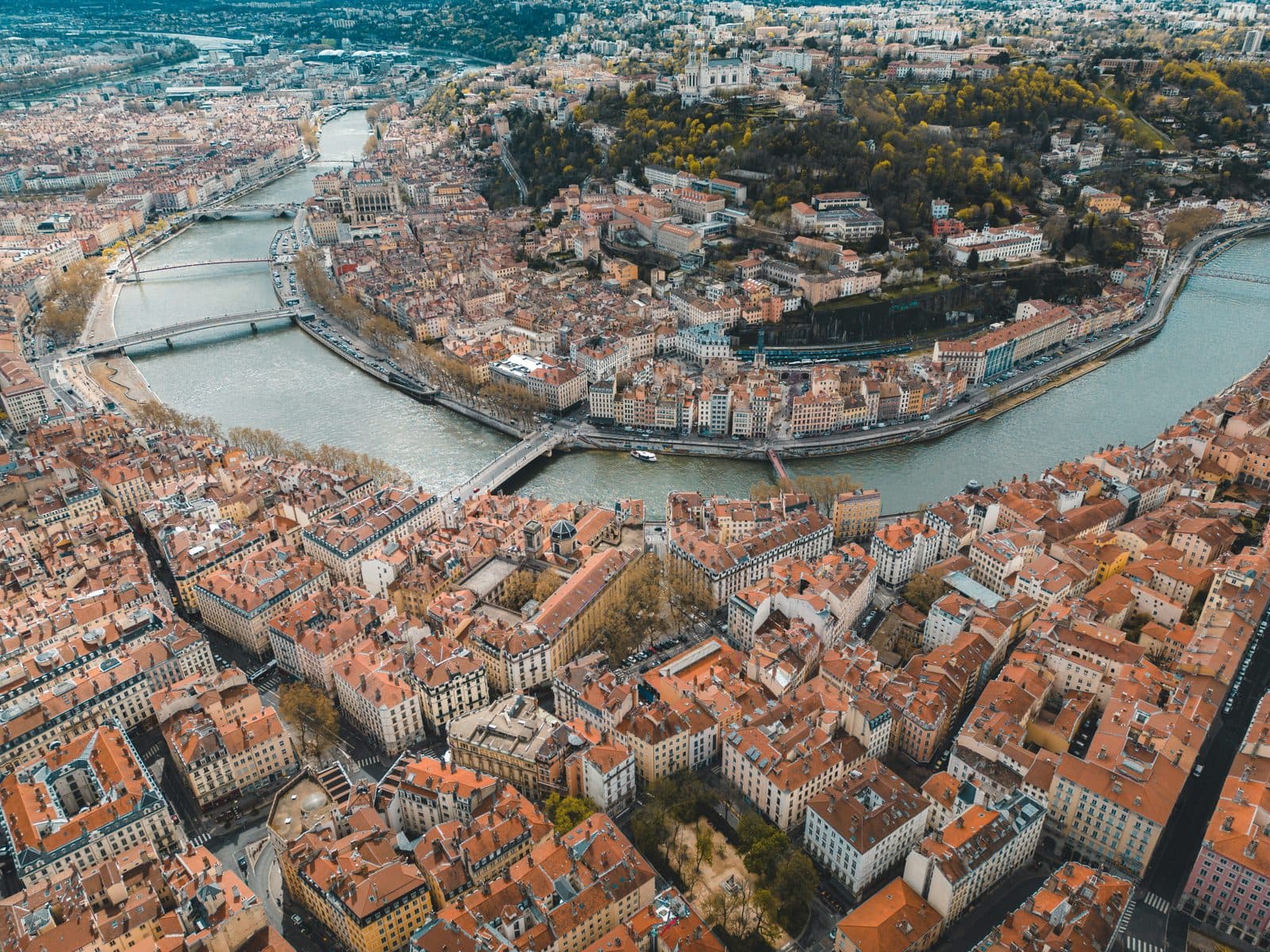
The Lookout Above the Saône: The Geographic Drop is the Political Drop
Southern edge of the Croix-Rousse plateau, on the boulevard de la Croix-Rousse near the Gros Caillou, a roughly five thousand eight hundred-year-old glacial erratic boulder set on the plateau's southern edge as a public marker in eighteen ninety-two. The view runs south over the Saône and the Lyon historical centre, with the two-river confluence to the south.
Details
Best Time to Visit
Tuesday through Saturday morning, ideally between nine and noon. The Croix-Rousse boulevard market runs on the plateau Tuesday through Sunday mornings, which gives stops four through seven the living texture of a working market neighborhood without overwhelming the audio. Monday is the weakest day: the Maison des Canuts is closed Sundays and Mondays, the Soierie Vivante atelier holds reduced Monday hours, and the plateau loses much of its weekday rhythm. Avoid early-afternoon summer heat on the Pentes climb; the slope between Place Colbert and the plateau is exposed and steep. October through April light is cooler and reads the four-metre window proportions of the canut buildings most cleanly.
Pro Tips
- •The audio anchors on the exterior of every stop and you do not need to buy entry to any building to follow the tour. The two interior visits that genuinely deepen the walk are the Maison des Canuts at stop four, for the working Jacquard loom demonstration, and the Soierie Vivante atelier at stop six. Both have entry fees in the single-digit euro range as of two thousand and twenty-six; check maisondescanuts.fr and soierie-vivante.asso.fr before you go.
- •The climb from Place Colbert at stop one to the Mur des Canuts at stop three is the steep part of the walk. About seven hundred and fifty metres of mostly continuous ascent on the Pentes, roughly fifty metres of vertical gain. Take it slow, drink water in summer, and use the stairs on rue Imbert-Colomès or rue Burdeau if you want a more direct line.
- •The Maison des Canuts at stop four runs Jacquard-loom demonstrations on a published schedule, usually mid-morning and mid-afternoon. If you want to see the loom run, time your walk so you arrive at stop four during a demonstration window. The museum's website lists the day's schedule.
- •The Soierie Vivante atelier at stop six is the field-walk variable on this tour. Hours and drop-in policy shift seasonally. If the door is locked when you arrive, read the canut building proportions from the street, and pick up a working-loom demonstration at the Maison des Canuts instead. The other Soierie Vivante workshops on the plateau, including the Atelier de Passementerie at twelve rue Justin Godart, hold complementary hours.
- •The Boulevard de la Croix-Rousse market runs Tuesday through Sunday, roughly six in the morning to one in the afternoon, on the median between stop five and stop seven. The market is unavoidable as a present-day texture of the plateau; the audio does not narrate it. Walk through it slowly if it is running and you will register the labor neighborhood that succeeded the canuts.
- •The synthesis lookout at stop seven is most legible in late-morning light, when the Presqu'île below is in full sun and the Saône reads clearly. The bench seating near the Gros Caillou is limited; the view is the artifact, and you do not need to sit.
- •Combine this walk with the sibling Lyon tours on different days, not the same morning. Lyon Fourvière and Vieux Lyon traboules each carry their own two-to-three-hour walking budget. Trying to stack two Lyon tours into one day will flatten the architectural reading the audio is teaching you.
Safety & Precautions
- •The Pentes climb between Place Colbert at stop one and the Mur des Canuts at stop three is steep, with gradients of roughly six to eight percent on stretches of rue Imbert-Colomès, rue Burdeau, and the connector stairs. Wear closed shoes with grip. The cobbled stretches can be slick in rain.
- •Lyon summers between June and September run hot, with limited shade on the Pentes ascent. Carry water and consider a morning start. The plateau is windier and cooler than the lower town in winter; the lookout at stop seven is exposed.
- •The Place de la Croix-Rousse at stop five and the market that runs along the boulevard de la Croix-Rousse can be crowded on market mornings. Keep wallets and phones in front pockets or zipped bags. Petty theft is not common on the plateau the way it is in some other Lyon tourist corridors, but a crowded market is a crowded market.
- •The Maison des Canuts at stop four is closed Sundays and Mondays. The Soierie Vivante atelier at stop six holds variable hours; confirm same-day on soierie-vivante.asso.fr or by phone before you set out, especially in winter or August.
- •The lookout at stop seven has a working railing along most of the boulevard de la Croix-Rousse southern edge, but the drop to the Saône is real. If you are walking with children, hold their hands at the railing. The Gros Caillou itself is a public-art object, not a play structure; do not climb on it.
Travel advisory: Exercise Increased Caution (Level 2).
Gallery
Related Reading
Go deeper on what you'll see, hear, and walk through.
Overview
Best Self-Guided Walking Tours in Lyon (2026)
4 min
Overview
Lyon Travel Guide: How Many Days, Getting Around, When to Go (2026)
5 min
Overview
One Day in Lyon: A Walkable Riverside Itinerary (2026)
5 min
Thematic
Best History Walking Tours in Lyon (2026)
3 min
Thematic
Bouchons and the Mères Lyonnaises: How Lyon's Working Kitchens Made It the Capital of French Food
3 min
Thematic
The City Silk Built: How One Fabric Made Three Different Lyons
4 min
Thematic
What to Eat in Lyon: A Food Guide (2026)
4 min
Companion
Croix-Rousse: The Hill Where One Machine Built a Neighbourhood and a Rebellion
4 min
Deep dive
Mur des Canuts: Europe's Largest Painted Wall, and the Neighbourhood It Keeps Ageing With
4 min
Read the walk
The full story of Croix-Rousse: Where the First Industrial Workers Rose, in words. Prefer to listen? Play it narrated, from home or on location.
Introduction
On the twenty-first of November, eighteen thirty-one, the silk weavers of one Lyon hillside marched down under a black flag carrying one motto: vivre en travaillant ou mourir en combattant. Live working, or die fighting.
The hillside is the Pentes de la Croix-Rousse in Lyon's first arrondissement, France. They were called the canuts. They wove on Jacquard looms, the punched-card machines Joseph-Marie Jacquard introduced in eighteen oh four, and the looms stood about four metres tall. That is why the ceilings in every workshop building on the slope are still four metres high. The machine designed the architecture, and the architecture outlasted the machine.
In November eighteen thirty-one the canuts took Lyon and held it ten days before Marshal Soult retook the city with twenty thousand troops. In April eighteen thirty-four they rose again, six days of fighting Lyon historians call la Sanglante semaine. About six hundred died in the first uprising, about three hundred and thirty in the second. What historians now consider the first organised wage-and-association uprising of an industrial workforce of a major industrial city happened twice, on this slope. Charles Babbage modelled the Analytical Engine's punched-card input on this loom. The hillside is computing's punched-card ancestor.
The walk is seven stops, about three and a half kilometres and one hundred minutes, climbing south to north from the Pentes onto the plateau. It starts at Place Colbert, at the foot of the slope, and closes at the lookout above the Saône. When you arrive at Place Colbert, begin with stop one.
1. Place Colbert and the Cour des Voraces: The Canut Traboule
You are standing at Place Colbert. Face number nine. The door in front of you opens on the Cour des Voraces, also called the Maison de la République. Per the Mairie du first arrondissement of Lyon, the Office du tourisme de Lyon, and Wikipedia's record of the Cour des Voraces, this is a six-floor courtyard stairway built in eighteen forty. Three entrances connect it: number nine Place Colbert, twenty-nine rue Imbert-Colomès, and fourteen bis montée Saint-Sébastien. The Pentes-as-a-whole are inscribed in UNESCO listing eight seventy-two, the Historic Site of Lyon, since nineteen ninety-eight.
The name on the building is the name of a worker group. The Voraces were the canut political faction of the eighteen forty-eight and eighteen forty-nine republican insurrections in Lyon, after the core uprisings this tour reads. The building took their name because it was their courtyard. The plaque on the wall, in translation, reads: "In the Cour des Voraces, hive of silk work, canuts struggled for their lives and their dignity."
What the Witness names at this stop is the canut traboule. A traboule is a passage cut through a Lyon building from one street to another. Vieux Lyon's traboules are sixteenth-century silk-merchant passages, narrated in a sibling tour. The Croix-Rousse traboule is something else. It is the canut social fabric: a stairway and a courtyard, vertical and shared, where weavers crossed paths between workshops and where, when the army of twenty thousand came up the hill in December eighteen thirty-one, fighters dispersed laterally instead of running into the street. The Cour des Voraces was also used as a concealment passage during the Second World War, per the Office du tourisme de Lyon and the Wikipedia record. One sentence on that; the Resistance-network thesis belongs to another tour.
In nineteen ninety-five Habitat et Humanisme, the social-housing association founded by Father Bernard Devers, acquired the building and rehabilitated it as social housing. The Cour you are looking at is still inhabited.
Notice the Companion register of the Pentes around you. The slope steepens north. The buildings are tall and narrow, with multi-paned windows facing north for the light a weaver needed. The Pentes are roughly six to eight percent gradient over short stretches. The climb is real.
Now walk north up the slope. About two hundred and fifty metres up, on a street like rue Imbert-Colomès or rue Burdeau, you will see a façade unlike a Haussmann Paris apartment. Tall windows, an almost industrial proportion. That is the next stop.
2. A Maison du Canut: The Building the Loom Designed
Stop on this street and look up. The façade in front of you is a maison du canut, a Croix-Rousse silk-workshop building. Per the Lyon Tourist Office's Croix-Rousse heritage page, the Soierie Vivante association's history of the typology, and Google Arts and Culture's guided survey of the hill, this is a functionally distinct urban form that emerged in the Pentes and on the plateau in the first three decades of the nineteenth century, designed to receive the Jacquard loom.
The Witness reads the proportions. Look at the windows. They are taller than the windows you grew up with. Multi-paned, set high in the wall, oriented toward the north where the light is cool and even. A weaver needed light on the warp threads. Look at the spacing between the floors. The Lyon Tourist Office gives ceiling heights of approximately four metres on average. Other heritage sources hedge four to five metres. The variance is real across individual buildings; the thesis holds the four-metre figure with the qualifier.
The four metres is the loom. The Jacquard mechanism, with its chain of punched cards suspended above the harness, stood about four metres tall. The workshop ceiling had to clear it. The workshop ceiling determined the building's section. The building's section determined the street's elevation. A machine made an architecture.
The floor under your feet, if you were inside, would be reinforced. The loom is heavy. The frame was wood, the harness and the punched-card chain added mass, and the master weaver's apartment was below the workshop or, in the smaller buildings, the workshop and the apartment were the same room. The chef d'atelier owned or rented the looms. Per the Gadagne Lyon History Museum's themed sheet on the canut revolts, Encyclopedia.com's entry on the silk workers' revolts, and Bezucha's nineteen seventy-four study, the labor structure was a three-tier guild: the chef d'atelier ran his looms in his apartment; the compagnon, a journeyman, worked one of them; the apprenti was learning the trade. The silk merchants of the lower town, called fabricants or soyeux, supplied raw silk on credit and bought the finished cloth, controlling the price.
Production lived here, on this floor plan, in this room. Profit lived in the lower town. There was no factory to picket. The hillside was the factory, and the building was a worker's apartment and his workplace at once.
Hold the word typology. You will see the proportions again on the plateau, in different buildings, and you will read them faster the second time.
Now keep climbing. About five hundred metres further up, you will cross from the Pentes onto the plateau and enter the Lyon fourth arrondissement. The first stop on the plateau is a wall, not a building. Look for a 1,200-square-metre painted façade at the corner of boulevard des Canuts and rue Denfert-Rochereau.
3. Mur des Canuts: The Painted Reminder
You have arrived at the Mur des Canuts. Step back into the boulevard if traffic allows, and take the wall in whole. The painted façade in front of you is 1,200 square metres, on a blind wall at the corner of boulevard des Canuts and rue Denfert-Rochereau. Per CitéCréation's own archive of the work, the Ville de Lyon, and the Office du tourisme de Lyon, this is a trompe-l'oeil fresco. The painters made a flat wall read as a Croix-Rousse street: stairs, doorways, balconies, ordinary residents going about ordinary morning.
The Companion takes the lead here because the artifact is visual. Look at the figures on the wall. The painters added a generation of residents in the nineteen ninety-seven update and another in twenty thirteen. The same wall reads the same neighborhood across three decades of repainting. The Office du tourisme de Lyon cites it as the largest painted wall in Europe.
The Witness names the documentary record. The mural was first painted in nineteen eighty-seven by CitéCréation, the Lyon cooperative of mural painters founded in nineteen seventy-eight and reorganised as a cooperative in nineteen eighty-six, per CitéCréation's own page and Wikipedia's record of the collective. CitéCréation is the painter as a collective, not as a single hand; the lens of this tour names the cooperative and stops there.
Here is the reminder beat. By nineteen eighty-seven, the canut community on this plateau was already gone. The silk industry collapsed in the late nineteenth and early twentieth centuries under competition from Lyon's own steam-powered mills and from cheaper Chinese silk imports, per the Soierie Vivante association's history and the standard Lyon economic record. The home-loom system did not survive the First World War. The plateau remained a working-class quarter through the twentieth century, then began to gentrify from the nineteen eighties, accelerating after the nineteen ninety-eight UNESCO inscription. When CitéCréation painted this wall, the silk-weaver families had already left it.
The Mur des Canuts is the painted reminder that the canut community is named on the wall because it is no longer on the street. The Witness does not say the community survived. The Companion does not flatter the present residents with continuity they did not inherit. The wall is the answer to the question: where did the canuts go.
Now walk about one hundred and fifty metres east, into the small streets of the plateau. The next stop is the institutional anchor for everything you have just learned to read.
4. Maison des Canuts: The Working Looms
You have arrived at the Maison des Canuts, at ten to twelve rue d'Ivry. The building is the institutional anchor of this walk. Per the Mairie du fourth arrondissement, Ville de Lyon, Atlas Obscura, Auvergne-Rhône-Alpes Tourisme, and the museum's own record at maisondescanuts.fr,…
Full narration for this stop unlocks with the tour.
5. Place de la Croix-Rousse: The Square the Canuts Marched From
You have arrived at the Place de la Croix-Rousse. Stand near the centre. Look up at the bronze figure on the pedestal. Per Wikipedia's record of La Croix-Rousse and Wikipedia's entry on Joseph-Marie Jacquard, this is Joseph-Marie Jacquard, seventeen fifty-two to eighteen…
Full narration for this stop unlocks with the tour.
6. Soierie Vivante: The Loom That Still Runs
You have arrived at the Soierie Vivante atelier, at twenty-one rue Richan. Per the Soierie Vivante association's own record and Auvergne-Rhône-Alpes Tourisme's listing, the association was founded in nineteen ninety-three to preserve the canut weaving heritage on the…
Full narration for this stop unlocks with the tour.
7. The Lookout Above the Saône: The Geographic Drop is the Political Drop
You have arrived at the lookout on the southern edge of the plateau, near the Gros Caillou. Per Ville de Lyon and the Office du tourisme de Lyon, the boulder beside you is a roughly five-thousand-eight-hundred-year-old glacial erratic, set on the plateau's southern edge as a…
Full narration for this stop unlocks with the tour.