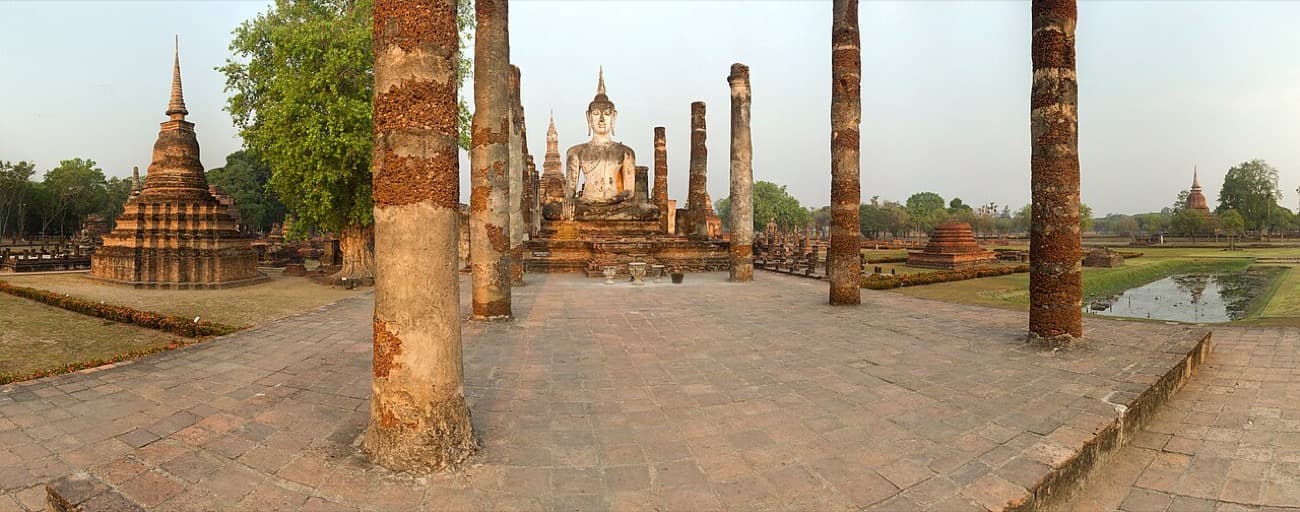
Walk the walled heart of Sukhothai, the kingdom that Thailand looks back on as its beginning, where a golden-age story was set in stone and where scholars still argue over the stone itself.
Start · King Ramkhamhaeng Monument: The Claim in Bronze
DirectionsStops
- 1
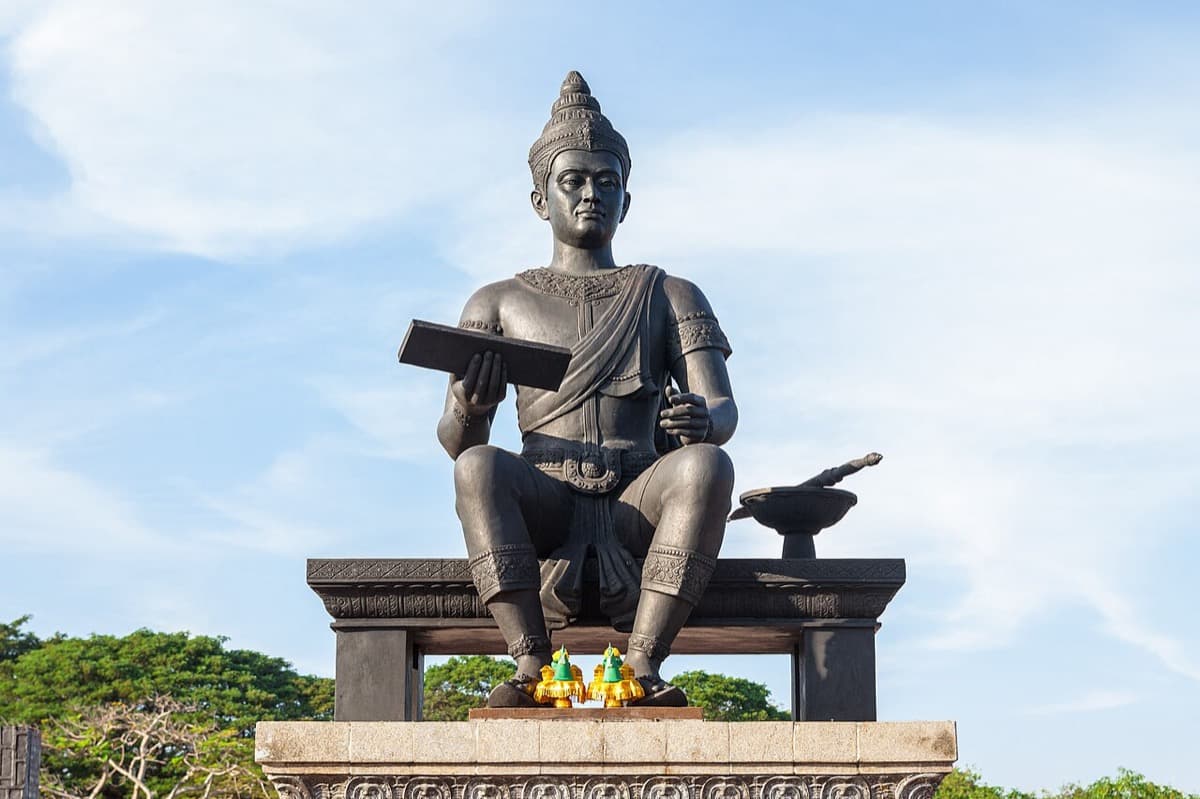
King Ramkhamhaeng Monument: The Claim in Bronze
A modern bronze statue of the king most associated with the Sukhothai golden age, seated on a throne modeled on the legendary stone seat of the inscriptions.
- 2
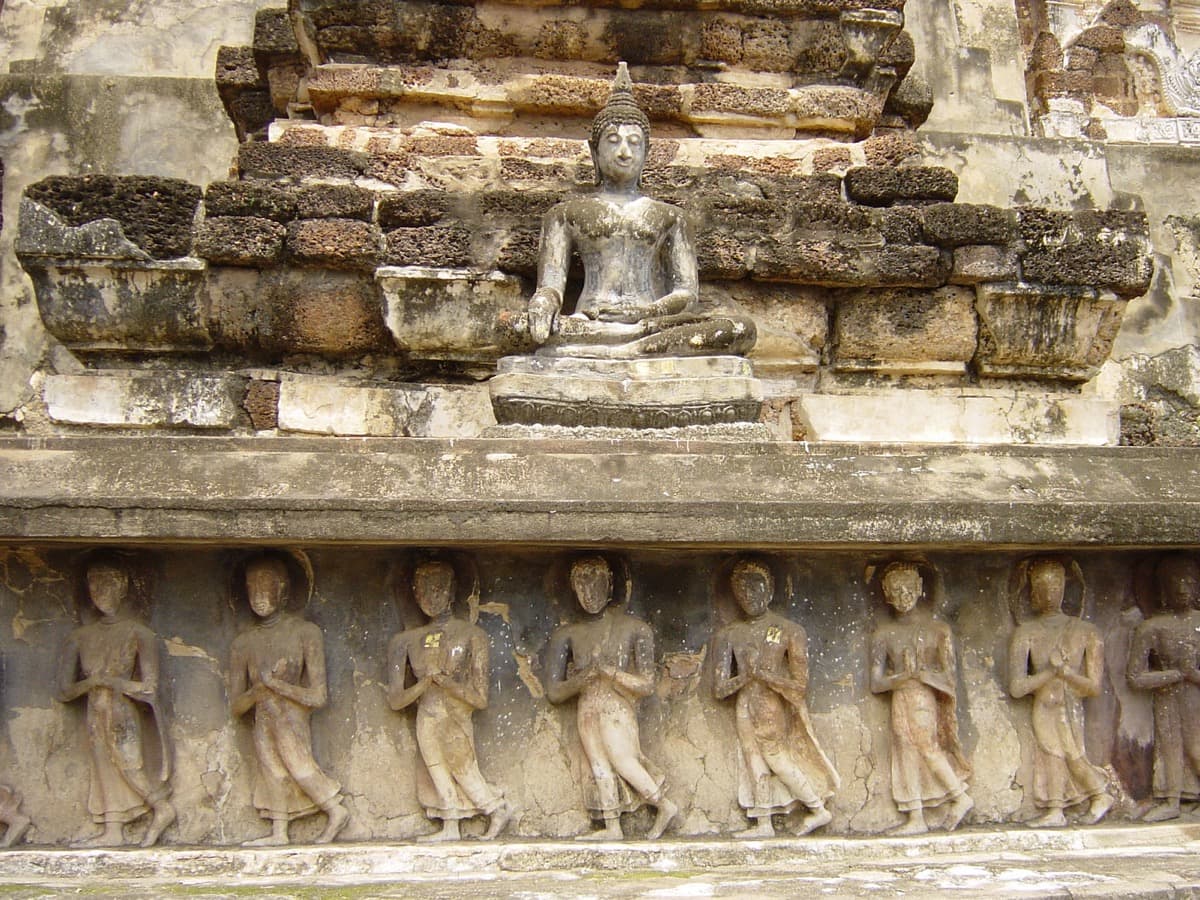
Wat Mahathat: The Temple of the Great Relic
The principal royal temple of Sukhothai, whose central spire carries the lotus-bud finial that became the signature form of the kingdom.
- 3
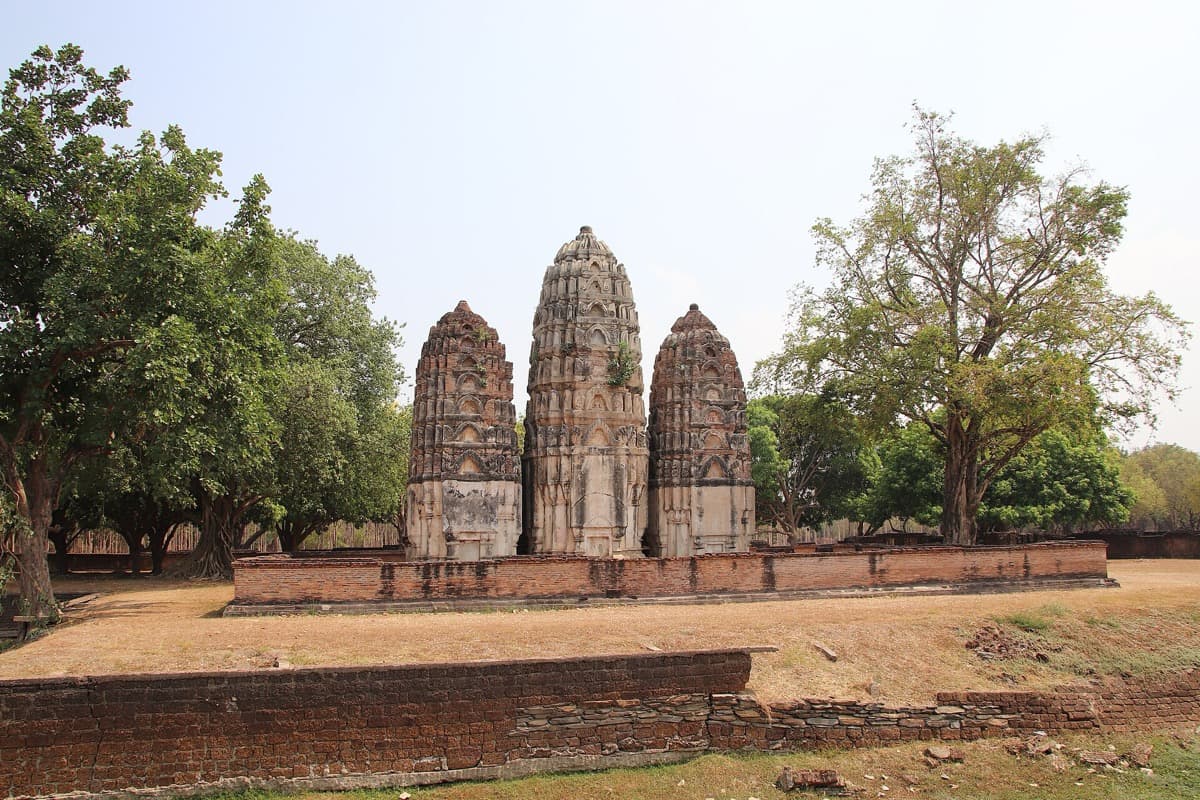
Wat Si Sawai: What Came Before
Three Khmer-style towers that began as a Hindu sanctuary and were later converted to Buddhist use, a reminder that the Thai city rose on older foundations.
- 4
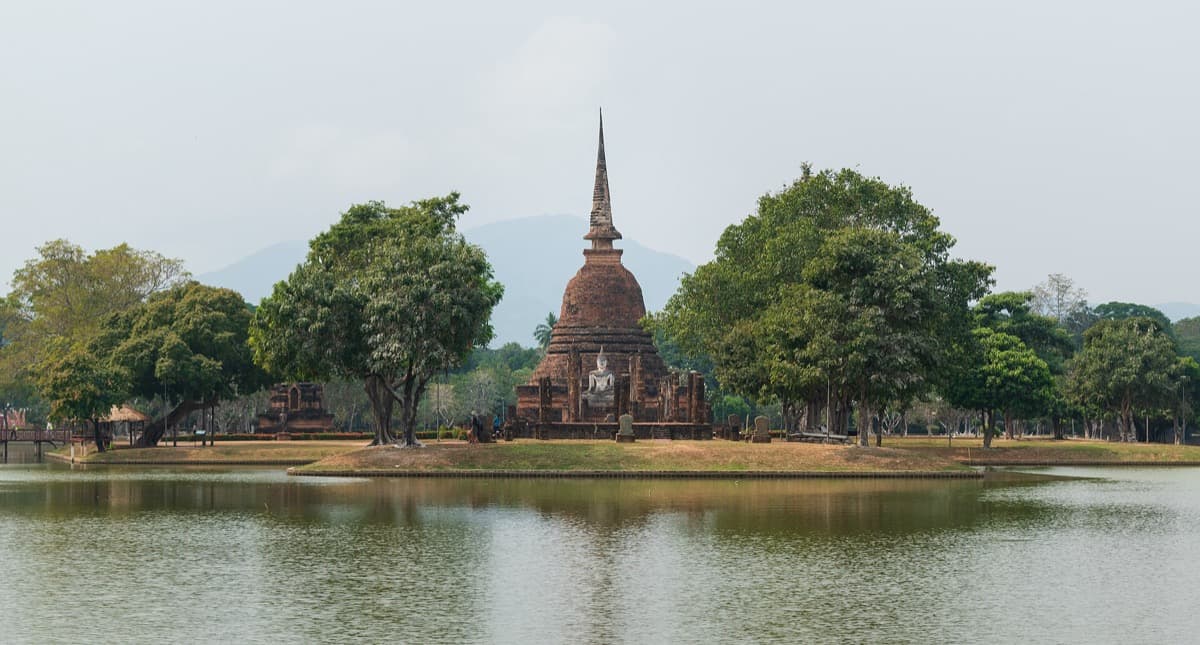
Wat Sa Si: The Island of the Faith
A serene temple on an island in a lotus-filled pond, its Sri Lankan bell-shaped spire marking the Theravada Buddhism that reached Sukhothai from across the sea.
- 5
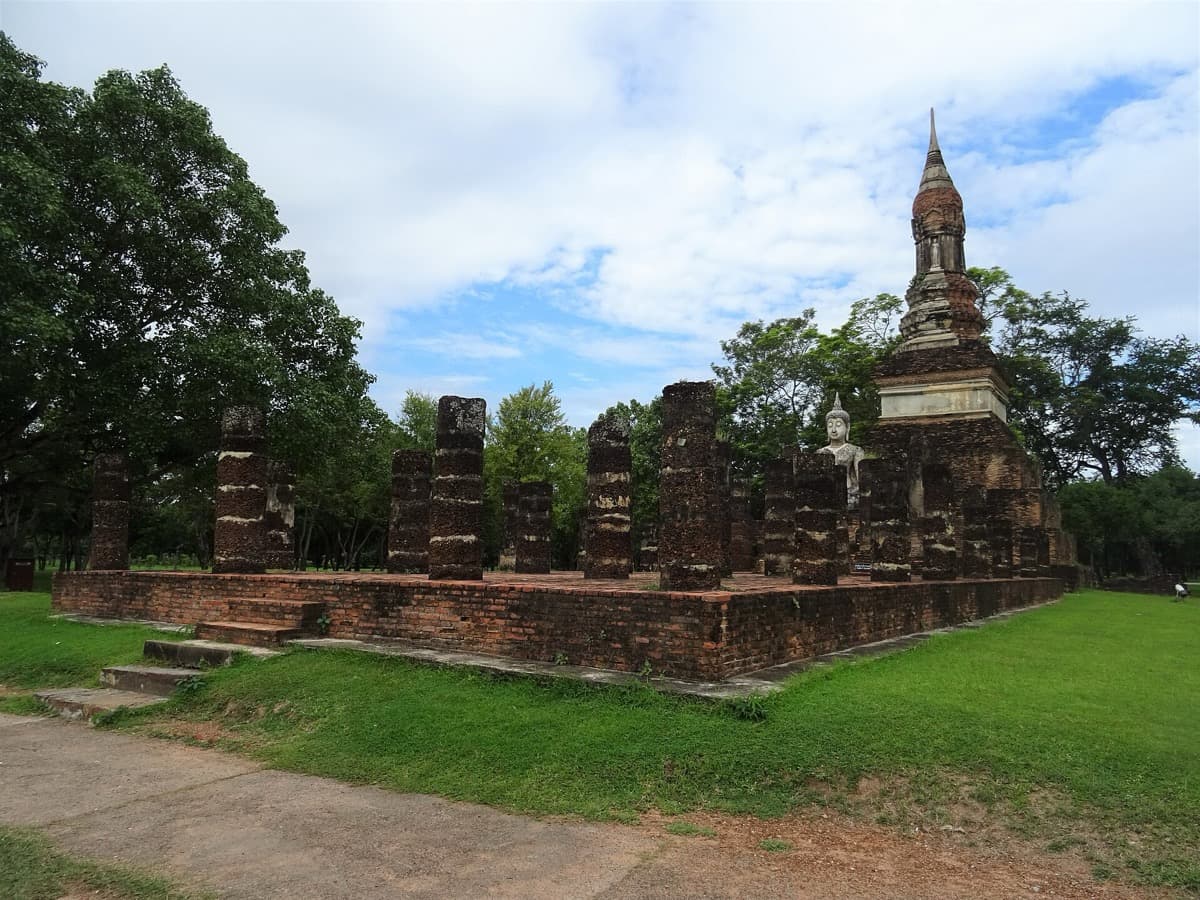
Wat Traphang Ngoen: The Silver Pond
A temple named for the silver reservoir beside it, crowned by a refined lotus-bud spire and famous for a graceful walking Buddha, the golden-age aesthetic at its most polished.
- 6
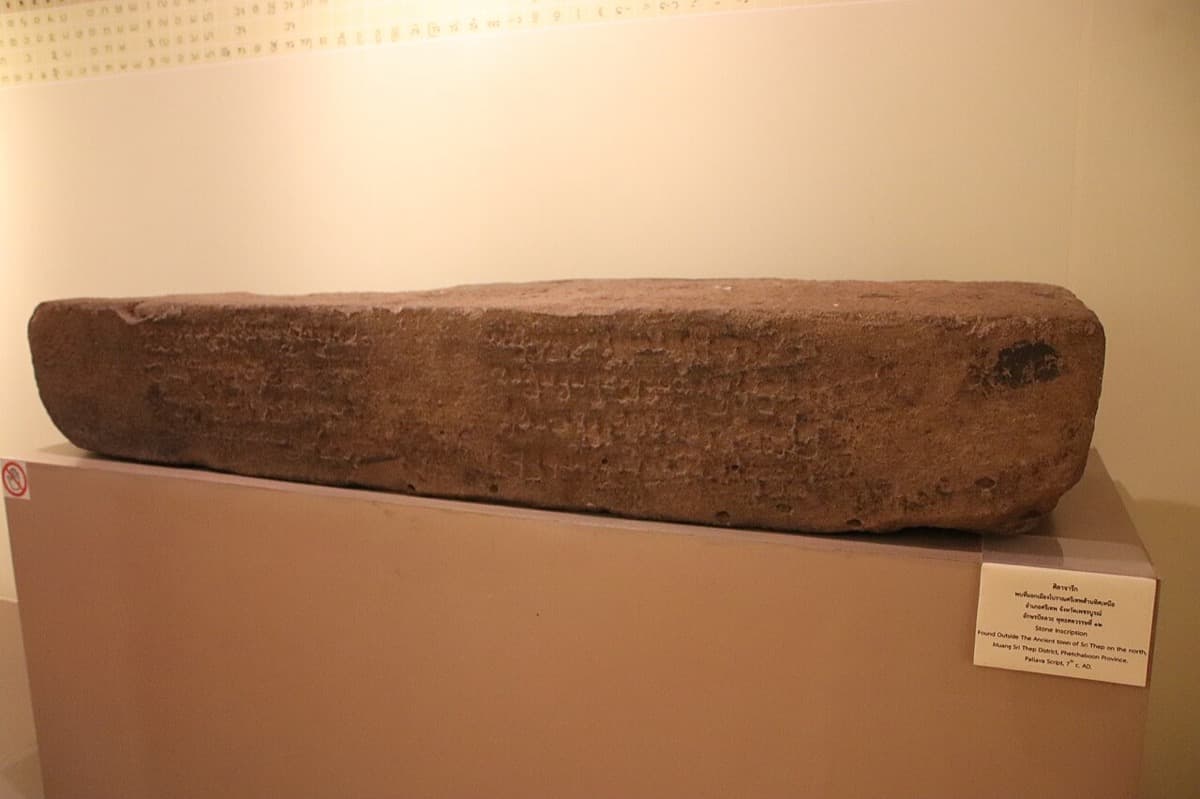
Ramkhamhaeng National Museum: The Stone and the Debate
The park museum where the origin story meets the scholarship, holding a replica of the famous inscription that founds the golden-age legend and remains the subject of debate.
Details
Best Time to Visit
Come early in the morning, soon after the park opens, or in the last hours before sunset. The central zone is open ruins and reflecting ponds with little shade, so the low sun is both kinder to walk in and far better for seeing the lotus-bud spires mirrored in the water. Midday heat and glare are intense across the exposed laterite. The cooler, drier months from November through February are the most comfortable overall, while the rainy season from roughly May to October brings green landscapes and full ponds along with sudden afternoon downpours.
Pro Tips
- •Rent a bicycle at the park entrance if you want to cover more ground comfortably. The walled zone is roughly two kilometres across, and a bike lets you rest your feet between temples while keeping the slow, self-paced feel of the walk.
- •Carry more water than you think you need. Shade is scarce among the ruins, and refill points are limited once you are inside the central zone.
- •Keep a small amount of cash for the zone ticket and the separate museum admission. Foreigner ticket rates were reported in the range of one hundred to two hundred baht in twenty twenty-six, and sources conflict, so confirm the current price at the gate.
- •Check the museum's days and hours before you plan stop six around it. It typically opens Wednesday through Sunday, roughly nine in the morning to four in the afternoon, so a Monday or Tuesday visit can miss the inscription replica entirely.
- •Save the ponds for golden hour. Wat Sa Si on its island and Wat Traphang Ngoen across the silver reservoir are at their most beautiful when the light is low and the water is still.
- •Move at your own rhythm and skip freely. Every stop stands on its own, so if the heat rises or a pond draws you in, you can linger, rest, or shorten the route without losing the thread of the story.
Safety & Precautions
- •Heat and humidity are the main hazard. The central zone is open and exposed, so pace yourself, wear a hat and sunscreen, and take shade and water breaks between temples to avoid heat exhaustion.
- •Dress and behave respectfully at the temples. Cover your shoulders and knees, speak quietly near Buddha images, and never climb on the spires, statues, or ruins. Where a temple building has an active shrine or a raised platform for worship, remove your shoes before stepping up as signs indicate.
- •In the rainy season from roughly May to October, expect sudden heavy downpours that make bridges, stone steps, and pond edges slippery. Watch your footing on the island temples and their bridges, and carry light rain protection.
- •Watch for traffic on the roads that cross and border the park, including bicycles, motorbikes, and the shuttle carts. Look both ways when moving between temple clusters and stay on marked paths near the ponds.
Travel advisory: Exercise Normal Precautions (Level 1).
Gallery
Related Reading
Go deeper on what you'll see, hear, and walk through.
Overview
Best Self-Guided Walking Tours in Sukhothai (2026)
3 min
Overview
One Day in Sukhothai: A Walkable Morning-to-Evening Itinerary
8 min
Overview
Sukhothai Travel Guide: Days, Transport, Costs, and Safety
7 min
Thematic
Sukhothai: The Kingdom Thailand Reads as Its Beginning
7 min
Companion
Wat Mahathat: Where Sukhothai Turned Its Origin Story Into Stone
6 min
Deep dive
The King Ramkhamhaeng Monument: Where Thailand Points to Its Beginning
6 min
Read
What to Eat in Sukhothai: The Noodle Bowl That Carries the Town's Name
6 min
Read the walk
The full story of Historical Park: The Dawn of Happiness, in words. Prefer to listen? Play it narrated, from home or on location.
Introduction
The name Sukhothai is often translated as the dawn of happiness, and this walled central zone in Thailand is where a nation set down its origin story. This is a place that calls itself the first Thai kingdom, and over the next six stops you will read the ground that claim was built on. You will meet a monument to a king remembered as a great lawgiver, a royal temple crowned with a lotus-bud spire that became the signature of a golden age, Khmer towers that remember what stood here before the Thai city, an island temple in a lotus pond, a temple mirrored in a silver reservoir, and finally a museum holding a copy of the famous inscription that describes a kingdom with fish in the water and rice in the fields. The walk runs about three kilometres, mostly flat across open ruins and ponds, and takes roughly two hours at an unhurried pace, longer if you linger. Go slowly. These are short, skippable stops, and you are moving at your own speed among laterite towers and reflecting water. Along the way I will tell the origin story as a story, name tradition as tradition, and be honest about where scholars still disagree, because the golden age is real as memory and contested as history, and both belong on this walk. When you arrive at the King Ramkhamhaeng Monument, just north of Wat Mahathat, begin with stop one.
1. King Ramkhamhaeng Monument: The Claim in Bronze
Begin here, in front of a seated king cast in bronze. This monument was raised in nineteen seventy-five, so it is modern, not ancient, and that matters, because the man it honors comes to us mostly through memory and a single old stone we will reach at the end of the walk. The figure is Ramkhamhaeng, remembered as Ramkhamhaeng the Great. By tradition he was the third king of Sukhothai, of the Phra Ruang line, a son of Si Inthrathit and Queen Sueang, and his reign is usually given as twelve seventy-nine to twelve ninety-eight. He sits on a throne modeled on the Phra Thaen Manangkhasila, the stone seat named in the old inscription tradition. Tradition credits this king with a great deal. It says he shaped the Thai alphabet by combining letters drawn from Khmer and from the Indian scripts of Sanskrit and Pali. It says he firmly set Theravada Buddhism as the faith of the kingdom. Hold those as attributions, the things tradition assigns to him, rather than settled facts, because much of what we say we know about him flows from one document, the inscription traditionally dated twelve ninety-two, the earliest surviving writing in Thai script. That is why this bronze is a fitting place to start. It plants the claim. The golden age that Thailand has looked back on ever since begins, in the national imagination, with this seated king. Stand with the claim for a moment. Over the next stops you will walk the physical kingdom that this story built, and at the last stop you will meet the stone the story rests on, and the debate that surrounds it.
2. Wat Mahathat: The Temple of the Great Relic
Walk into Wat Mahathat, and you are standing in the ceremonial heart of the kingdom. The name means temple of the great relic, and this was the principal royal temple of the city and of Sukhothai itself. By the Sukhothai inscriptions, the temple was built across a span somewhere between twelve ninety-two and thirteen forty-seven. I will not name a single founder as certain, because the sources differ on that point. Safer to say it rose in the reign of the early Sukhothai kings. Look up at the central spire. It rises to a shape like a closed lotus bud, and that lotus-bud finial is the signature architectural form of Sukhothai, a shape you will not mistake once you have seen it, meant to evoke the sacred cosmic mountain at the center of the world. Around that central spire stand smaller stupas at the corners and, at the four cardinal points, towers in the older Khmer manner. Come close to the base of the main spire and look for the stucco figures walking around it, a procession of disciples, roughly one hundred and sixty-eight of them, moving clockwise, restored in modern times by Thailand's Fine Arts Department. Across the whole complex you will find rows of columns from ruined assembly halls, nearly two hundred smaller spires, seated Buddha images with one hand reaching down to touch the earth, and two tall standing Buddhas set in their own chambers to the north and south. The whole plan reads like a map of the universe rendered in brick and laterite. This is the physical center of the kingdom that the origin story built. If the first stop planted the claim, this is the claim made solid.
3. Wat Si Sawai: What Came Before
Just south of the great royal temple stand three towers of a very different character, and Wat Si Sawai is the stop where the origin story admits what came before it. The three towers here are prangs, built in the Khmer manner, tall and tapered like a corn cob. Look at their…
Full narration for this stop unlocks with the tour.
4. Wat Sa Si: The Island of the Faith
Cross the footbridge to Wat Sa Si, and the mood of the walk changes. This temple sits on a small island in a pond called Traphang Trakuan, its water filled with lotus, and it is one of the most photographed places in the whole park for good reason. Take your time on the bridge.…
Full narration for this stop unlocks with the tour.
5. Wat Traphang Ngoen: The Silver Pond
Just west of the royal temple, across a wide reservoir, stands Wat Traphang Ngoen, and the name tells you where you are. It means temple of the silver pond. That silver pond is the large reservoir that separates this temple from Wat Mahathat to its east, so as you look back…
Full narration for this stop unlocks with the tour.
6. Ramkhamhaeng National Museum: The Stone and the Debate
End at the Ramkhamhaeng National Museum, just east of the royal temple. This is where myth meets evidence. The museum opened in nineteen sixty-four, at a ceremony on the twenty-fifth of January that year presided over by King Bhumibol Adulyadej and Queen Sirikit. It is a branch…
Full narration for this stop unlocks with the tour.