Historical Park: The Dawn of Happiness
90 min · 3 km · moderate
Sukhothai is the kingdom Thailand looks back on as its first, a planned rectangular city engineered against drought whose ruins hold a national origin story in stone: the lotus-bud spire, the walking Buddha, and a giant seated image pilgrims once believed could speak. Three self-guided walks read that origin story from three angles, and together they explain why a set of laterite towers on a dry plain in north central Thailand became the place a nation points to when it asks where it began. The claim is a proud one. It is also, at its foundation, contested, and the honest version of the story keeps both the legend and the argument in view.
The kingdom that set its origin in stone
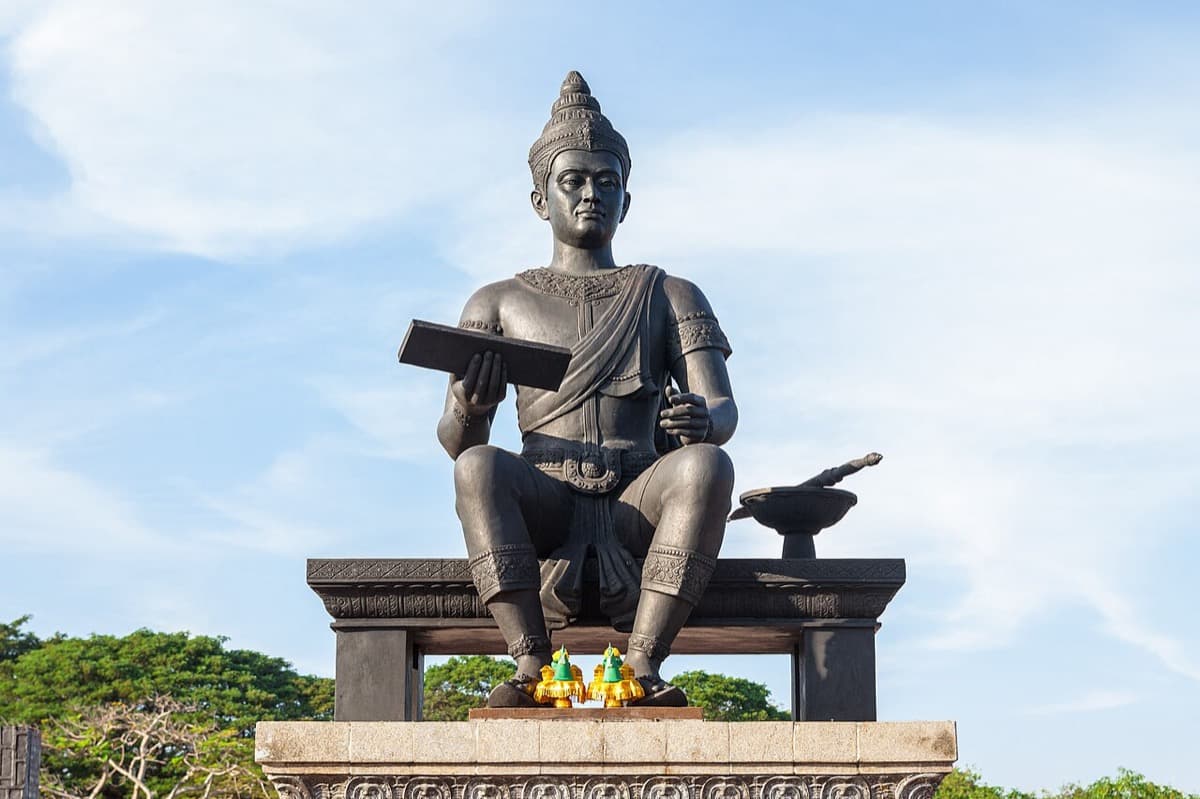
The name Sukhothai is often translated as the dawn of happiness, and the walled central zone is where the origin story was set down. The central walk, The Dawn of Happiness, starts at a bronze statue raised in nineteen seventy-five of the king most tied to the golden age, Ramkhamhaeng, remembered as Ramkhamhaeng the Great. He sits on a throne modeled on the stone seat named in the old inscriptions. Tradition credits him with shaping the Thai alphabet from Khmer, Sanskrit, and Pali letters and with firmly setting Theravada Buddhism as the faith of the kingdom. The walk names those as attributions, things tradition assigns to him, because much of what we say we know about him flows from one document.
That document waits at the end of the same walk, in the Ramkhamhaeng National Museum, which opened in nineteen sixty-four. There you meet a replica of Inscription One, traditionally dated twelve ninety-two, carved on all four faces of the stele across one hundred and twenty-four lines. It describes a prosperous, freely governed kingdom and carries the beloved line that says, in the water there is fish, in the fields there is rice. King Mongkut, Rama the Fourth, is said to have found it in eighteen thirty-three, and in two thousand three it entered UNESCO's Memory of the World register. Here is the part that makes the story serious rather than merely proud: since nineteen eighty-seven, scholars have questioned whether the stone is truly thirteenth century. Michael Vickery challenged its authenticity, and Piriya Krairiksh argued it might have been composed as late as the reign of King Mongkut. A nineteen ninety electron-microscopy study found the stele about the same age as four other Sukhothai inscriptions, which supports authenticity, and most scholars now regard it as at least partly genuine. The origin story ends not in certainty but before an open question.
An identity built on borrowed ground
Hear a stop from this walk
Ramkhamhaeng National Museum: The Stone and the Debate
The three walks agree on something the golden-age legend can obscure: the Thai city rose on older Khmer foundations. At Wat Si Sawai, three towers built in the Khmer manner began as a Hindu, Brahmanical shrine from the late twelfth or early thirteenth century, before or overlapping the founding of the Thai kingdom, and were later converted to Buddhist use in the fourteenth century. A surviving lintel there shows Vishnu reclining on the coils of a great serpent.
The northern walk, The Watching Buddha, makes the point its opening move. It begins at San Ta Pha Daeng, a single east-facing laterite tower widely described as the oldest surviving monument at Sukhothai, built by the Khmer toward the end of the twelfth century, in the Angkorian era. During a restoration in the late nineteen fifties, workers uncovered five headless sandstone figures there, carved in the Khmer manner, their jewellery echoing the reliefs at Angkor Wat. From there the walk reaches Wat Phra Phai Luang, a Khmer complex of three laterite prangs north of the walled city, thought to be the ritual centre of the pre-Sukhothai era and possibly the original core the settlement gathered around. After the Thais established their kingdom, traditionally dated to twelve thirty-eight, the site was converted to Theravada Buddhism, and its walls still stack three eras, Khmer beneath, then Sukhothai, then Ayutthaya. The Thai identity Sukhothai remembers is real, and it is also a story of conversion and inheritance.
The grammar a new kingdom invented
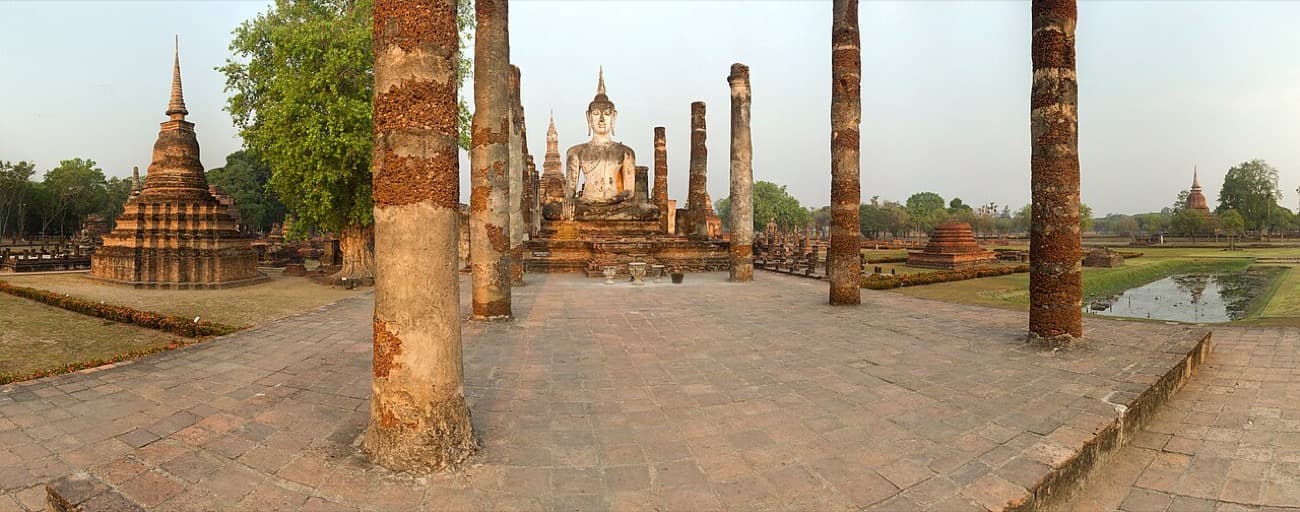
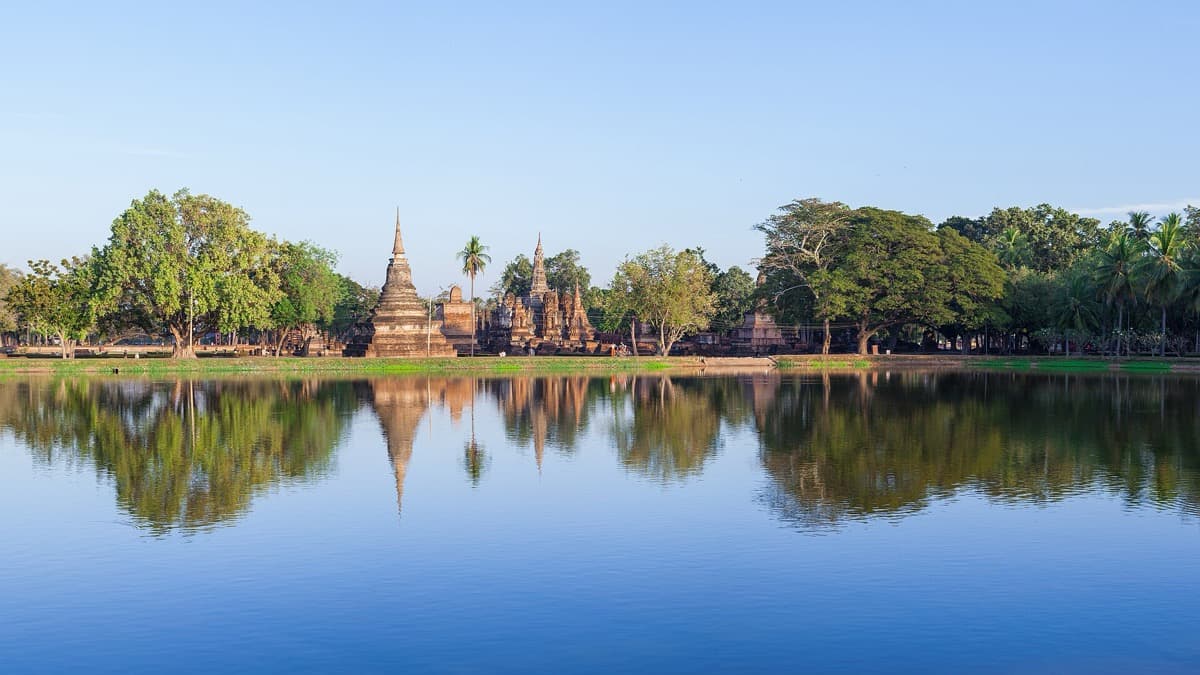
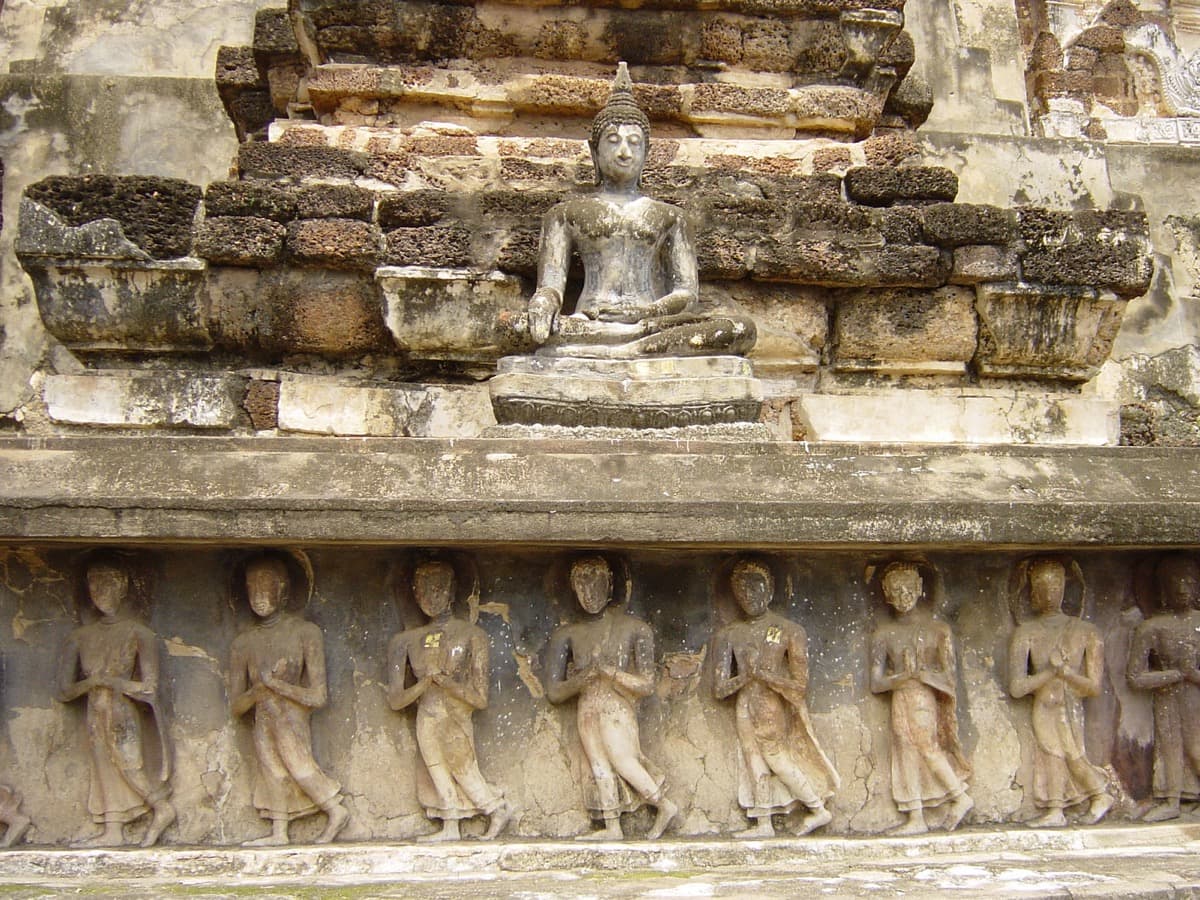
What the Thai artists did after they arrived is the second half of every walk. At Wat Mahathat, the principal royal temple, the central spire rises to a closed lotus bud, the signature architectural form of Sukhothai, meant to evoke the cosmic mountain at the center of the world. A frieze of roughly one hundred and sixty-eight walking disciples circles its base, restored by Thailand's Fine Arts Department. The bell-shaped spires elsewhere, at Wat Sa Si on its lotus-pond island and at the elephant-ringed Wat Sorasak, follow the Sinhalese model that carried Theravada Buddhism from Sri Lanka. Wat Sorasak is one of the few Sukhothai monuments with a firm date: inscription number forty-nine, unearthed in nineteen fifty-five, fixes its foundation to the year fourteen twelve and names its patron, Nai Inthara Sorasak.
Above all, there is the walking Buddha, the phra lila, a figure caught mid-stride with robes flowing, prized as the celebrated invention of Sukhothai art. You meet it in relief at Wat Traphang Ngoen, the temple of the silver pond, where the lotus-bud spire and the walking Buddha appear together, the golden-age look at its most polished and doubled in still water.
A watching Buddha and a speaking one
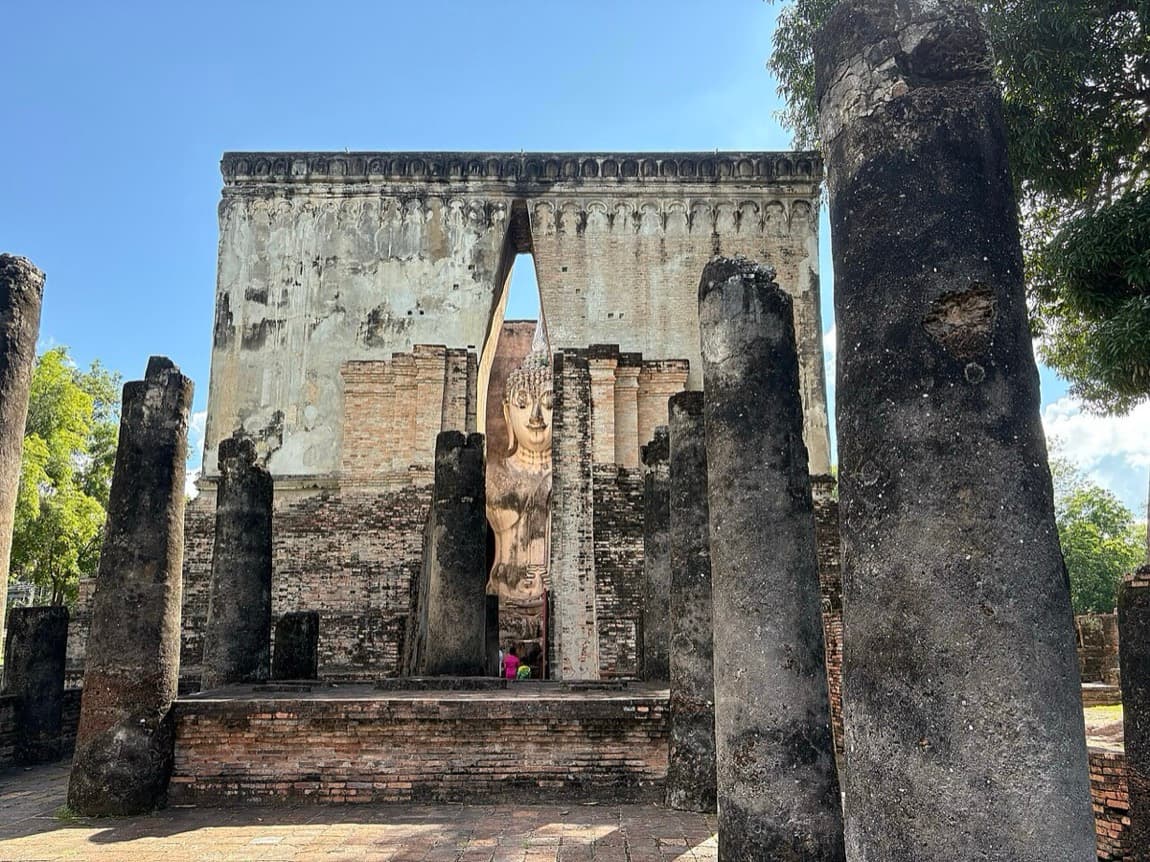
Two colossal images anchor the walks and turn architecture into an experience. At Wat Si Chum, the climax of the northern route, a roofless brick chamber about thirty-two metres on each side holds Phra Achana, a seated Buddha about eleven metres wide and almost fifteen metres high, met through a tall vertical slot that narrows as it rises. The name means, roughly, he who is not frightened. Legend, given strictly as legend, holds that during the wars with Burma in the reign of King Naresuan late in the sixteenth century, a soldier climbed a stair hidden in the wall and spoke, and the chamber's acoustics made the words seem to fall from the Buddha, so the troops believed the image had spoken and took heart. That gave it a second name, Phra Pood Dai, the speaking Buddha.
Engineering at the bottom, transcendence at the top
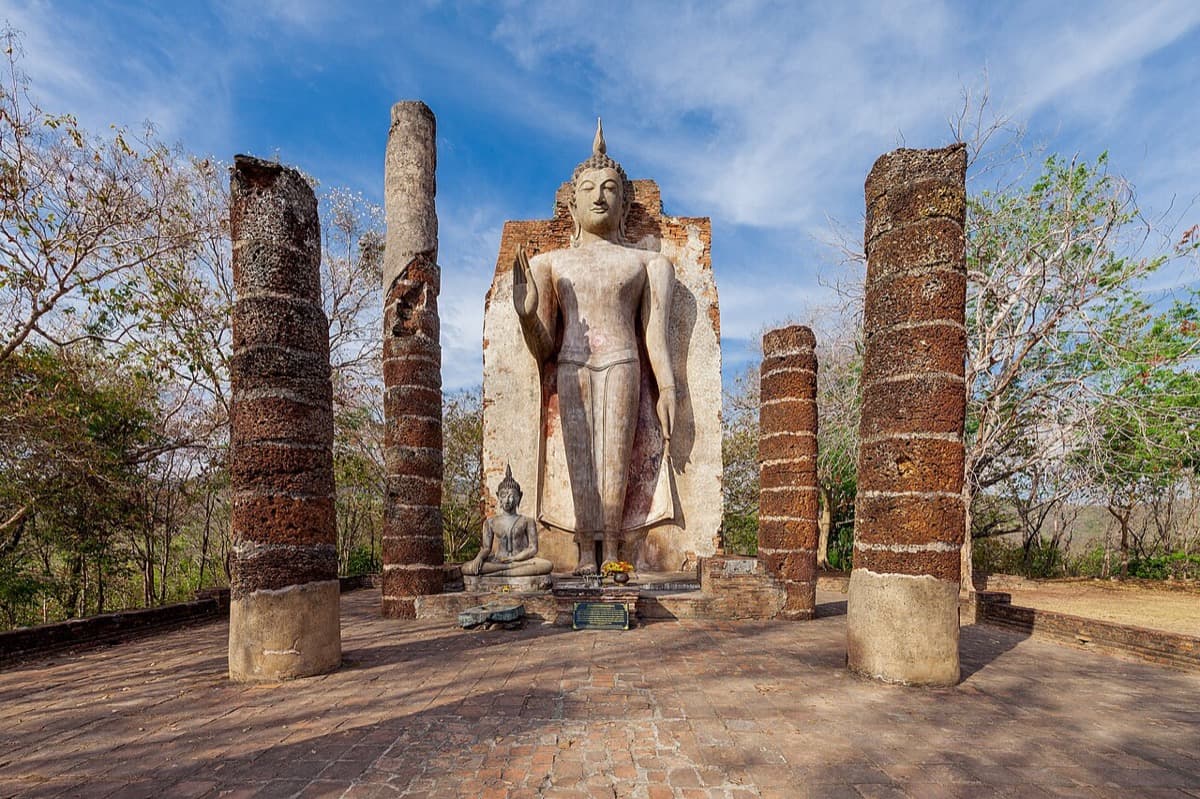
The third walk, The Hydraulic City, reads the whole kingdom as plumbing. This plain had no dependable dry-season river, so the kingdom raised the Saritphong Dam between two hills west of the walled city to trap the monsoon, then fed the stored water through the Sao Ho canal into four reservoirs inside the walls, named silver, gold, lemon, and water spinach. No single engineer is named. Phra Ruang is a legendary and dynastic royal name, so the work belongs to the kingdom as a whole. The walk pivots from the elephant-girded Wat Chang Lom and the four-posture shrine at Wat Chetuphon to that mound of packed earth, then climbs. At the summit of Wat Saphan Hin, reached by a slate stair up a hill about two hundred metres high, the Phra Attharot stands about twelve and a half metres tall, hand raised against fear, facing back out over the grid and the ponds the dam filled. The northern walk ends on the earthen city wall, a planned rectangle of roughly two kilometres by one point six, ringed by triple ramparts and two moats that served defense and water management at once. Sukhothai was inscribed on the UNESCO World Heritage list in nineteen ninety-one. Read all three walks and the origin story comes into focus as one continuous thought: water stored on the flat, faith carried uphill, and a golden age remembered in stone that scholars are still, honestly, arguing over.
For the full set of routes, see Sukhothai walking tours.
Sources
- Ramkhamhaeng National Museum and Inscription One (Sukhothai Inscription No. 1), UNESCO Memory of the World register, inscribed 2003.
- UNESCO World Heritage Centre, Historic Town of Sukhothai and Associated Historic Towns, inscribed 1991.
- Fine Arts Department of Thailand, Sukhothai Historical Park (temple restoration and inscription records, including inscription no. 49 dating Wat Sorasak to 1412).
- Scholarship on the authenticity debate of Inscription One, including Michael Vickery and Piriya Krairiksh (from 1987) and the 1990 electron-microscopy study.
Frequently asked questions
- Why is Sukhothai called the first Thai kingdom?
- Sukhothai is the kingdom Thailand looks back on as its beginning, with a traditional founding date of twelve thirty-eight after a Tai leader broke from Khmer rule. Much of the origin story rests on Inscription One, traditionally dated twelve ninety-two, which describes a prosperous, freely governed kingdom. The claim is central to Thai national memory, though parts of it are debated by scholars.
- Is the famous Ramkhamhaeng inscription genuine?
- Its authenticity has been contested since nineteen eighty-seven. Michael Vickery challenged it, and Piriya Krairiksh argued it might have been composed as late as the reign of King Mongkut in the nineteenth century. A nineteen ninety electron-microscopy study found the stele about the same age as four other Sukhothai inscriptions, and most scholars now regard it as at least partly genuine.
- What is the giant Buddha at Wat Si Chum?
- It is Phra Achana, a seated Buddha about eleven metres wide and almost fifteen metres high, filling a roofless brick chamber and seen through a tall vertical slot in the front wall. Its name means roughly he who is not frightened. A legend, given as legend, holds that a soldier once spoke from a stair hidden in the wall so troops believed the image itself had spoken, earning it the second name Phra Pood Dai, the speaking Buddha.
- What is the lotus-bud spire and why does it matter?
- The lotus-bud finial is the signature architectural form of Sukhothai, a spire shaped like a closed lotus bud meant to evoke the sacred cosmic mountain at the center of the world. You see it at the royal temple Wat Mahathat and, in refined form, at Wat Traphang Ngoen. Art historians treat it as the defining Sukhothai contribution to temple architecture.
- How did a city survive on a dry plain?
- The plain had no dependable dry-season river, so the kingdom raised the earthen Saritphong Dam between two hills west of the city to trap the monsoon. Stored water was carried through the Sao Ho canal into four reservoirs inside the walls, named silver, gold, lemon, and water spinach. The walled city itself was a planned rectangle ringed by triple ramparts and two moats that served both defense and water management.
Ready to experience it?
Historical Park: The Dawn of Happiness
90 min · 3 km · moderate
More from Sukhothai
Explore more at your own pace.
One Day in Sukhothai: A Walkable Morning-to-Evening Itinerary
Sukhothai Travel Guide: Days, Transport, Costs, and Safety
Wat Mahathat: Where Sukhothai Turned Its Origin Story Into Stone
Wat Saphan Hin: Reading Sukhothai's Ruins as One Idea in Two Hands
Wat Si Chum and the Buddha That Watches Through a Slot