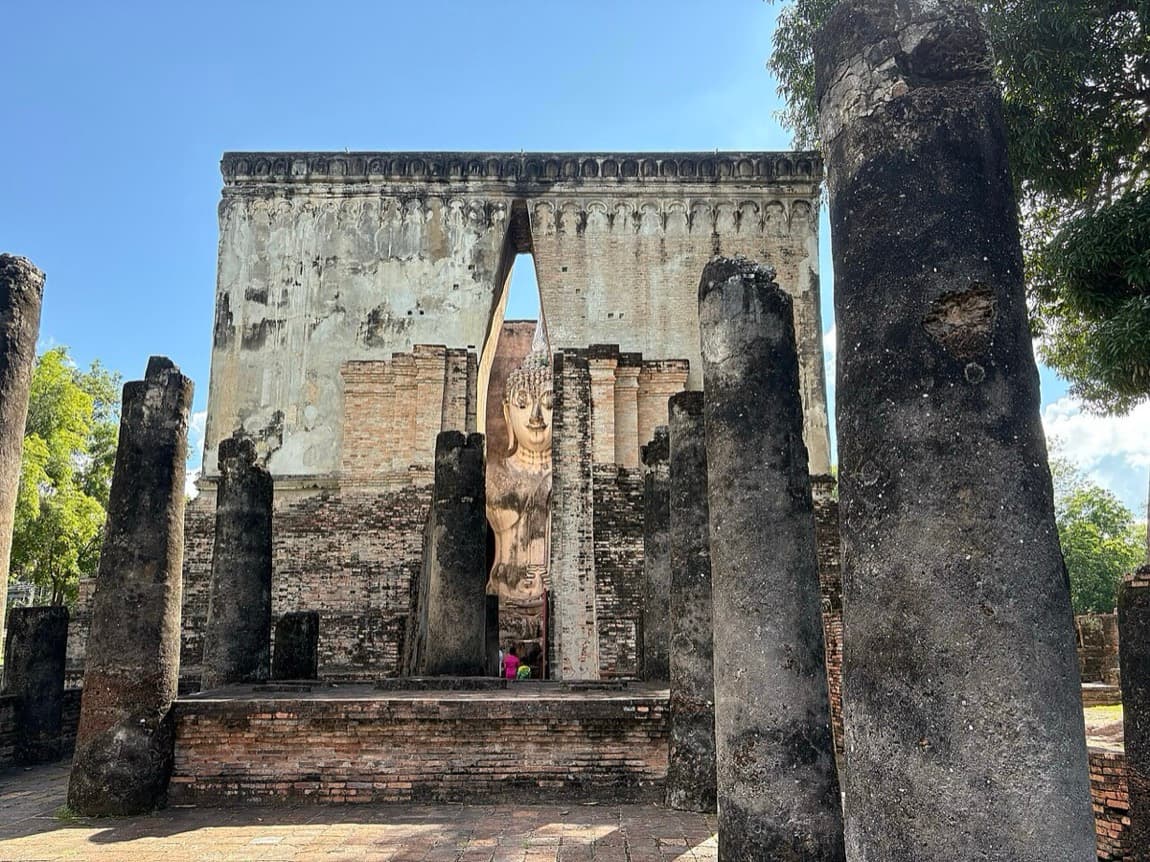
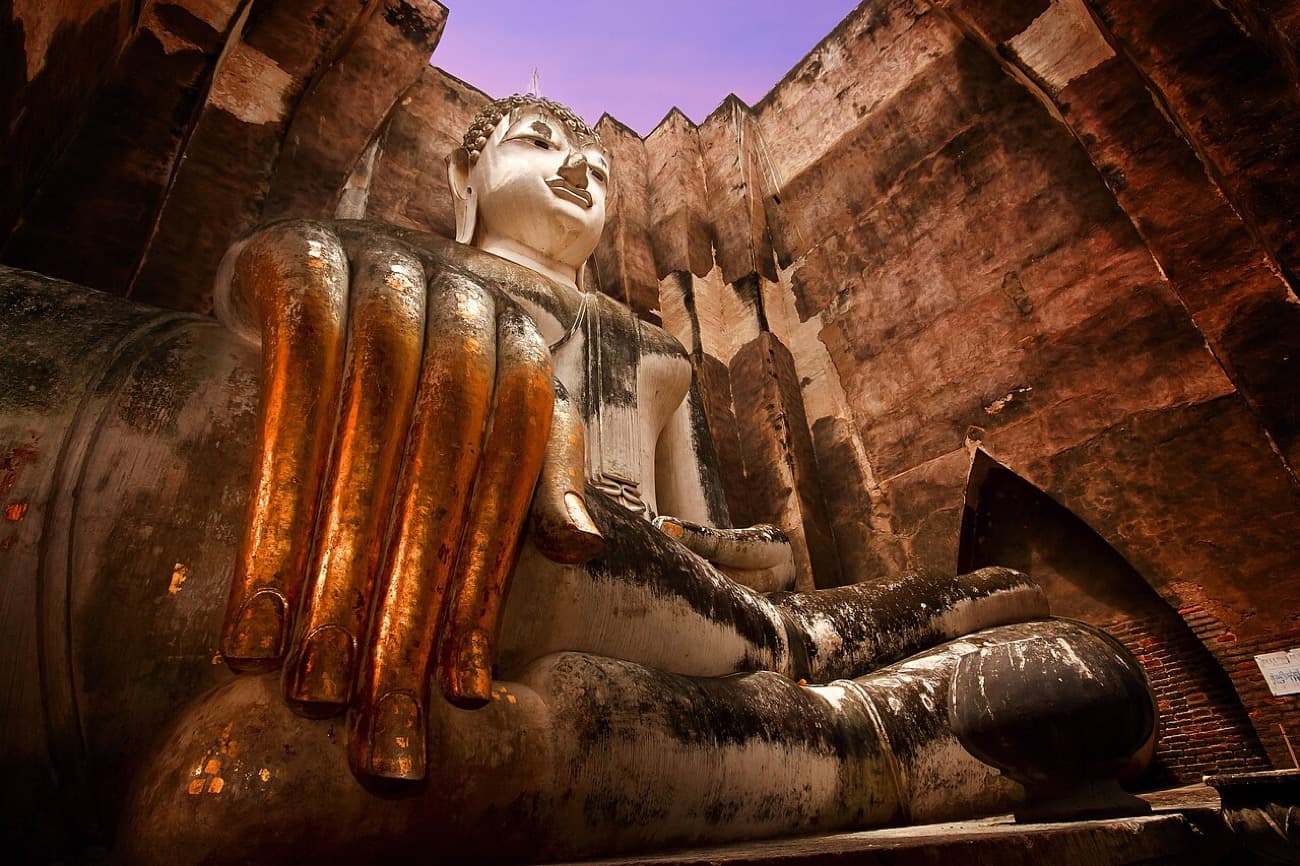
Walk far enough north in old Sukhothai and you reach a roofless brick chamber with a tall vertical slot cut into its front wall. Come at it straight on, and through that slot an enormous downcast face rises to meet you: Phra Achana, a seated Buddha about eleven metres wide and almost fifteen metres high, filling the chamber to the top. This is Wat Si Chum, and it is the stop the northern walk leans toward. To understand why the reveal lands the way it does, it helps to know what you passed to get here, because the whole route is an argument about what the Thai artists added to the Khmer ground they inherited.
The ground before the kingdom
The northern temples sit above an older world. The Thai kingdom that raised this city in the thirteenth century built on land the Khmer had held before them, and the walk opens on the proof. San Ta Pha Daeng, the first stop, is a single east-facing tower of laterite, the rusty pitted stone that hardens in open air. It is widely described as the oldest surviving monument at Sukhothai, built by the Khmer toward the end of the twelfth century, in the Angkorian era. During a restoration in the late nineteen fifties, workers uncovered five headless sandstone figures here, male and female, carved in the Khmer manner, their jewellery echoing the reliefs at Angkor Wat. This was a Hindu place, its gods facing east on a high stone plinth, before there was any Sukhothai smile.
That is the "before" the rest of the walk answers. When a Tai leader rebelled against the Khmer governor, a new kingdom began, traditionally dated to twelve thirty eight. What the new Thai artists did next is the story you are following stop by stop.
Two stops that teach the new grammar
Hear a stop from this walk
Wat Si Chum: He Who Is Not Frightened
The change shows itself in stages. At Wat Sorasak, a bell-shaped tower, a chedi, rises from a low square base, and twenty four elephants moulded in brick and stucco push out from the sides, shoulder deep, as if carrying the spire upward on their backs. This one carries an unusually firm date. A stone inscription, catalogued as number forty nine and unearthed by the Fine Arts Department in nineteen fifty five, fixes the foundation to the year fourteen twelve. The bell shape and the elephant base are Sinhalese ideas, carried along the Theravada Buddhist world from what is now Sri Lanka. The same elephant-girdled chedi appears at Si Satchanalai up the road, which tells you this was a shared regional vocabulary, not a single flourish.
Then the ground turns older again. Wat Phra Phai Luang, north of the walled city, began as a Khmer work laid out with three laterite prang towers, the corn-cob-shaped tower that is a Khmer signature. Only the northern one still stands to any height. Scholars think this may have been the ritual centre of the pre-Sukhothai era, possibly the original core the city first gathered around. After the Thais established their kingdom, they converted it to Theravada Buddhism and expanded it, and you can still read the layered phases stacked in the same walls: Khmer beneath, then Sukhothai, then Ayutthaya. A moat about six hundred metres long once wrapped the whole thing.
The Buddha that watches, and the one that spoke
By the time you reach Wat Si Chum, you have seen the whole transition compressed into stone. Now the payoff. The chamber, a mondop, measures about thirty two metres on each side, and its walls run some three metres thick. The tall front slot narrows as it rises, and the Buddha behind it fills the space almost exactly. The name Phra Achana means, roughly, "he who is not frightened."
The details reward the pause. Inside the thickness of one wall runs a hidden stair, closed to visitors now, that climbs toward the roof. Its ceiling once held more than fifty engraved slate slabs showing Jataka tales, the previous lives of the Buddha, counted among the oldest surviving Thai line drawings. They now rest in the Ramkhamhaeng National Museum in town, alongside inscription forty nine from Wat Sorasak.
And there is the legend, offered strictly as legend. The image has a second name, Phra Pood Dai, the speaking Buddha. Tradition holds that during the wars with Burma, in the reign of King Naresuan late in the sixteenth century, a soldier climbed that hidden stair and spoke, and the acoustics of the chamber made the words seem to fall from the Buddha itself, so the troops took heart. There is one more debated thread: Phra Achana is named in the famous Ramkhamhaeng inscription, whose authorship scholars have argued over since the nineteen eighties. Most now regard it as at least partly authentic. Either way, standing in the slot of light, you feel yourself watched, and you understand the question the walk has been asking. What is the Sukhothai calm made of, and why does a downcast gaze in stucco feel so unlike the Khmer stone it grew out of.
The frame around everything
The route ends on the earthen north rampart, and the wall explains the plan. The old city was laid out as a deliberate rectangle, its ramparts running about two kilometres east to west by one point six kilometres north to south, built as a triple ring of earthen banks with two moats threaded between them. Those moats were defense and water management at once, part of a planned grid that caught the monsoon in a dry region. Look south and you read the city as its builders drew it, palace and temples inside the walls, reservoirs beyond. Look north, and Wat Phra Phai Luang, the possible original core, sits outside the rectangle, older than the grid that frames the rest. That single sightline holds the whole arc: Khmer ground first, then a planned Thai city filled with a new kind of stillness. The town was inscribed as a UNESCO World Heritage site in nineteen ninety one.
Walking it yourself
This is a flat, roughly four and a half kilometre route through the northern zone, best ridden or walked in the early morning when light comes through the slot at Wat Si Chum and the northern temples stay quiet. The northern temples sit in a separate ticketed zone from the central ruins, so budget for that at the gate, carry more water than you think you need, and approach Wat Si Chum from straight in front so the Buddha reveals itself slowly. For the full route, the audio, and the other Sukhothai walks, see the Sukhothai walking tours guide and the Sukhothai city page.
Sources
- Sukhothai Historical Park, Wikipedia. Overview of the walled city plan, ramparts, moats, and the northern temple zone.
- Historic Town of Sukhothai and Associated Historic Towns, UNESCO World Heritage Centre (list entry 574). Confirms the 1991 inscription.
- Wat Si Chum in the Sukhothai Historical Park, Renown Travel. Description of the mondop, Phra Achana, the hidden stair, and the speaking-Buddha legend.
- Wat Sorasak, Renown Travel. The elephant-ringed chedi and inscription number forty nine dating the foundation to 1412.
- Wat Phra Phai Luang, Oriental Architecture. The three Khmer prangs and the temple's role as a pre-Sukhothai centre.
Ready to experience it?
Wat Si Chum: The Watching Buddha
100 min · 4.5 km · moderate
More from Sukhothai
Explore more at your own pace.
One Day in Sukhothai: A Walkable Morning-to-Evening Itinerary
Sukhothai Travel Guide: Days, Transport, Costs, and Safety
Sukhothai: The Kingdom Thailand Reads as Its Beginning
Wat Mahathat: Where Sukhothai Turned Its Origin Story Into Stone
Wat Saphan Hin: Reading Sukhothai's Ruins as One Idea in Two Hands