Wat Mahathat is the ceremonial center where Sukhothai turned its origin story into stone. Walk into the temple of the great relic and you are standing at the physical heart of the kingdom that Thailand looks back on as its beginning, reading in brick and laterite the claim that a national golden age was born here. The whole walled central zone spirals out from this one spire, and understanding what rises above you here is the way to understand why the rest of the walk matters.
Start with the name. Mahathat means the great relic, and this was the principal royal temple of Sukhothai, the state temple of a kingdom that called itself the first Thai state. By the Sukhothai inscriptions, the temple was built across a long span, somewhere between twelve ninety-two and thirteen forty-seven. No single founder can be named with certainty, because the sources differ. It is safer to say the temple rose across the reigns of the early Sukhothai kings, which already tells you something: this was not one ruler's monument but a kingdom's, assembled over generations.
The spire that became a signature
Look up. The central spire narrows to the shape of a closed lotus bud, and that lotus-bud finial is the defining architectural invention of Sukhothai. Once you have seen it you will not mistake it anywhere else in Thailand. It is meant to evoke the sacred cosmic mountain at the center of the Buddhist universe, so the temple is not merely decorated. It is a map of the cosmos rendered vertically in stone.
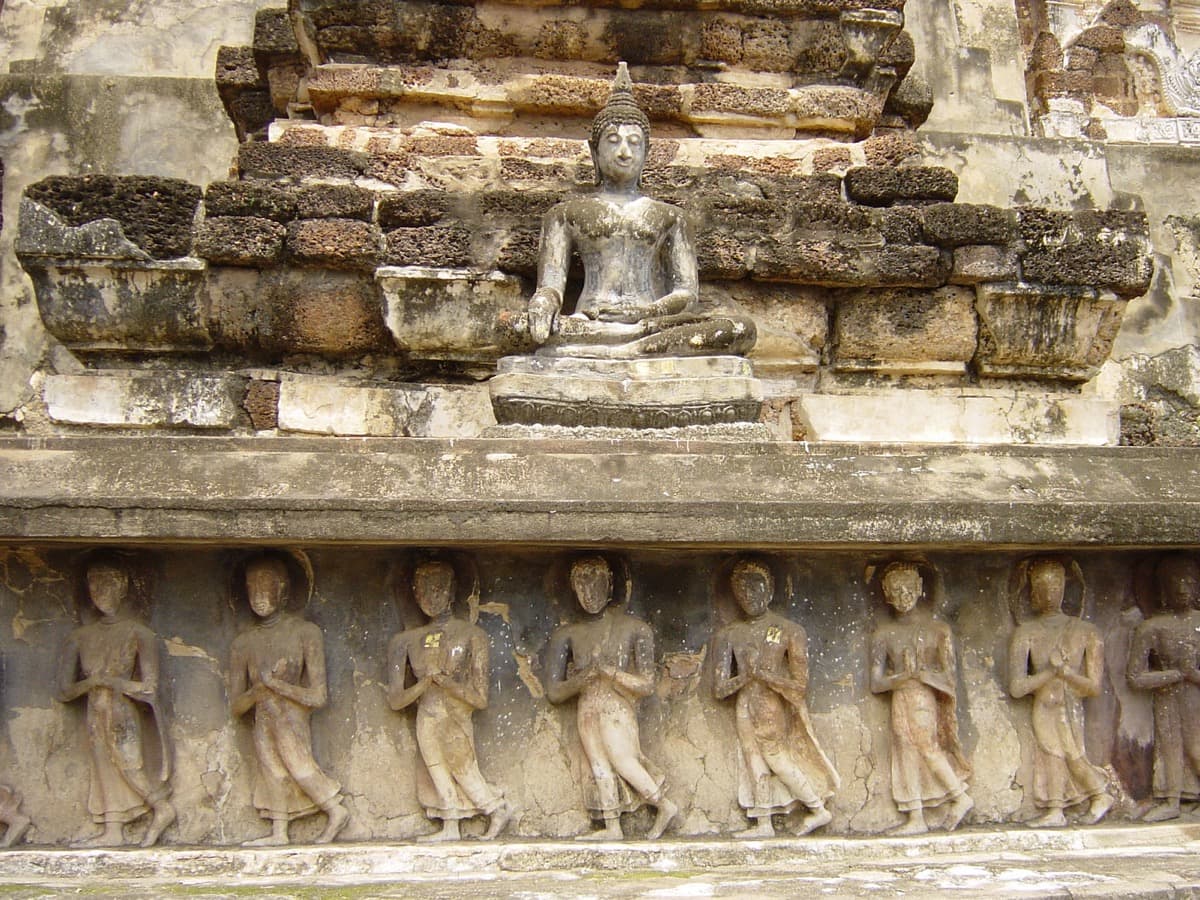
Around the central spire, the plan continues that logic. Smaller stupas stand at the corners. At the four cardinal points rise towers built in the older Khmer manner, a quiet acknowledgment of the older civilization the Thai city inherited its forms from. Come close to the base of the main spire and look for the stucco figures walking around it. A procession of roughly one hundred and sixty-eight disciples moves clockwise around the monument, restored in modern times by Thailand's Fine Arts Department. Across the wider complex you will find rows of columns from ruined assembly halls, close to two hundred smaller spires, seated Buddha images with one hand reaching down to touch the earth, and two tall standing Buddhas set into their own chambers to the north and south.
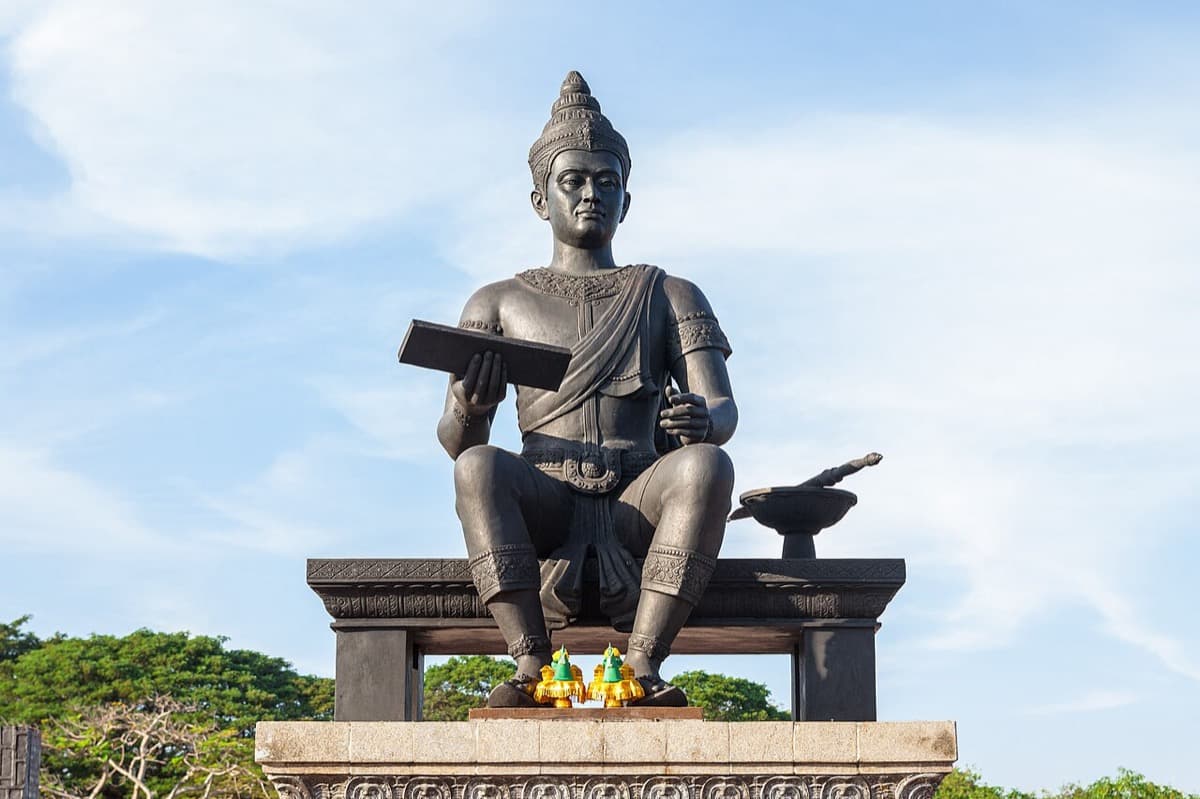
If the first stop of the walk, the King Ramkhamhaeng Monument raised in nineteen seventy-five, plants the claim of the golden age, Wat Mahathat is that claim made solid.
Why one temple opens the whole city
Hear a stop from this walk
Ramkhamhaeng National Museum: The Stone and the Debate
The reason to keep walking after Wat Mahathat is that the central zone is an argument, and each temple around the royal one answers a different part of it. Sukhothai's self-portrait as the origin of Thai identity is genuine as memory and contested as history, and the six stops of the central walk let you hold both at once.
Just south of the great temple stand the three tapering towers of Wat Si Sawai. Their lower parts are laterite in the clear Khmer style, their upper parts reworked by Thai builders in brick and stucco. The place began as a Brahmanical shrine from the era of Khmer and Lavo influence, which means it predates or overlaps the very founding of the Thai kingdom. A surviving carved lintel shows the god Vishnu reclining on the coils of a great serpent. Later, during the Sukhothai period, the site was converted to Buddhist use. The birthplace of a Thai identity, in other words, was itself built on borrowed ground.
Cross a footbridge to Wat Sa Si and the register changes. This temple sits on an island in a lotus-filled pond, and its main spire is not the lotus bud but a bell shape on a square base, built in the Sinhalese manner of Sri Lanka. That silhouette is a signal, not an ornament. Theravada Buddhism reached Sukhothai from Sri Lanka, and the Lankan bell form carries the faith in its outline. West of the royal temple, across a wide reservoir, Wat Traphang Ngoen, the temple of the silver pond, doubles the golden-age look in still water: a refined lotus-bud spire and a graceful walking Buddha carved in relief, one hand raised in teaching. The walking Buddha, caught mid stride with robes flowing, is one of the celebrated inventions of Sukhothai art.
Where the story meets its doubt
The walk ends at the Ramkhamhaeng National Museum, just east of Wat Mahathat, and this is where the origin story meets the scholarship. The museum opened in nineteen sixty-four and holds a replica of Inscription One, the famous stone traditionally dated twelve ninety-two, the earliest surviving writing in Sukhothai script. It is the source of the beloved line, in the water there is fish, in the fields there is rice, and it entered UNESCO's Memory of the World register in two thousand three.
Here is the honest part. Since nineteen eighty-seven, scholars have questioned whether the stone is truly thirteenth century. Michael Vickery challenged its authenticity, and the art historian Piriya Krairiksh argued it may have been composed as late as the reign of King Mongkut, Rama the Fourth. A nineteen ninety study using electron microscopy found the stele about the same age as four other Sukhothai inscriptions, which supports authenticity, and most scholars now regard it as at least partly genuine. The debate remains unresolved. The origin story closes not in certainty but in an open question, standing before the very stone it rests on.
That arc, from the claim in bronze to the claim in stone to the debate over the stone, is why Wat Mahathat is a beginning rather than a stop. The walk runs about three kilometres across flat, open ruins and reflecting ponds, and takes roughly two hours at an unhurried pace. Every stop stands on its own, so you can linger at a pond, rest in what little shade there is, and move at your own rhythm. Come early or late, when the low sun sets the spires in the water. For the full route and the other central-zone temples, see our Sukhothai walking tours, and to plan the visit around the park, start at Sukhothai.
Sources
- Sukhothai Historical Park, Wikipedia. Overview of the walled central zone, its temples, and their forms.
- Wat Mahathat, Wikidata (Q2552296). Coordinates and identification of the royal temple.
- Ram Khamhaeng Inscription, Wikipedia. The text, its line count, and the authenticity debate involving Michael Vickery and Piriya Krairiksh.
- The King Ram Khamhaeng Inscription, UNESCO Memory of the World. Official record of the inscription's two thousand three inscription on the register.
- Ramkhamhaeng, Britannica. Biography of the king traditionally credited with the Sukhothai golden age.
Ready to experience it?
Historical Park: The Dawn of Happiness
90 min · 3 km · moderate
More from Sukhothai
Explore more at your own pace.
One Day in Sukhothai: A Walkable Morning-to-Evening Itinerary
Sukhothai Travel Guide: Days, Transport, Costs, and Safety
Sukhothai: The Kingdom Thailand Reads as Its Beginning
Wat Saphan Hin: Reading Sukhothai's Ruins as One Idea in Two Hands
Wat Si Chum and the Buddha That Watches Through a Slot