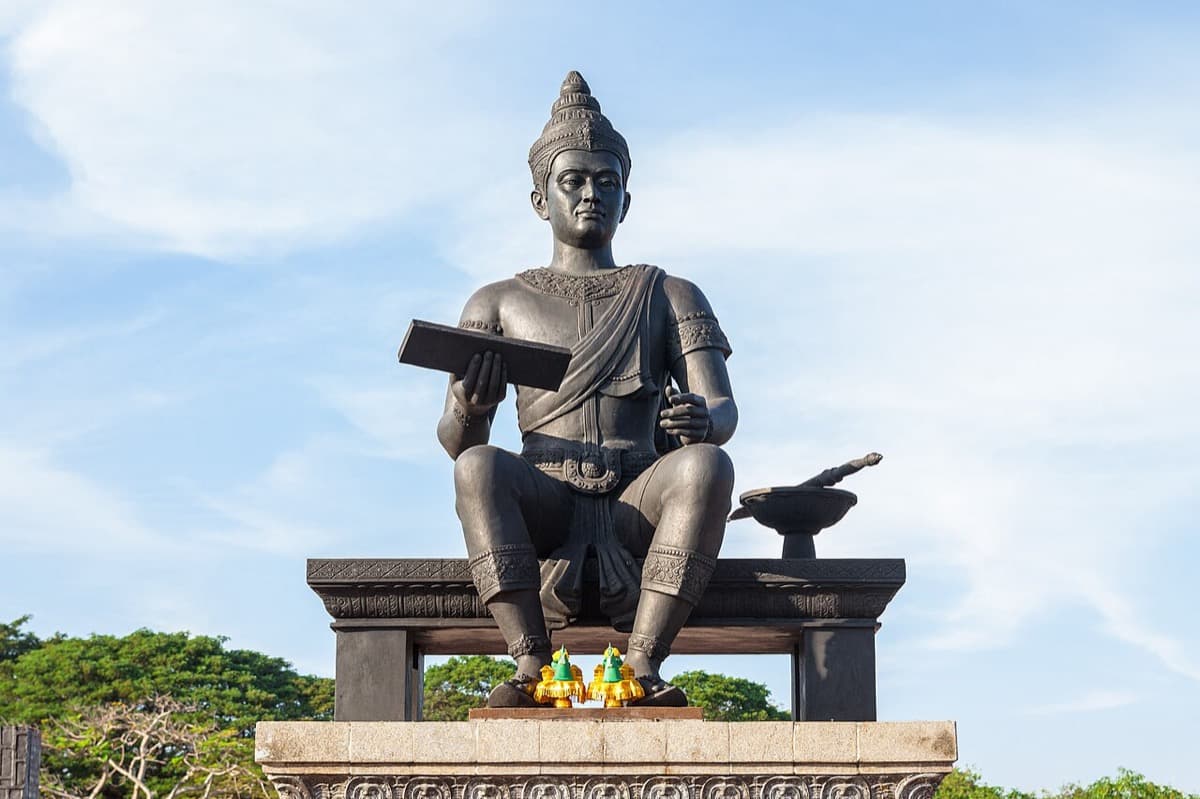
The King Ramkhamhaeng Monument is a bronze statue, cast in 1975, that plants Thailand's national origin claim at the center of the walled city of Sukhothai. It sits on Charotwithithong Road, just north of Wat Mahathat, and it honors a king remembered as a lawgiver and the founder of a golden age. The one thing worth understanding while you stand in front of it is this: the monument is modern, the legend it carries is ancient, and almost everything the legend asserts flows from a single old stone you will not reach until the end of the walk. The bronze is not the evidence. It is the claim.
A modern statue for an ancient argument
The seated figure is cast from bronze mixed with copper, stands about three metres high, and weighs roughly three tons. That physical scale matters less than its date. The ruins around it are laterite and brick that have stood for centuries. This king, by contrast, was raised in 1975, which makes the monument younger than most of the people who visit it. The gap between the age of the statue and the age of the city is the first honest fact of the tour, and it sets the tone for everything that follows.
The throne beneath him is not invented. It is modeled on the Phra Thaen Manangkhasila, the stone seat named in the old inscription tradition of Sukhothai. So even the furniture of this monument reaches back to a written source rather than to a surviving object. The sculptors were not depicting a documented man from documented likenesses. They were rendering a figure who reaches us through memory and text, and they tied him to the text at every point they could.
Who the king is said to have been
Hear a stop from this walk
Ramkhamhaeng National Museum: The Stone and the Debate
By tradition, Ramkhamhaeng was the third king of Sukhothai, of the Phra Ruang line, a son of Si Inthrathit and Queen Sueang. His reign is usually given as 1279 to 1298. He is remembered as Ramkhamhaeng the Great, and Thai national memory credits him with a great deal.
Tradition says he shaped the Thai alphabet, combining letters drawn from Khmer and from the Indian scripts of Sanskrit and Pali. Tradition says he firmly set Theravada Buddhism as the faith of the kingdom. These are attributions, the things a national story assigns to a founding figure, rather than settled facts confirmed by independent record. The attribution of the alphabet in particular is a tradition, not a documented historical event. It is worth holding that distinction lightly in your mind as you look at the statue, because the whole point of the walk that begins here is to separate what memory claims from what evidence can support.
Much of what anyone says they know about this king comes from one document: the inscription traditionally dated 1292, the earliest surviving writing in Thai script. That is a slender foundation for a national origin story, and Sukhothai is unusually candid about admitting it. The kingdom that Thailand looks back on as its beginning rests, in large part, on a single stele.
Why the story begins with bronze, not stone
There is a deliberate logic to opening the central-zone walk here rather than at the inscription itself. This monument plants the claim in its boldest form. A king on a throne, cast in metal, seated at the center of the old capital, is the golden age made confident and legible. It tells you what the nation wants to remember before you go looking at what the record can prove.
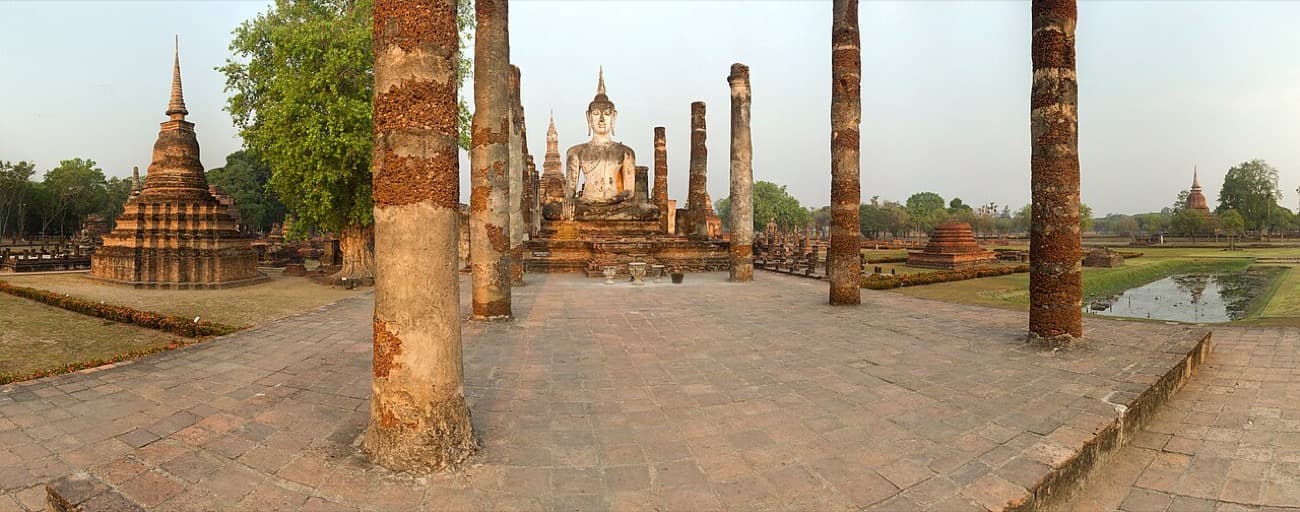
The rest of the walk then tests that claim against the ground. A short distance south stands Wat Mahathat, the principal royal temple, its central spire rising in the closed lotus-bud form that became the signature of Sukhothai architecture. That is the claim made solid in brick and laterite. Farther on, Wat Si Sawai reveals three Khmer-style towers that began as a Hindu sanctuary before the Thai city rose, a reminder that the origin was built on borrowed and older ground. The island temple of Wat Sa Si carries a Sri Lankan bell-shaped spire, the Theravada faith arriving from across the sea. Wat Traphang Ngoen doubles the golden-age aesthetic in the still water of a reservoir.
And only at the last stop, in the Ramkhamhaeng National Museum, do you meet a replica of the famous inscription itself, the stone that describes a kingdom with, in its beloved phrase, fish in the water and rice in the fields. The original inscription has resided in the Bangkok National Museum since 1968, so the park museum shows only a faithful copy. It entered UNESCO's Memory of the World register in 2003. It has also been contested since 1987, when scholars began questioning whether the stone is truly thirteenth century. The monument you are standing in front of now is the confident opening statement. The museum is the honest, unresolved closing question. The tour is designed so you feel both.
What to notice while you are here
Read the statue as a piece of national storytelling, because that is what it is. Notice how new the bronze is against the ancient stone of the surrounding temples. Notice that the throne quotes a text rather than an object. Notice that the alphabet, the Buddhism, the reign dates, and the very lineage all come to you framed as tradition, which is exactly how this walk presents them, with care about the line between memory and history.
Standing here, you are at the head of an origin story that is real as memory and contested as history. Both belong on the walk. The King Ramkhamhaeng Monument is stop one of the central-zone route through Sukhothai, a roughly three-kilometre loop across open ruins and reflecting ponds that ends at the disputed stone the whole legend depends on. If you want the full arc, from the claim in bronze to the debate over the inscription, see the other Sukhothai walking tours and let the audio carry the story stop by stop. Come early or late in the day, when the low sun is kinder on the exposed laterite and the spires mirror cleanly in the water.
Sources
- Ramkhamhaeng, Wikipedia. Biographical tradition, reign dates 1279 to 1298, Phra Ruang line, and the alphabet attribution.
- Ramkhamhaeng, King of Sukhothai, Britannica. Overview of the king's place in Thai memory and the caution around documented fact.
- Ram Khamhaeng Inscription, Wikipedia. Details of Inscription One, its 1292 traditional date, and the authenticity debate begun in 1987.
- The King Ram Khamhaeng Inscription, UNESCO Memory of the World. Confirms the 2003 register inscription and the document's significance.
- Sukhothai Historical Park, Wikipedia. Context on the walled central zone, Wat Mahathat, and the surrounding temples.
Ready to experience it?
Historical Park: The Dawn of Happiness
90 min · 3 km · moderate
More from Sukhothai
Explore more at your own pace.
One Day in Sukhothai: A Walkable Morning-to-Evening Itinerary
Sukhothai Travel Guide: Days, Transport, Costs, and Safety
Sukhothai: The Kingdom Thailand Reads as Its Beginning
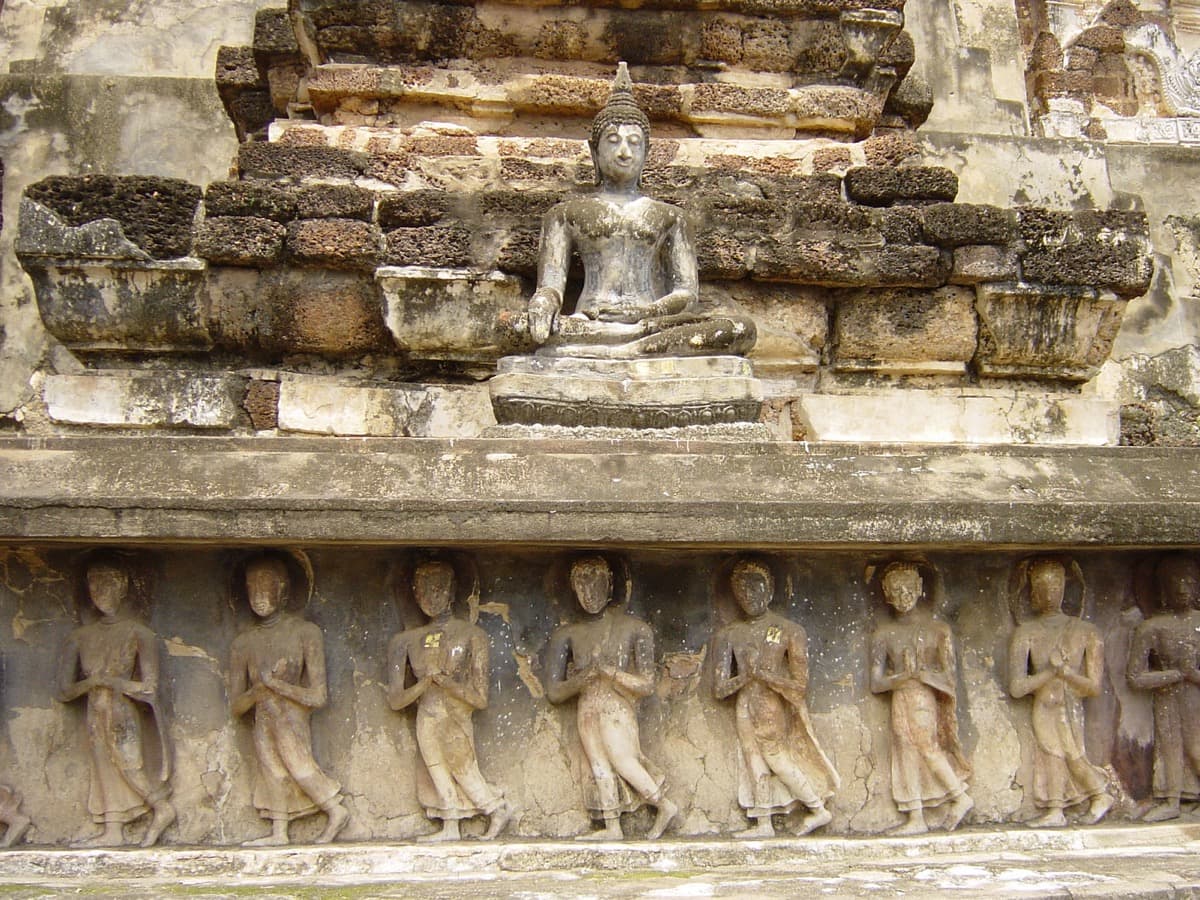
Wat Mahathat: Where Sukhothai Turned Its Origin Story Into Stone
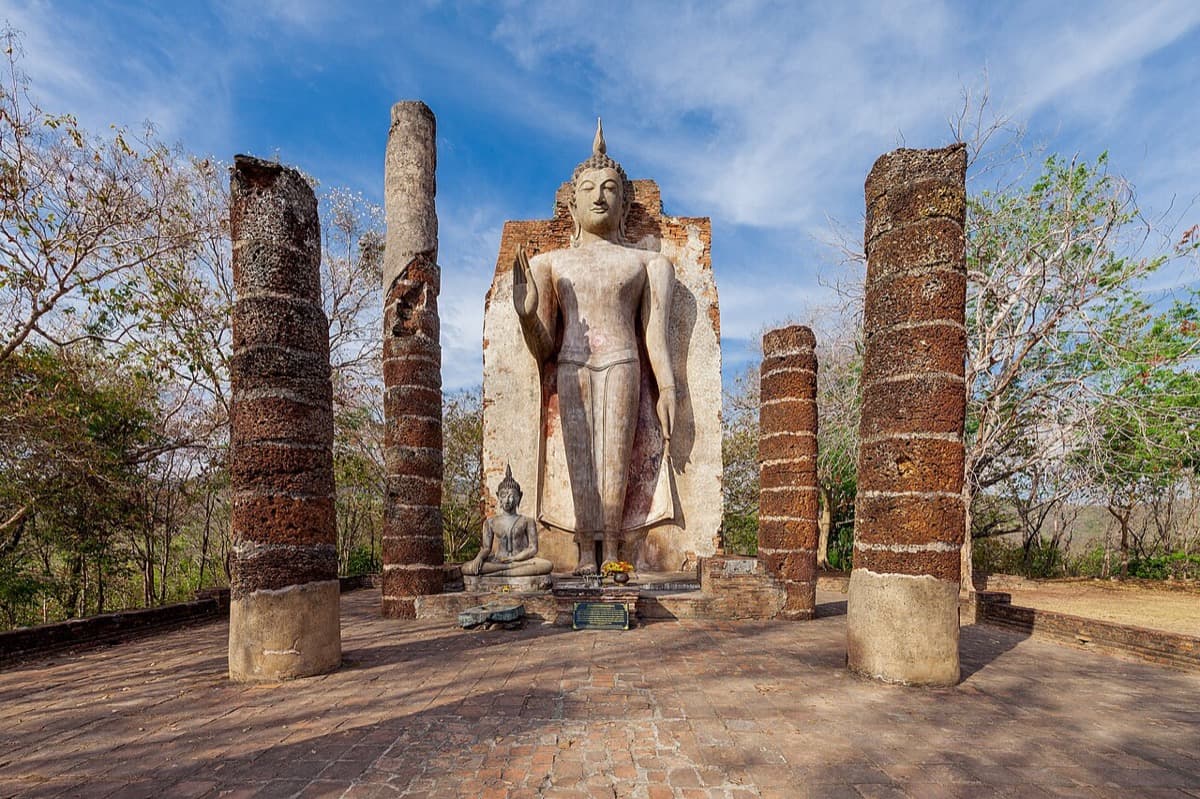
Wat Saphan Hin: Reading Sukhothai's Ruins as One Idea in Two Hands