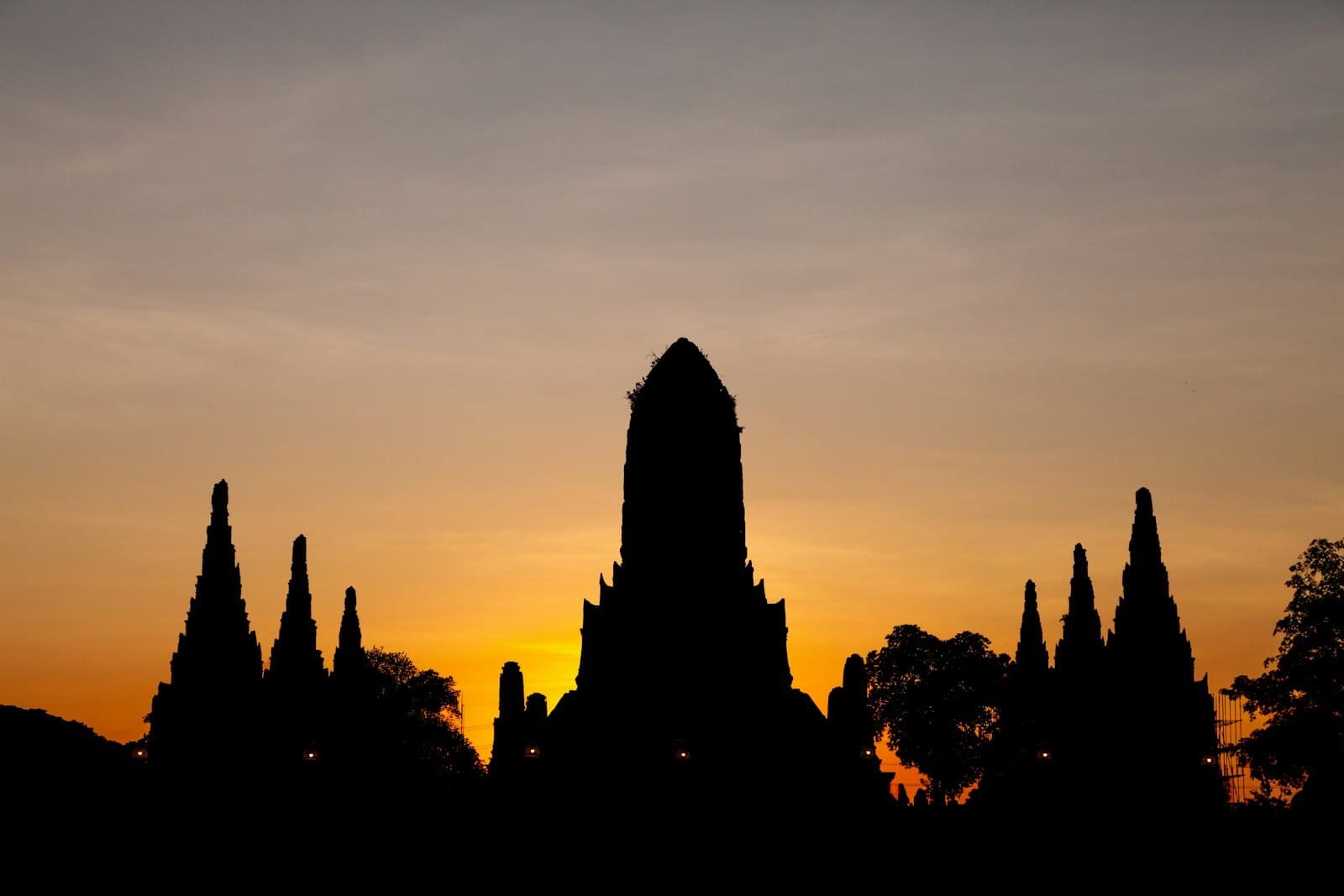
A walk through the western and riverside temples of Ayutthaya that reads the old royal skyline as a language, tracing how the tapering prang and the bell-shaped chedi became the shapes that meant Siam.
Start · Wat Na Phra Men: The Roofline That Survived
DirectionsStops
- 1
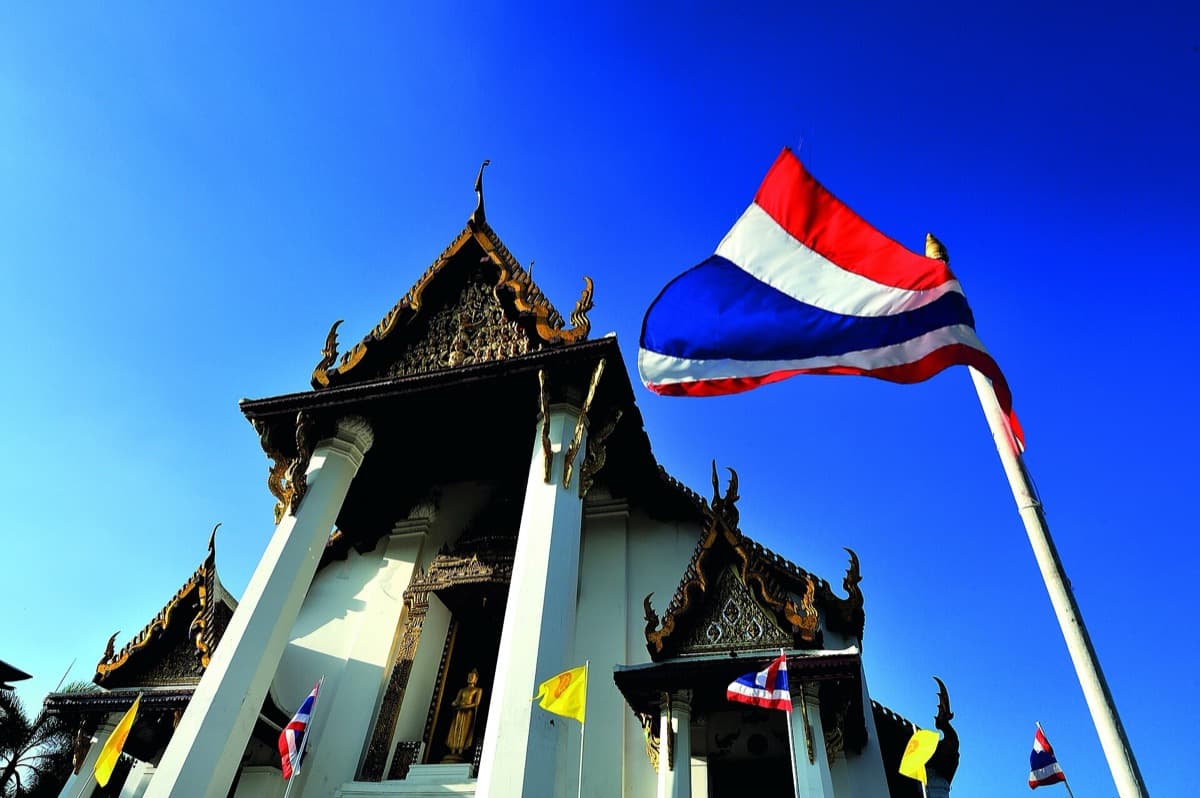
Wat Na Phra Men: The Roofline That Survived
The one temple in the city of Ayutthaya spared in the Burmese sack of seventeen sixty-seven, where you learn to read an intact roofline before meeting ruins.
- 2
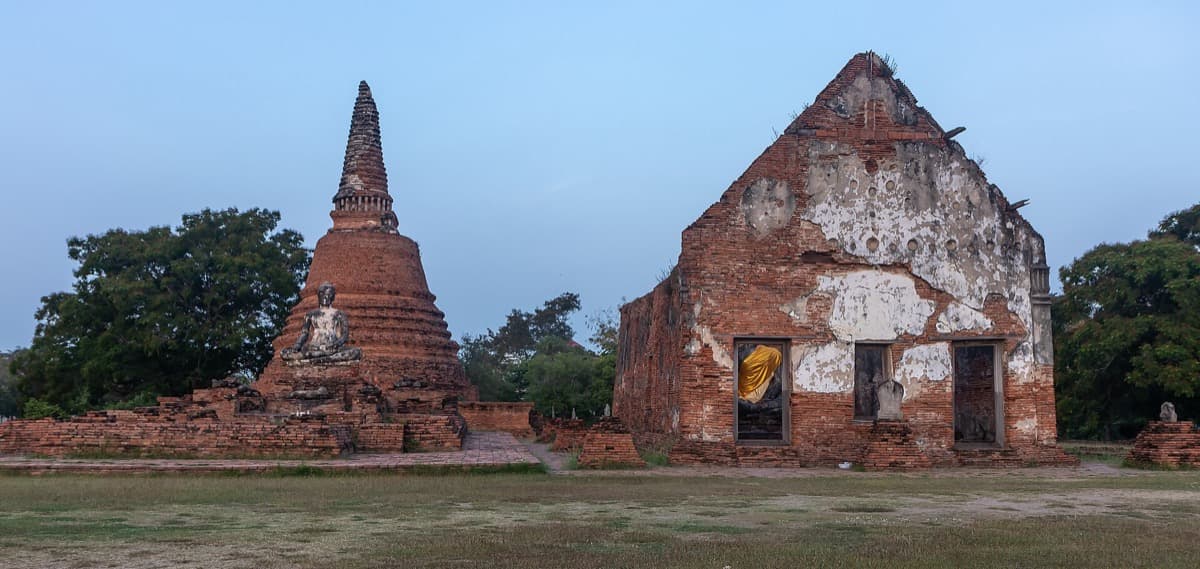
Wat Worachettharam: The Bell in the Grammar
A roofless ruin west of the royal palace whose large bell-shaped chedi shows the Sinhalese-derived memorial form standing beside the prang.
- 3
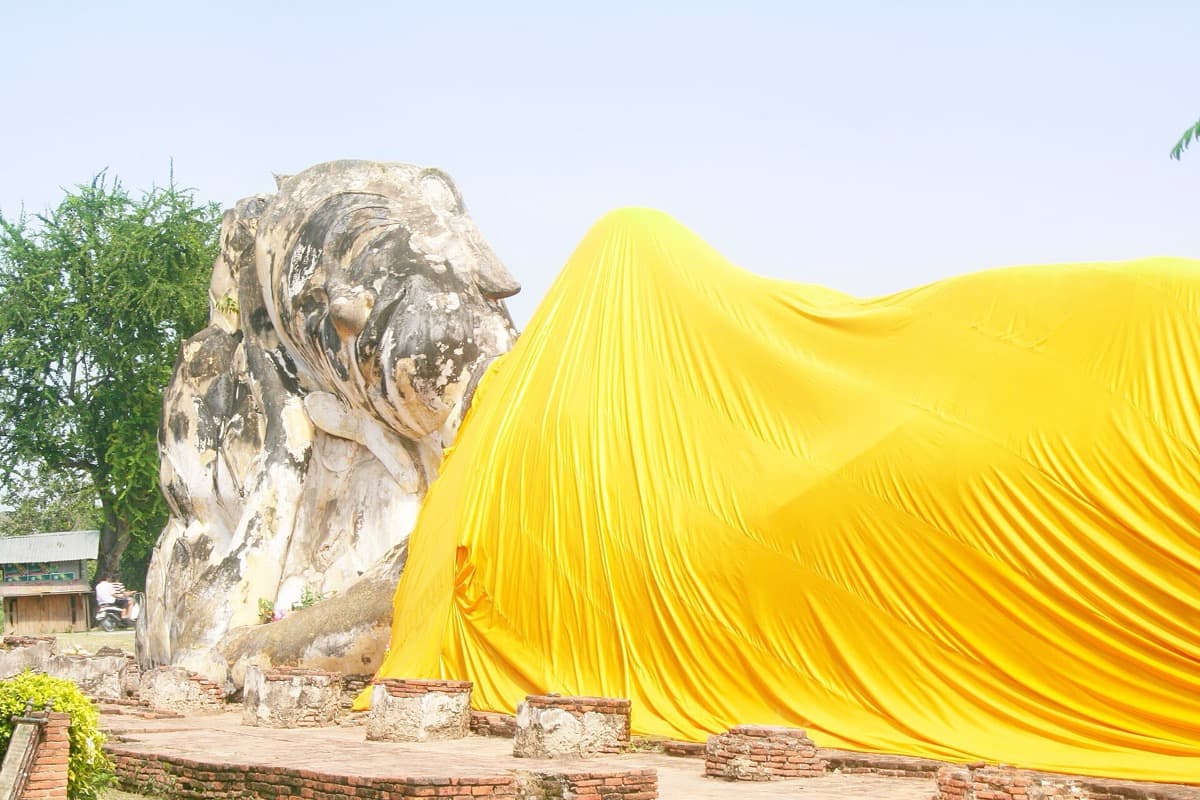
Wat Lokayasutharam: The Reclining Giant
A roughly forty-metre reclining Buddha lying in the open air, a change of register from the vertical towers to horizontal repose.
- 4
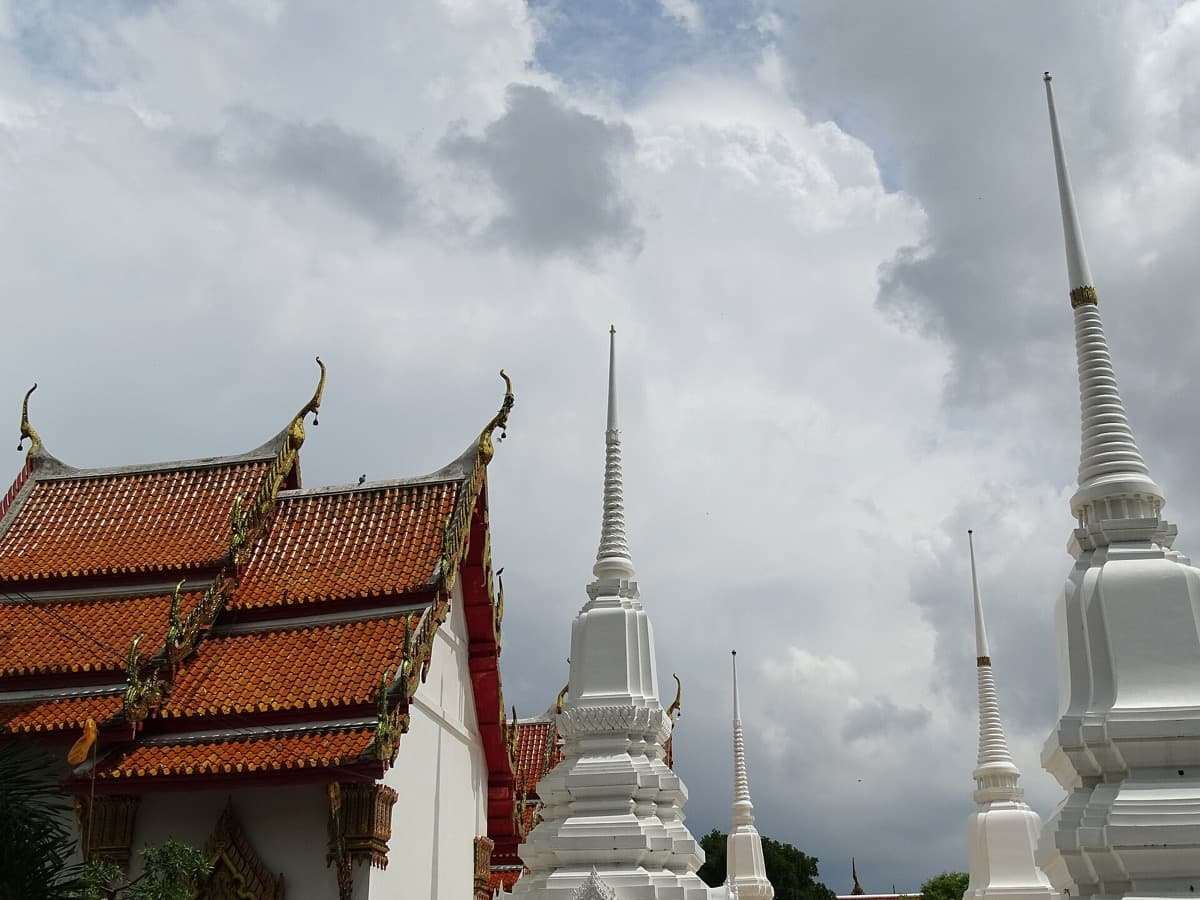
Wat Kasattrathirat: The Prang in Everyday Use
A still-active riverside monastery on the west bank whose thick, rounded prang shows the tower as a living, working shape.
- 5
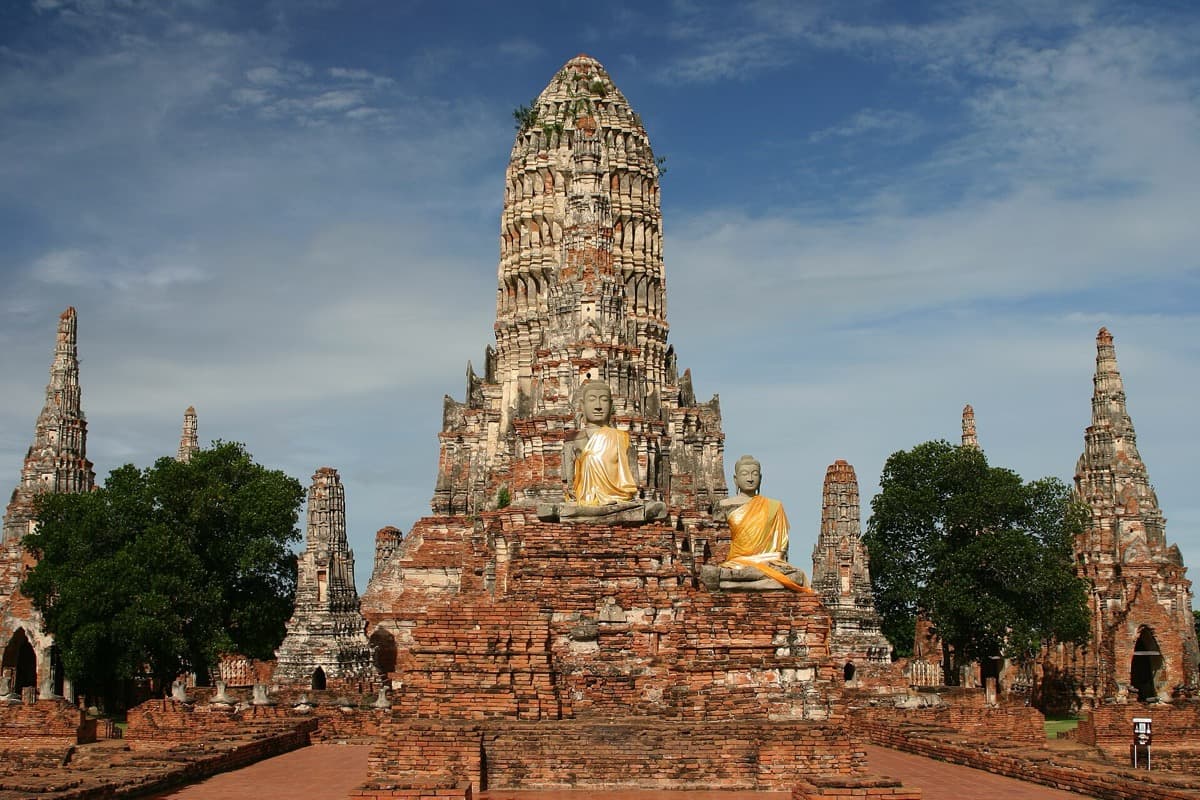
Wat Chaiwatthanaram: The Cosmos as a Plan
The flagship west-bank temple of King Prasat Thong, laid out as a diagram of the Buddhist universe with a central prang for Mount Meru.
- 6
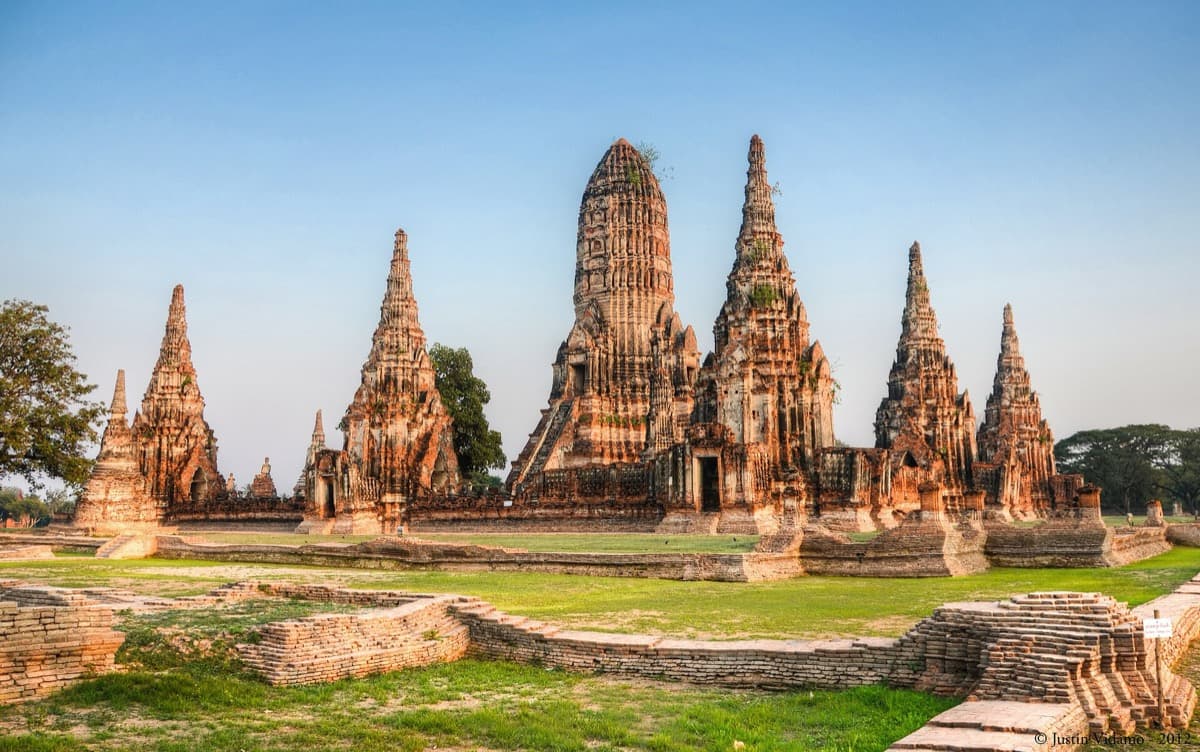
Wat Chaiwatthanaram Riverside: The Silhouette Resolves
The temple's own river frontage on the west bank, where the whole cosmological plan reads as one silhouette against the Chao Phraya at golden hour.
Details
Best Time to Visit
Late afternoon into golden hour is ideal, so that you reach Wat Chaiwatthanaram and its riverbank as the sun drops and lights the western faces of the towers. If you prefer cooler air and thinner crowds, start in the early morning instead and simply return to the riverside at dusk. The dry, cooler months from roughly November through February are the most comfortable overall; the hot season from March to May is punishing at midday, and the monsoon months from June through October bring heavy afternoon downpours.
Pro Tips
- •Carry small cash in baht for temple entry: about twenty baht at Wat Na Phra Men and fifty baht at Wat Chaiwatthanaram, with the western island ruins and the riverside monastery generally free.
- •Time the walk so you reach the final riverside vantage at golden hour, the soft hour before sunset, when the low sun lights the western faces of the prangs and the river mirrors the silhouette.
- •Wear slip-on shoes, because you will remove them to enter the halls that still hold principal Buddha images, such as at Wat Na Phra Men.
- •Bring plenty of water and a hat: much of this walk, especially the reclining Buddha and the riverside temple, is fully exposed with almost no shade.
- •Plan the river crossing between the island and the west bank in advance, whether by bridge, local boat, or a short ride, since the Chao Phraya separates the last two stops from the first three.
- •Go slowly and skip freely: each stop stands on its own, so if the heat builds, rest in shade and rejoin the walk at whichever temple still pulls you.
Safety & Precautions
- •Central Thailand is hot and very humid for much of the year. Much of this route is unshaded brick and stone, so pace yourself, drink water constantly, and avoid the harsh midday hours if you can.
- •These are active places of worship. Dress modestly with shoulders and knees covered, remove your shoes before entering any hall that holds a Buddha image, never point your feet toward a Buddha, and never climb on the ruins or the reclining figure.
- •In the monsoon months the afternoon rain arrives hard and fast and the ground turns slick. Carry a light rain layer, watch your footing on wet brick and uneven stone, and be ready to shelter until a downpour passes.
- •The route crosses the Chao Phraya and touches roads with local traffic and tour vehicles. Cross with care, stay aware near the riverbank edges, which can be unfenced, and keep the strong tropical sun in mind by using shade, a hat, and sunscreen throughout.
Travel advisory: Exercise Normal Precautions (Level 1).
Gallery
Related Reading
Go deeper on what you'll see, hear, and walk through.
Overview
Ayutthaya Travel Guide: Days, Transport, Season, Safety, and Costs
5 min
Overview
Best Self-Guided Walking Tours in Ayutthaya (2026)
3 min
Overview
One Day in Ayutthaya: A Walkable Itinerary from Morning to Sunset
8 min
Thematic
The Burned Capital: How Ayutthaya's Ruins Read the World That Made Them
7 min
Companion
Reading Ayutthaya's Royal Skyline at Wat Chaiwatthanaram
7 min
Deep dive
Wat Lokayasutharam: Reading Ayutthaya's Reclining Buddha
7 min
Read
What to Eat in Ayutthaya: River Prawns, Boat Noodles, and Roti Sai Mai
7 min
Read the walk
The full story of Wat Chaiwatthanaram: The Architecture of Kings, in words. Prefer to listen? Play it narrated, from home or on location.
Introduction
This is a walk about shapes. For four centuries the royal builders of Ayutthaya, in central Thailand, worked with two towering forms until they became a kind of writing across the sky. One is the prang, a tall corn-cob tower that tapers toward heaven and borrows from Khmer temple building. The other is the chedi, a bell rising from a rounded base, an idea that traveled from Sri Lanka. Ayutthaya's genius was holding both, and letting each carry royal meaning. Over about six stops and roughly three to three and a half hours, covering about seven kilometres, so it rewards a slow pace or a bicycle including a river crossing, you will learn to read that grammar shape by shape. You will begin at the one temple in the city that the Burmese did not burn in the year seventeen sixty-seven, so you can study an intact roofline before you meet ruins. You will move down the western side of the island past a memorial bell-chedi and a giant reclining Buddha. Then you will cross the Chao Phraya river to a working monastery where the prang is a living, everyday shape, before arriving at the masterpiece where a central tower stands for the sacred Mount Meru at the center of the universe, ringed by smaller towers for the continents. The final vantage is the temple's own riverbank, where the whole composition resolves into a single silhouette against the water. Go at your own pace. Each stop stands on its own, so skip any that does not pull you. When you arrive at Wat Na Phra Men, begin with stop one.
1. Wat Na Phra Men: The Roofline That Survived
Start here, because almost nothing else in this city gives you an unbroken roofline. Wat Na Phra Men, the temple in front of the royal palace, sits across the moat on the north side of the island, and it is the one temple in the city of Ayutthaya that the Burmese did not destroy in the sack of the year seventeen sixty-seven. The reason is grimly practical. According to accounts gathered by the Fine Arts Department, the Burmese used this temple as a military headquarters, so it was spared the fire that leveled the rest. That is why you can stand here and study a complete building, the tiered roof, the tall windows, the whole silhouette a temple was meant to have, before the walk turns to ruins. Step inside and the principal image is a crowned bronze Buddha in full royal attire, seated in the earth-touching gesture that marks the moment of enlightenment, about six metres high with a lap roughly four point four metres wide. A king dressed as a king, a Buddha dressed as a monarch. In a side hall sits a very different figure, a green stone Buddha called Phra Khanthararaj, seated in the European fashion with legs pendant, carved in the older Dvaravati period and thought to be well over one thousand five hundred years old. Tradition credits the founding to a prince named In, around the year fifteen oh three, but the documentary evidence is thin, so treat that as legend rather than fact. Let the intact roof teach your eye. Everything after this you will read as fragments, and you will be able to complete them because you saw one whole.
2. Wat Worachettharam: The Bell in the Grammar
Here the grammar shows you its second word. Wat Worachettharam is a restored roofless ruin just west of where the royal palace once stood, and its chief feature is a large bell-shaped chedi, the rounded dome rising to a spire ringed with about twenty-five stone bands. This is the chedi idiom, a form whose ancestry runs back through Sri Lanka, and here it stands as a royal memorial rather than a cosmic diagram. Look at how different it is from the pointed prang the walk is building toward. The prang climbs like a spire; the chedi swells like a bell before it tapers, and above the bell you can still make out the square platform, the harmika, that crowns it. Around the central monument you can trace the footprints of sermon halls and an ordination hall and a scatter of smaller chedis. Now the honest part. A plaque from the Fine Arts Department attributes this temple to King Ekathotsarot, who is said to have built it in the year sixteen oh five in memory of his brother King Naresuan, who had died earlier that year. It is a moving story, a temple raised as an act of mourning. But the historians at ayutthaya-history dot com caution that this attribution is disputed and may actually belong to a different temple, so hold the memorial story lightly, as tradition rather than settled record. What is not in doubt is the shape. The bell and the spire are one of the two great forms Ayutthaya spoke in, and you will need both of them in your eye to read the temple where the whole language finally assembles.
3. Wat Lokayasutharam: The Reclining Giant
After two vertical shapes, the walk lies down. At Wat Lokayasutharam, on the western side of the island, an enormous reclining Buddha stretches out in the open air. It is called Phra Buddha Saiyat, built of brick and finished in stucco, and it depicts the Buddha in his final…
Full narration for this stop unlocks with the tour.
4. Wat Kasattrathirat: The Prang in Everyday Use
Cross the Chao Phraya to reach this one, because here the prang stops being a monument and becomes a working shape. Wat Kasattrathirat is a still-active monastery on the west bank of the river, off the city island, standing at the edge of a broad field near the masterpiece you…
Full narration for this stop unlocks with the tour.
5. Wat Chaiwatthanaram: The Cosmos as a Plan
This is where the whole language assembles into a single sentence. Wat Chaiwatthanaram was built in the year sixteen thirty by King Prasat Thong as the first temple of his reign, raised on this west-bank site connected to his mother's former residence, part memorial and part…
Full narration for this stop unlocks with the tour.
6. Wat Chaiwatthanaram Riverside: The Silhouette Resolves
End at the water, on the temple's own riverbank. Wat Chaiwatthanaram faces west and stands on the west bank of the Chao Phraya, so the famous view is not something you cross the river to find. It is read right here, from the temple's own river frontage, looking back at the…
Full narration for this stop unlocks with the tour.