Zagreb keeps one medieval town gate, and it is not a ruin or a museum piece but a working shrine where candles burn all day to a painting that people believe survived a fire. The Stone Gate, in Croatian the Kamenita vrata, is the last of the gates that once controlled entry to Gradec, the free town on the hill that became half of modern Zagreb. To stand inside its vaulted passage is to stand in the single spot where the medieval defensive city and the living devotional city touch. Everything else on the hill has changed function. This gate never stopped being used, first as a door in a wall, then as an altar in a thoroughfare.
What the gate actually is
Gradec was chartered as a free royal town in twelve forty-two, when King Bela the Fourth granted it self-government and ordered it to raise walls and towers. That building campaign ran through the next two decades and produced a defensive ring: watchtowers, ramparts, and a set of gates that could be shut at night. The Lotrscak tower at the other end of the walk belongs to the same push. So does this gate. Of all the openings that once pierced the wall of the free town, the Kamenita vrata is the only one still standing. The others are gone, absorbed into later building or demolished as the town spread down the hill and lost its need for defenses.
That single fact is worth holding onto as you walk through. This is not a reconstruction or a picturesque quotation of a gate. It is the genuine surviving fabric of the medieval circuit, a real passage through what was once a real wall. The word vrata simply means gate, and kamenita means stone, so the name is plain and old: the stone gate, as opposed to whatever wooden or lesser gates once stood elsewhere on the wall.
The fire and the painting
Hear a stop from this walk
St Mark's Church: The Roof That Flies the Kingdom
The reason the gate became a shrine rather than just a preserved arch is a fire. On the night of the thirtieth to thirty-first of May in seventeen thirty-one, a great fire broke out in the Upper Town, swept through Gradec, and spread across the ravine to the neighbouring hill of the clergy. Fires were the recurring catastrophe of these tight wooden hilltowns, and this one was among the worst.
According to tradition, when people searched the burnt ruins some days later, they found a painting of the Virgin Mary and the Christ Child lying undamaged in the ashes, with only its wooden frame burned away. The image itself is the work of an unknown seventeenth-century painter. It is honest to call the survival tradition rather than documented fact, and the tour treats it that way. What matters historically is not whether the flames spared the panel by miracle or by chance, but what the city did next. A devout widow had a small altar built beneath the arch of the gate so that citizens could venerate the image, and the painting was set into the gate itself. It has stayed there ever since, protected behind an ornate Baroque wrought-iron grille that dates from the reconstruction of the gate in the decades after the fire.
That is the one thing to understand standing in front of it. The Stone Gate is a place where a disaster was converted into devotion, and the conversion became permanent. Our Lady of the Stone Gate is honoured as a patron of the city, and the gate is one of the most visited devotional sites in Zagreb.
Standing inside it
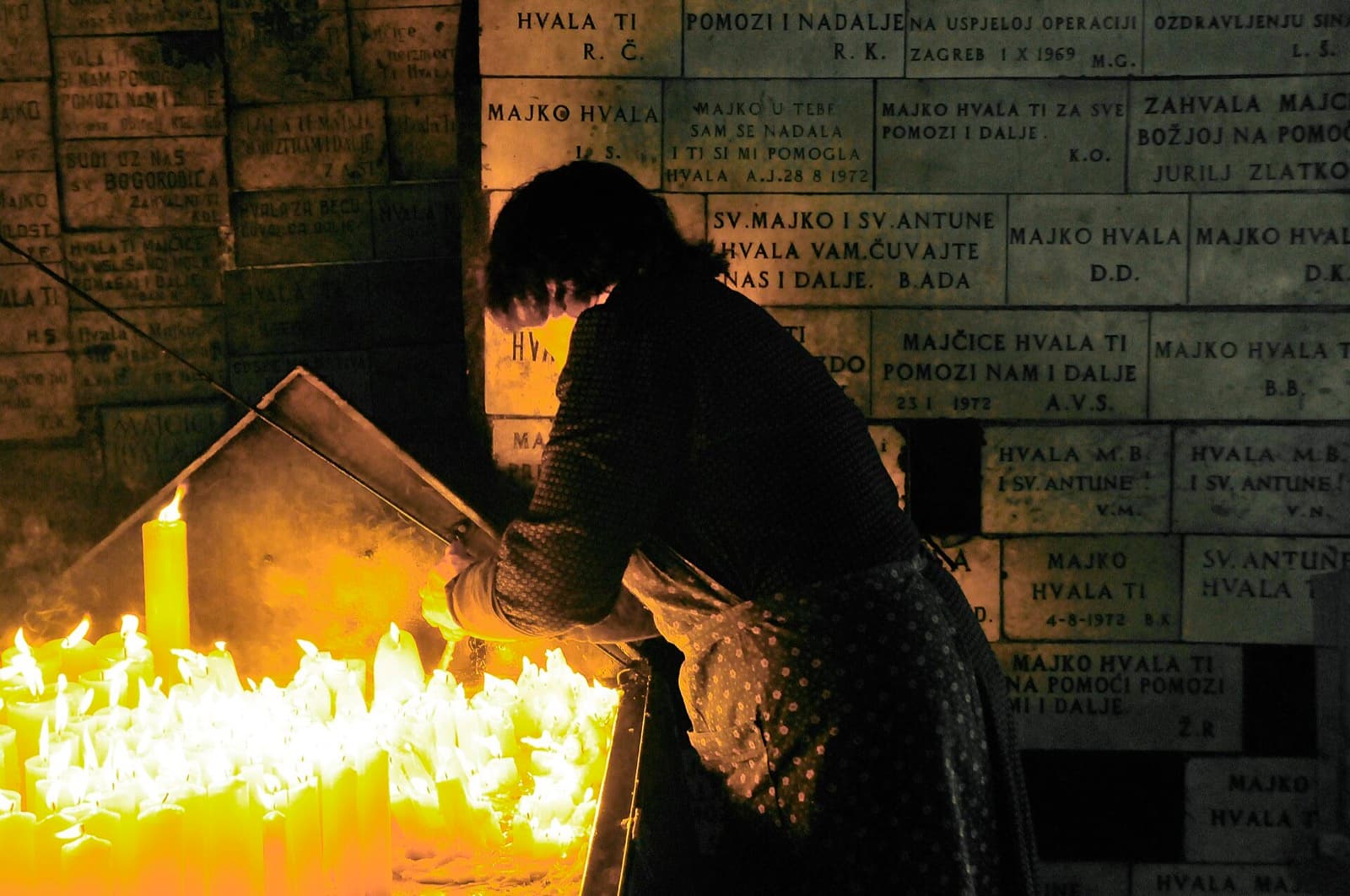
The passage today holds benches, banks of candles, and marble plaques carved with prayers of thanks, many of them a single word: hvala, thank you, or the Croatian and Latin abbreviations that mean the same. People come on their way through, light a candle, sit for a moment, and move on. Some kneel. The gate is not cordoned off from ordinary use, so cars and pedestrians still pass through the same arch where someone is praying at the altar. That collision of the everyday and the sacred is the whole character of the place.
For a visitor this asks for a particular kind of behaviour. Move through quietly. Keep your voice down near the altar and put the camera away there, because this is an active shrine and the people at the benches have genuinely come to pray, not to be photographed. You can look, you can light a candle yourself, you can read the plaques, but the register of the space is closer to a chapel than a monument.
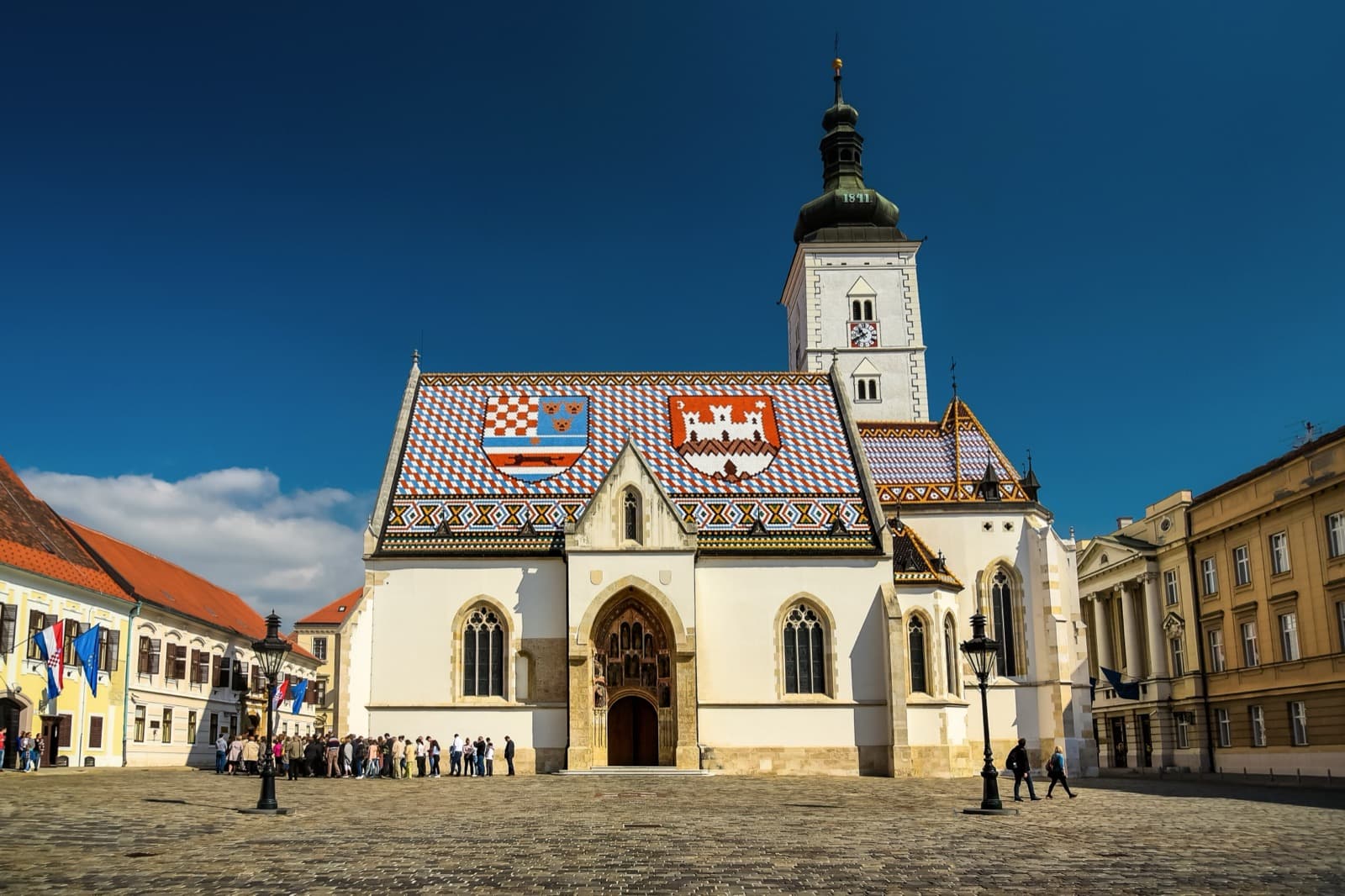
The gate sits on the natural route between the political square of the hill and its churches, which is why the tour reaches it fourth of seven stops, at the turn of the walk. You come to it after Saint Mark's Church with its heraldic roof and Saint Mark's Square with its parliament, and you leave it toward the white Baroque of Saint Catherine's. Placed there, the gate reads as the hinge: the point where the origin story of a chartered, walled, self-governing town folds into the living faith of the city that grew out of it.
Walk it yourself
The Stone Gate rewards a slow visit far more than a quick photograph, and it makes most sense inside the full arc of the hill it defended. The self-guided zagreb-upper-town-gradec audio tour walks Gradec end to end in about an hour and a half over roughly one kilometre, mostly flat along the top of the hill, and it lets you take the stops in your own order and linger at the gate as long as you like. You will arrive at the Kamenita vrata already carrying the context that makes it legible: the twelve forty-two charter, the vanished walls, the fire of seventeen thirty-one, and the widow who built the altar.
For the wider set of routes across the city, including the cathedral hill of Kaptol and the grand nineteenth-century Lower Town, see the full list of Zagreb walking tours. But if you have time for one quiet stop in the Upper Town, make it this gate, and give it the few unhurried minutes it asks for.
Sources
- Stone Gate, Wikipedia. Encyclopedia entry covering the Kamenita vrata as Gradec's only surviving medieval gate, the seventeen thirty-one fire, and the shrine to the Virgin.
- Croatian Parliament (Sabor), official history pages. Context on Gradec's charter era and the political geography of the Upper Town.
- Zagreb Excursions, Stone Gate (Kamenita vrata) attraction page. Notes the seventeen thirty-one fire and the surviving painting attributed to an unknown seventeenth-century artist.
- Infozagreb, official Zagreb tourist board. Background on Upper Town monuments and devotional sites including Our Lady of the Stone Gate.
Ready to experience it?
Upper Town: The Hill of Saint Mark
90 min · 1 km · moderate
More from Zagreb
Explore more at your own pace.
One Day in Zagreb: A Walkable Morning-to-Evening Itinerary
Two Hills and a Horseshoe: How Zagreb Became a City
Dolac Market and the Seam That Made Zagreb One City
Zagreb Cathedral: The Twin-Spired Church That Keeps Rebuilding Itself
Zagreb's Botanical Garden: The Living Corner of the Green Horseshoe