Upper Town: The Hill of Saint Mark
90 min · 1 km · moderate
Zagreb began as two rival hill-towns divided by a single narrow stream, and the whole city is still legible as that old split resolved and then answered. On one rise sat Gradec, the free town of merchants and craftsmen, crowned by Saint Mark's tiled roof. On the other sat Kaptol, the bishop's town of canons and the cathedral. Between them ran the Medvescak creek, a border that separated the two towns for centuries and sometimes turned the quarrel to blood. Below the hills, nineteenth-century Habsburg planners laid out a brand-new Lower Town on a grid and threaded a U-shaped chain of leafy squares through it, the Green Horseshoe, a statement that this young provincial capital had arrived among European cities. Read the three walks in order and you read the making of Zagreb: the proud free hill, the seam where two towns became one, and the planned district that announced the result to Europe.
The free hill of Gradec
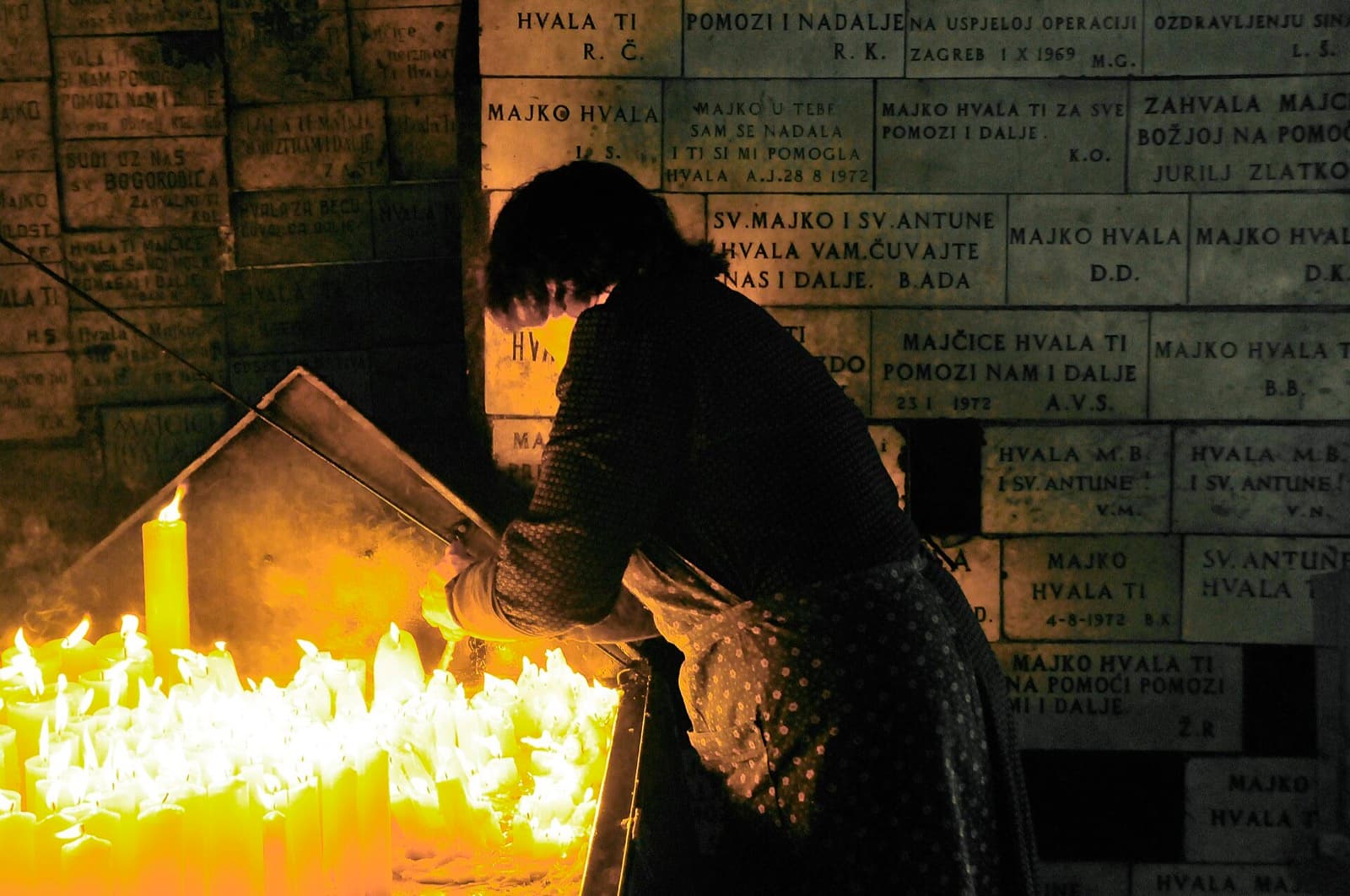
Start on the older and prouder of the two hilltop towns. Gradec was born as a self-governing place: in twelve forty-two, King Bela the Fourth granted it a royal charter that made it a free town and obliged it to raise defensive walls and towers, work finished around twelve sixty-six. The Hill of Saint Mark walk reads that grammar of independence stop by stop. The thirteenth-century Lotrscak tower guarded the southern gate of the town wall, and its cannon has been fired from the tower every day at noon since the first of January eighteen seventy-seven, originally so the city's bell-ringers would have one exact midday signal. The Stone Gate, the Kamenita vrata, is the only preserved medieval town gate of Gradec, the last survivor of a walled free town, now a living shrine where candles burn to a painting of the Virgin that tradition says was found undamaged in the ashes of a great fire in seventeen thirty-one.
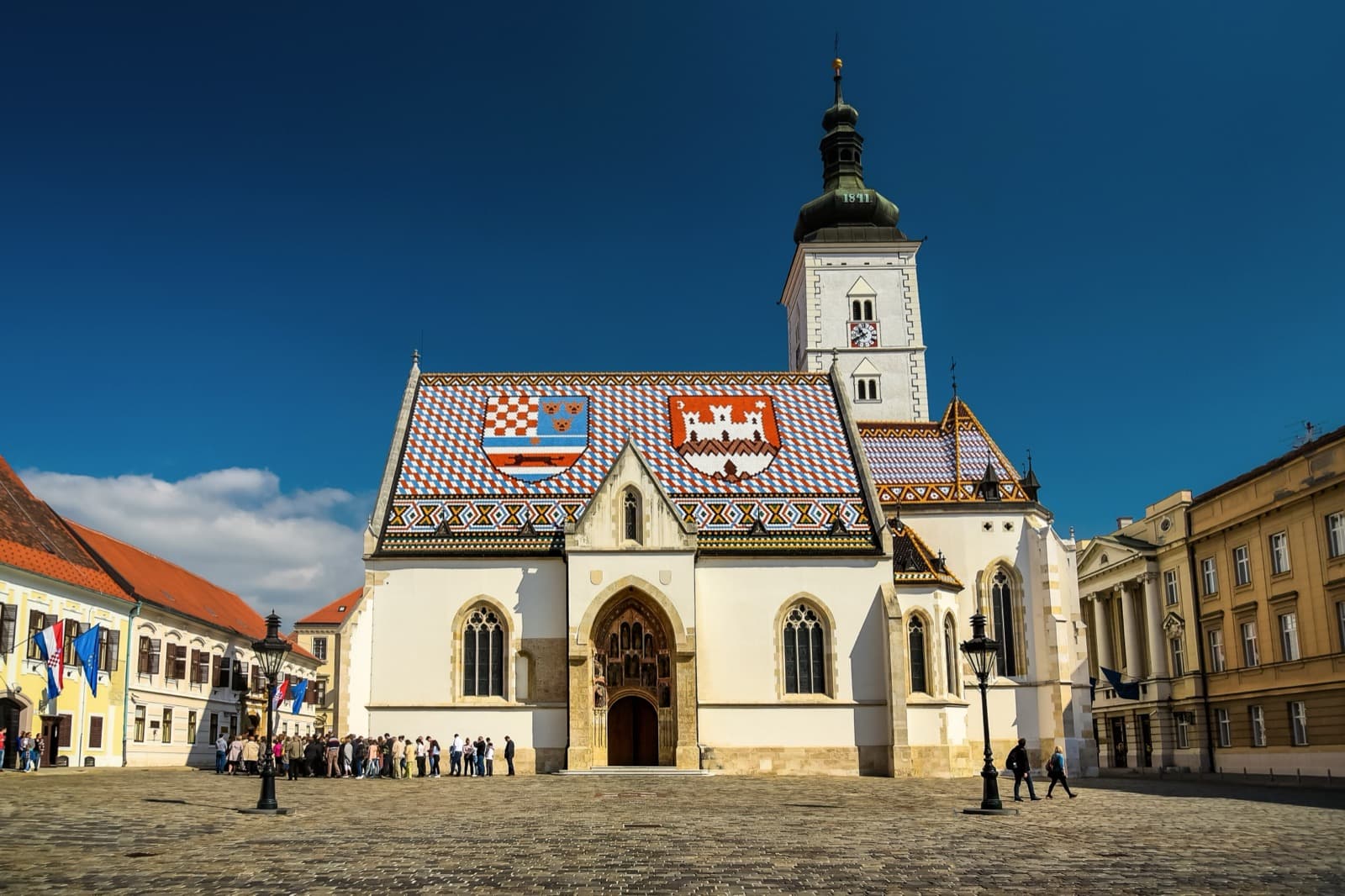
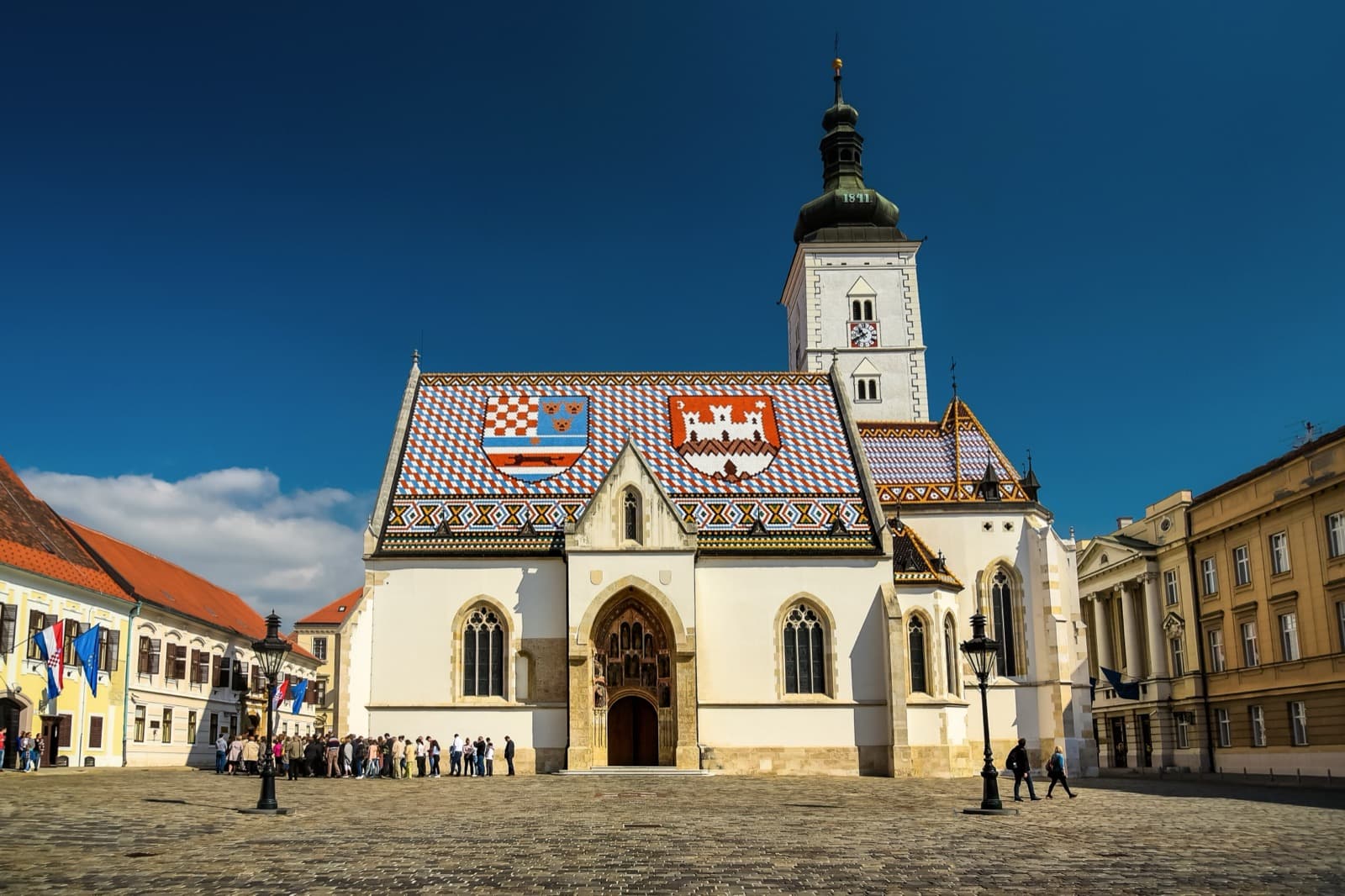
The hill's most photographed image says the same thing in tile. Saint Mark's is the medieval parish church of Gradec, but the roof everyone carries home was laid during a neo-Gothic restoration in the eighteen seventies and eighties, led by the Viennese restorer Friedrich Schmidt with his collaborator Hermann Bolle. It flies two coats of arms: on the left the medieval Triune Kingdom of Croatia, Slavonia and Dalmatia, on the right the white castle of the City of Zagreb. The roof flies, quite literally, both the town and the kingdom. A few paces away, Saint Mark's square concentrates the machinery of a whole nation on ground a charter freed almost eight centuries ago. Parliament, the Sabor, has met on this site since seventeen thirty-seven; the Banski dvori, named for the ban, the historic viceroy of Croatia, now house the government; and the Constitutional Court sits nearby. The decisions to leave Austria-Hungary in nineteen eighteen and Yugoslavia in nineteen ninety-one were both taken on this one small square. The walk ends on the Strossmayer promenade, along the line of Gradec's old ramparts, where the rampart built to keep the world out is now the town's favourite place to sit and look over what it became.
The seam where two towns joined
Hear a stop from this walk
St Mark's Church: The Roof That Flies the Kingdom
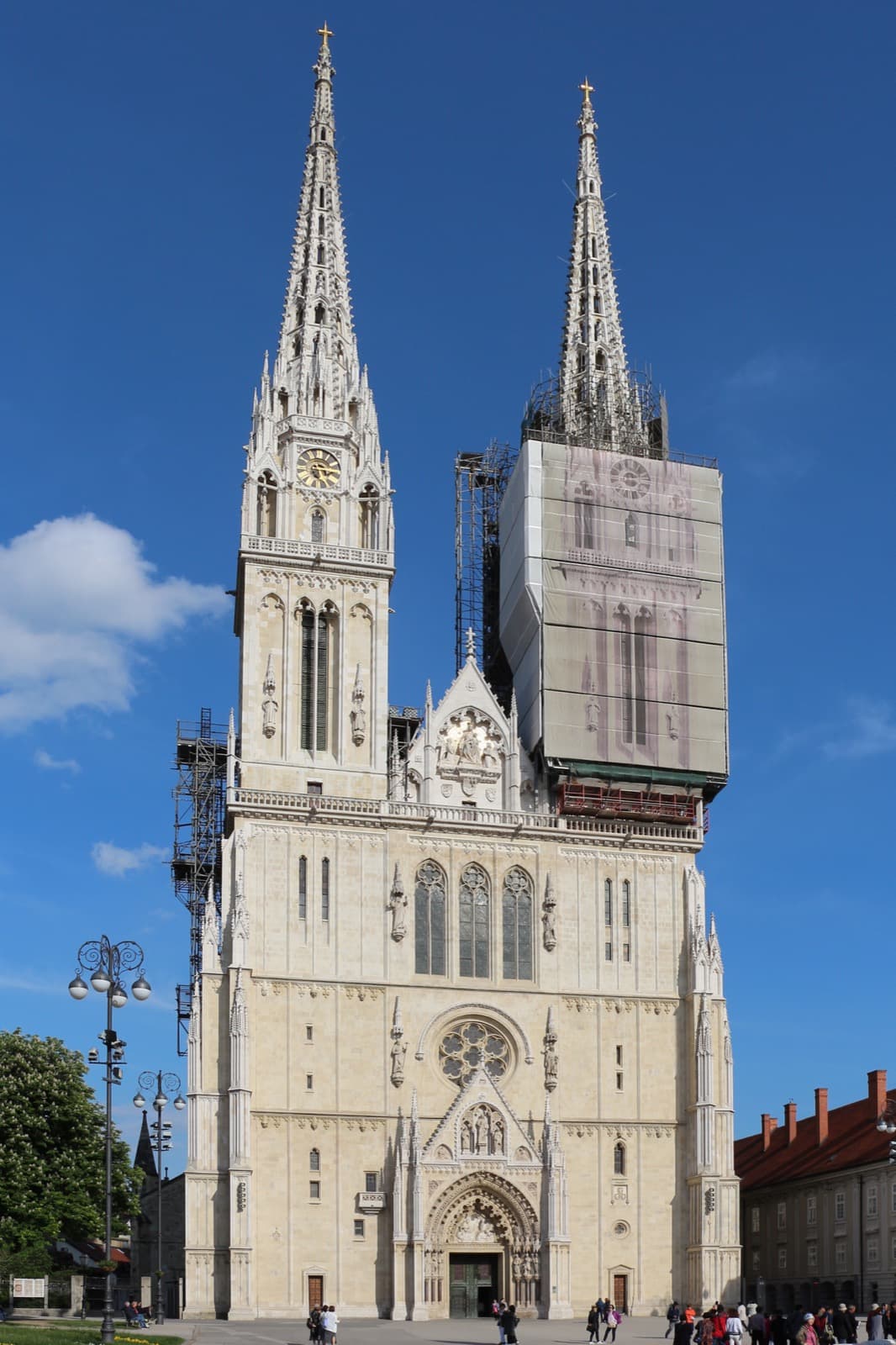
The second walk explains why any of this needed resolving. The Kaptol and Dolac walk follows the exact seam between merchant Gradec and the bishop's Kaptol, and much of the drama is buried in plain sight. Kaptol was never about merchants or mills. Its name comes from the Latin capitulum, the body of canons who governed the church-town, and the Diocese of Zagreb was established here in ten ninety-four by King Ladislaus. On this side of the creek people answered to the bishop and lived by the calendar of the church. Its climax is Zagreb Cathedral, the tallest sacral building in Croatia, whose twin neo-Gothic spires climb to about one hundred and eight metres each. That form is not medieval: after an earthquake severely damaged the church on the ninth of November eighteen eighty, the architect Hermann Bolle rebuilt it between eighteen eighty and nineteen oh two, which is when it received the twin spires. In another quake on the twenty-second of March twenty twenty, the tip of the southern spire broke off and the northern spire was taken down that April, and reconstruction continues.
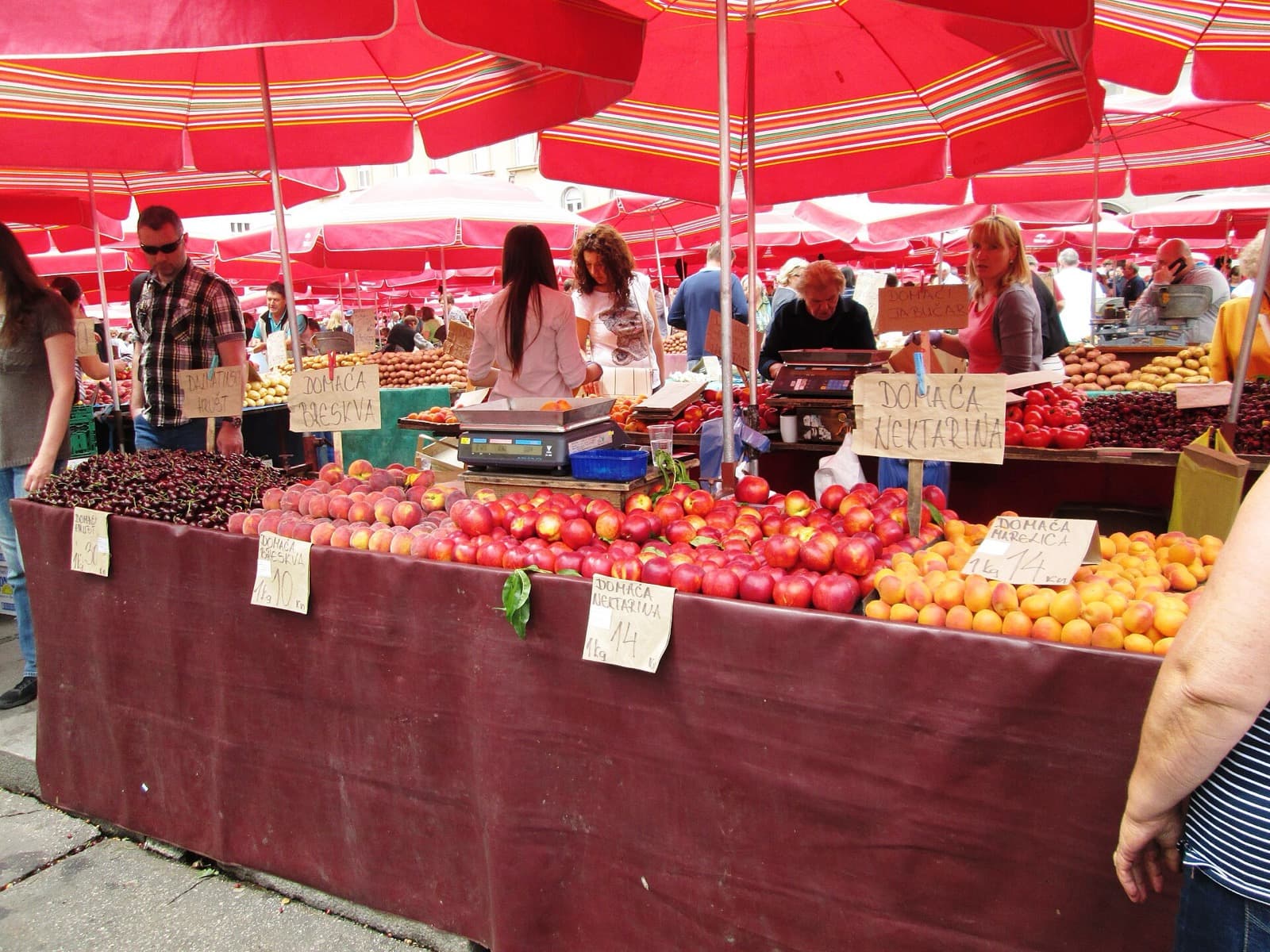
Between the two towns ran the Medvescak, and the modern city sits on top of it. Ban Jelacic Square, the great central square, spreads across the flat ground between the two hills, on the site of the old shared marketplace spring, the Mandusevac, which was paved over in eighteen ninety-eight and rediscovered in nineteen eighty-six. Just above it, Dolac market opened on the first of September nineteen thirty on a raised terrace right on the seam between the two old hills, its field of red parasols standing on the very boundary. Tkalciceva street runs directly over the covered bed of the Medvescak, the creek that formed the frontier and once powered the mills and tanneries that made Zagreb prosperous; a peace treaty of thirteen ninety-two even forbade building new watermills on the shared border, leaving only two standing. The bluntest reminder is the lane called Krvavi most, the Bloody Bridge, named for a wooden bridge that crossed the creek at the frontier and for a rivalry that recurred from the fourteenth century until peace in the eighteenth. The earliest documented mention of the name is tied to a battle recorded on the seventeenth of November sixteen sixty-seven. Two proud towns, two ways of life, one narrow stream between them, now stitched into a single city.
The planned city that announced the result
The third walk is Zagreb's answer to the question of whether a city grown from two feuding hills could belong among European capitals. In the late nineteenth century the young capital, boxed in below its two old hills, laid out the Lower Town, the Donji Grad, on a grid and threaded through it a U-shaped chain of leafy squares. People call it the Green Horseshoe, or the Lenuci Horseshoe, after the urbanist Milan Lenuci, who conceived the scheme beginning in eighteen eighty-two, spurred on by rebuilding after the eighteen eighty earthquake. The Green Horseshoe walk reads that ambition park by park.
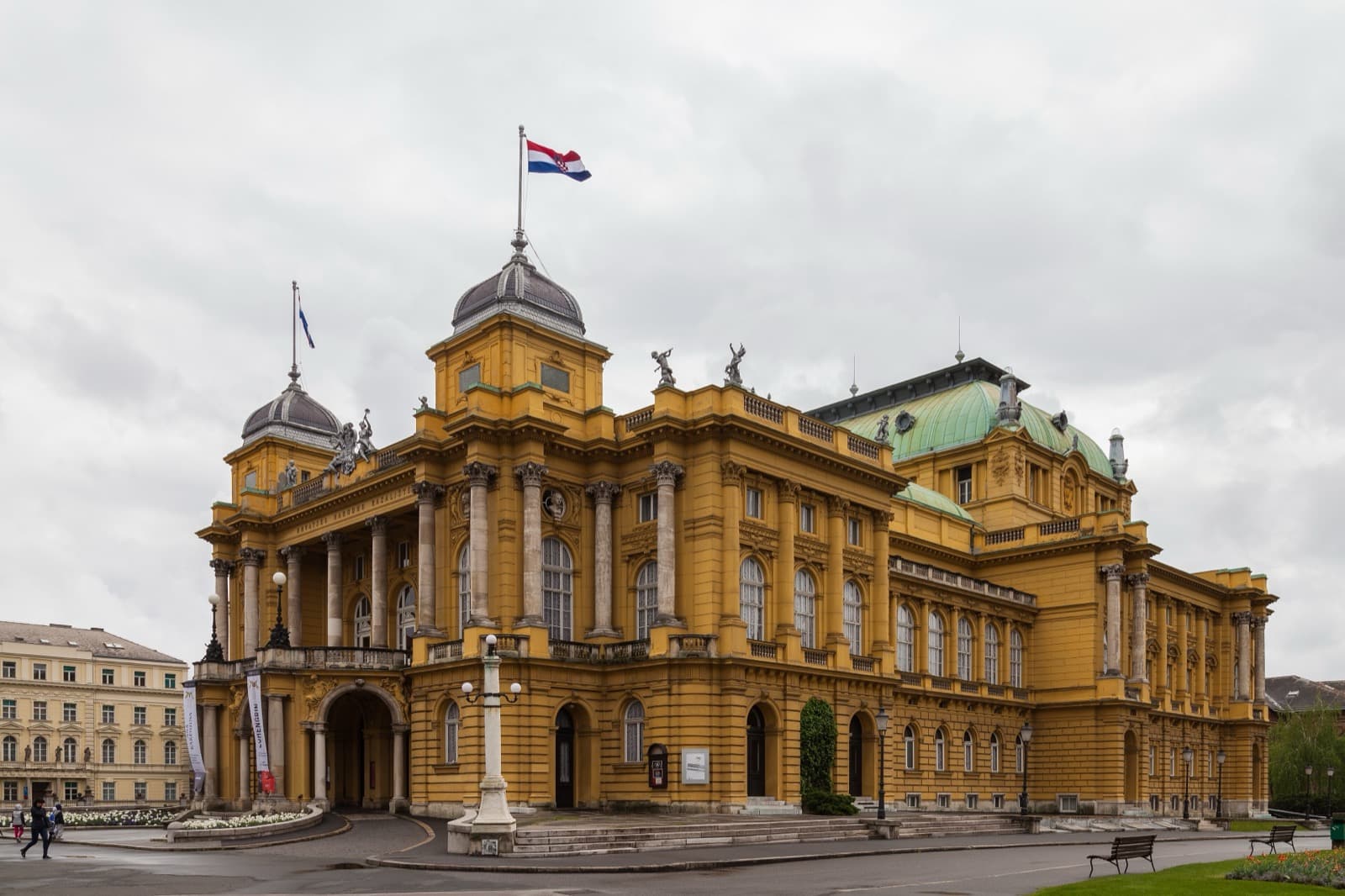
Zrinjevac, the first and grandest square, opened in eighteen seventy-three on what had been a cattle-market field, its avenue of plane trees ringed by academies, museums, and courts, setting the pattern the whole Horseshoe would follow. At its southern end, the Croatian Academy of Sciences and Arts grew from the patronage of Bishop Josip Juraj Strossmayer, who endowed the institution and, in eighteen sixty-eight, decided to give his collection of Old Masters to the Croatian people; the building also safeguards the Baska tablet, dated to around eleven hundred and two, the oldest known Glagolitic inscription. The Art Pavilion embodies the whole idea of importing culture: its iron frame was first assembled in Budapest for the eighteen ninety-six Millennium Exhibition, then dismantled and carried to Zagreb by train. King Tomislav Square aligns a bronze king on horseback with the facade of the Main Railway Station, inaugurated on the eighteenth of August eighteen ninety-two, so that a traveler stepping off the train met ambition first. The Croatian National Theatre, designed by the Viennese firm Fellner and Helmer, opened during Emperor Franz Joseph's eighteen ninety-five visit, with Ivan Mestrovic's bronze fountain the Well of Life at its feet. The Botanical Garden of the University of Zagreb, founded in eighteen eighty-nine, is the green hinge of the U, and the Mimara Museum closes the western arm. Walk the horseshoe whole and you see a city that decided ambition was something you could lay out on a grid, and then did.
Taken together, the three walks tell one story: two rival hill-towns, the stream that divided them, and the planned lower city that proved they had become a capital. For the full set of routes, start at Zagreb walking tours.
Sources
- Zagreb en.json tour transcripts for The Hill of Saint Mark (Gradec, Upper Town), fact-audited stop content.
- Zagreb en.json tour transcripts for The Other Hill (Kaptol and Dolac), fact-audited stop content.
- Zagreb en.json tour transcripts for The Green Horseshoe (Donji Grad), fact-audited stop content.
- City of Zagreb tourist board (Zagreb Tourist Board), Upper Town, Kaptol, and Lower Town heritage overviews.
- Croatian Academy of Sciences and Arts and Zagreb Cathedral institutional histories.
Frequently asked questions
- Why is Zagreb said to have been built on two hills?
- Zagreb grew from two separate medieval towns on neighboring rises. Gradec was a free town of merchants and craftsmen, made self-governing by a royal charter from King Bela the Fourth in twelve forty-two. Kaptol was the bishop's town of cathedral canons, where the Diocese of Zagreb was established in ten ninety-four. A stream called the Medvescak ran between them as a border, and the two towns feuded for centuries before uniting into one city.
- What is the Green Horseshoe in Zagreb?
- The Green Horseshoe, also called the Lenuci Horseshoe, is a U-shaped chain of tree-lined squares laid out through Zagreb's Lower Town in the late nineteenth century. It is named for the urbanist Milan Lenuci, who conceived the scheme beginning in eighteen eighty-two. Its squares are ringed with academies, museums, a theatre, a railway station, and a botanical garden, and it was built to prove the young capital belonged among European cities.
- Why is Saint Mark's Church roof so famous?
- Saint Mark's is the medieval parish church of the Gradec upper town, but its colorful tiled roof was actually laid during a neo-Gothic restoration in the eighteen seventies and eighties, led by Friedrich Schmidt with Hermann Bolle. The tiles carry two coats of arms: the medieval Triune Kingdom of Croatia, Slavonia and Dalmatia on the left, and the white castle of the City of Zagreb on the right.
- What is buried under Tkalciceva street?
- Tkalciceva street runs directly over the covered bed of the Medvescak creek, the stream that once separated the towns of Gradec and Kaptol. The creek powered watermills and tanneries central to Zagreb's medieval economy and was so contested that a treaty of thirteen ninety-two banned new mills along the border. The stream was covered over around eighteen ninety-eight, and the street on top was named for the historian Ivan Tkalcic in nineteen thirteen.
- How much time do the three Zagreb walks take?
- The Hill of Saint Mark walk across Gradec has seven stops over about one kilometre and takes roughly an hour and a half. The Kaptol and Dolac walk has seven stops over a little more than one kilometre, about ninety minutes to an hour and forty-five. The Green Horseshoe walk has seven stops over a little more than three kilometres of flat walking and takes about two hours at a gentle pace.
Ready to experience it?
Upper Town: The Hill of Saint Mark
90 min · 1 km · moderate
More from Zagreb
Explore more at your own pace.
One Day in Zagreb: A Walkable Morning-to-Evening Itinerary
Dolac Market and the Seam That Made Zagreb One City
St Mark's Church in Zagreb: The Roof That Flies a Whole Kingdom
Zagreb Cathedral: The Twin-Spired Church That Keeps Rebuilding Itself
Zagreb's Botanical Garden: The Living Corner of the Green Horseshoe