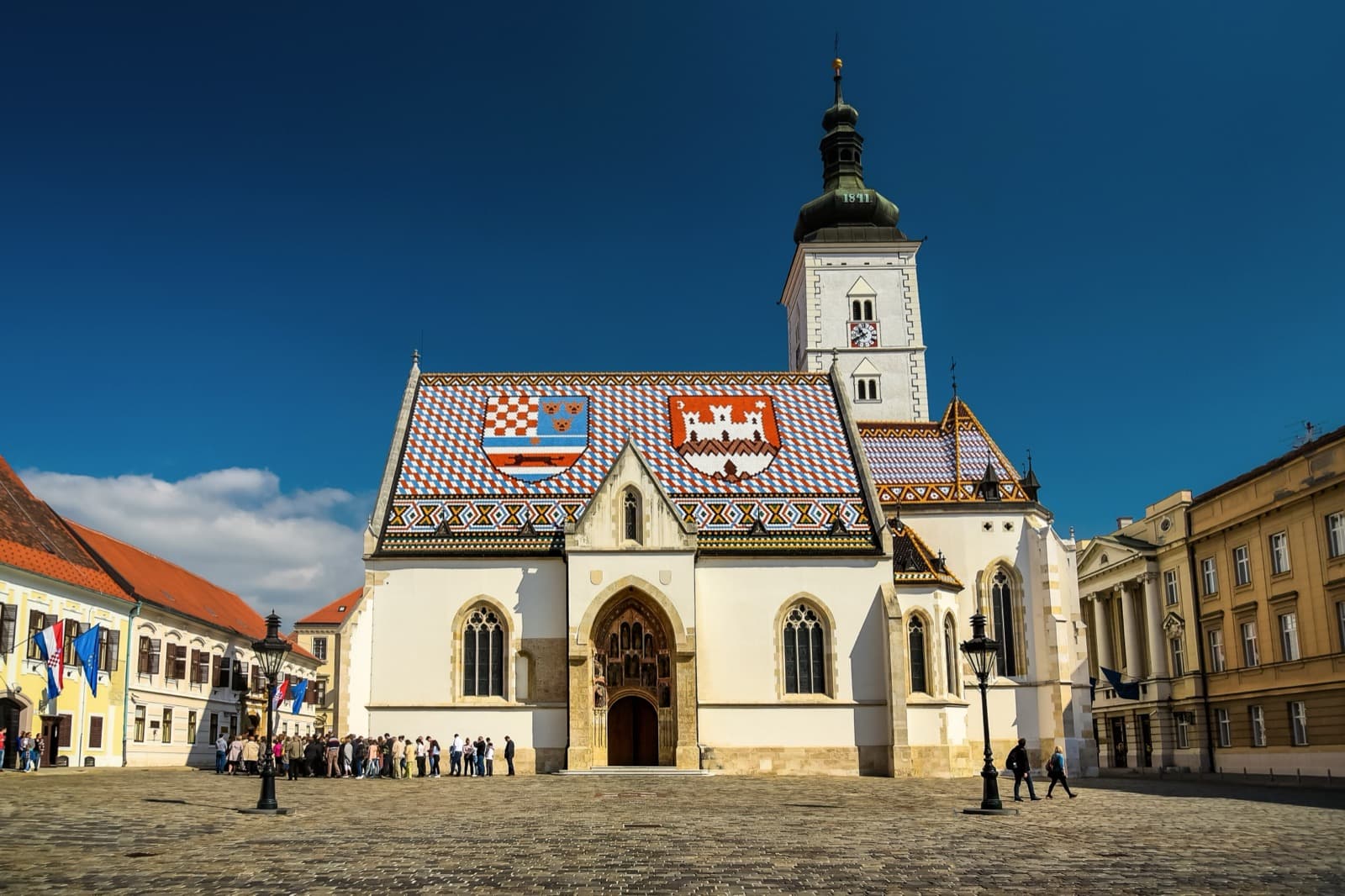
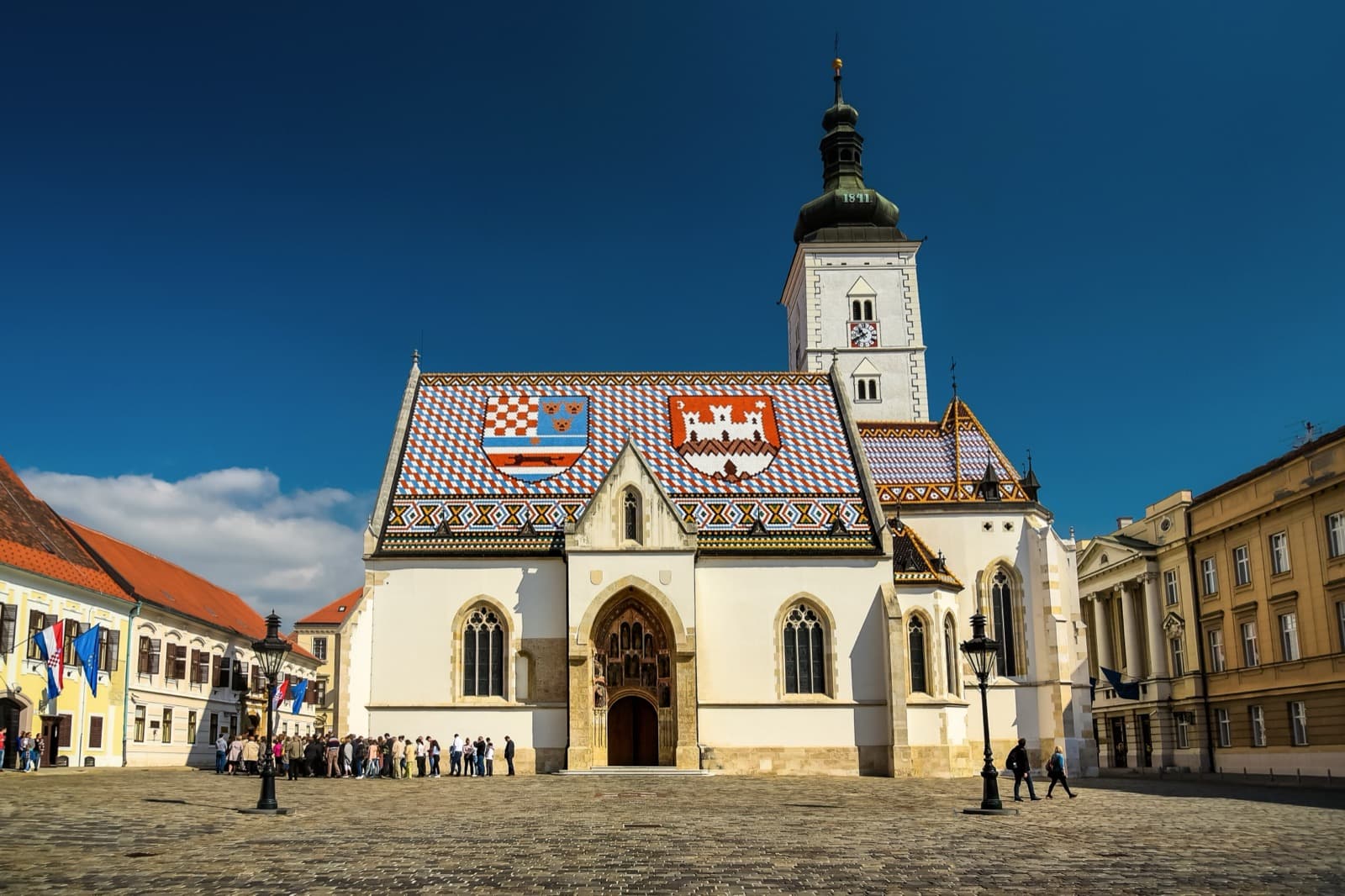
The tiled roof everyone photographs on St Mark's Church in Zagreb flies two coats of arms, and reading them is the fastest way to understand why this small parish church became the emblem of a whole city and a whole kingdom. The roof is not medieval. Those bright glazed tiles were laid during a neo-Gothic restoration in the eighteen seventies and eighties, led by the Viennese restorer Friedrich Schmidt with his collaborator Hermann Bolle. What looks like a survival from the Middle Ages is in fact a nineteenth-century statement made in ceramic, and it is the perfect way into the walk across Gradec, the older and prouder of the two hilltop towns that grew together into Zagreb.
A church older than its famous roof
Strip the tiles away in your mind and the building underneath is genuinely old. St Mark's began in the thirteenth century and was rebuilt in the second half of the fourteenth into a late-Gothic church of three naves. It served as the parish church of Gradec, the free town whose story runs through every stop on this walk. In twelve forty-two a royal charter from King Bela the Fourth made Gradec a self-governing town and obliged it to raise walls and towers, work that took about twenty years and finished around twelve sixty-six. St Mark's is the spiritual center of the community that charter created.
Below the roofline, look for the Gothic south portal, which survived from the earlier church. It holds fifteen carved figures set in eleven niches: among them Mary and the infant Jesus, Saint Mark with his lion, and the twelve apostles. It is described as the richest Gothic portal in southern Central Europe, and the sculpture is attributed to the Parler workshop of Prague in the late fourteenth century. Most visitors tilt their heads up at the tiles and never look at this doorway, which is a quieter and older achievement.
Reading the two coats of arms
Hear a stop from this walk
St Mark's Church: The Roof That Flies the Kingdom
Now the roof itself. Two heraldic shields sit in the glazed tilework, and each one tells you what this town wanted the world to know about it. On the left is the medieval combined coat of arms of the so-called Triune Kingdom: Croatia, Slavonia, and Dalmatia, three lands held under one crown. On the right is the arms of the City of Zagreb itself, a white castle on a red field. So the roof flies, quite literally, both the town and the kingdom at once. This was not decoration for its own sake. Laying national and civic heraldry into the roof of the Upper Town's parish church during a period of intense Croatian cultural assertion was a deliberate act, joining the emblem of the kingdom to the emblem of the free medieval city on a single sloping surface.
That is the argument the rest of the walk keeps making in different materials. This hill has always spoken in symbols of self-government, and St Mark's is where you learn to read them.
Why this stop opens the whole hill
St Mark's sits at the center of the Gradec plateau, and every other stop on the Zagreb walking tours route through the Upper Town clarifies something the church introduces. Just downhill is the Lotrscak tower, a thirteenth-century watchtower from the same first ring of defenses the charter set in motion. A cannon has been fired from it every day at exactly noon since the first of January eighteen seventy-seven, originally so the city's bell-ringers would have one exact midday signal. If you time your morning to end near the tower at midday, you will hear the boom that still keeps the town on schedule.
Step out of the church onto St Mark's Square, and the symbols turn into working government. Three institutions of state ring this modest hilltop square. The Sabor palace holds the Croatian parliament, which has met on this site since seventeen thirty-seven. Facing it, the Banski dvori, once the palace of the ban or viceroy, now house the government of Croatia and the office of the prime minister. The Constitutional Court sits nearby. Within a few dozen paces you have the legislature, the executive, and the highest court of an entire country. Two of the most consequential turns in modern Croatian history were decided here: the break from Austria-Hungary in nineteen eighteen and the departure from Yugoslavia in nineteen ninety-one. The picturesque roof you just admired and the machinery of a nation share the same few hundred square metres of paving.
Where the walk goes next
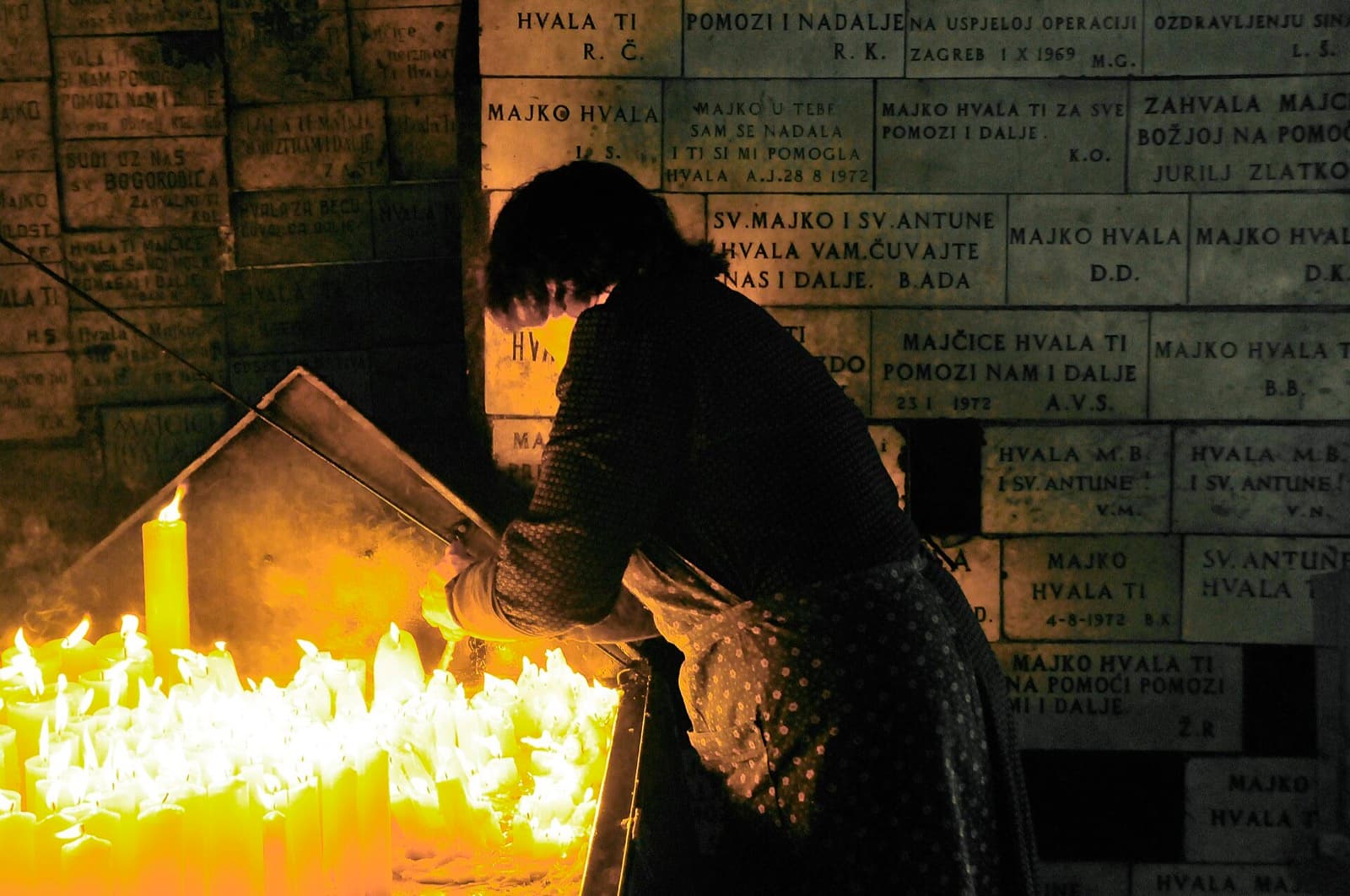
From the square the route bends to the Stone Gate, the Kamenita vrata, the only preserved medieval town gate of Gradec and the last of the free town's gates still standing. After a great fire on the night of the thirtieth to thirty-first of May in seventeen thirty-one, tradition holds that a painting of the Virgin and Child was found undamaged in the ashes, with only its wooden frame burned away. A widow had a small altar built beneath the arch, and the passage became a living shrine that still draws people to light candles and sit for a moment on their way through.
Then the walk turns to Baroque. St Catherine's Church, built by the Jesuits between sixteen twenty and sixteen thirty-two, holds the finest Baroque interior in the city under a ceiling of luxurious white stucco. Nearby the hill shows its range: the Klovicevi dvori gallery occupies a former eighteenth-century Jesuit monastery, while a few steps away the Museum of Broken Relationships, founded in twenty ten and winner of the Kenneth Hudson Award in twenty eleven, turns donated relics of ended love into one of Europe's most original collections. The walk resolves on the Strossmayer promenade along the line of the old ramparts, where an aluminium statue of the poet Antun Gustav Matos, placed by sculptor Ivan Kozaric in nineteen seventy-eight, sits on a bench above the red roofs of the Lower Town.
Walking it yourself
The whole loop is about one kilometre, mostly flat along the top of the hill, and takes roughly ninety minutes at an easy pace. You can view St Mark's roof and portal freely from the square. The interior is a working church that opens around Mass, so treat it accordingly if you happen to catch it open: modest dress, a lowered voice. Start late in the morning so you finish near the Lotrscak cannon at noon, and save the promenade for last. To see how this stop fits the rest of the Upper Town and the two other Zagreb tours, browse Zagreb and let the roof send you into the walk.
Sources
- St. Mark's Church, Zagreb (Wikipedia): church history, the eighteen seventies-eighties roof restoration by Schmidt and Bolle, and the two coats of arms.
- St. Mark's Square, Zagreb, and the Croatian Parliament Palace (Sabor official site): the parliament, government, and Constitutional Court around the square, and the nineteen eighteen and nineteen ninety-one decisions.
- Lotrscak Tower (Wikipedia): the thirteenth-century tower, the twelve forty-two charter of King Bela the Fourth, and the daily noon cannon since eighteen seventy-seven.
- Stone Gate (Wikipedia): Gradec's only surviving medieval gate and the seventeen thirty-one fire tradition behind its shrine.
- Museum of Broken Relationships (Wikipedia): its twenty ten founding and twenty eleven Kenneth Hudson Award.
Ready to experience it?
Upper Town: The Hill of Saint Mark
90 min · 1 km · moderate
More from Zagreb
Explore more at your own pace.
One Day in Zagreb: A Walkable Morning-to-Evening Itinerary
Two Hills and a Horseshoe: How Zagreb Became a City
Dolac Market and the Seam That Made Zagreb One City
Zagreb Cathedral: The Twin-Spired Church That Keeps Rebuilding Itself
Zagreb's Botanical Garden: The Living Corner of the Green Horseshoe