Laneways and Arcades: The Hidden City Inside the Grid
75 min · 2 km · easy
Melbourne's food is a coffee culture and a gold-rush immigrant kitchen served in the same few blocks: a flat white or a "magic" from a laneway espresso bar, dim sims and yum cha in a Chinatown born of the gold rush, a chicken parma at a pub, and a Four'N Twenty meat pie at the football. Most of these dishes were invented or shaped in Victoria, and you can eat the whole story on foot in the city centre, between the arcades of the Laneways and Arcades: The Hidden City Inside the Grid walk and the grand end of town on the Spring Street route. Here is what to order, where the tradition comes from, and how to ask for it like a local.
Start with coffee, because Melbourne did
Coffee is the first thing to order in Melbourne, and the city takes it more seriously than almost anywhere. The default is a flat white: espresso with steamed milk and a thin layer of microfoam, poured so the milk and crema sit level. The drink is traced to Australia and New Zealand in the 1980s, and Melbourne runs on it. The city's laneways, the same narrow service alleys the laneways walk threads through, made small, low-rent cafes viable, which is part of why espresso bars multiplied here.
If you want to order like a regular, ask for a "magic." The magic is a Melbourne invention: a double ristretto topped with steamed milk, served in a small cup of roughly 120 to 150 millilitres, about three-quarters the size of a flat white. It is often off-menu, so you simply ask the barista for one by name. Some cafes will know it instantly, others less so, which is part of the fun.
The culture behind the cup arrived with postwar migration. Between 1947 and 1961 the number of Italian-born residents in Victoria rose from around 8,300 to more than 91,000, and they brought espresso with them. Pellegrini's Espresso Bar on Bourke Street, opened in 1954 by brothers Leo and Vildo Pellegrini, was among the first Melbourne cafes to run an authentic Italian espresso machine, and it was added to the National Trust of Australia's register in 2014.
Dim sims and dumplings in Chinatown
Hear a stop from this walk
Federation Square: The Lid Over the Railway
The single most Melbourne thing to eat is the dim sim, and you eat it where it was born. The modern dim sim was developed in Melbourne's Chinatown in 1945 by entrepreneur William Chen Wing Young for his food processing company, Wing Lee. It is a large, meaty, thick-skinned dumpling, and the ordering ritual is a small local test: you decide steamed or fried. Steamed is softer and more traditional, fried is crisp-skinned and what many locals grab from a takeaway window. Both are correct. The bigger, rounder version you will see is called a "South Melbourne dim sim," named for the South Melbourne Market where that style originated.
Chinatown itself runs along the eastern end of Little Bourke Street and grew from the gold rush, as Chinese migrants arrived in significant numbers from 1853. The City of Melbourne calls it Australia's oldest Chinatown, and it is a core stop on the Laneways and Arcades tour. For a full meal, order yum cha, which means eating a spread of dim sum, dumplings, and small plates with tea, usually at lunch. Some Chinatown restaurants still push the classic trolleys around the room, so you point at the bamboo steamers you want as they pass. Others hand you a tablet or a paper checklist. Either way the move is the same: order a few dishes at a time, keep the tea topped up, and keep going until you are full.
The pub plate: chicken parma
For a sit-down dinner, the answer in a Melbourne pub is the chicken parma. Also spelled parmi or parmigiana, it is a crumbed, fried chicken cutlet topped with tomato sauce and melted cheese, often with ham, and served with chips and salad. Italian immigrants brought the dish to Australia, and it appeared here in the 1950s before becoming a fixture on casual pub and bistro menus.
The local ordering knowledge worth having: many Melbourne pubs run a "parma night," usually a weeknight, where a parma plus a drink comes as a discounted meal deal. If you are eating on a budget, ask whether the pub has a parma special that night. It is one of the cheapest good meals in the city.
The football pie
If you are anywhere near a match, order a meat pie. The hand-sized pastry filled with minced meat and gravy is standard football food, and the dominant brand is Four'N Twenty, which is the official pie of the Australian Football League. The Four'N Twenty story starts in 1947, when L.T. McClure was baking meat pies in Bendigo in regional Victoria, and the name comes from the nursery rhyme "Sing a Song of Sixpence." Generations of AFL crowds have eaten one as part of the ritual of the game.
Two more Victorian snacks belong on the list. The dim sim, already covered, is a takeaway staple. The Chiko Roll, a deep-fried savoury roll loosely inspired by the Chinese spring roll, was invented by Frank McEncroe, a boilermaker from Bendigo who catered at football matches; it first went on sale as the "Chicken Roll" and appeared at the Wagga Wagga Show in 1951. Neither the Chiko Roll nor the dim sim is fine dining. Both are honest, cheap, and part of the city's food identity.
Afternoon tea in the arcades
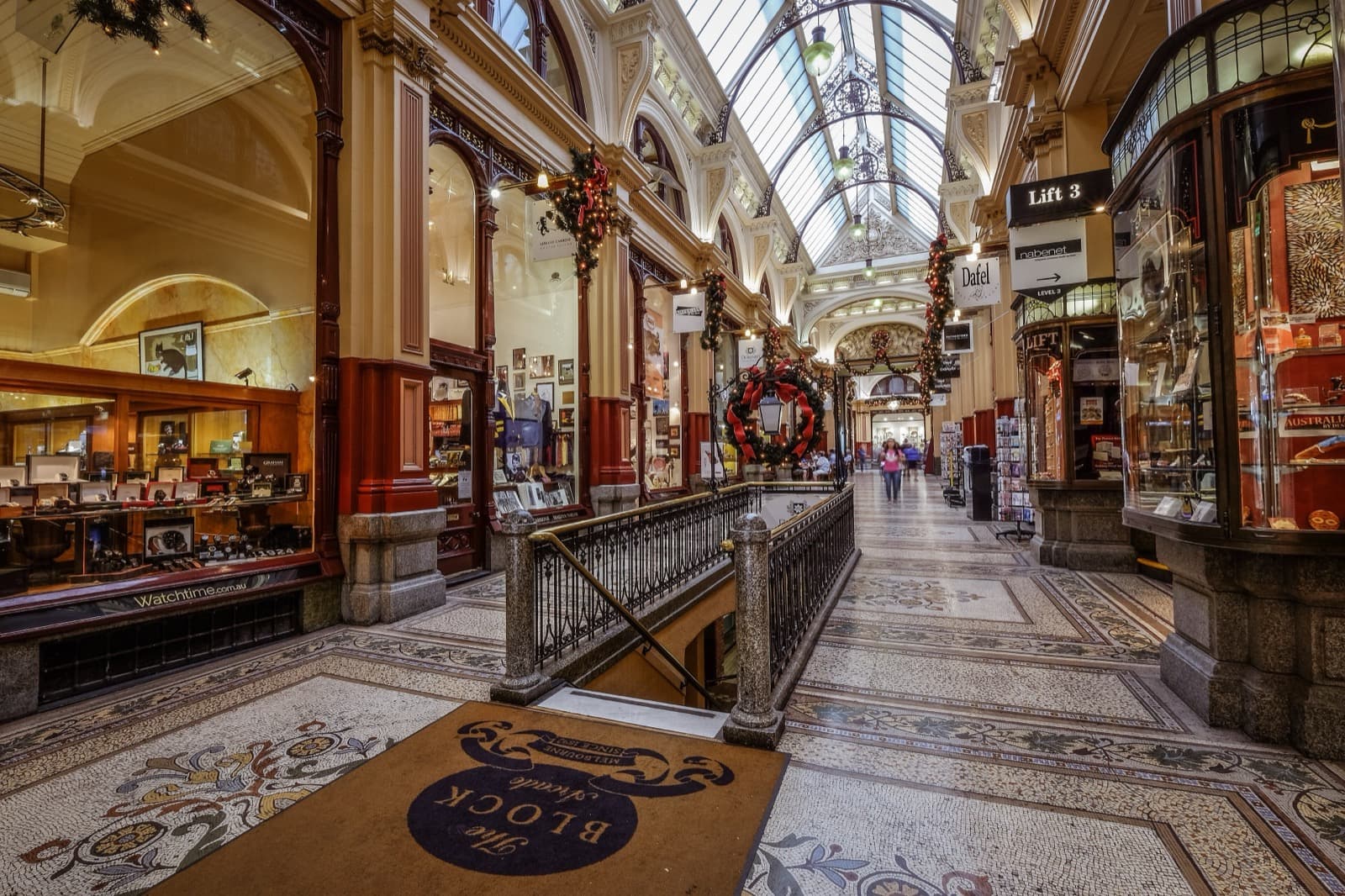
For something gentler, and a direct link to the land-boom wealth that built the Block Arcade, take afternoon tea in the Block Arcade. A tea room has operated here since the 1890s, first run by the Victorian Ladies' Work Association, and today it trades as The Tea Rooms 1892. The Hopetoun Tea Rooms, which traded in the arcade for decades, left in 2020 for a new home on Bourke Street. Ordering here is simple: a pot of tea and a plate of cakes or a high tea, taken slowly under the arcade's glass roof. The Block Arcade and the nearby Royal Arcade, the oldest surviving shopping arcade in Australia, are both stops on the laneways walk, so afternoon tea slots neatly into that route.
How to eat the city in a day
A practical order of operations: start with a flat white or a magic mid-morning in a laneway cafe, do a Chinatown yum cha or a quick dim sim for lunch, take afternoon tea in the Block Arcade, and finish with a pub parma for dinner. If your visit lands on a footy weekend, add a Four'N Twenty pie at the ground. Melbourne's food is walkable, and it maps almost exactly onto the two self-guided routes through the centre. Browse the full set of Melbourne walking tours to pair the eating with the history, or head straight to the Melbourne city page to start a tour. You set the pace, and you stop to eat whenever you want.
Sources
Frequently asked questions
- What food is Melbourne famous for?
- Melbourne is famous for its coffee culture, especially the flat white and the locally invented off-menu 'magic.' The city is also known for the dim sim, developed in Melbourne's Chinatown in 1945, the pub chicken parma, and the Four'N Twenty meat pie eaten at Australian Football League games.
- What is a 'magic' coffee in Melbourne?
- A magic is a Melbourne coffee order: a double ristretto topped with steamed milk, served in a small cup of about 120 to 150 millilitres, roughly three-quarters the size of a flat white. It is often off-menu, so you order it by asking the barista for a 'magic' by name. Awareness varies from cafe to cafe.
- Where was the dim sim invented?
- The modern dim sim was developed in Melbourne's Chinatown in 1945 by entrepreneur William Chen Wing Young for his food processing company, Wing Lee. It is a large, thick-skinned dumpling ordered either steamed or fried. The bigger rounded version is called a 'South Melbourne dim sim,' named after the South Melbourne Market.
- What is a chicken parma and where do you eat it in Melbourne?
- A chicken parma, also spelled parmi or parmigiana, is a crumbed fried chicken cutlet topped with tomato sauce and melted cheese, usually served with chips and salad. Italian immigrants brought it to Australia and it appeared in the 1950s. You eat it at Melbourne pubs, many of which run a discounted 'parma night' on a weeknight.
- Is Melbourne's Chinatown good for food?
- Yes. Melbourne's Chinatown runs along the eastern end of Little Bourke Street and grew from the gold rush, as Chinese migrants arrived in significant numbers from 1853; the City of Melbourne calls it Australia's oldest Chinatown. It is the best place to order yum cha, a spread of dim sum and dumplings with tea, served from trolleys or ordered by tablet or checklist.
- Where can you have afternoon tea in central Melbourne?
- The Tea Rooms 1892 sit inside the Block Arcade, where a tea room has operated since the 1890s, first run by the Victorian Ladies' Work Association. The Hopetoun Tea Rooms, which traded in the arcade for decades, left in 2020 for a new home on Bourke Street. Order a pot of tea and cakes or a high tea under the arcade's glass roof.
Ready to experience it?
Laneways and Arcades: The Hidden City Inside the Grid
75 min · 2 km · easy
More from Melbourne
Explore more at your own pace.
Melbourne Travel Guide: How Many Days, Getting Around, and When to Go
Gold-Rush Melbourne: The Hidden Laneways and the Boom City
Hosier Lane and the Hidden City Inside Melbourne's Grid
Parliament House, Melbourne: The Building That Governed a Nation It Was Never Meant To
Flinders Street Station: Why Melbourne Meets Under the Clocks