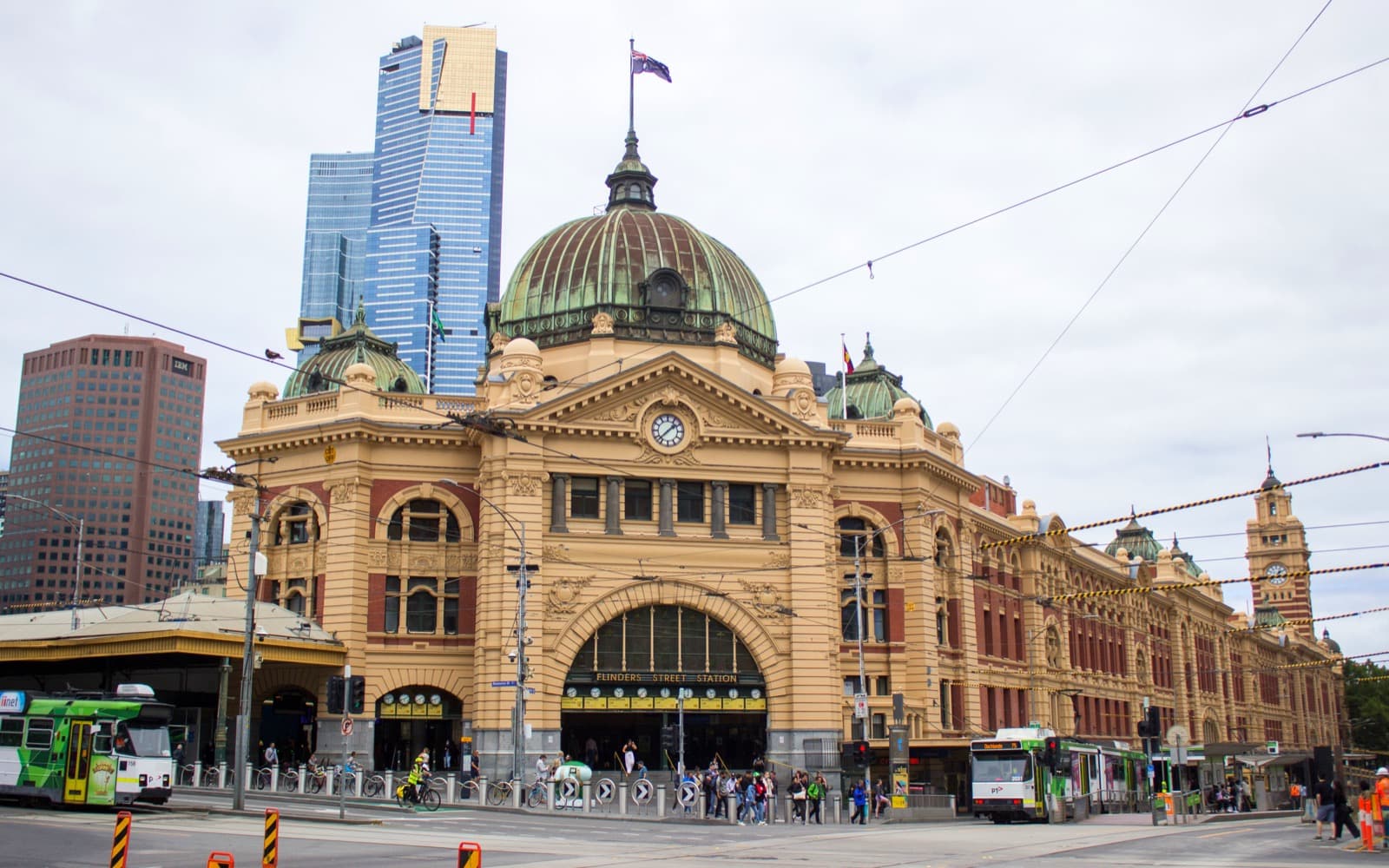
Flinders Street Station is the symbolic center of Melbourne, and the reason is a row of clocks. Above the main entrance, at the corner of Flinders and Swanston Streets, a line of indicator clocks shows the times of departing trains. For well over a century those clocks have done a second job the railway never planned for. They gave a whole city a place to say "meet me under the clocks," a spot vague enough that anyone can find it and precise enough that no one gets lost. Stand in front of the station and you are looking at the practical machinery of a railway city, and at the small human habit that machinery accidentally created.
A station built on Australia's oldest railway ground
The site is far older than the building. In eighteen fifty-four this ground became the town terminus of the Melbourne and Hobson's Bay Railway Company, the first steam-hauled passenger railway in Australia. When you stand at the corner, you are standing where the city has been catching trains for the better part of two centuries. The building you see came much later. A design competition was held in late eighteen ninety-nine and judged in early nineteen hundred, and it was won by two men on the Railways Department's own staff: the architect James Fawcett and the engineer H.P.C. Ashworth. The corner entrance opened to the public on Sunday the tenth of October, nineteen oh nine, a spring day in Melbourne, and the main building, with its great dome and its long facade, was completed in nineteen ten.
That continuity matters to how the station reads. This is not a monument dropped onto the grid to impress. It grew where the trains already were, then dressed itself in a dome and a facade its architects called French Renaissance "in a free manner." Even the entrance is set on the diagonal, its great arch facing the middle of the crossroads rather than either street. The result anchors the whole southern edge of the old town, wide and public and unmistakable, at a corner of the grid the surveyor Robert Hoddle laid out in eighteen thirty-seven.
The busiest station in the world, or so the railway said
Hear a stop from this walk
Federation Square: The Lid Over the Railway
In nineteen thirteen the Railways Department claimed Flinders Street was the busiest passenger station in the world, and in nineteen twenty-three railway men were still making the claim. That year's figures counted about two hundred and nine thousand passengers and more than two thousand trains every day. It is worth pausing on that number while you look at the entrance. Two hundred thousand daily journeys is a genuine river of people, and all of them passed through this one station. That volume is the quiet explanation for the clocks. When that many strangers need to find each other in one place, they need a landmark that is obvious to everyone and owned by no one. The indicator clocks, put into use at the main entrance on the eleventh of July, nineteen ten, were built to answer "when is my train," but their real gift to the city was answering "where shall we meet."
The phrase caught on and never let go. For decades the clocks were set by hand, with a long pole, around nine hundred times in an eight-hour shift. In nineteen eighty-three the railways planned to replace them with digital displays, and after a public outcry the clocks stayed. They are computer-operated now, and "I'll meet you under the clocks" is still Melbourne's default, understood without explanation by people who have never thought about why the clocks are there. Few pieces of public infrastructure end up carrying that much affection. The clocks did it by being useful first and beloved second, which is usually the only order that works.
The colour that had its own argument
The station has a smaller drama written on its walls. For years the facade wore a distinctive mustard yellow, but that was not the original: the station had been repainted five times since the early nineteen hundreds. In twenty sixteen and twenty seventeen it was repainted in its original colours, identified from forensic analysis of the old paint layers at the University of Melbourne. The mustard became a lighter stone colour, and the maroon sections and green trim were darkened. That kind of care tells you how the city regards this place. The station is listed on the Victorian Heritage Register, and repainting it was treated less like maintenance and more like restoring a portrait. Look closely at the facade and you are seeing a colour recovered from evidence, not chosen from a palette.
The one thing to understand standing here
If you take one idea away while facing the station, let it be this. Flinders Street is the front door of the old grid, wide and rational and built to be seen. But the real Melbourne, the one this walk goes looking for, is folded into the gaps behind these grand streets. A short walk north lie the narrow lanes that multiplied as the grid's big blocks were cut up and cut up again, and the glass-roofed arcades that boom-time money built among them. The station is where the confident, public city announces itself. Everything hidden and human about Melbourne begins just around the corner from it. That contrast, the grand front and the secret interior, is the whole shape of the old town, and the clocks are the perfect place to start reading it.
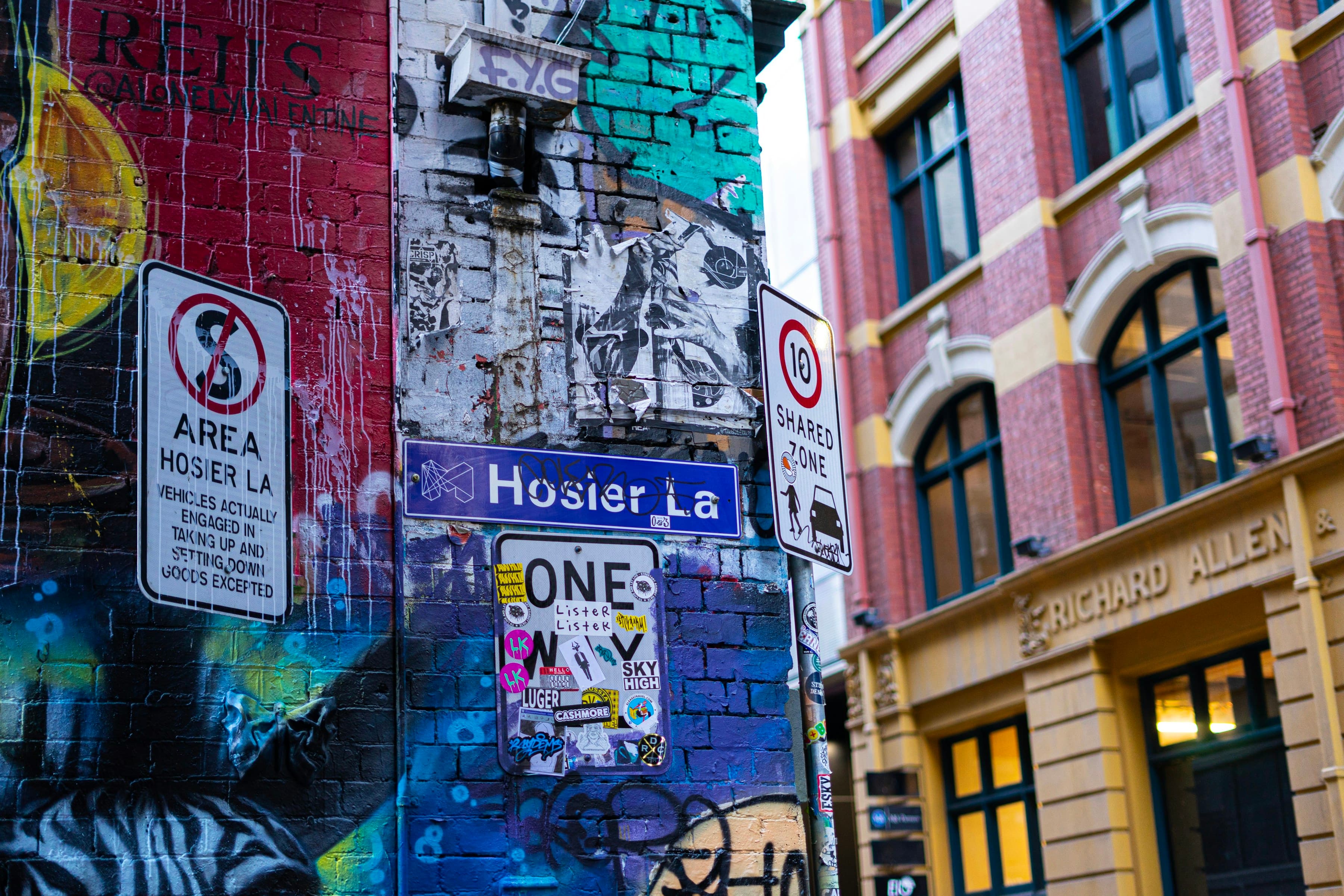
This is why the station opens the walk. From under the clocks, the route crosses into the lanes of Degraves Street and Centre Place, climbs to the mosaic floors and glass roofs of the Block and Royal Arcades, broadens along the Bourke Street Mall beneath the old General Post Office, and turns into Chinatown, which the City of Melbourne calls Australia's oldest. Then it loops back past Melbourne Town Hall and the painted walls of Hosier Lane to finish at Federation Square, just across the road from the clocks where it began. Each of those places is a version of the hidden layer the station points you toward.
Walk it yourself
Flinders Street Station is free to visit, a working public station you can stand in front of at any hour. Meeting under the clocks costs nothing and takes as long as you like, which is the right spirit for the whole of the old town. If you want the full story of the hidden city behind the grid, this station is stop one of nine on Laneways and Arcades: The Hidden City Inside the Grid, a self-paced audio walk of about two kilometres and seventy-five minutes. Browse more Melbourne walking tours, or start from the Melbourne city page and let the clocks send you into the lanes.
Sources
- Flinders Street Railway Station Complex (H1083) and the National Trust classification (B3006), Victorian Heritage Database. The eighteen fifty-four terminus, the competition of late eighteen ninety-nine, the nineteen ten completion, the diagonal entrance and "under the clocks."
- The Herald and The Australasian (nineteen oh nine and nineteen ten) and Sun News-Pictorial and The Herald (nineteen twenty-three), via Trove. The corner entrance opening, the first day of the clocks, and the railway's busiest-station claim.
- Old Treasury Building, "On the Tracks: Station Staff." Setting the clocks by hand and the nineteen eighty-three outcry.
- Premier of Victoria media release (twenty sixteen) and ABC News (twenty seventeen). The repaint and the University of Melbourne paint analysis.
- Roamer tour transcript, "Laneways and Arcades: The Hidden City Inside the Grid." Fact-audited narration covering the clocks, the station's history and the facade repaint.
- eMelbourne (Encyclopedia of Melbourne), "Grid Plan" and "Lanes and Alleys." Hoddle's eighteen thirty-seven grid and the lanes that grew as its blocks were subdivided.
Ready to experience it?
Laneways and Arcades: The Hidden City Inside the Grid
75 min · 2 km · easy
More from Melbourne
Explore more at your own pace.
Melbourne Travel Guide: How Many Days, Getting Around, and When to Go
One Day in Melbourne: A Walkable Itinerary Through the Laneways and the Gold-Boom Edge
Gold-Rush Melbourne: The Hidden Laneways and the Boom City
Hosier Lane and the Hidden City Inside Melbourne's Grid
Parliament House, Melbourne: The Building That Governed a Nation It Was Never Meant To