Spring Street: The Gold Colony's Grand End
80 min · 3.1 km · moderate
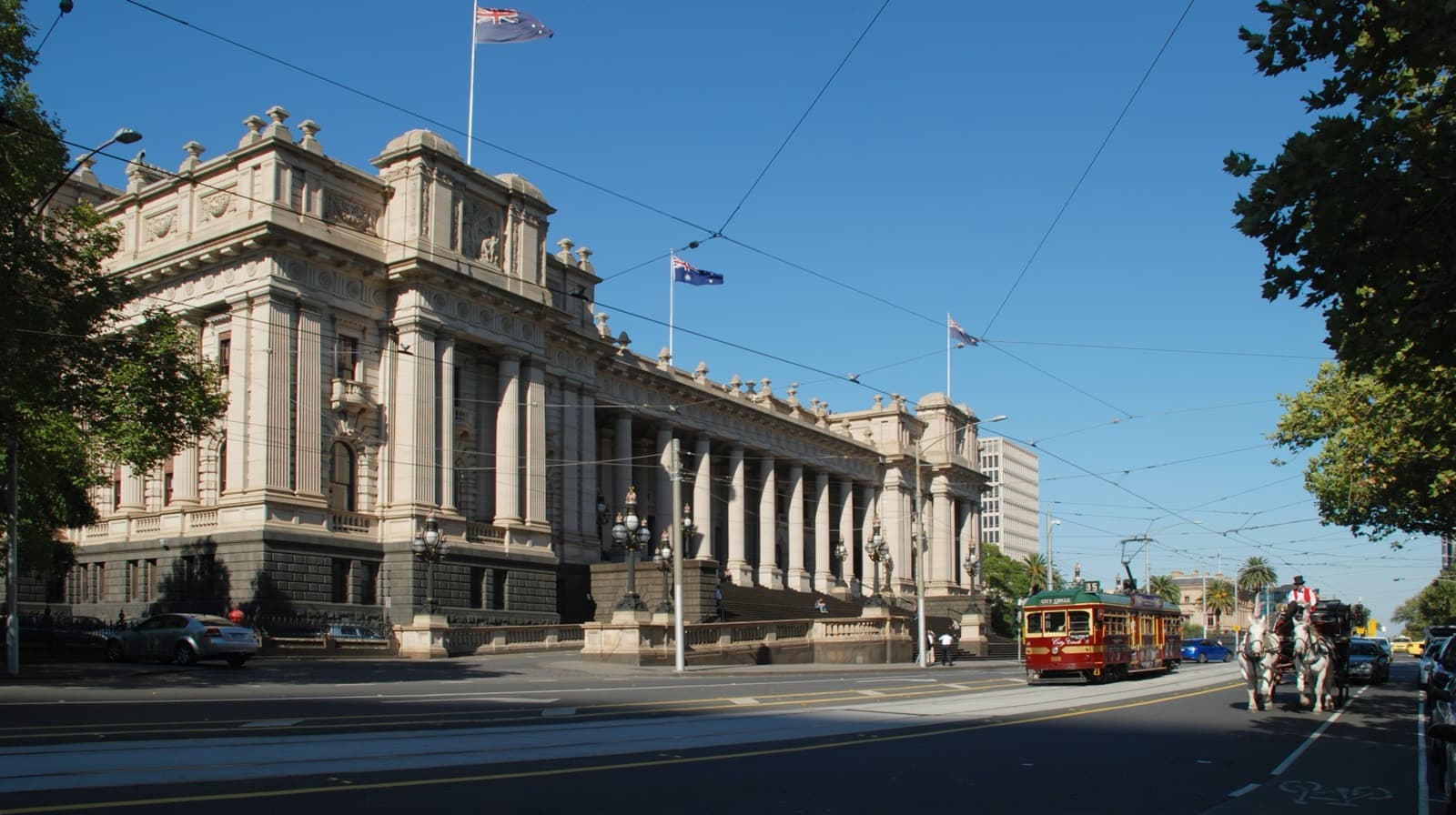
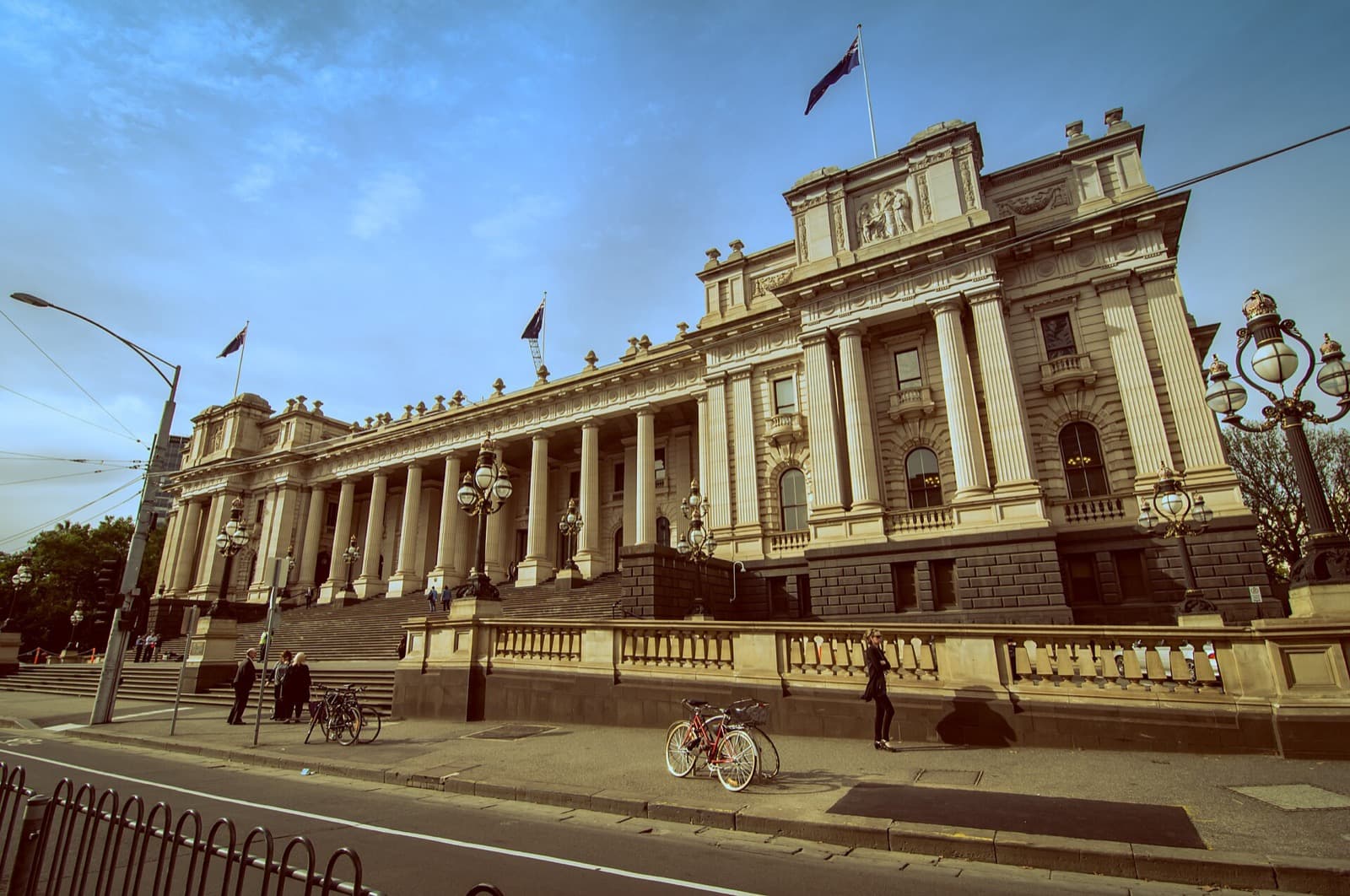
Melbourne's Parliament House governed the whole Australian nation from 1901 until 1927, borrowing a state legislature's chamber for a country that had not yet built its capital. That accident of timing sits behind a colonnade that was itself never finished, and it is the pivot of a short walk along Spring Street where gold-boom wealth raised a gaol, a theatre, a treasury, and a parliament within a few blocks of one another. Stand on the broad steps at the top of the street and you are looking at the most consequential unfinished building in the city.
The colonnade at the top of the town
Construction of Parliament House began in the mid 1850s, around 1855 and 1856, to designs by the architects Knight and Kerr, the engineer John George Knight and Peter Kerr. The first parliamentary session sat here on the 25th of November, 1856, only a few years after gold was struck in Victoria and the colony became, almost overnight, one of the richest places on earth. The columns screen the front like a temple of government, which was precisely the point. A colony flush with bullion wanted its authority written in stone.
Here is the detail worth carrying with you as you look: the building was never truly finished. A great dome was planned to crown it and was never built, which makes that missing dome one of Melbourne's most famous unbuilt features. The parliament went up in stages over decades, always with one more grand intention than the colony managed to complete. There is something honest in that. Gold made Melbourne bold, but boldness and completion are different things, and the gap between what was planned and what was paid for is legible in the skyline to this day.
The years it belonged to a nation
Hear a stop from this walk
Fitzroy Gardens and Cooks' Cottage: A Yorkshire Cottage Among the Elms
For most of its life this has been the seat of the parliament of Victoria, the state legislature. But for a stretch it held a far larger role. When the six Australian colonies federated into the Commonwealth of Australia on the first of January, 1901, there was as yet no national capital. Canberra had not been built. So the new federal parliament of the whole country met right here, in this building, borrowing Victoria's house for the nation.
The parliament of Victoria records that the federal parliament stayed until 1927, when it departed for Canberra, and the Victorian parliament officially returned to Spring Street on the sixth of July that year. For the first quarter-century of the nation's life, the laws of all Australia were debated behind this colonnade. It is a strange thought to hold on the steps: that a state parliament house, in a city that was never meant to be the permanent capital, served as the working seat of a continent-sized country for twenty-six years while its purpose-built capital rose slowly inland.
That history is not sealed off behind glass. On non-sitting days the parliament offers free public tours, and you can step into the chambers where those debates happened. It is one of the few stops on this walk where the interior is both free and open, so it rewards planning your day around a sitting calendar.
Why the parliament makes sense of everything around it
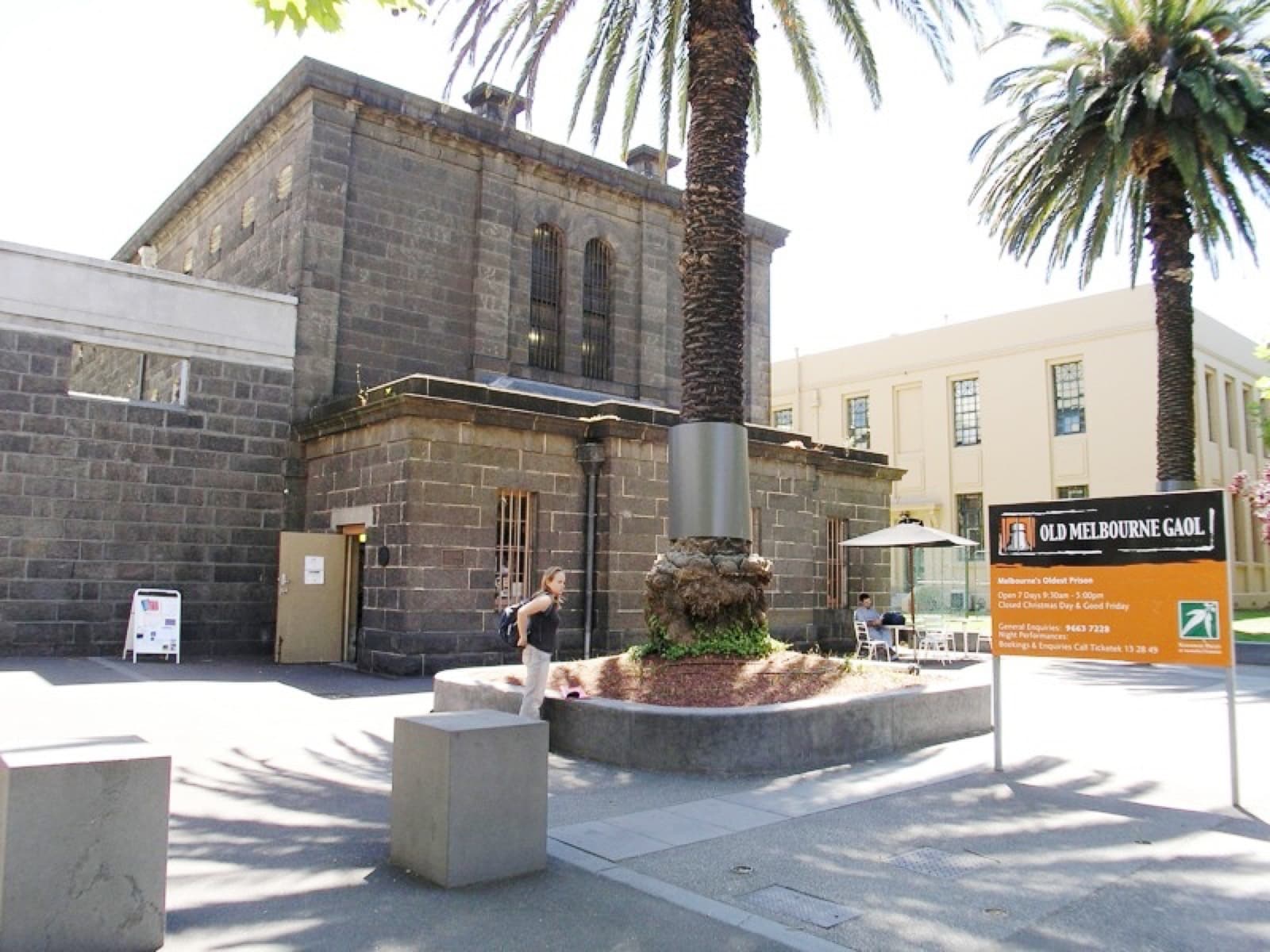
The reason to start with Parliament House is that it explains the rest of the street. The same gold-boom confidence that raised this colonnade raised its neighbours, and the walk reads them in sequence. A few blocks away stands the Old Melbourne Gaol, the oldest surviving penal establishment in Victoria, where well over one hundred and thirty people were hanged during its working years, the bushranger Ned Kelly among them on the 11th of November, 1880. Grandeur and the gallows, a few blocks apart. The same colony that built a temple of government also built the bluestone rooms where it exercised its power to condemn, and the two truths belong in the same walk.
Along Spring Street you also pass the Princess Theatre, rebuilt in its ornate form in 1886 by the architect William Pitt, described as the oldest surviving entertainment site on mainland Australia. Across from Parliament sits the Hotel Windsor, Melbourne's only surviving purpose-built grand Victorian-era hotel, where delegates finalising the Australian constitution stayed during the federal convention session of January 1898. The constitution was not written there, but a nation shaped some of its founding arguments in its rooms, over the road from where the formal sessions ran. Read together, the hotel and the parliament tell one story from two angles: the informal late-night talk and the formal chamber, both part of how a country was made.
Then comes the climax of the gold theme, the Old Treasury Building, designed by John James Clark when he was only nineteen years old, with bluestone vaults built to hold the bullion pouring off the goldfields. By the time the vaults were finished the first rush had passed, and they came to hold government documents rather than gold. The whole arc of the boom is written into those empty cellars. The walk closes on quieter notes: Saint Patrick's Cathedral, begun in 1858 and not finished with its spires until 1939, and the Fitzroy Gardens, where a small Yorkshire cottage was shipped across the world stone by stone and rebuilt among the elms.
Walking it at your own pace
This is a flat grid walk of roughly three kilometres over about seven stops, an easy route on gentle city slopes. The stops are short and skippable, so you can linger on the parliament steps or in the treasury vaults and move quickly past anything that holds you less. Watch the trams when you cross Spring Street: they are quiet, frequent, and give way to no one. Go on a non-sitting day if you can, budget time to go inside the free interiors at the parliament, the treasury, and the cathedral, and save the gardens for last.
If you want to place this walk among the others in the city, the Melbourne walking tours hub sets out the routes across the grid, and the Melbourne city page collects everything in one place. Start at the top of Spring Street, on the steps beneath the dome that never came, and let the building explain its street.
Sources
- Parliament of Victoria, "The federal years 1901-1927": official account of the federal parliament's residence in the building and the 1927 return to Spring Street.
- Parliament House, Melbourne (Wikipedia): construction history, the architects Knight and Kerr, and the unbuilt dome.
- Old Melbourne Gaol (National Trust of Australia): the gaol's history as the colony's principal place of execution.
- Old Treasury Building, Melbourne (official museum site): John James Clark's design and the bluestone gold vaults.
- Victorian Heritage Database: heritage listings for the Princess Theatre, Hotel Windsor, and the Spring Street precinct.
Ready to experience it?
Spring Street: The Gold Colony's Grand End
80 min · 3.1 km · moderate
More from Melbourne
Explore more at your own pace.
Melbourne Travel Guide: How Many Days, Getting Around, and When to Go
One Day in Melbourne: A Walkable Itinerary Through the Laneways and the Gold-Boom Edge
Gold-Rush Melbourne: The Hidden Laneways and the Boom City
Hosier Lane and the Hidden City Inside Melbourne's Grid
Flinders Street Station: Why Melbourne Meets Under the Clocks