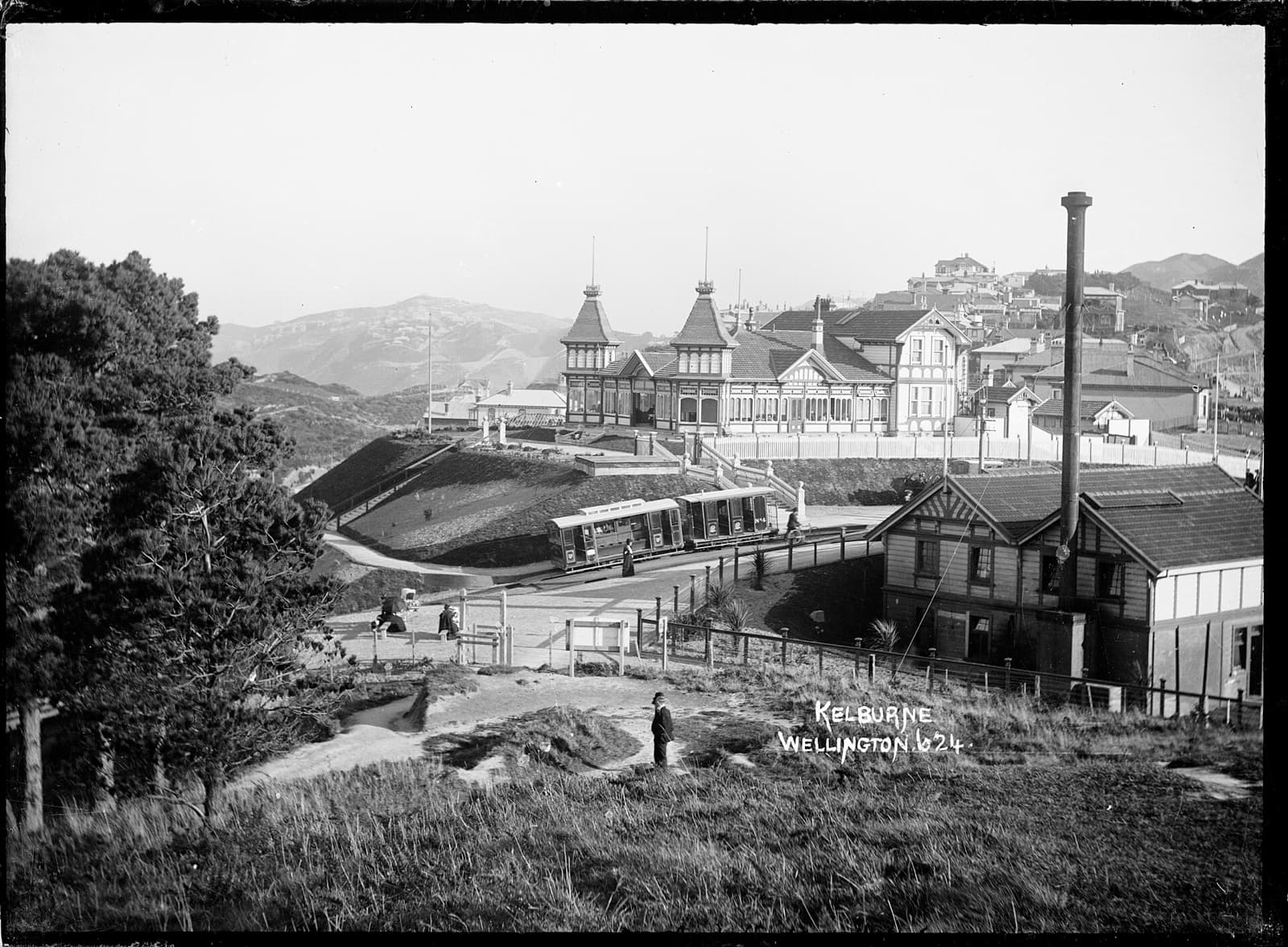
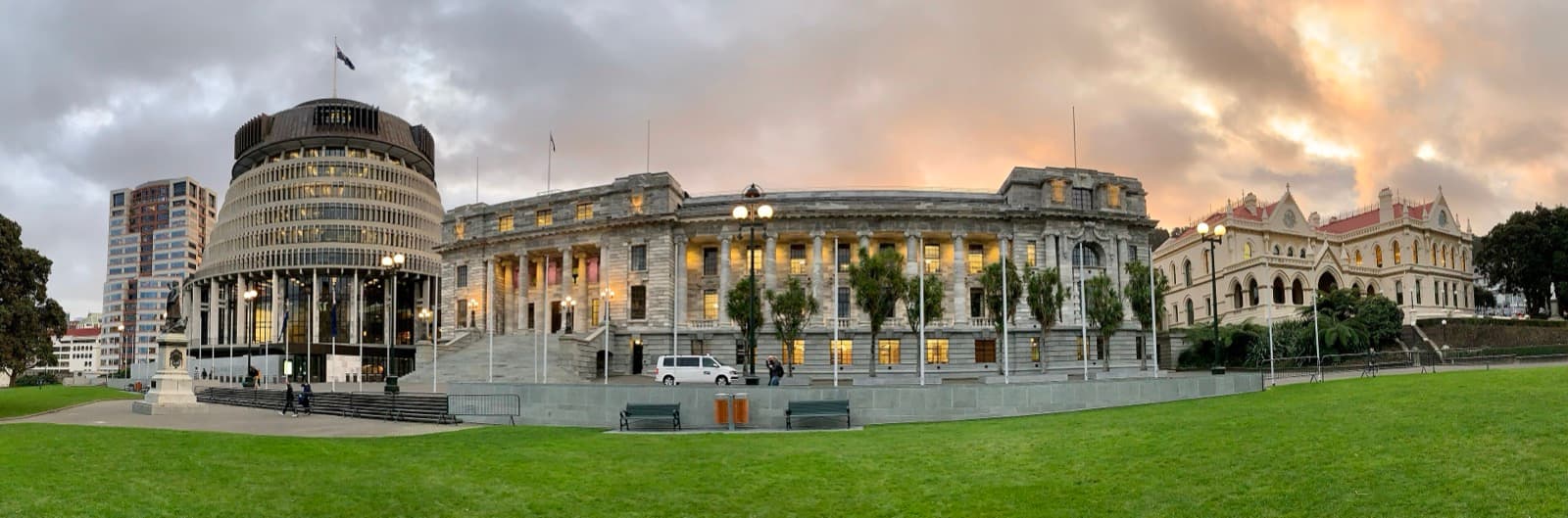
Wellington's Parliament and the Beehive stand as three buildings in a row across three architectural eras, and reading that grammar of the state is the way into a whole capital walk laid out on ground the sea gave back. Most visitors photograph the round Beehive and move on. Slow down instead, and the row becomes a legible sentence about how a small nation pictured its own government over eighty years. That single reading unlocks the argument of an entire compact walk through New Zealand's capital core.
Three Buildings, Three Ways a State Pictures Itself
Walk into the Parliament grounds and look left to right. In the middle sits Parliament House, the debating-chamber building, an Edwardian neoclassical block designed by the Government Architect John Campbell and built between 1914 and 1922. It is a capitol interrupted. The design was split into two stages, and the grand second half, which was to hold Bellamy's and a new library, was never built, so what you read is a symmetrical intention left deliberately unfinished. Beside it rises the Parliamentary Library, completed in 1899 in a soaring Gothic Revival style, older than the chamber it now flanks.
Then, to the left, the Beehive. Officially the Executive Wing, it is a round, tapering modernist tower that houses the government's ministers. It was conceived in 1964 to a design by the Scottish architect Sir Basil Spence, built through the 1970s, officially opened in 1977, and occupied from 1979. It rises about ten storeys, roughly 72 metres, and its stacked circular floors gave it the shape that named it. A Gothic library, a neoclassical chamber, a modernist tower: nineteenth-century faith in ornament, Edwardian confidence in classical order, and postwar belief in the clean curve, all standing side by side on one lawn. The whole grammar of the state, in three tenses.
There is a survival story built into the row, too. In the fire of 1907 that destroyed the earlier Parliament buildings, the library's iron fire-door earned its keep and helped save the collections next door. The library had been built of brick with that fire-door separating it from the rest of the complex, which is why the 1899 building still stands while the timber assembly it once served is gone. Entry to the grounds is free, and Parliament runs free guided tours inside if you want the debating chamber and the Beehive from within. But the reading from the lawn is the point, and it costs nothing.
Why This Row Is the Key to the Whole Walk
Hear a stop from this walk
Lambton Quay: The Shoreline of Eighteen Forty in the Pavement
The Parliament grounds are stop two of seven, and the anchor for everything around them. This is a tour about a capital that had to build itself in a hurry on unstable, borrowed ground, and Parliament states that theme plainly. Wellington took over from Auckland as the capital in 1865, and much of the flat land the government now occupies was lifted from the sea by a great earthquake and then reclaimed. The seat of the nation stands, quite literally, on former harbour floor.
Once you have read the three-styles idea at Parliament, the rest of the route rhymes with it. A short walk away, the Old Government Buildings of 1876 pull the same trick as the Beehive, only in reverse: designed by the Colonial Architect William Clayton, the whole structure is native kauri and Tasmanian hardwood, yet every stone-looking quoin, cornice and rusticated block is timber shaped and painted to imitate carved stone. For over a century it was often called the second-largest wooden building in the world, after the great temple of Todai-ji in Nara, Japan. A young government wanted to look permanent, and permanence, in scarce-stone Wellington, meant wood wearing a stone skin.
Old St Paul's carries the theme into faith. Designed by Frederick Thatcher, who was also the parish's own vicar, and consecrated on Trinity Sunday, 6 June 1866, it takes the European idea of a stone Gothic cathedral and rebuilds it in native rimu, totara, matai and kauri. Where an English Gothic interior is cool and grey, this one glows warm and dark with the grain of New Zealand forest. Again the capital adapts an imported form to the materials of the land.
The Ground Itself Is the Story
The tour's deepest turn is the one you have to look down to catch. Lambton Quay is Wellington's main shopping street, and it is called a quay, a word for a waterfront, though no water is anywhere near it. That is not an error. When the settlement was laid out in 1840, this line was the beach, and the street ran along the shore. Brass plaques set into the footpath now mark that 1840 shoreline.
Two forces pushed the sea away. The Wairarapa earthquake of 23 January 1855, of magnitude at least 8.2, lifted the land by two to three metres in a single violent movement, raising part of the harbour floor out of the water. Decades of reclamation did the rest. Today Lambton Quay lies about 250 metres from the present shoreline. The ground rose by the height of a room in one afternoon, and the quay kept its name and lost its water.
The walk folds all of this together at the Old Bank Arcade, the former Bank of New Zealand of 1901. Beneath its floor lie the timbers of the ship Inconstant, which a settler named John Plimmer bought as a wreck in 1851 and reused as a warehouse and jetty on the beach. Known as Plimmer's Ark, the buried hull was rediscovered during a late-1990s redevelopment, and a section is now on display inside the arcade. A grand bank, on a street that was once a beach, with the bones of a beached ship kept beneath it. The whole logic of the capital sits in that one basement.
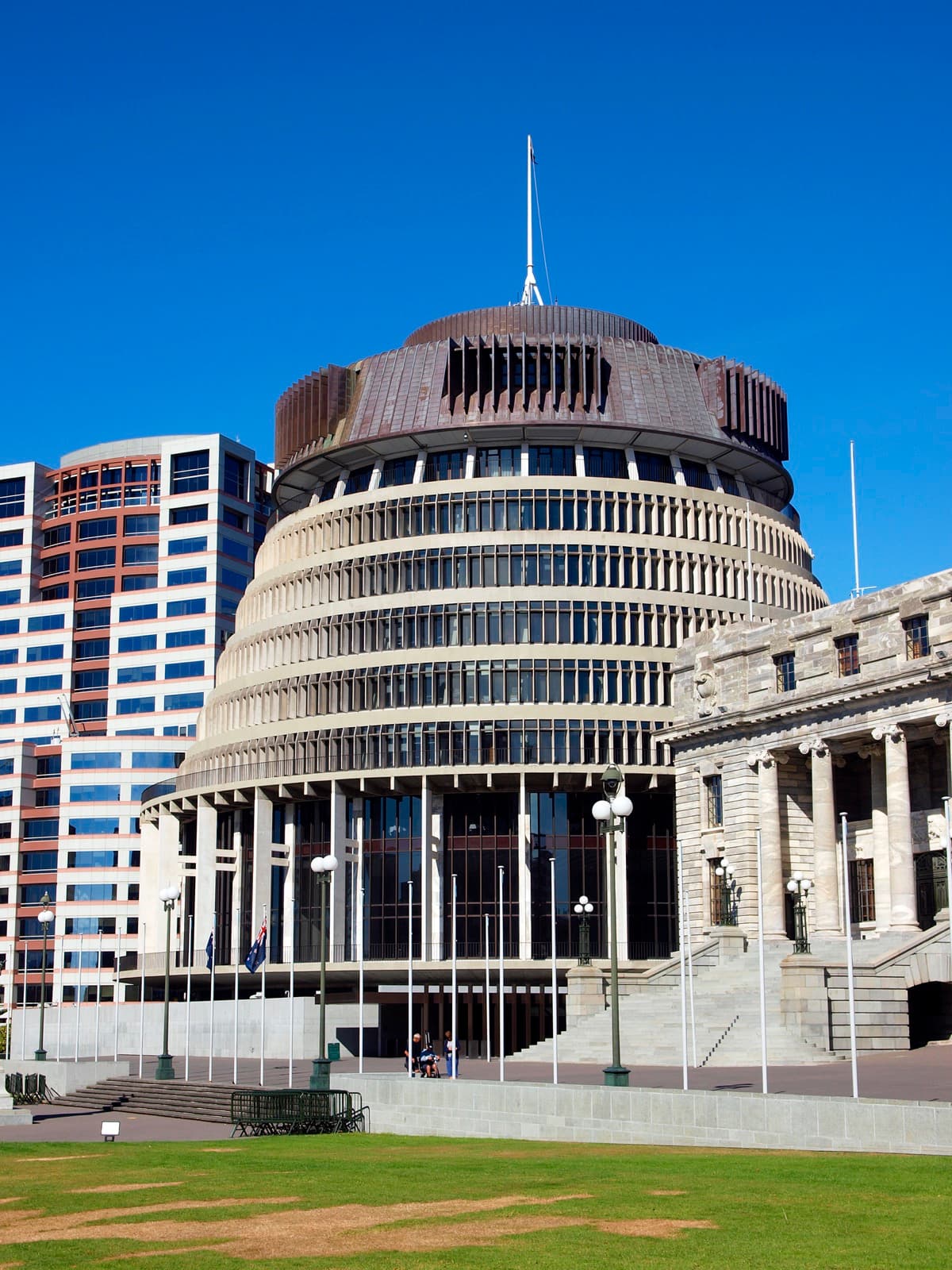
The route finishes by rising above all of it. The Wellington Cable Car, opened on 22 February 1902 and rebuilt as an electric funicular in 1979, climbs about 120 metres to the Wellington Botanic Garden, established in 1868. From the Kelburn lookout the little capital and its reclaimed flats lie spread below, and the three-styles row you decoded at Parliament becomes one small pattern in a much larger one.
This is a self-guided walk, which means you set the clock. Sit in the timber light of Old St Paul's as long as you like, find the plaques and the ship's hull at your own pace, and read the Parliament row without a group pulling you on. For the full picture of the city and its other routes, browse Wellington walking tours, or start planning from the Wellington city page. The Beehive is where the walk begins to make sense, and it is only stop two.
Sources
- Beehive (New Zealand), Wikipedia: design by Sir Basil Spence, construction and opening dates, and the building's dimensions and nickname.
- Parliament House, Wellington, Wikipedia: John Campbell's neoclassical design, the 1914 to 1922 construction, and the two-stage plan whose second half was never built.
- Old Government Buildings, Wellington, Wikipedia: William Clayton's 1876 timber building disguised as stone and its scale relative to Todai-ji.
- The 1855 Wairarapa earthquake, Te Ara Encyclopedia of New Zealand, and NZ History: the magnitude, the two-to-three-metre uplift, and the reshaped Wellington shoreline.
- Wellington Cable Car and Wellington Botanic Garden, Wikipedia: the 1902 opening, the 1979 electric rebuild, and the garden's 1868 establishment.
Ready to experience it?
Lambton Quay: The Capital on the Old Shoreline
95 min · 4 km · easy
More from Wellington
Explore more at your own pace.
One Day in Wellington: A Walking Itinerary
Wellington Travel Guide: Days, Transport, Cost, and Safety
Wellington: The Capital on Ground the Sea Gave Back
Cuba Street, Wellington: The Bohemian Spine Named for a Ship, Not the Country
Te Papa Tongarewa: Why New Zealand's National Museum Is Built Around a Marae