Shinjuku Gyoen: The Estate That Named Shinjuku
90 min · 2.7 km · easy
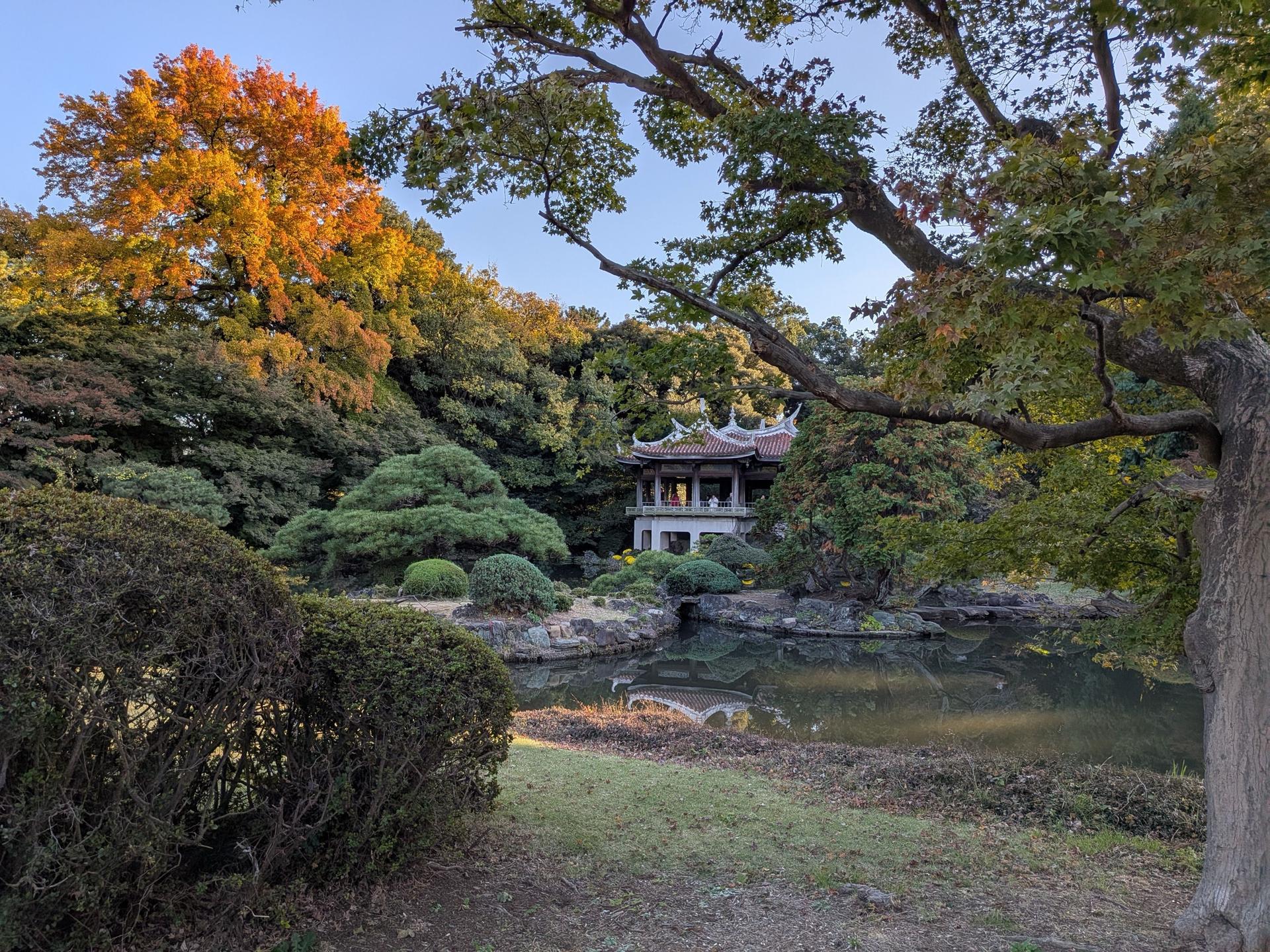
The Taiwan Pavilion is the one building in Shinjuku Gyoen that comes from somewhere else. Across the water from the pond path stands a pavilion with a reddish roof whose ridges sweep up at the ends like a swallow's tail. It was built in 1927 in the Minnan style of southern Fujian and Taiwan, largely from Taiwanese timber, as a wedding gift to the future Showa emperor from Japanese residents of colonial Taiwan. When the air raids of 1945 burned most of the garden, it was one of only two buildings to come through.
A gift from a colony
The story starts with a royal tour. In 1923 Crown Prince Hirohito, later the Showa emperor, visited Taiwan, which Japan then ruled as a colony. When he married, Japanese living in Taiwan paid for this pavilion and presented it to commemorate the wedding. The Ministry of the Environment, which runs the garden, dates it to 1927. Its Japanese name is Kyu-Goryo-tei, roughly the old imperial cool pavilion.
It is worth reading plainly. This is a colonial gift: settlers in a ruled territory sending the imperial family a building in that territory's own style. The pavilion is a small, beautiful piece of evidence about how the empire of the 1920s presented itself in its capital's gardens.
How to read the style
Hear a stop from this walk
Shinjuku Gate: The Lord's Horse
The Ministry says the pavilion takes up features of the Minnan style used in Taiwan since the middle of the Qing period. Minnan, written Binnan in some Japanese sources, is the building tradition of southern Fujian, carried across the strait to Taiwan. The tell is the roof. Look for the ridge ends curling upward into points, the swallowtail line that nothing else in the garden shares, and the reddish tiles.
Then the material. According to the Ministry, many of the materials were brought from Taiwan: Taiwanese cedar for the pillars and Taiwanese cypress for the ceiling, which give the interior a warm, dark tone. The government's building records list it as a single storey wooden building with a tiled roof and a floor area of 165 square metres, designed by Moriyama Matsunosuke and built by Yokomizo Toyokichi.
The best detail is a window. The pavilion has a round window carved in the shape of Chinese characters. The Ministry identifies the phrase as a classical saying that pictures fish leaping, used as words of praise for the ruler. A window that is also a sentence, set in a wall of imported wood, on a pond in Tokyo.
The survivor
In 1945 air raids burned most of Shinjuku Gyoen. Only two of its buildings came through: this pavilion, and the 1896 Western-style rest house by the greenhouse on the far side of the lawns. So of everything that stood in this imperial garden, what survived was a wooden villa in the Western manner and a pavilion in the manner of southern China and Taiwan. Neither is Japanese in style.
The pavilion has since been cared for as a historic building. The regional development bureau of the national government completed a preservation repair in February 2002, mending decayed parts, restoring the interior and exterior and adding structural reinforcement after an earthquake survey. In fiscal 2004 Tokyo selected it as one of the metropolis's historic buildings.
Seeing it
The pavilion sits behind a boundary on the ponds, so you see it across the water, which is how it was meant to be seen: a roofline reflected in a still pond. Autumn trees frame it well, but the swallowtail ridges read in any light. On the park walk, its story plays when you reach the pond path, whichever gate you came in by, so you can pause here as long as you like, on your own time and with no group.
The pavilion is stop 10 of Shinjuku Gyoen: The Estate That Named Shinjuku. Read the Shinjuku Gyoen companion for the whole garden, and see every route on the Tokyo page.
Sources
- Ministry of the Environment, historic buildings (English): built in 1927 to commemorate the wedding of Crown Prince Hirohito, funded by Japanese residents of Taiwan after his 1923 visit, Binnan style, Taiwanese cypress and cedar, the round window with a proverb praising the emperor.
- Ministry of the Environment, historic buildings (Japanese): Minnan features used in Taiwan since the mid Qing period, materials brought from Taiwan, cedar pillars and cypress ceiling, the round window's classical phrase of leaping fish.
- Ministry of Land, Infrastructure, Transport and Tourism, Kanto Regional Development Bureau, Shinjuku Gyoen Kyu-Goryo-tei: built 1927, designer Moriyama Matsunosuke, builder Yokomizo Toyokichi, wooden single storey with tiled roof, 165 square metres, preservation repair completed February 2002, Tokyo selected historic building in fiscal 2004.
- Roamer's audited park tour transcript for Shinjuku Gyoen, stops 3 and 10: the swallowtail roof, the reddish tiles and the two buildings that came through 1945.
Ready to experience it?
Shinjuku Gyoen: The Estate That Named Shinjuku
90 min · 2.7 km · easy
More from Tokyo
Explore more at your own pace.
Best Culture Walking Tours in Tokyo (2026)
Best History Walking Tours in Tokyo (2026)
Best Nature Walking Tours in Tokyo (2026)
Asakusa and Senso-ji: Why the Grand Buildings Are Young and the Survivors Are Small
Edo Castle, Gate by Gate: How the Shogun's Fortress Became a Garden Anyone Can Walk Into