Shinjuku Gyoen: The Estate That Named Shinjuku
90 min · 2.7 km · easy
Shinjuku Gyoen's Formal Garden is Meiji Japan importing Europe whole. Between 1902 and 1906 an imperial garden in Tokyo was redesigned from a plan by a professor at Versailles. Its rows of plane trees were among the first in Japan, and the rustic little bridge at the bottom of the garden, which looks like knotted branches, was made of the newest material of its day: concrete moulded to look like old wood.
A garden ordered from France
By the 1890s the old Naito estate was an imperial botanical garden. In 1898 it got a new head, Fukuba Hayato, who had studied in France and Germany. The Ministry of the Environment, which runs the garden today, says Fukuba asked Henri Martinet, a professor at the horticultural school at Versailles, to prepare a new scheme. The garden then underwent large-scale renovation over five years, from 1902 to 1906, and the new garden opened in May 1906 with the Emperor Meiji there.
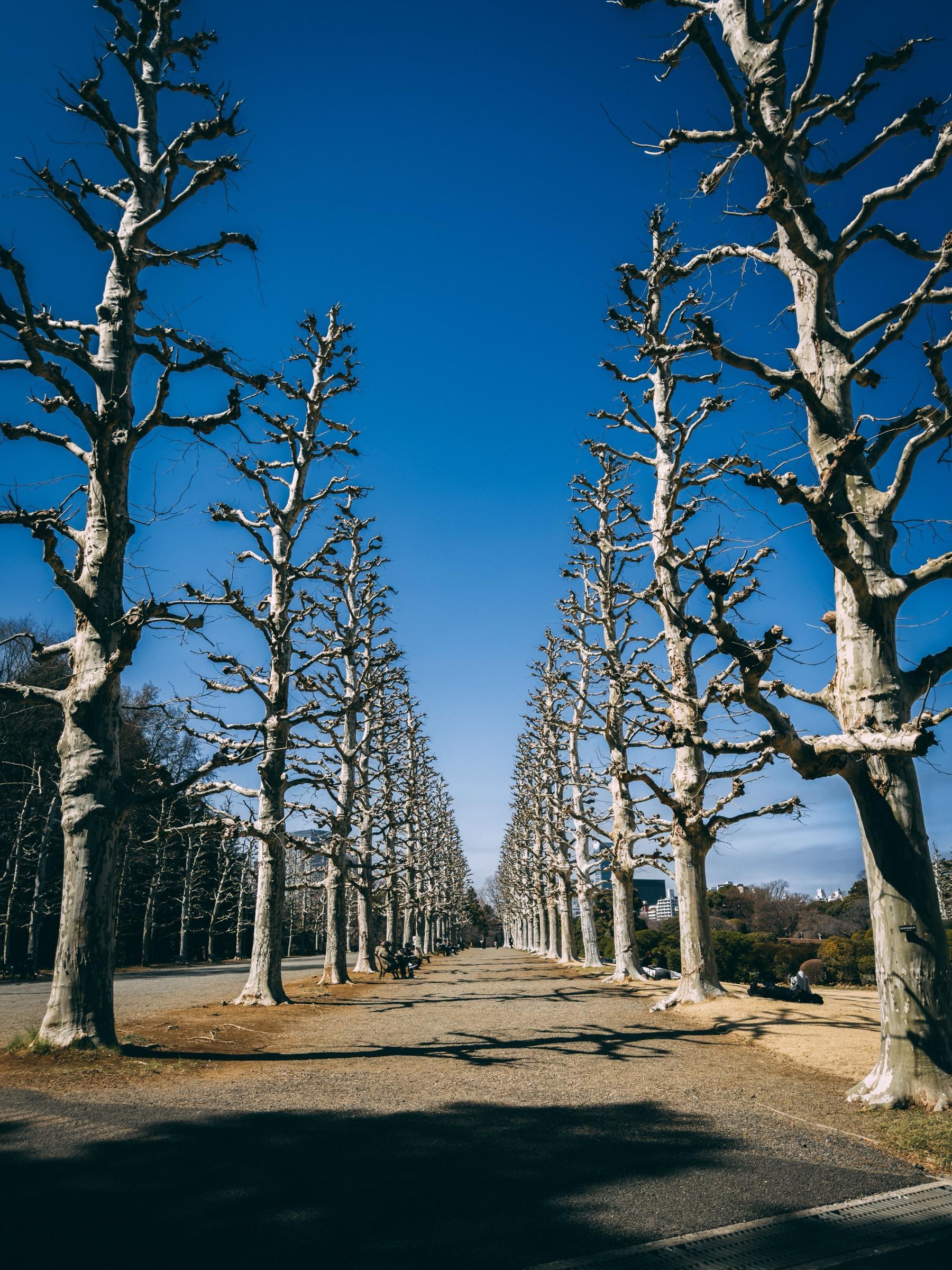
What you are standing in at stop 7 is the most French part of that scheme. The Ministry describes the Formal Garden as characterised by symmetry and geometry, and it is easy to read. Everything runs in straight lines: about 160 planes in eight rows, and rose beds between them, about five hundred bushes of a hundred varieties. Martinet also tied the formal garden to the English lawns with one long sightline, the Main Vista, running north west toward Shinjuku Gate. Stand at the head of the rows, look along the axis, and you can see the plan working.
Japan's first planes
Hear a stop from this walk
Shinjuku Gate: The Lord's Horse
The trees are the second import. The Ministry says the first London planes in Japan were planted at Shinjuku Gyoen in the late 1800s, and the walk's research adds, from the Ministry's own giant tree guide, that saplings went out from this garden across the country. The biggest of them stands near Shinjuku Gate, more than six metres round.
Planes are a good choice for a formal design because they reward pruning and show their structure. In summer the rows are a green tunnel; in late autumn they turn gold; in winter the pale trunks stand in perfect lines like the columns of a hall with no roof. Look at the bark in any season: it flakes away in patches and leaves a camouflage of cream, grey and olive.
A bridge that isn't wood
Walk south to the Lower Pond, stop 8, and the import becomes a joke on the eye. The balustrades of the little bridge look like old, gnarled wood. The Ministry is blunt: they are in fact textured concrete. The bridge was installed in 1905, during the makeover, using a technique that the Ministry says drew attention at the 1900 Paris Exposition, and it is believed to be the first imitation wooden bridge in Japan.
Think about what that means for a garden designer in 1905. Western gardens of the time loved a rustic look, but real timber rots, especially over water. Concrete, cast and textured to copy bark, gives the rustic picture with a modern lifespan. So the most natural looking object in this corner is the most industrial one. It has outlasted any real wooden bridge that could have stood here.
The rise of trees beside it is Maple Hill, red and orange late in autumn. Together the rows, the vista and the false timber bridge show how completely Meiji designers adopted not just European plants but European tricks.
Visiting
The rows and the bridge are open whenever the garden is, and they change every season, so there is no wrong time. Because the park walk plays each story when you reach its place, you can come to this corner first or last, straight from Shinjuku Gate along the vista or up from the ponds, on your own route and with no group to follow.
The Formal Garden and the Lower Pond are stops 7 and 8 of Shinjuku Gyoen: The Estate That Named Shinjuku. Read the Shinjuku Gyoen companion for the whole garden, and see every route on the Tokyo page.
Sources
- Ministry of the Environment, Shinjuku Gyoen history: Fukuba Hayato head from 1898, Henri Martinet of the Versailles horticultural school asked for a new scheme, the renovation from 1902 to 1906.
- Ministry of the Environment, the gardens: the Formal Garden's symmetry and geometry, about 160 trees in eight rows, about 500 roses of 100 varieties, the Main Vista.
- Ministry of the Environment, notable trees: the first London planes in Japan planted here in the late 1800s.
- Ministry of the Environment, historic buildings: the imitation wooden bridge of textured concrete, the 1900 Paris Exposition, installed in 1905, believed to be Japan's first, near the Lower Pond and Maple Hill.
- Roamer's audited park tour transcript for Shinjuku Gyoen, stops 7 and 8: the May 1906 opening with the emperor, the saplings sent out across Japan, the giant plane near Shinjuku Gate.
Ready to experience it?
Shinjuku Gyoen: The Estate That Named Shinjuku
90 min · 2.7 km · easy
More from Tokyo
Explore more at your own pace.
Best Culture Walking Tours in Tokyo (2026)
Best History Walking Tours in Tokyo (2026)
Best Nature Walking Tours in Tokyo (2026)
Asakusa and Senso-ji: Why the Grand Buildings Are Young and the Survivors Are Small
Edo Castle, Gate by Gate: How the Shogun's Fortress Became a Garden Anyone Can Walk Into