The Peristyle in Split is the colonnaded court where Diocletian was presented as a living god, and its meaning has since inverted completely. The room built to hold an emperor at a distance is now the most open public square in the city, free to anyone who wanders in. Understand that one reversal, and you understand the whole of Diocletian's Palace: a place saved not by reverence but by ordinary use.
What the Peristyle Is
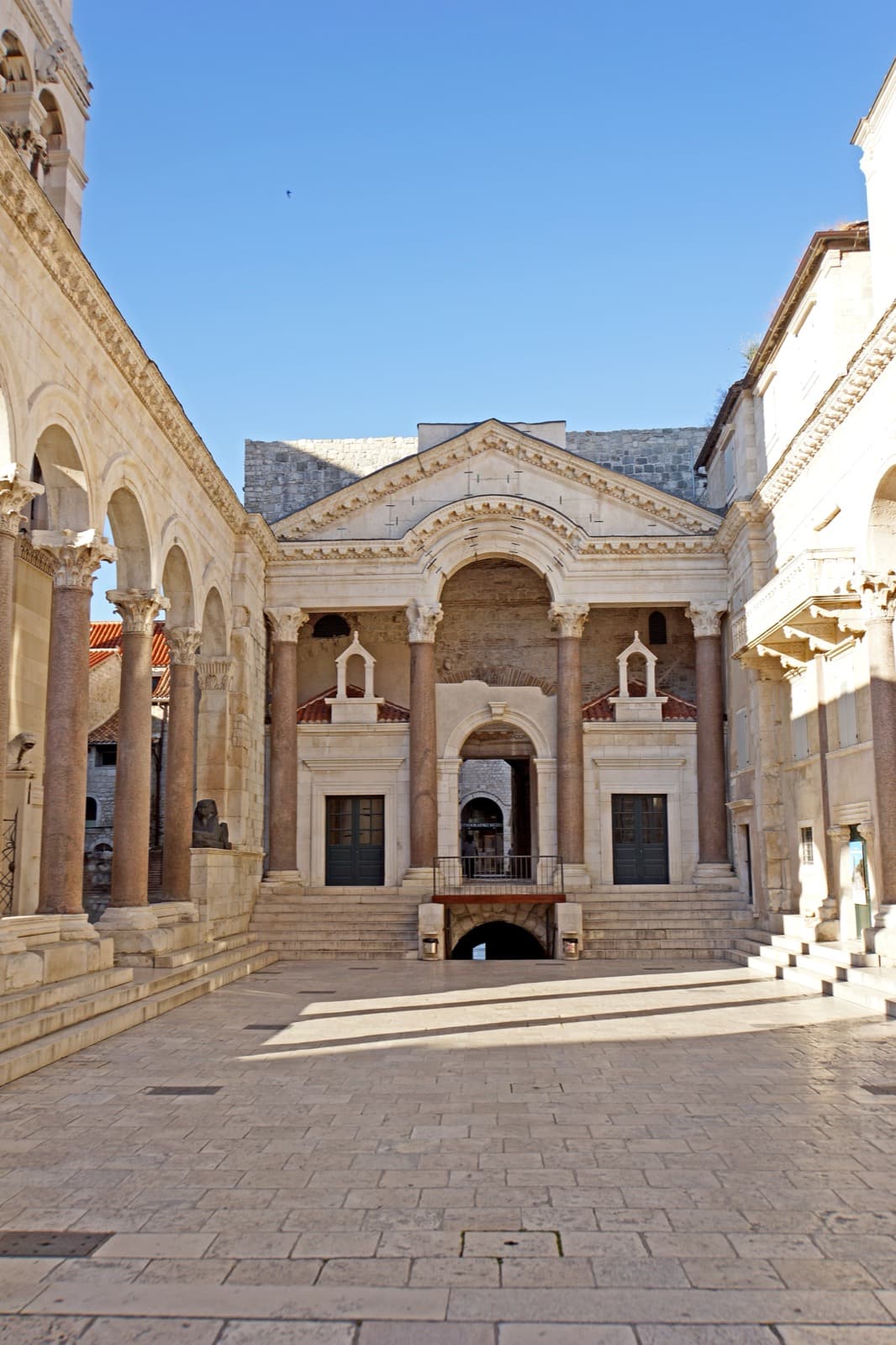
The Peristyle, in Croatian the Peristil, is the ceremonial heart of the palace, set at the crossing of its two main streets. Roman planners laid out the palace like a military camp, with a north-south spine called the cardo and an east-west line called the decumanus. Where those two axes meet, the builders opened this long rectangular court, framed on its two long sides by rows of columns carrying carved Corinthian capitals, the columns linked overhead by arches.
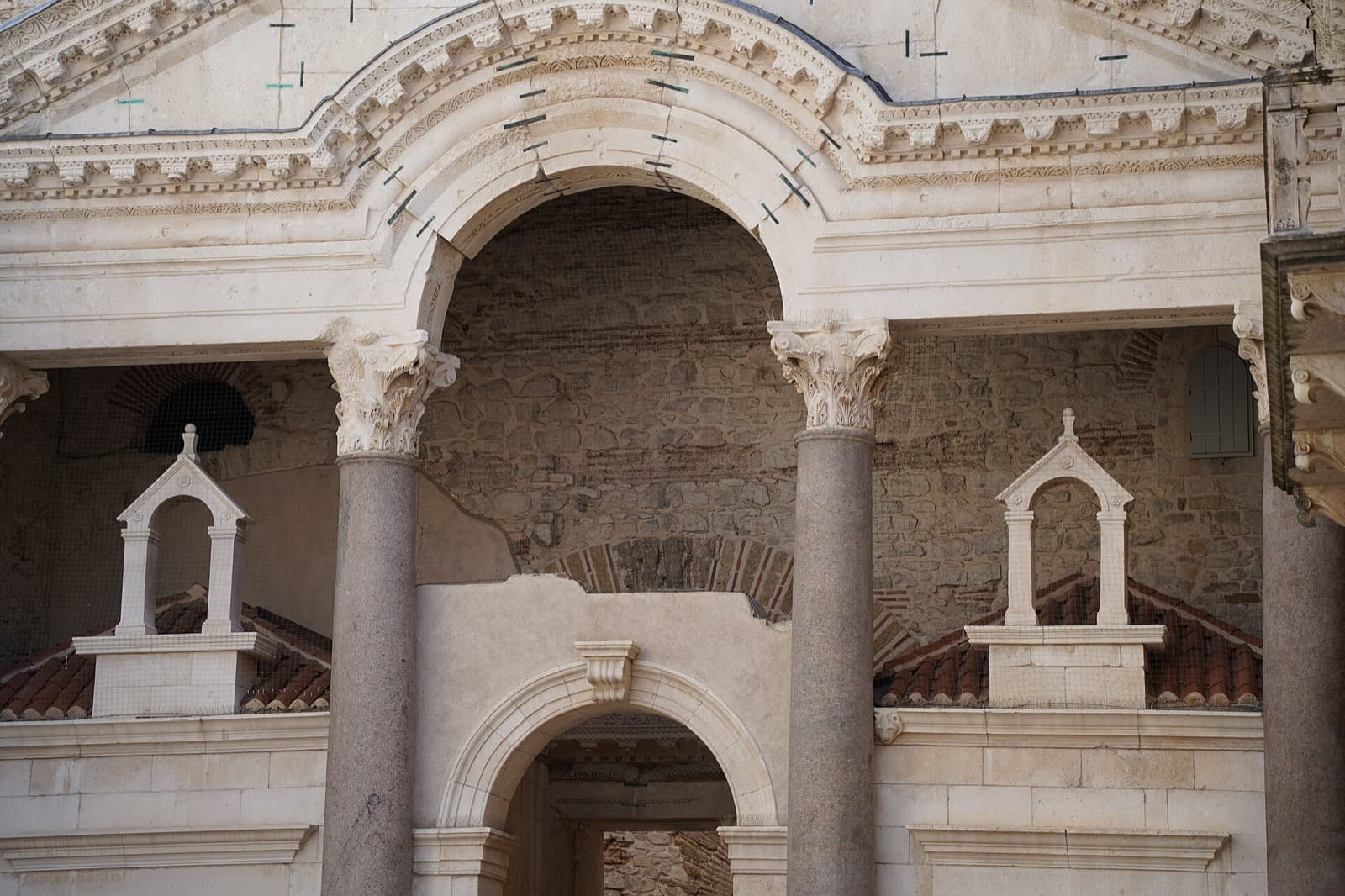
Look closely at the columns on the south side, the end where the emperor appeared. They are red Egyptian granite, and that colour was not an accident. Red signalled ceremony and power, and it was chosen to mark this as the most charged ground in the complex. At the south end stands the Protiron, a triangular gable carried on four columns with an arch springing between the two central ones. That arch framed the imperial loggia. It was, in effect, a stage set in stone, designed so that a single figure standing beneath it would seem to belong to a different order of being than the people looking up.
The Man Who Claimed to Be a God
Hear a stop from this walk
The Golden Gate: The Emperor's Threshold and the Bishop of the Common Tongue
Here is what happened on this spot. Diocletian was celebrated as Jovius, the living son of Jupiter, and this court was built to make that claim visible. He would appear under the Protiron, and his subjects would come forward on their knees to kiss the hem of his scarlet cloak, or lie flat on the ground before him in the ritual called proskynesis. A man, standing where you now stand, presented and worshipped as a deity.
It helps to remember why an emperor needed such theatre. Diocletian took power at the end of the third century, after decades in which Roman emperors had been made and murdered by their own armies with grim regularity. His answer was to raise the office far above the reach of ordinary soldiers and citizens, to wrap it in ceremony so heavy that no one could imagine touching it. The Peristyle is that political idea rendered in granite and shadow. The whole point of the court was distance: the columns, the raised gable, the red stone, the rules of approach, all of it arranged to keep the god apart from the crowd.
The Reversal
Now notice what the Peristyle actually is today. It is a public square. People sit on these steps in the sun with a coffee. Children run across the stone. Someone is very often singing. The court engineered to hold a god aloof from his subjects has become the most open room in Split, a place where the only ceremony is the slow business of passing an afternoon.
That inversion is the single thing to carry away from this stop. The palace survived, uniquely among Roman imperial residences, because the people who came after the empire did not treat it as a monument. They moved in. They built homes into the walls, turned the emperor's mausoleum into a cathedral, and made his ceremonial court into the town square. The distance the Peristyle was designed to enforce collapsed, and the space filled with exactly the ordinary life it was meant to exclude. Use, not reverence, is what kept it standing.
The Sphinx That Saw It All
Before you move on, look toward the cathedral steps for a small dark shape. It is a black granite Egyptian sphinx, and it is far older than everything around it, roughly three thousand five hundred years old, carved in the age of the pharaoh Thutmose the Third. Diocletian shipped several such sphinxes here from Egypt to lend his new palace the borrowed authority of a far older empire.
Sit with what that stone has witnessed. It was already ancient when it was set down in this court. It watched an emperor stand under the Protiron and be worshipped as a living god. It watched the empire recede, the worship stop, the god-emperor turn to legend. And it is still here, in the same square, watching tourists photograph their coffees. The sphinx is the longest memory in Split, a silent witness to the entire arc from divine spectacle to public living room. If you want a single object that measures how completely the meaning of this place has changed, it is that patient, weathered figure on the far side of the court.
Standing in the Court
The one thing to understand while you are here is the gap between what this square was for and what it is now. Everything in the design pushes toward hierarchy and awe: the red columns, the framed gable, the ritual of approach on hands and knees. Everything in the present pushes the other way: open steps, free entry, coffee cups, klapa singers whose voices carry across from the nearby Vestibule. The Peristyle did not become a democratic space because anyone decided to democratise it. It happened because the town simply kept using the room, and the meaning drained out of the old ceremony and refilled with daily life.
The Peristyle is one of seven stops on the self-guided [split-diocletian-palace] audio walk, which threads the Golden Gate, the Cathedral of Saint Domnius, the Temple of Jupiter, the substructures, the Vestibule, and the Iron Gate into a single loop of a little under one kilometre. You go at your own pace, no group, no schedule, every stop short and skippable. For more routes through the old town, see our guide to Split walking tours, or browse everything on offer in Split. Stand in the court first, though. Find the red columns, find the sphinx, and let the distance the Romans built here dissolve into the square it has become.
Sources
- Diocletian's Palace, Wikipedia. Background on the palace layout, the Peristyle, and its role as the ceremonial court at the crossing of the cardo and decumanus.
- The Peristyle of Diocletian's Palace, Absolute Croatia. Detail on the red Egyptian granite columns, the Protiron, and the Egyptian sphinx near the cathedral steps.
- Roamer tour transcript, "The Palace People Never Left" (split-diocletian-palace), fact-audited. Primary source for the Jovius cult, the sphinx dating to Thutmose the Third, and the present-day use of the square.
- UNESCO World Heritage List, Historical Complex of Split with the Palace of Diocletian. Context on the palace's preservation and status.
Ready to experience it?
The Palace People Never Left
90 min · 0.7 km · easy
More from Split
Explore more at your own pace.
One Day in Split: A Walkable Morning-to-Evening Itinerary
Split: The City That Moved Into an Emperor's Palace
Marjan Summit: Why Split's Green Hill Is the Walk That Turns Its Back on the Palace

Picigin at Bacvice: The Shin-Deep Game That Explains Split
The Cathedral of Saint Domnius: How a Persecutor's Tomb Became His Victim's Church