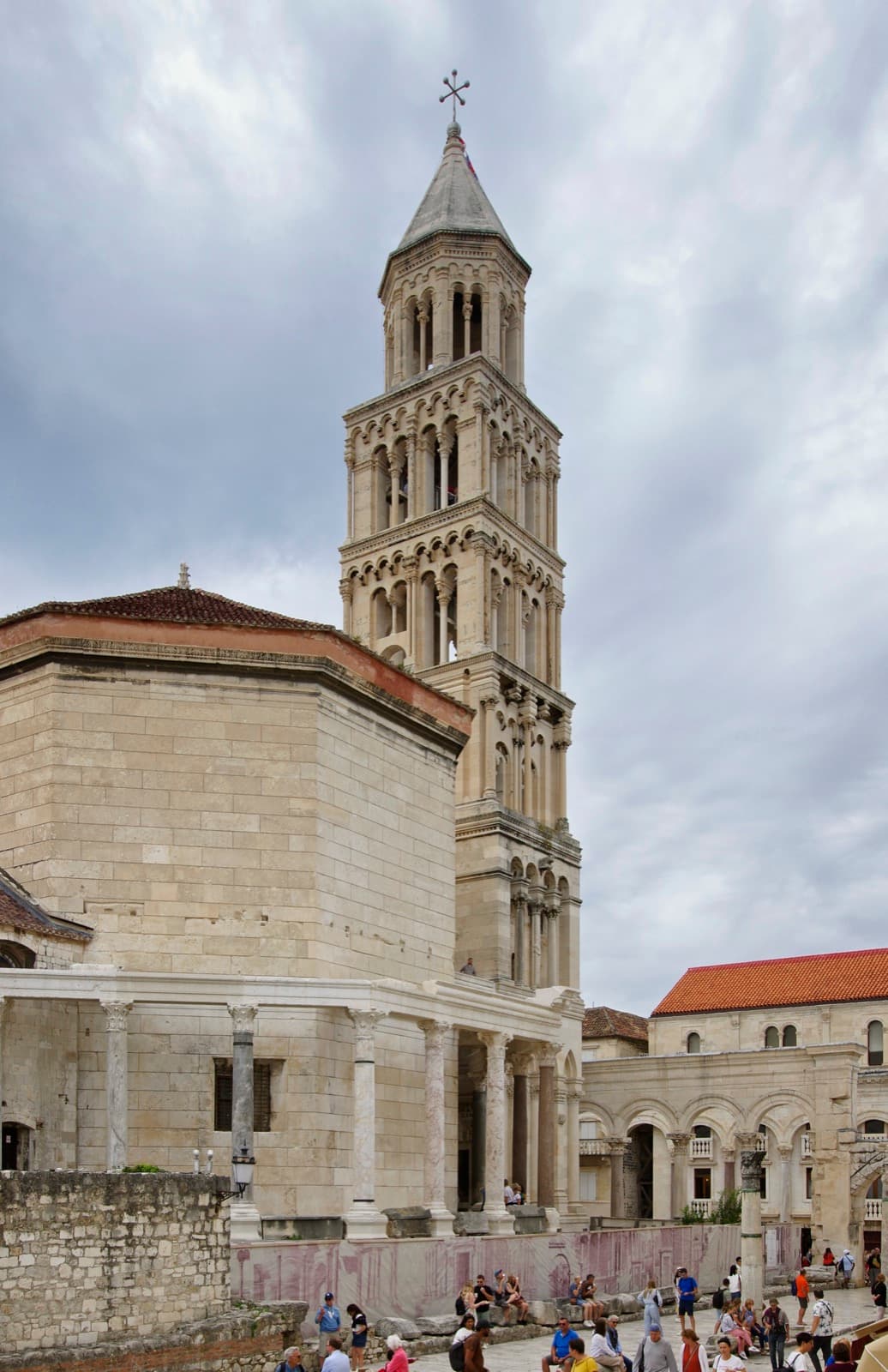
The octagonal building at the center of Split began as the tomb of the emperor who tried to erase Christianity, and it is now the Cathedral of Saint Domnius, named for a bishop his persecution put to death. That reversal is not a footnote. It is the clearest single lesson in the whole of Diocletian's Palace, and it explains why this Roman monument survived when every comparable palace on earth became a ruin behind a rope: the town kept using the building, and the meaning changed underneath it.
Start with the man who built it. Diocletian raised his fortified retirement residence on the Dalmatian coast around the years 295 to 305 A D, and this eight-sided structure was his mausoleum, finished around the year 305, the tomb of the emperor himself. It was meant to hold his body for eternity, a pagan god-king laid to rest inside his own walls. Diocletian had declared himself Jovius, the living son of Jupiter. He had also launched the Great Persecution, the last and most systematic Roman campaign against Christians.
The reversal at the heart of the palace
Now the other half of the story. Saint Domnius, in Croatian Sveti Duje, was a bishop of Salona, born in Antioch and martyred at Salona in 304 A D, during that very persecution. Salona was the provincial capital of Dalmatia and Diocletian's own birthplace, a short distance inland from the palace. When the Avars and Slavs destroyed Salona in the seventh century, refugees fled to the shelter of the emperor's abandoned palace. By the middle of that century they had done something quietly astonishing: they consecrated the persecutor's tomb as a Christian church, in the name of one of his victims. Domnius became the patron saint of Split.
Sit with that for a moment, soberly. A tomb raised for a man who tried to wipe out a faith now shelters that faith, dedicated to a man he killed. Nobody planned that ending. There was no grand act of reclamation, no triumphal rededication staged for the history books. A displaced population needed a solid stone building, this one was standing, and they used it. The purpose flipped while the walls stayed exactly where the Roman masons left them. This is the pattern the entire palace repeats, and the cathedral is where you feel it most sharply.
Because the structure was never torn down and rebuilt, the building is described as the oldest Catholic cathedral in the world still in use in its original structure. Not the oldest church, not the oldest congregation, but the oldest cathedral fabric never rebuilt from the ground up. The Romanesque bell tower beside it came later, begun in the thirteenth century and finished in the mid-sixteenth, and it now offers a climb straight up over the palace roofs to the sea. If you step inside the cathedral, look for the carved walnut doors by Andrija Buvina, dated 1214, with twenty-eight scenes from the life of Christ worked into the wood.
Why this stop is the argument, not just a stop
Hear a stop from this walk
The Golden Gate: The Emperor's Threshold and the Bishop of the Common Tongue
The Cathedral of Saint Domnius is the third stop on a compact cluster walk of seven through the old core of Split, and it is the pivot the whole route turns on. The tour's thesis is simple and true: every other Roman imperial palace on earth survives as a ruin you view from a distance, while this one survives as a neighborhood you walk straight through, because when the empire faded the people moved in and never left. They built their homes into the emperor's walls, turned his mausoleum into a cathedral, ran a market through his cellars, and are still doing it seventeen centuries later.
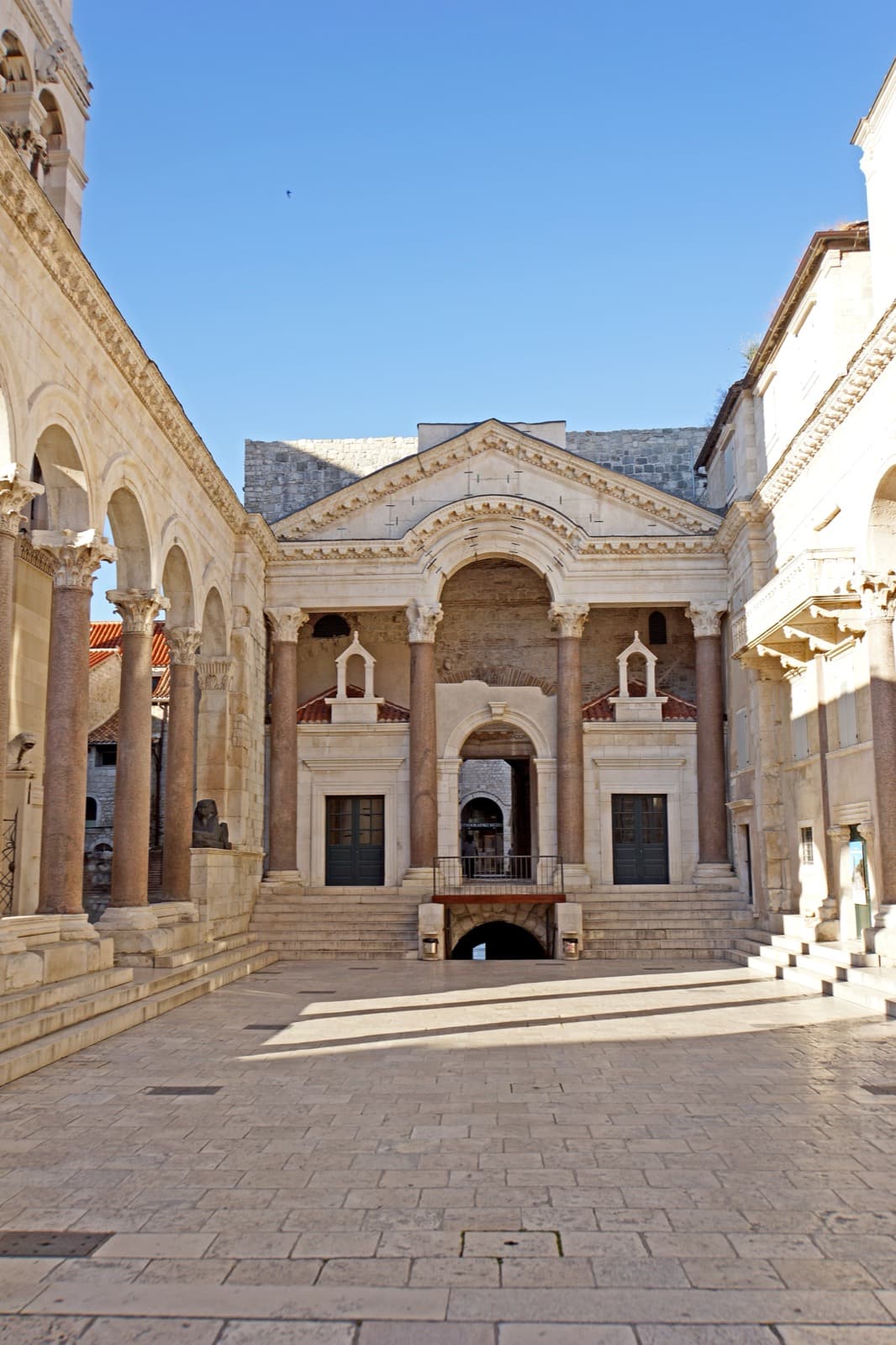
Every stop repeats the reversal in a different key. At the Peristyle, the colonnaded court where Diocletian appeared beneath the Protiron as a living god and subjects knelt to kiss the hem of his scarlet cloak, people now sit on the steps with a coffee while children run across the stone. A black granite Egyptian sphinx, roughly three thousand five hundred years old and dating from the era of the pharaoh Thutmose the Third, still watches from near the cathedral steps, older than the palace it decorates. Just west, the small and remarkably intact Temple of Jupiter became the cathedral's baptistery, a pagan temple turned Christian font under one carved barrel vault of coffered stone. The Scottish architect Robert Adam surveyed these ruins and published his drawings in 1764, rating that little temple among the finest monuments in Europe.
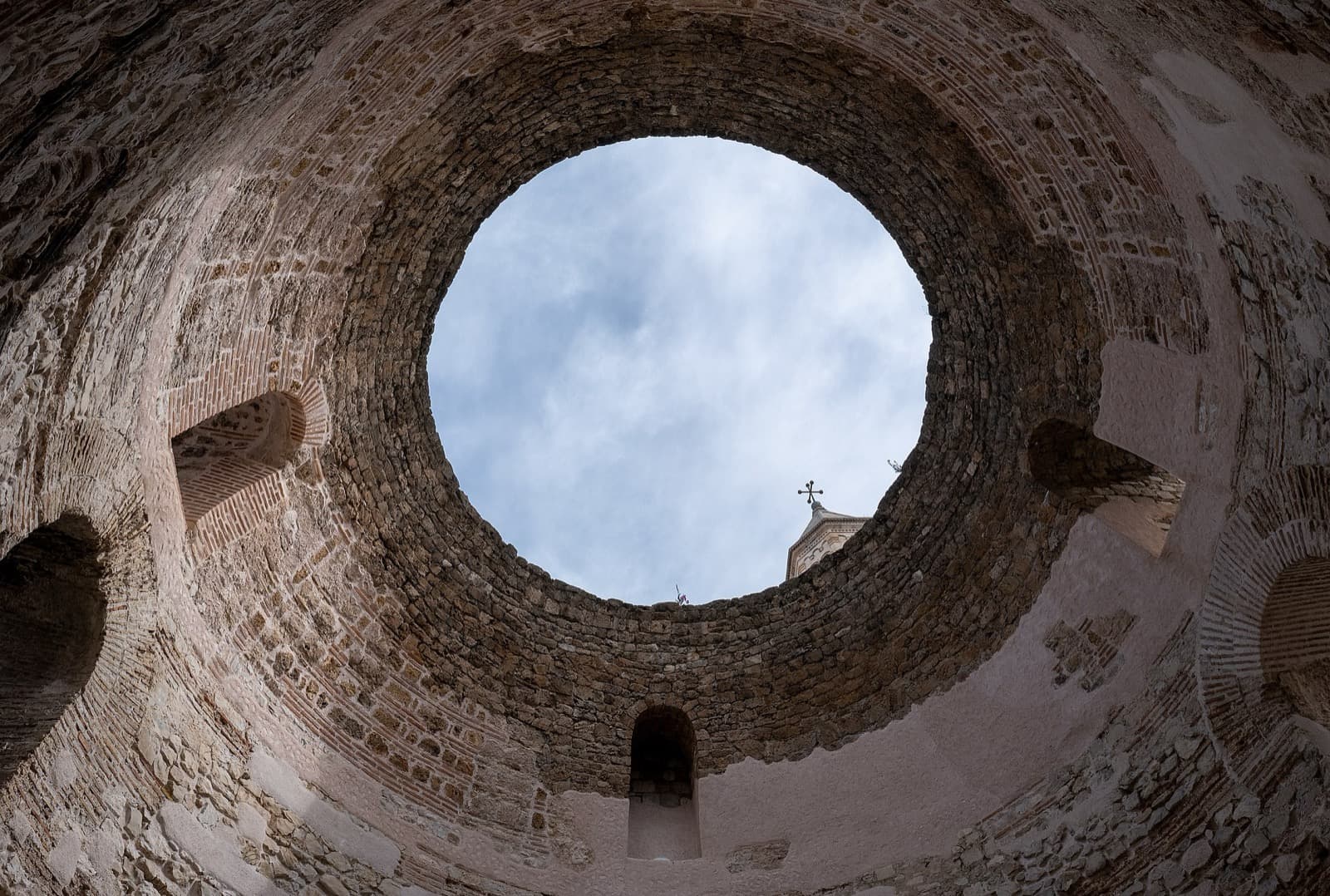
The pattern keeps going. Beneath the seaward half of the palace, the substructures, the Podrumi, preserve the exact floor plan of the emperor's vanished apartments overhead, because the cellars were built to carry that lost floor. Packed with refuse for centuries, they were cleared in the twentieth century and now hold market stalls and exhibitions. The Vestibule, the circular domed antechamber to the emperor's private rooms, stands open to the sky through its oculus, a hall built so gods could gaze down on an emperor and now a place where klapa singers, the Dalmatian a cappella tradition, send ordinary voices up toward the light. The walk ends at the Iron Gate, the only one of the palace's four gates that has never once closed in seventeen centuries, opening onto the medieval People's Square where Roman becomes medieval becomes the living city, all on one continuous stone.
Stand in front of the octagonal cathedral and you hold the whole idea in a single glance. The tomb of a persecutor, keeping the faith he hunted, in the name of the bishop he killed. Understand that reversal here, and the rest of the palace reads like variations on one theme. This is a walk you take at your own pace, about ninety minutes over a little under one kilometer of old limestone, no group waiting and every stop short enough to skip or linger over as you please. If you want the fuller picture of what else the old town holds, the Split walking tours overview lays out the routes, and the city page for Split sets the palace in its wider Dalmatian setting.
Sources
- Cathedral of Saint Domnius, Wikipedia: overview of the mausoleum-to-cathedral conversion, the Buvina doors, and the bell tower dates.
- Diocletian's Palace, Wikipedia: the 295 to 305 A D construction, the UNESCO inscription of 1979, and the palace layout.
- Temple of Jupiter, Split, Wikipedia: the temple-to-baptistery conversion and Robert Adam's 1764 survey and drawings.
- Visit Split (visitsplit.com), official city tourism site: practical detail on the cathedral, baptistery, and combined ticketing.
- Roamer tour "The Palace People Never Left": the fact-audited self-guided walk of seven stops through Diocletian's Palace that this article accompanies.
Ready to experience it?
The Palace People Never Left
90 min · 0.7 km · easy
More from Split
Explore more at your own pace.
One Day in Split: A Walkable Morning-to-Evening Itinerary
Split: The City That Moved Into an Emperor's Palace
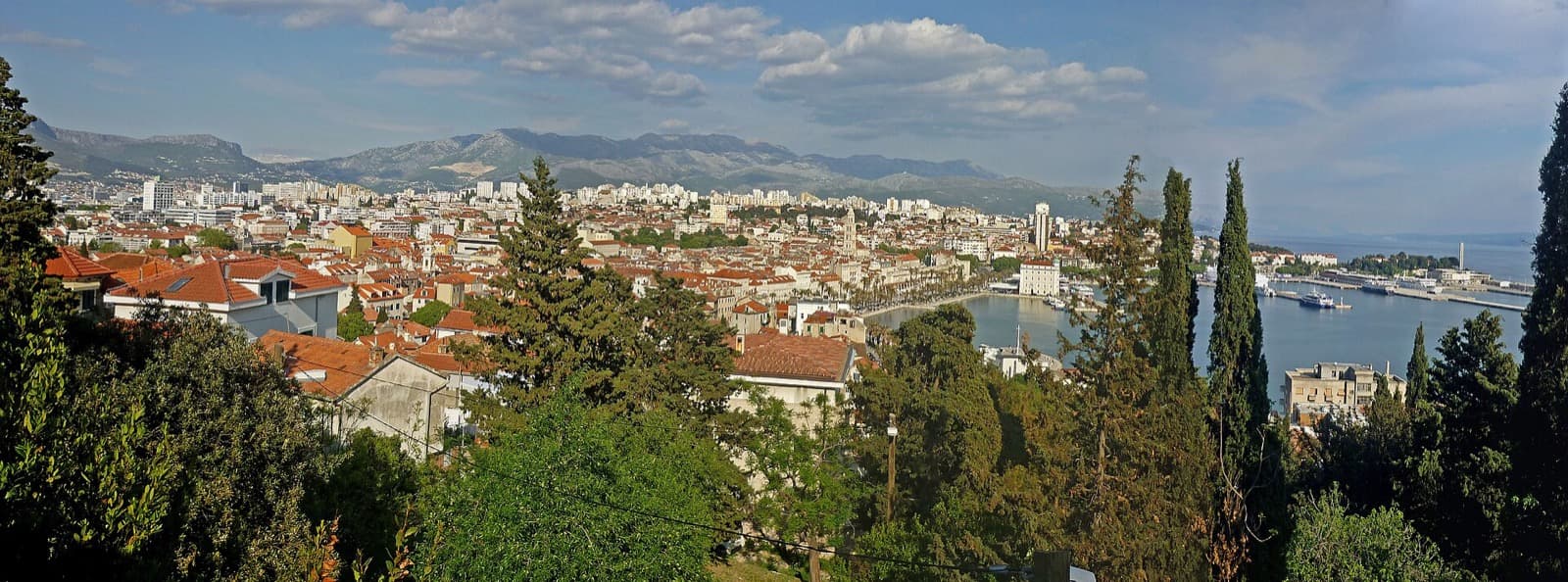
Marjan Summit: Why Split's Green Hill Is the Walk That Turns Its Back on the Palace
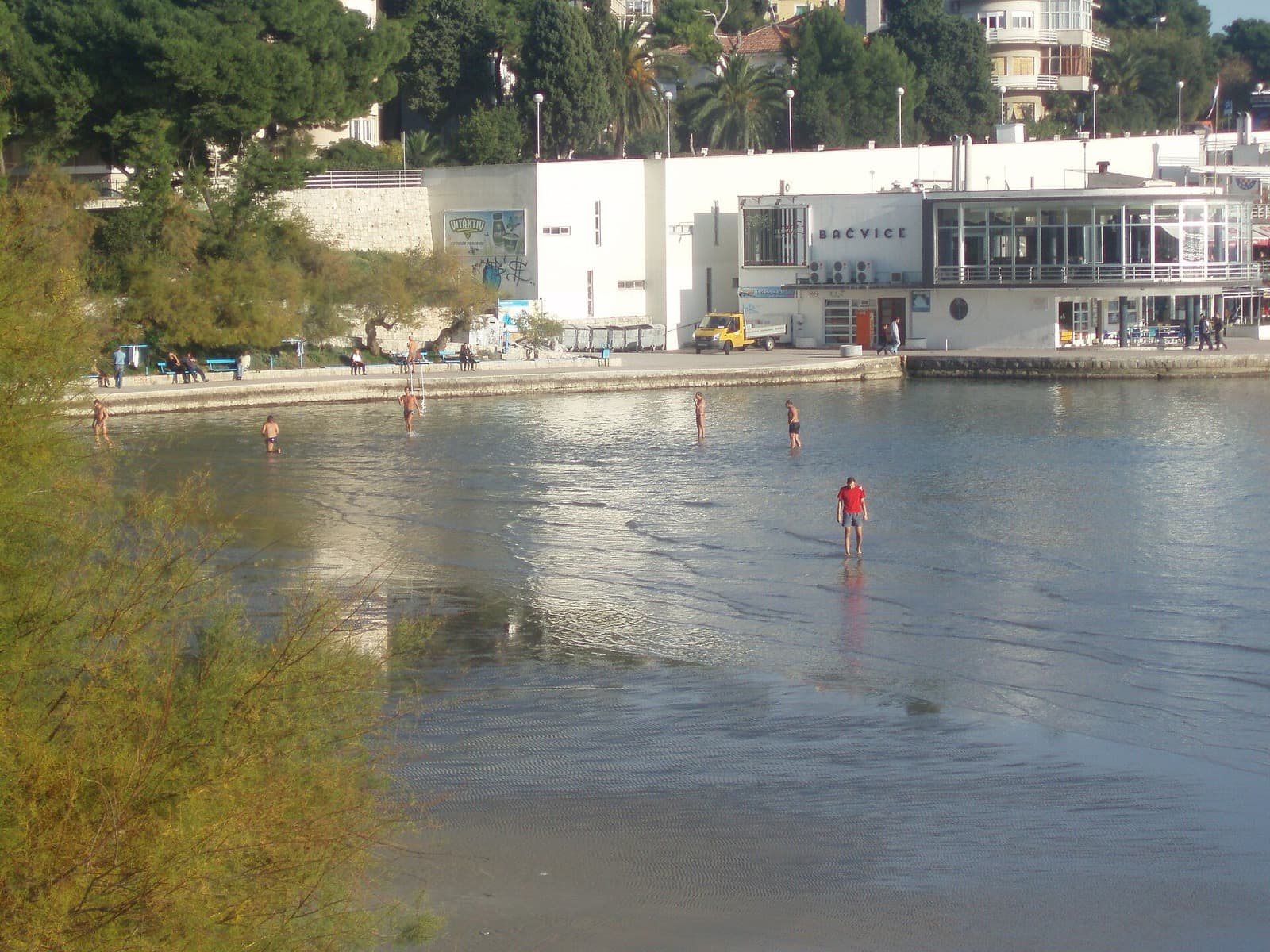
Picigin at Bacvice: The Shin-Deep Game That Explains Split
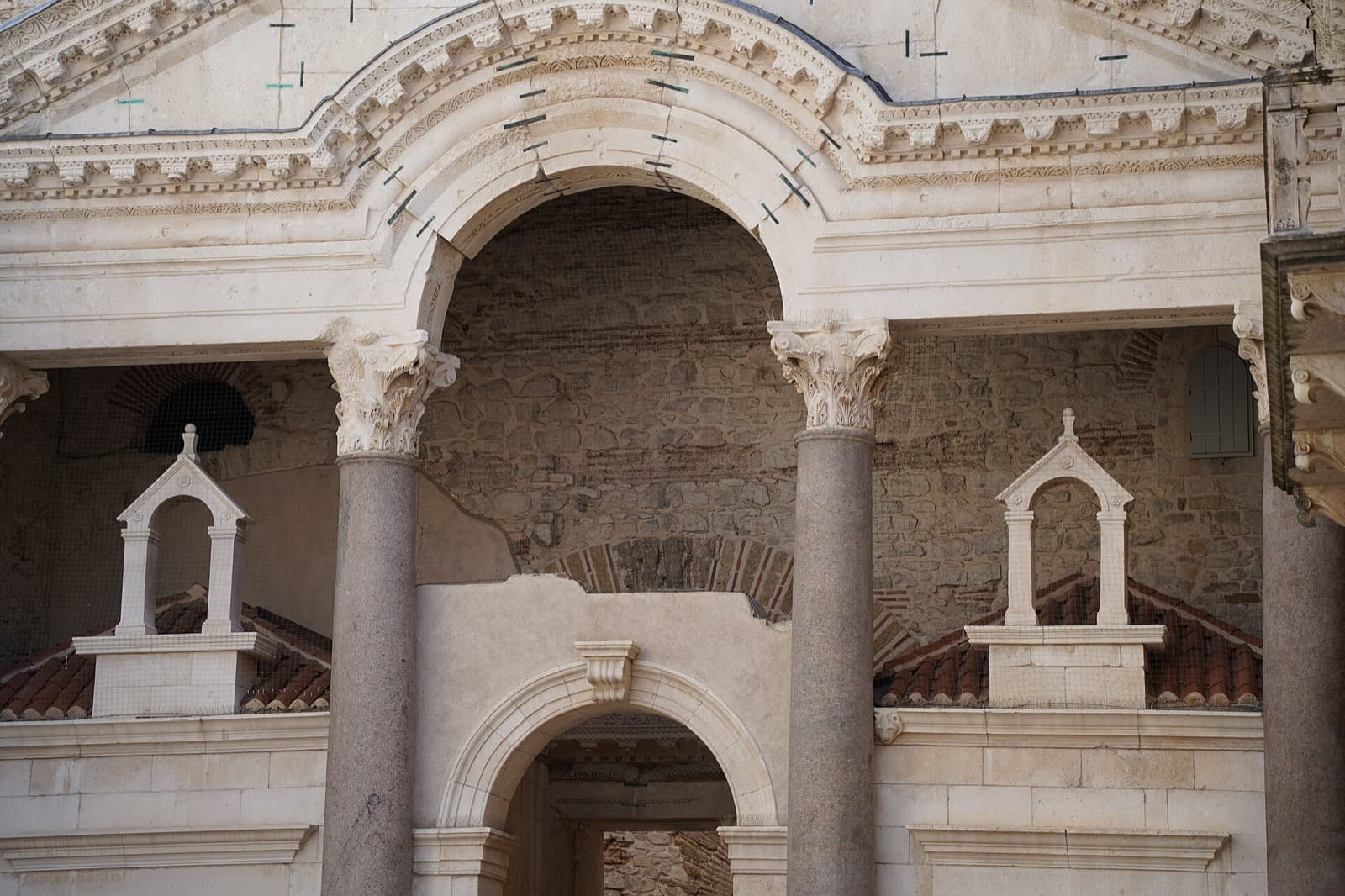
The Peristyle in Split: The Roman Court Where an Emperor Played God