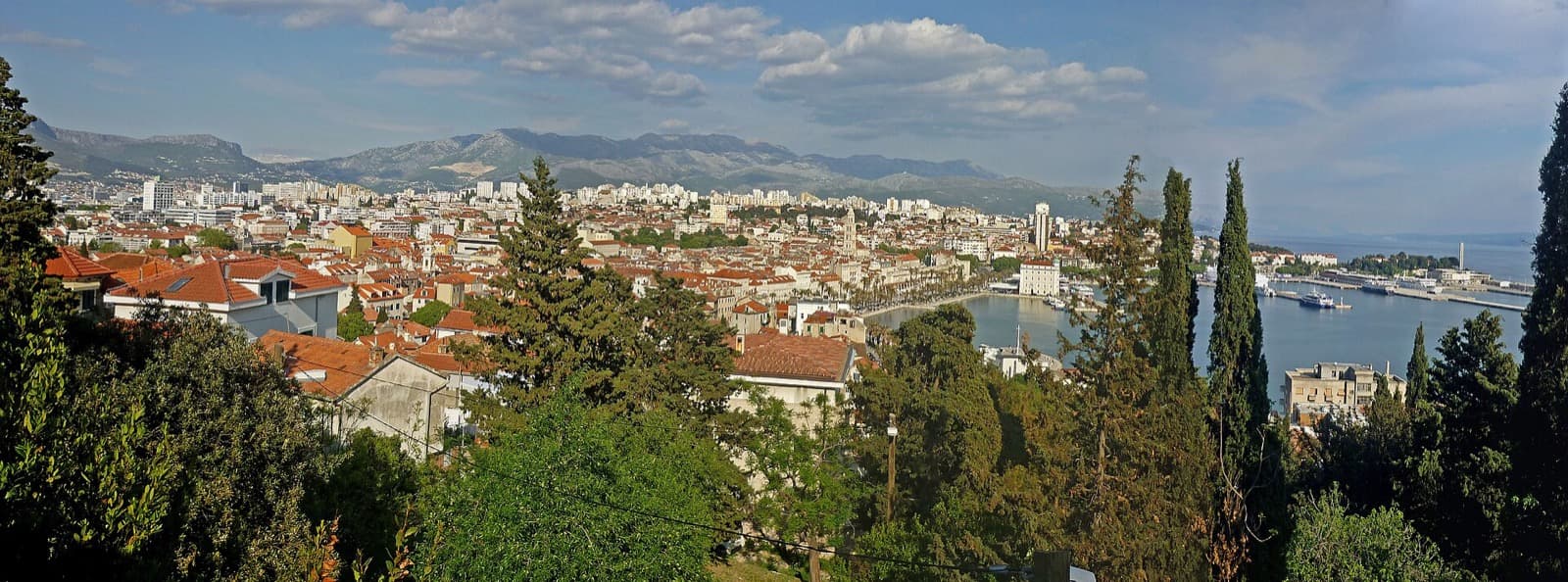
Most people arrive in Split for one reason: the marble palace a Roman emperor built for his retirement, its southern wall still standing against the sea. The Marjan summit at Telegrin, 178 metres above that water, is the payoff of a walk that turns its back on all of it. To climb Marjan is to trade the emperor's carved marble for pine, stone, and a working city that grew up beside him. By the time you reach the top, you have passed the fishermen's stone lanes and the hermit's cliff and arrived at a green hill the city calls its lungs and its soul. This is the second Split, the one that hides behind the palace, and the summit is where it finally opens up.
The name on the summit tells the whole story
Telegrin is not an ancient word. It comes from a telegraph station that stood on this exact summit in the Napoleonic era, using the height above town to relay signals down the coast. That single detail is a good way to understand Marjan: a green point that has always been useful, watched, and set apart from the crowded city below. Today the top carries a large white stone cross and a Croatian flag, and around them the forest runs in every direction. Marjan has been a protected forest park since 1964, which is exactly why the whole peninsula stayed wooded while the town at its foot filled with stone.
From the summit the coast lays itself out. Split sits small against the water below you. Beyond it the wide blue Adriatic opens, and out on that blue are the offshore islands: Brac, Solta, and Hvar, with Ciovo closer in. On a clear day it feels as though the entire seaboard gathers into one green vantage point. This is the physical and spiritual high point of the walk, and it earns that title honestly, because you have to climb for it.
The climb is the argument
Hear a stop from this walk
The Southern Shore: Where Forest Meets the Sea
The reason the summit lands so hard is everything you walk through to reach it. The route starts at sea level on the Riva, Split's palm-lined marble waterfront running about 250 metres along the palace's sea-facing wall. Locals call it the city's living room, and in the evening you understand why: the whole town comes down to stroll it slowly over coffee. It is not a monument you look at. It is a place you join. Everything from there is uphill.
Just west, the Prokurative gives you a taste of borrowed grandeur. Officially Trg Republike, or Republic Square, it is a three-sided arcaded space built to imitate the Procuratie that ring St Mark's Square in Venice. The long-serving nineteenth-century mayor Antonio Bajamonti, who lived from 1822 to 1891, drove the project, and the central building went up in 1859. It once held a theatre, which burned down in 1882. So here is a city dressing itself in a rival's elegance across the water. Hold that thought, because the next turn climbs into a Split that had no grandeur to borrow at all.
That is Veli Varos, the quarter of the people the palace left out: fishermen, stonemasons, and laborers, some fleeing Ottoman raids inland. They built small, tightly packed Dalmatian houses of pale stone, many from the seventeenth century, laced together with stepped lanes barely wide enough to pass. Set among them is the little Romanesque Church of Saint Nicholas, known locally as Sveti Mikula, whose twelfth-century western doorway names the ordinary citizen who endowed it, a man called Ivan, together with his wife Tiha. Their names sit in the stone of a working neighbourhood, not a palace. These lanes are lived in still, laundry strung overhead and cats in the shade, so move quietly and let people pass.
Then the town gives way to the hill. A stone stairway of roughly three hundred steps lifts you to the Vidilica, the first great viewpoint, where you turn and see for the first time how far you have risen: red roofs, harbour, the palace you left, and the sea beyond. On the slope just below lies something older and quieter. The Old Jewish Cemetery was established in 1573, when the city granted a Sephardic community, descended from refugees expelled from Spain and Portugal, this ground on the hillside. It holds more than seven hundred low tombstones with Hebrew inscriptions, its last burial in 1945, and it is the oldest Jewish cemetery in Croatia. Treat it as heritage, with quiet respect, not as a view to consume.
Higher still, where pine gives way to bare grey cliff, you reach the churches cut into the rock. The Church of Saint Jerome, known as Sveti Jere, was built in the second half of the fifteenth century and dedicated to the patron saint of Dalmatia. Its Renaissance altar was carved and signed by the sculptor Andrija Alessi in 1480, with a Pieta relief set into the arch above. Beside it, walled directly into the cliff, are the cells and caves where hermit monks once lived in prayer and solitude. A nearby church, Our Lady of Bethlehem, known as Gospa od Betlema, predates 1500, from the era of the Split writer Marko Marulic. This is the quiet, contemplative layer, the Split that traded even the fishermen's stone for pure solitude. These are working churches, so keep your voice low and shoulders and knees covered when they are open.
Why the summit changes how you see Split
Stand at Telegrin and think about where you began: at sea level, on the marble promenade below the emperor's wall. You have climbed past the fishermen's stone, past the hermit's cave, and arrived at ground that belongs to no emperor and no quarter, just pine and rock and open sea. The palace, from up here, is one small marble box against a much larger city and coast. That shift is the entire point of the walk, and it only works if you make the climb.
The route does not end at the top. The descent carries you back to the sea on the hill's far, quiet side, where the forest runs straight down to the water. Kasjuni is a pebble cove of about 300 metres, roughly three kilometres from the old town, backed entirely by the park's pine and cypress and known for its clear turquoise water. The same Adriatic that lapped the marble promenade at the start now laps a forested shore, softer and almost private. That symmetry is the resolution: marble to pine, and back to the water on the quiet side.
If you want the full route with the pacing, the steps, and every stop set to audio, start with Split walking tours or browse what else the city holds at Split. This is a genuine uphill walk, around three hundred steps to the first viewpoint and more to the summit, so wear grippy shoes, carry water, and go entirely at your own pace. Aim to reach Telegrin before sunset for the clearest island panorama, then walk it back down while there is still light on the paths.
Sources
- Marjan, Split (Wikipedia): summit elevation, Telegrin name and telegraph origin, and the 1964 forest-park designation.
- Visit Marjan official site: the hill as the city's forest park and green heart, plus its small churches and hermit history.
- Split Synagogue (Wikipedia) and ESJF cemetery survey: the Old Jewish Cemetery's 1573 founding and Sephardic origins.
- Antonio Bajamonti (Wikipedia): the mayor behind the Prokurative and its Venetian-inspired construction dates.
- Split Tourist Board (visitsplit.com): the Riva, Veli Varos, and the small churches of Marjan as visitor context.
Ready to experience it?
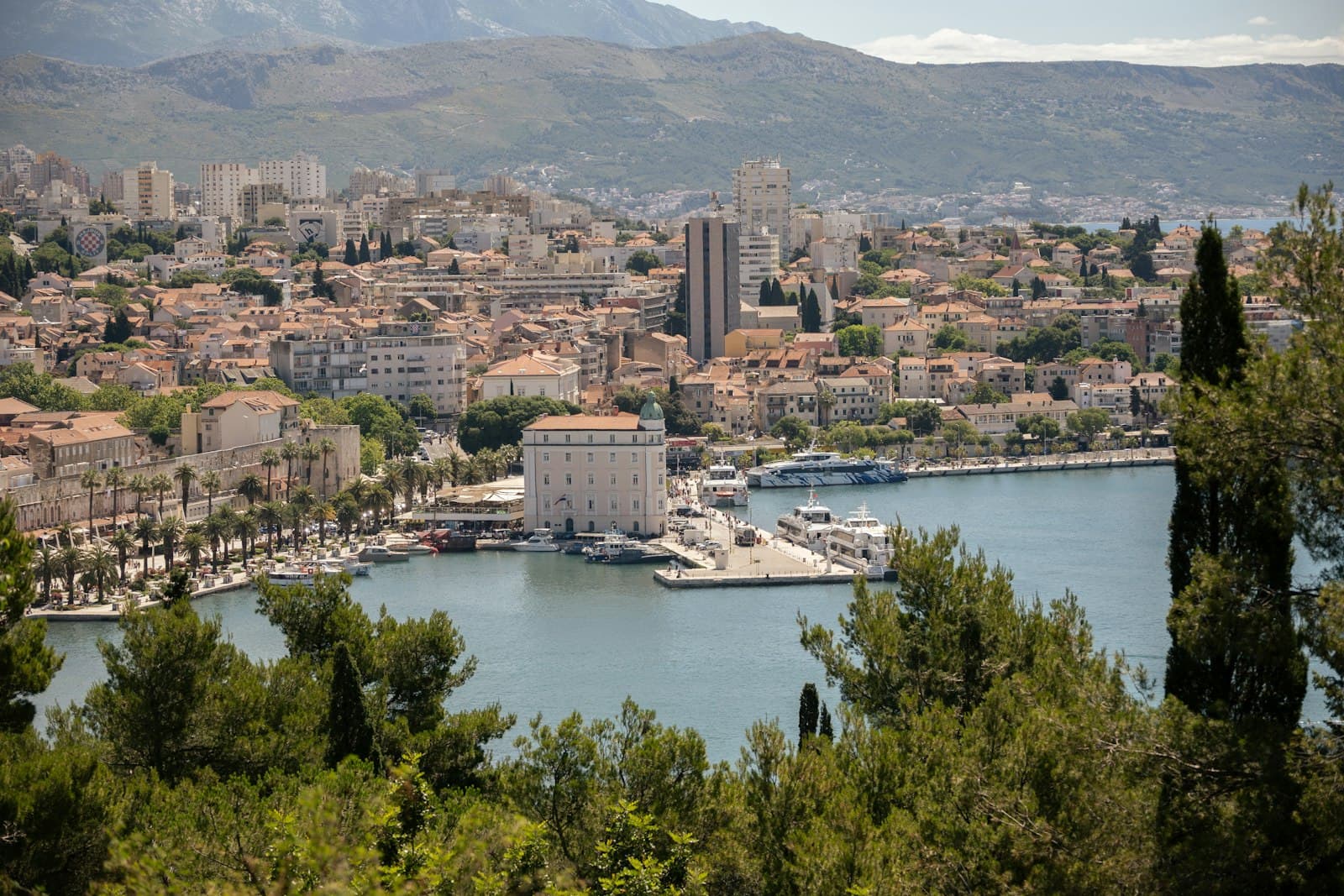
Varos and Marjan Hill: The Fishermen's Hill
150 min · 6.4 km · challenging
More from Split
Explore more at your own pace.
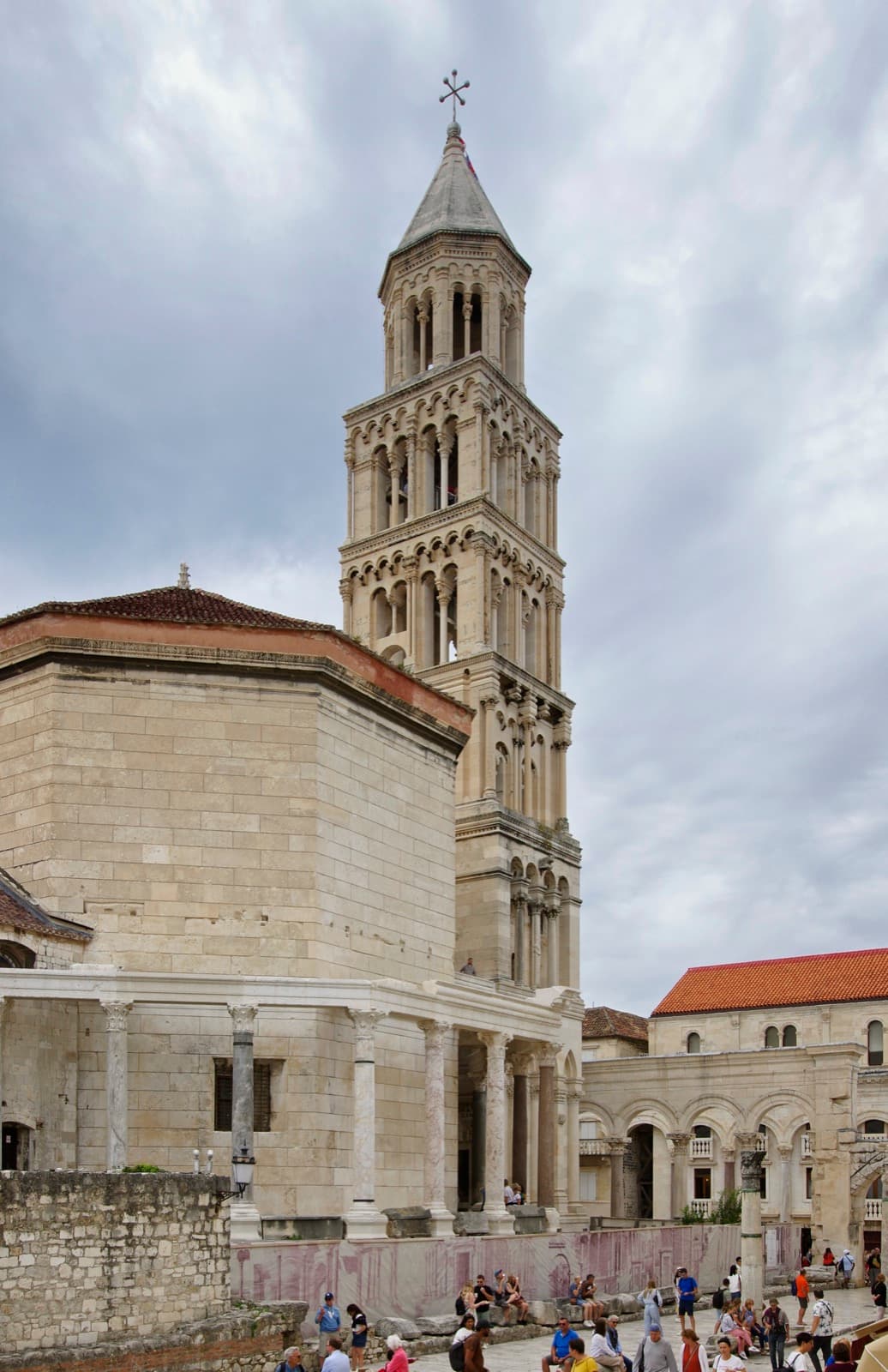
One Day in Split: A Walkable Morning-to-Evening Itinerary
Split: The City That Moved Into an Emperor's Palace
Picigin at Bacvice: The Shin-Deep Game That Explains Split
The Cathedral of Saint Domnius: How a Persecutor's Tomb Became His Victim's Church
The Peristyle in Split: The Roman Court Where an Emperor Played God