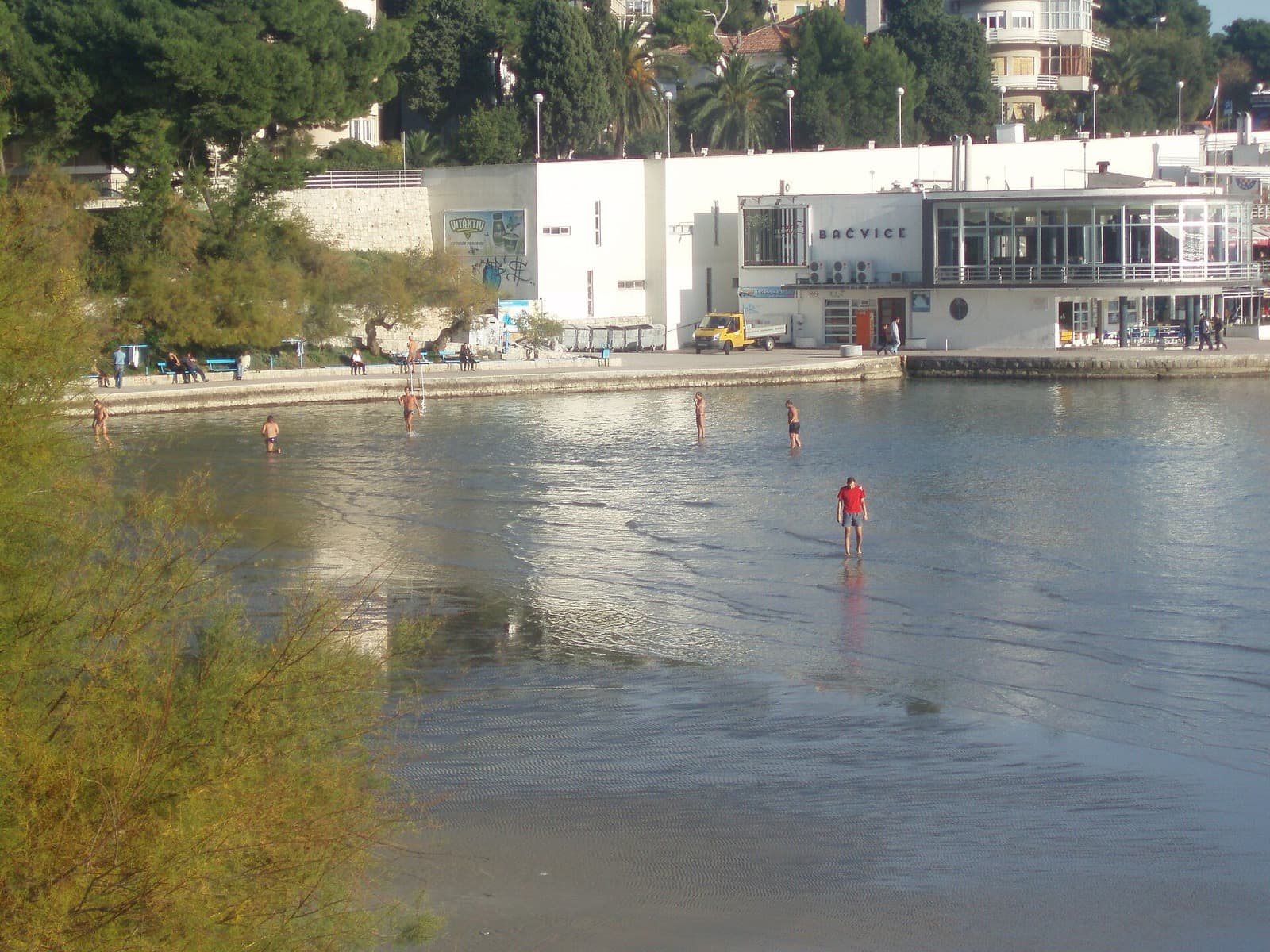
Picigin, a ball game invented on Bacvice beach in 1908, is the plainest key to understanding Split. Watch a handful of players stand in a loose circle in shin-deep water and bat a small ball with the flat of their palms, keeping it in the air for no reason but the pleasure of it, and you have already understood the argument that a whole market-and-water's-edge walk through the city is trying to make. Split is famous for a palace an emperor built himself, a Roman monument so complete that people have lived inside it for seventeen centuries. But the city shows its real face a few steps beyond those walls, in the everyday, sensory Split of green markets, fish halls, fishermen's slips, and a shallow bay where a hundred-year-old game is still played every day.
A game made from a limitation
The story of picigin is short and perfect. In 1908, a group of Croatian students came home from Prague wanting to play water polo. The water at Bacvice was too shallow for it, ankle-deep and then shin-deep, warm and gentle, stretching a long way out before it ever reaches your knees. Instead of giving up, they made something new. They took a tennis ball, stripped off its felt, and polished it down a few millimetres so it would fly lighter and truer. Then they invented a rule: you may not catch the ball, only strike it, again and again, so that it never touches the water.
That constraint is the whole game. Traditionally about five players spread into a rough circle and keep the ball alive with open palms. There are even named roles: the sidrun, the anchor, who holds a position, and the trkac, the runner, who chases down the balls that get away. The best players throw themselves flat across the surface in spectacular diving saves, and this is the point rather than an accident of it. The entire spectacle is built on doing very little, a ball and your hands, with enormous grace.
There is a real institutional life behind the play. Picigin was declared a protected Croatian intangible cultural good in 2008, and that status was confirmed in 2013. A World Championship has been held right here on Bacvice every year since 2005, and from 2008 the winner has been chosen partly on artistic impression, which tells you everything: this is a competition that rewards how beautifully you do a small thing, not how hard you hit.
Why the whole tour lives in that shallow water
Hear a stop from this walk
Bacvice and the game of picigin
Once you have watched a round of picigin, the rest of Split reads differently. The game is the living heart of a route that begins at the eastern edge of the Roman palace and ends on a quiet green headland, and every stop along the way is another version of the same idea: the ordinary done well, close to the water.
It starts at the Silver Gate, the eastern gate of Diocletian's Palace, whose historic centre was inscribed as a UNESCO World Heritage Site in 1979. The gate itself has a strange biography. It was walled up from the medieval period onward, sealed and forgotten for centuries, and only reopened in 1952 after a Baroque church that had grown against it, damaged in wartime bombing, was demolished. So the doorway is at once seventeen hundred years old and, in its open form, younger than the city's living memory. And residents use this gate more than any other, because it opens straight onto the daily market.
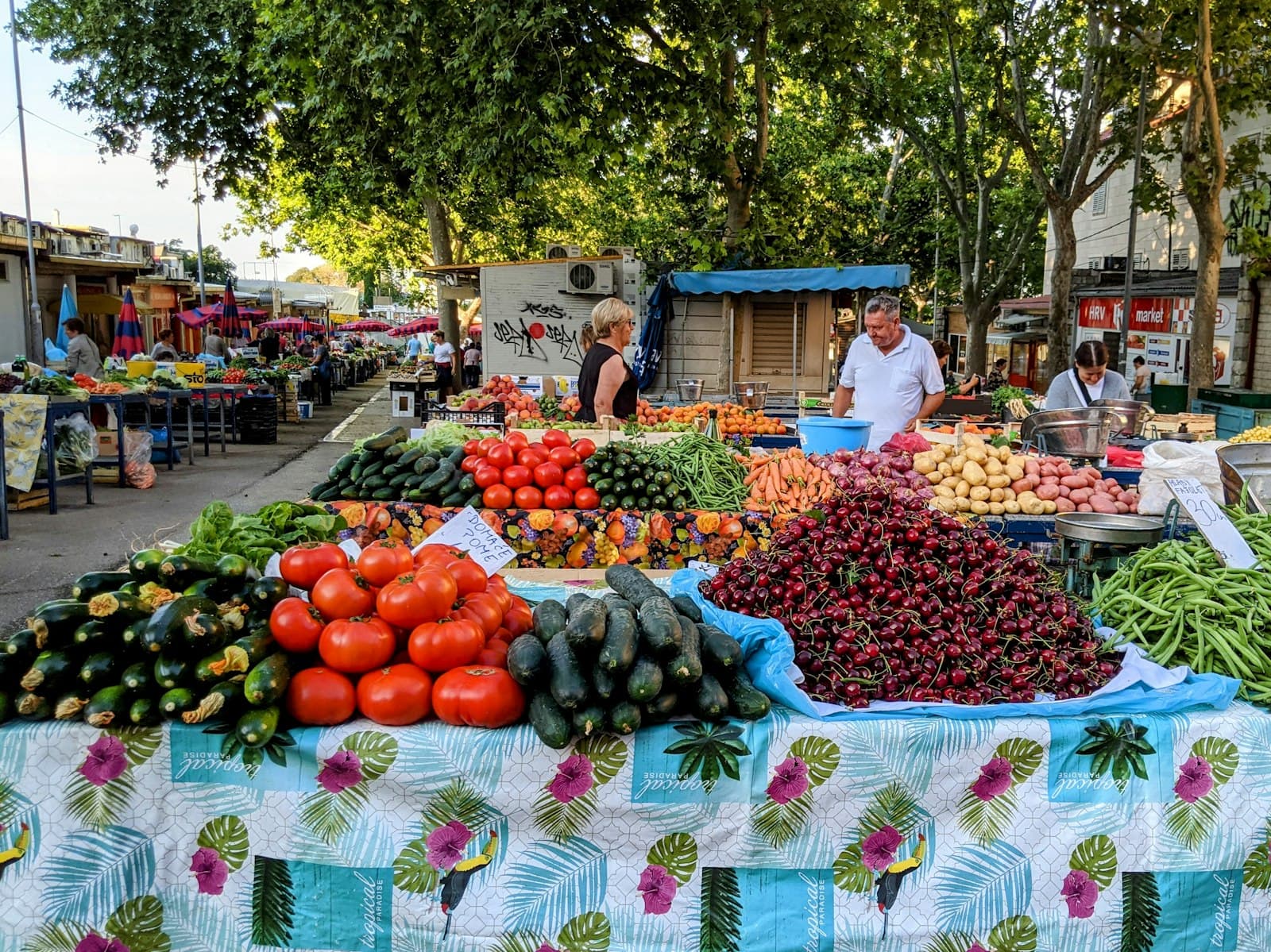
That market, the Pazar, is the sensory heart of the walk. Its stalls run in a long ribbon directly against the ancient eastern wall, so the awnings and crates literally lean on Roman stone. Farmers come down from the Dalmatian hinterland every morning and sell whatever was ripe that week: tomatoes and figs, olive oil in reused bottles, honey, cheese, bundles of lavender. It runs daily, weekends included, from early morning into the early afternoon. The official tourist office points to the noise itself, the yelling and the bargaining, as the thing that makes it feel like living Dalmatia rather than a staged attraction.
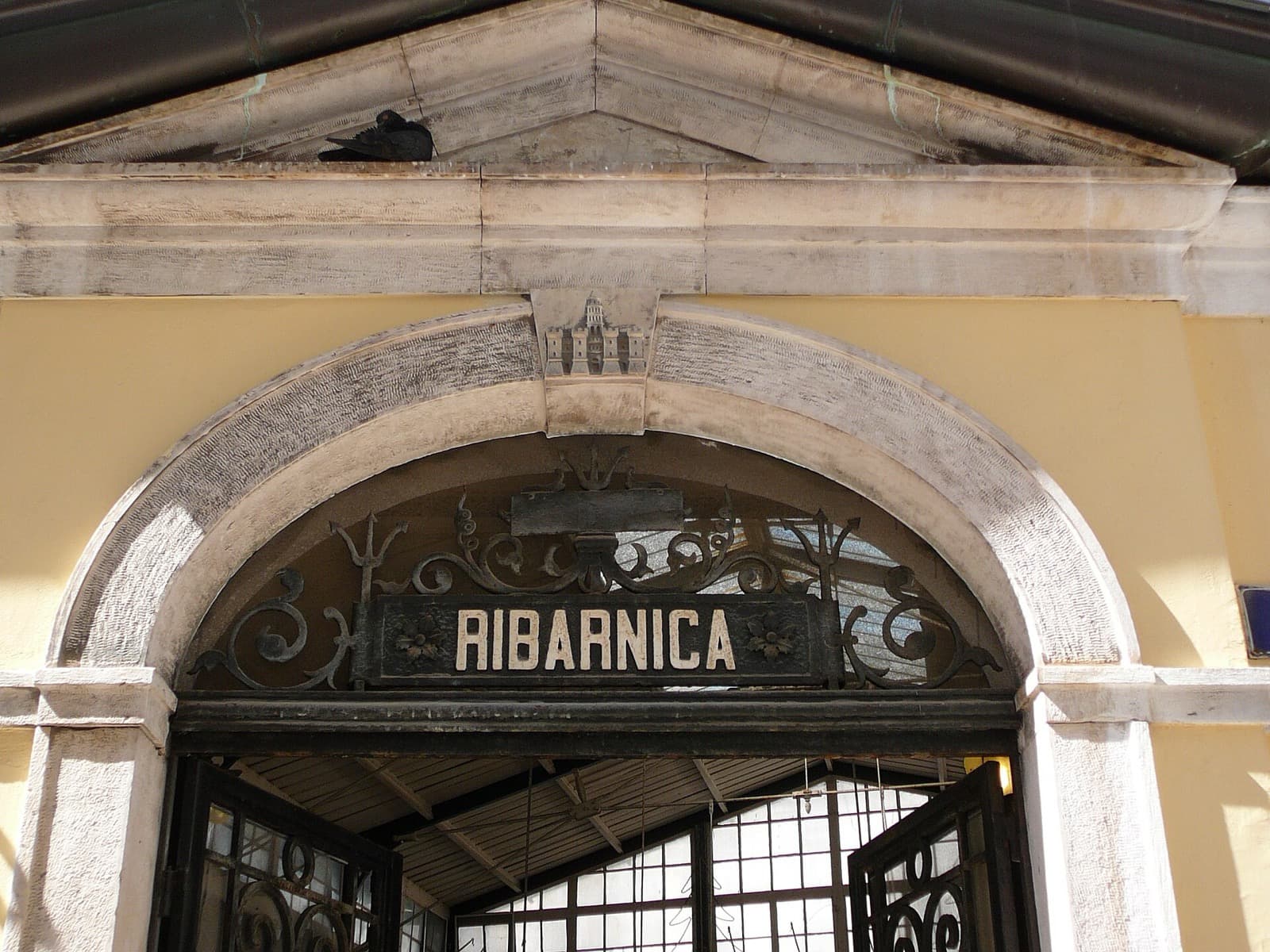
West of the palace, the Fish Market carries the sea's half of the same larder. It is a covered hall built in the Secession style, the Central European branch of Art Nouveau, and it has stood for more than a hundred years. The local legend is worth telling as exactly that, a tradition rather than a fact: Splitcani will tell you with straight faces that no fly ever enters the hall, a quirk they blame on the sulphur smell of a neighbouring thermal spring. The same folklore claims those springs were among the reasons the emperor Diocletian, said to be troubled by rheumatism, chose to settle here.
Then comes Fruit Square, popularly Vocni trg, where a fifteenth-century octagonal Venetian tower stands beside a bronze statue of Marko Marulic, born in 1450 and called the father of Croatian literature. His Judita, completed in 1501 and printed in Venice in 1521, was the first printed work of secular literature in the Croatian language. The statue is the work of the sculptor Ivan Mestrovic, unveiled in 1925. This is the tour's turn: a square that once fed the town's body now feeds its sense of who it is.
Before the beach, the route pauses at Matejuska, the small working fishermen's slip at the western end of the Riva. For centuries, fishermen came down the slopes of Marjan and Veli Varos before dawn to launch wooden boats for sardines, and they still do. A monument shaped like a large fish hook honours the act of setting out to sea. Come at golden hour, when the light goes amber on the water and the paint of the boats.
The plainest thing Split does
After Bacvice, the walk exhales at Sustipan, a pine-shaded headland southwest of the harbour. It carries many layers: a medieval Benedictine monastery abandoned by the fourteenth century, then the city's communal cemetery from 1832, cleared after the Second World War when burials moved to Lovrinac. A single classicist gloriette survives among the pines, and the view opens back over the harbour toward Marjan and out to the Adriatic islands of Solta and Brac.
That view is the resolution of everything the tour has been arguing. Split has never been far from two things: the pines above and the sea below. A hundred years after those students invented their game, you can still stand on an ordinary afternoon and watch strangers keep a small ball out of shin-deep water, laughing, for no reason but the pleasure of it. If you want to walk the whole route from the Silver Gate to the headland, the app carries you stop by stop. Browse the full set of Split walking tours, or start planning from the Split city page.
Sources
- Picigin, Wikipedia: origin on Bacvice in 1908, rules, roles, and the 2008 and 2013 heritage status.
- Visit Split tourist office (Pazar, Fish Market, Vocni trg, Sustipan pages): descriptions of the markets, fish hall, square, and headland.
- Marko Marulic, Wikipedia and Encyclopaedia Britannica: dates, Judita, and status as the first printed secular work in Croatian.
- Sustipan, Wikipedia and Split tourist office: the monastery, 1832 cemetery, postwar clearing to Lovrinac, and surviving gloriette.
- Silver Gate (Diocletian's Palace), Wikipedia: walled up from the medieval period, reopened in 1952, and the 1979 UNESCO inscription.
Ready to experience it?
Pazar Market and Bacvice: The Everyday City
120 min · 4.1 km · moderate
More from Split
Explore more at your own pace.
One Day in Split: A Walkable Morning-to-Evening Itinerary
Split: The City That Moved Into an Emperor's Palace
Marjan Summit: Why Split's Green Hill Is the Walk That Turns Its Back on the Palace
The Cathedral of Saint Domnius: How a Persecutor's Tomb Became His Victim's Church
The Peristyle in Split: The Roman Court Where an Emperor Played God