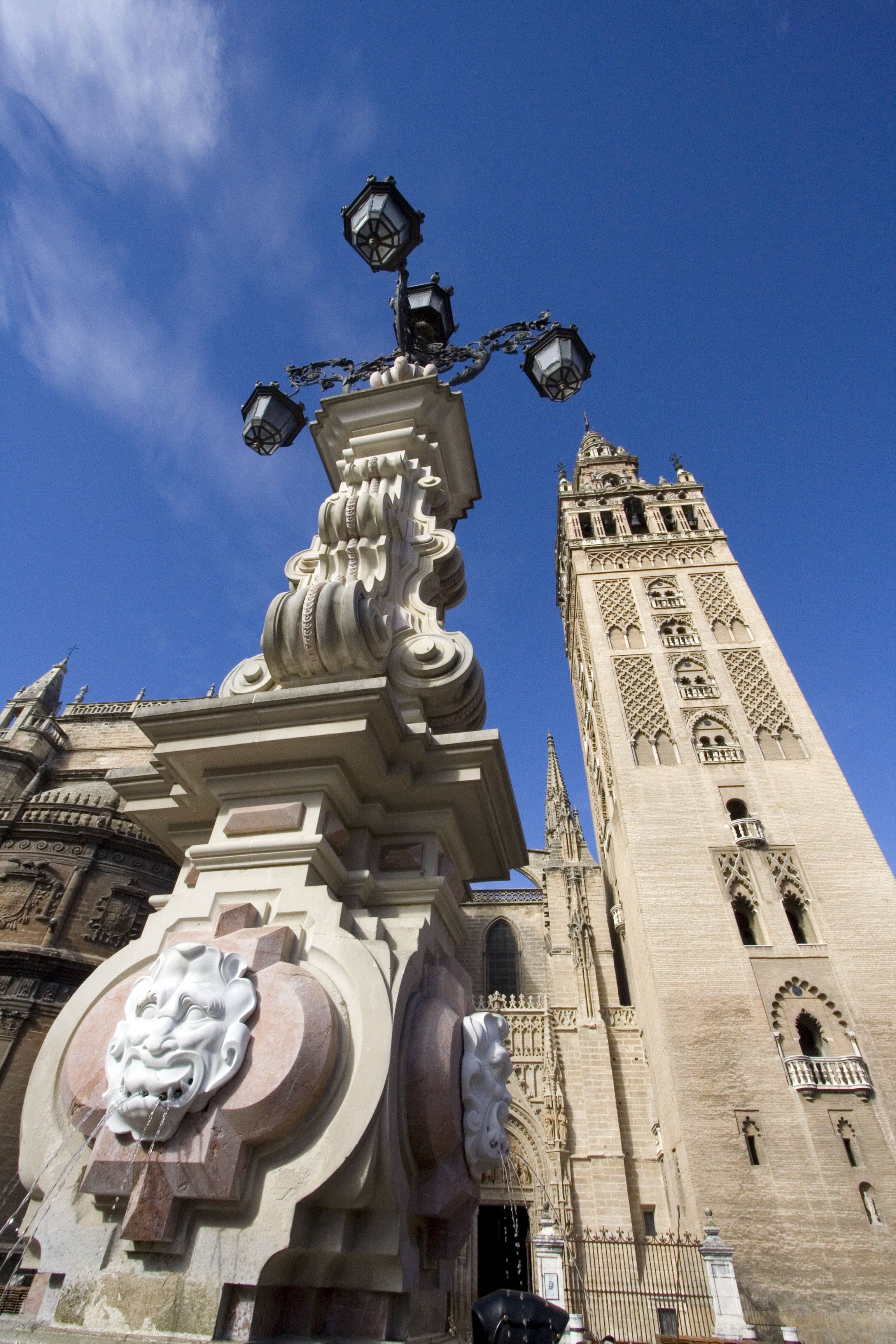
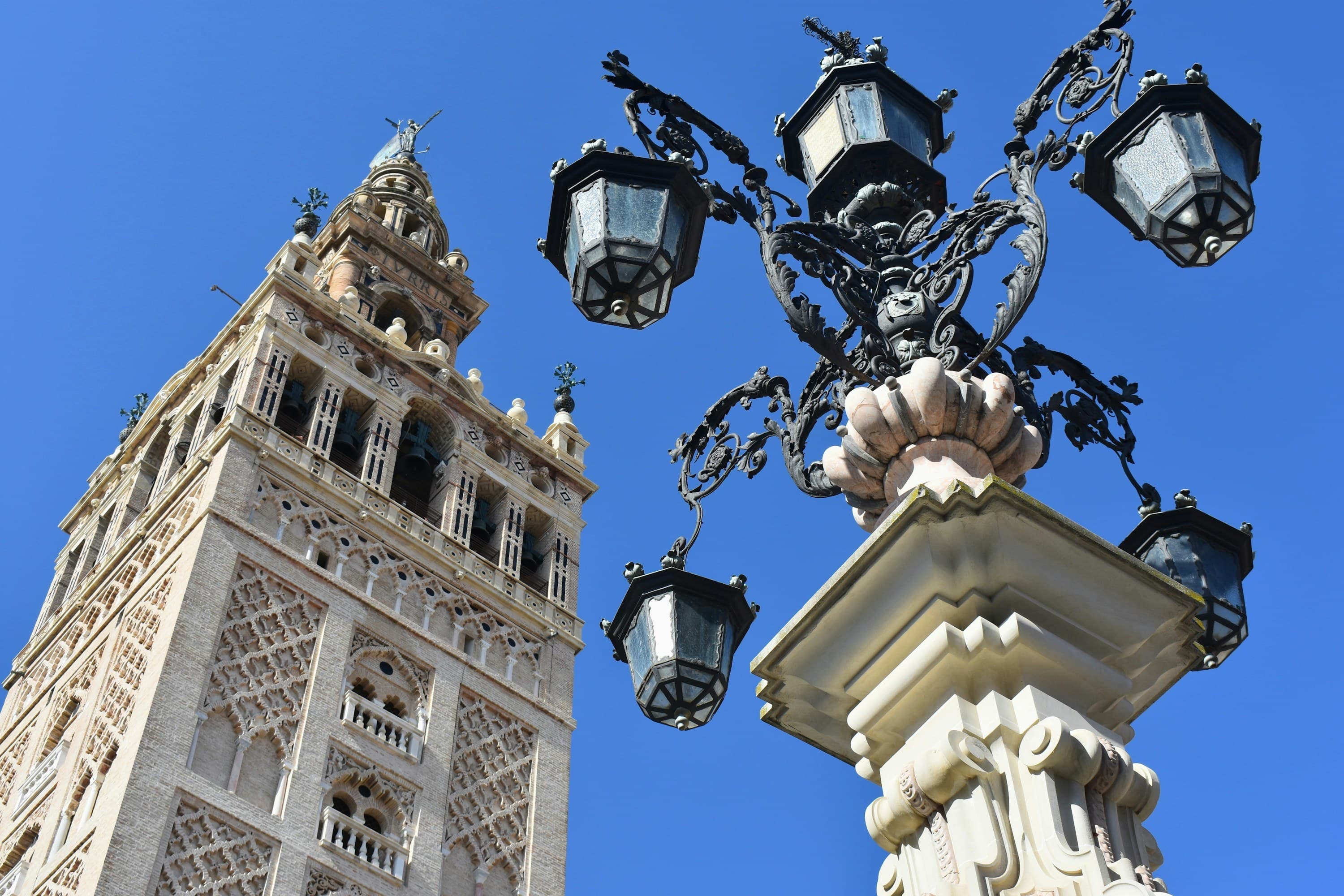
Stand at the far side of the Plaza Virgen de los Reyes, not at the foot of the tower, and look up the Giralda's brick shaft. You are looking at two civilizations stacked in one tower, with a visible seam between them. The usual line is that the Giralda survived, whole, because Castile chose not to pull it down. Half of that is true. The shaft survived the conquest. The head did not survive the weather.
The lower 50 metres: an Almohad minaret
The bottom of the tower, roughly the lower fifty and a half metres of brick, is a minaret built for the great mosque of Almohad Seville. The documentary spine is unusually complete. The caliph Abu Yaqub Yusuf commissioned the mosque and minaret in 1171. The foundations were dug in 1184 by the master builder Ahmad ibn Baso. The main brick body was raised by Ali al-Ghumari, a Maghrebi Berber architect. The top secondary shaft was completed on the tenth of March, 1198, by Abu Layth al-Siqilli, a Sicilian, under the caliph Abu Yusuf Yaqub al-Mansur, to commemorate a victory over Castile four years earlier. Three architects, one Almohad master-builder team, fourteen years of construction, one brick tower.
The brick texture you can read at eye level was laid by Muslim hands in the 1190s. It is the same tower a muezzin once climbed to call prayer over al-Andalus.
The head that came off in 1356
Hear a stop from this walk
Puerta del Perdon: Arabic on a Cathedral Door
Castile took Seville in 1248 under Ferdinand the Third, and the conqueror made a choice that defines the whole city: he did not demolish the minaret. He kept it as the cathedral's bell tower. That much of the standard story is exactly right, and it held for a century.
Then, on the twenty-fourth of August, 1356, an earthquake threw down the tower's dome and the metal finial above it. The shaft stood. Its head did not. For roughly two centuries the Giralda carried a makeshift belfry instead, until Hernán Ruiz the Younger designed the Renaissance crown it wears today. The Giraldillo, the bronze weathervane from which the tower takes its name, went up in August 1568, the works were signed off in February 1569, and the architect was dead by that April.
So when someone tells you the Giralda survived the 1356 earthquake, correct them gently. The tower survived. What is on top of it is a replacement, added two hundred years after the damage, by a third set of hands.
That still leaves the seam you can see from the square: the brick below laid by Muslim builders in the 1190s, the stone above by Christian builders in the 1560s.
Why the tower survived when the mosque did not
The Giralda's survival is pointed, because the mosque it belonged to did not survive. The building was converted for Christian use in 1248 and served as the cathedral for the best part of two centuries. Then, in 1433, demolition of the prayer hall began. What the Gothic cathedral inherited from the mosque was its outline and part of its foundations, not its fabric. Two pieces of the original complex were kept standing: the minaret, now the Giralda, and the courtyard of orange trees, the sahn, now the Patio de los Naranjos. Our companion to the Cathedral, Giralda and Alcázar walk follows the full sequence of what was kept and what was cleared.
So the tower is not a survivor by accident. It was spared twice: once by the conquerors of 1248 who adopted it as a bell tower, and again by the cathedral builders of the fifteenth century who took down the prayer hall around it. That is a real continuity, and it is narrower than the postcard version. Seville kept the outline and rebuilt the rooms.
What to do with this at the tower
The Giralda is stop nine of our Cathedral, Giralda and Alcazar: Nobody Here Started From Nothing walk, approached along the Alcázar wall so the tower arrives all at once, and the Puerta del Perdón beside it is stop ten. Both are free public ground, as every stop on that route is.
Two practical things. Stay at the far side of the square: from the foot of the tower, less than sixty metres on, you get a crick in the neck instead of a tower. And the best framed shot on the whole walk is not from here at all but from the south end of the Patio de Banderas, looking back through the arch you came in by. The deeper reason Seville accumulated rather than erased is set out in our thesis on the port that monopolized the New World.
Ready to experience it?
Cathedral, Giralda and Alcazar: Nobody Here Started From Nothing
90 min · 1.6 km · easy
More from Seville
Explore more at your own pace.
One Day in Seville: A Walkable Old-Town and Triana Itinerary (2026)
Seville Travel Guide: How Many Days, Getting Around, When to Go (2026)
The Port That Monopolized the New World: How Seville Ran an Empire From One River Bend
Nobody Here Started From Nothing: A Companion to Seville's Cathedral, Giralda and Alcázar
The Casa de Contratación Was Never in This Building