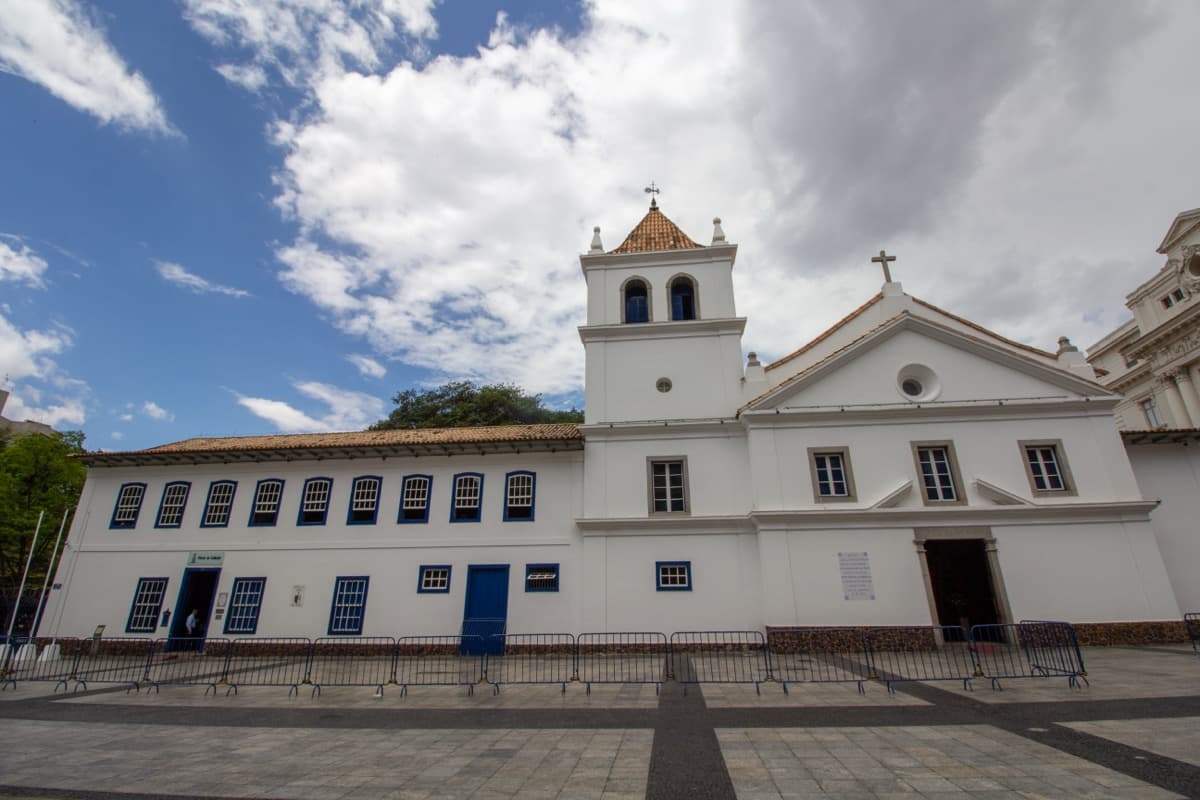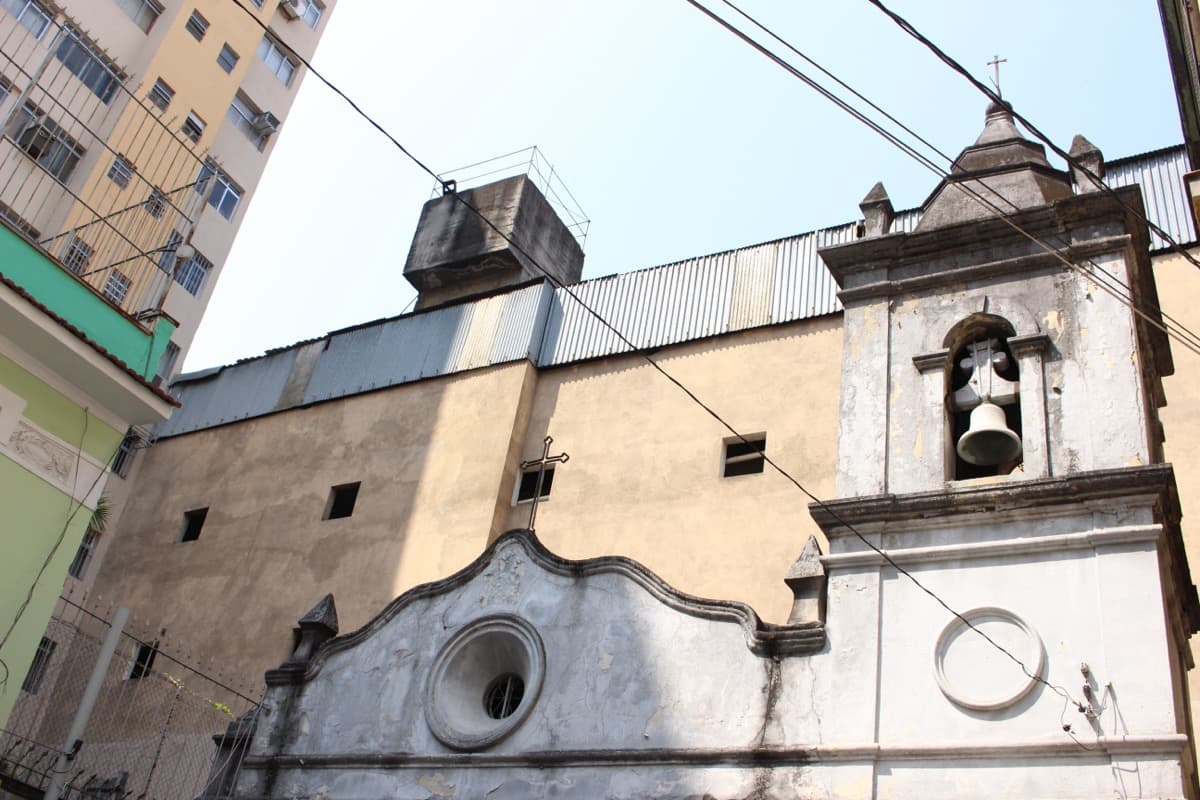
The Capela dos Aflitos marks where São Paulo's first public cemetery buried the enslaved and the executed, which means the joyful Japanese quarter of Liberdade is a living neighborhood built directly over a ground of death. Most people who photograph the red lanterns and the nine-metre torii never learn this. They walk a shopping street that was once the field of the gallows, and they eat weekend food over the site of a demolished burial ground. The small colonial chapel on Rua dos Aflitos is the one structure still standing that remembers.
A chapel beside a graveyard
The Capela dos Aflitos, the chapel of Our Lady of the Afflicted, is one of the few colonial-era religious buildings left in a city that rebuilt almost everything around it. Its cemetery ground opened in October of 1775, and the chapel itself followed in 1779. Beside it, and now beneath the surrounding streets, stood the Cemitério dos Aflitos, described in the Portuguese-language record as the first public cemetery of São Paulo. The ground was built between 1774 and 1775, and burials began in 1779.
The word public deserves a small qualification. The cemetery operated under the supervision of the Catholic Church and was, in strict administrative terms, never fully public. But it was the first ground the city set aside for common burial, and it served the people the city pushed to its margins: enslaved men and women, those who had been whipped, those who had been hanged, and the destitute. This was not a place for the comfortable dead. It was where the city put the bodies it did not want to keep.
Why a neighborhood sits over a grave
Hear a stop from this walk
Feira da Liberdade: The Gallows Ground, Now a Table
The cemetery did not last. It was deactivated in 1858, when the Consolação cemetery opened and gave São Paulo a larger, more central place to bury its dead. In 1883 the old site was demolished outright. Its remains were removed, and its land was subdivided and sold. That single administrative decision is the reason a living quarter now sits over a burial ground. The graves were cleared, the plots were parceled out, shops and homes went up, and within a few decades an entirely different community was living on the surface.
That community was Japanese. The first Japanese immigrants reached Brazil in 1908, aboard the ship Kasato Maru, and from 1912 many of them settled in this district, drawn by cheap rooms near the center. They were building a home over ground that the eighteenth century had reserved for the executed and the poor, though few of them would have known the full weight of what lay underneath. The chapel stayed. The cemetery did not. And so the honest way to read Liberdade is as two districts stacked on the same footprint: a ground of death, slowly and deliberately made into a ground of belonging.
The legend of Chaguinhas
Every honest history has a place where the record and the legend meet, and here that place has a name: Francisco José das Chagas, remembered as Chaguinhas. He was a Black soldier from Santos, condemned for taking part in the Motim de Santos, the Santos revolt of 1821. The revolt began over soldiers' pay, and specifically over the demand that Brazilian and Portuguese troops be paid equally. Chaguinhas was one of its figures. He was brought to São Paulo, condemned, and executed here at the gallows square that is now the Largo da Liberdade, on September 20, 1821.
Then the story turns. The rope broke. It was tied again, and it broke again. The accounts say Chaguinhas faced the gallows three times, and that the crowd, watching a man survive his own hanging, began to cry out Liberdade. Some hold that this cry gave the district its name. Others say the crowd saw death itself as the only road to freedom for a condemned man. The record supports both readings and settles neither. What is documented is the execution, the revolt, and the ropes that would not hold. What grew around those facts is popular memory, and it is worth keeping the two apart.
The devotion, though, is entirely real and entirely present. People still knock three times on the chapel door and leave a written request for Chaguinhas. It is a quiet, persistent custom, passed down for generations, and you can see the evidence of it if you look. A folk saint, a broken rope, and a chapel door that has heard three knocks countless times over.
Reading the ground twice
What makes this chapel worth a stop, and worth an article of its own, is that it holds the district's contradiction in one small building. The name Liberdade, meaning freedom, was first attached to a square whose principal function was public execution. Executions were carried out at the Campo da Forca until 1891, and only then was the ground renamed Praça da Liberdade. The lanterns and the torii came later, in the 1970s, layering an Asian-quarter identity over an execution ground that had already been renamed for a freedom it never offered the people buried below.
Stand at the chapel and you can feel the whole overwriting at once. Below you: the enslaved, the whipped, the hanged. Around you: a working immigrant district that arrived by sea and settled room by shared room. This is not a place that resolves into a single story, and the walk it belongs to does not try to make it. It asks you to hold both truths, the cemetery and the community, without collapsing either into the other.
If you want to read the ground this way for yourself, the Capela dos Aflitos is the second stop on a short loop through the district, a walk that begins at the square, descends into this death layer, and then climbs back to the weekend fair to see the same ground transformed. You can find the district and its tours on the São Paulo city page.
Sources
- Cemitério dos Aflitos, Portuguese Wikipedia. Construction between 1774 and 1775, first burials 1779, deactivation after the Consolação cemetery opened in 1858, demolition 1883, and its status as São Paulo's first (though never fully public) common cemetery for the enslaved and executed.
- Capela dos Aflitos, Portuguese Wikipedia. The chapel of Nossa Senhora dos Aflitos, its opening on October 3, 1775, the church built in 1779, and its survival as one of São Paulo's rare colonial ecclesiastical buildings.
- Francisco José das Chagas (Chaguinhas), Portuguese Wikipedia and Impressões Rebeldes (Universidade Federal Fluminense). The 1821 Santos revolt over equal pay, the September 20, 1821 execution, the broken-rope tradition, and the devotional custom at the chapel door.
- Liberdade (district of São Paulo), Wikipedia. Executions at the Campo da Forca until 1891 and the renaming to Praça da Liberdade, and the district's Japanese settlement from 1912.
- The Ship Kasato-maru, National Diet Library of Japan. The 1908 arrival of the first Japanese immigrants to Brazil at the port of Santos.
Brazil eSIM· 10% off with ROAMER10
Ready to experience it?
Liberdade: From Gallows to the Japanese Quarter
85 min · 2.1 km · easy
More from Sao Paulo
Explore more at your own pace.
One Day in São Paulo: A Walkable Central Itinerary (2026)
São Paulo Travel Guide: How Many Days, Getting Around, When to Go, Is It Safe (2026)
The City That Rebuilds Itself: How to Read Sao Paulo's Buried History
What to Eat in São Paulo: A Food Guide (2026)
Edificio Martinelli: The Man Who Lived on His Own Skyscraper to Prove It Was Safe