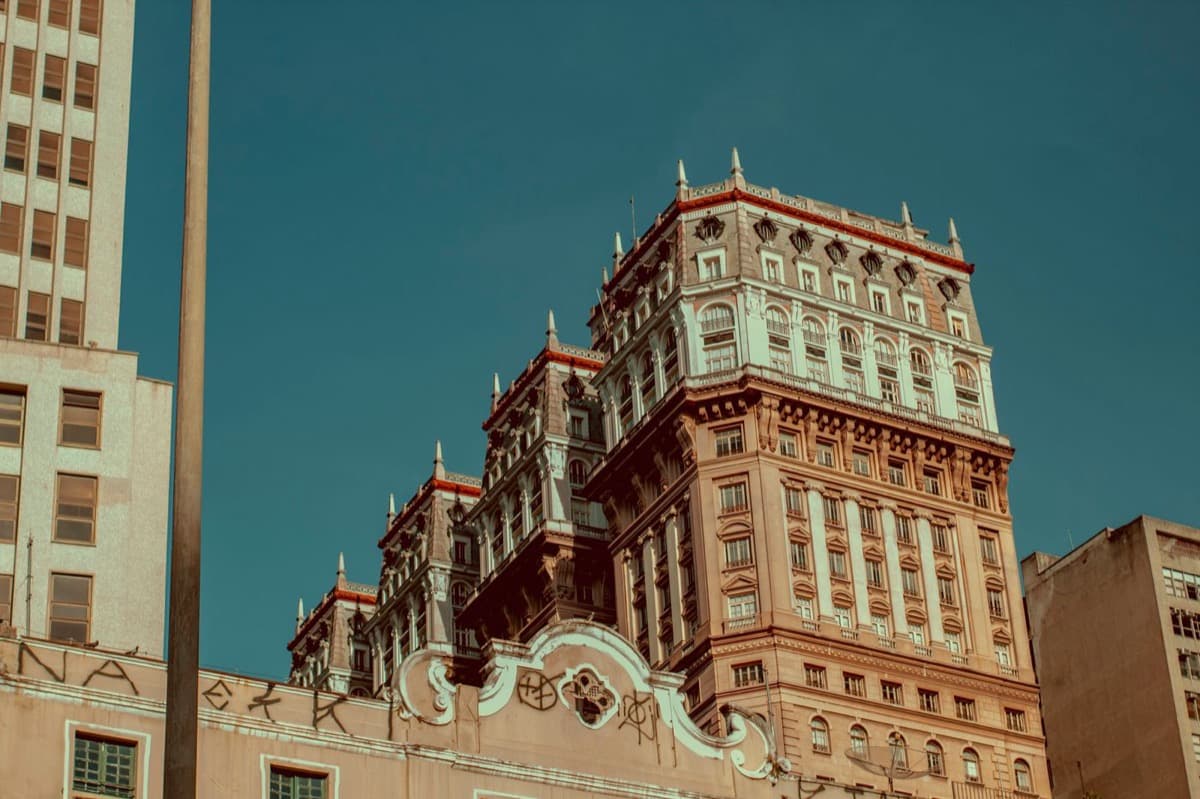
When the Edificio Martinelli rose over central Sao Paulo in the 1920s, it was so tall that people were afraid it would fall down. Brazil had never built anything like it, and a hundred-meter tower of concrete looked, to many, like a dare against gravity. So the man who built it did something extraordinary to answer the fear. He built a mansion on the roof and moved his own family into it, staking their lives on the building as living proof that it would stand. That gesture is the key to the whole building: this was Brazil's first skyscraper, and it was raised by a city equal parts ambitious and anxious about how high it dared to go.
An immigrant who made a fortune, then a tower
The builder was Giuseppe Martinelli, an Italian who had landed at the port of Rio de Janeiro in 1889 and, within two decades, built remarkable wealth in Sao Paulo during the coffee boom that was making the city rich. He planned his tower in 1922, at the height of that boom, as a monument to what an immigrant could achieve in the fast-growing city. Construction began in 1924 and was completed in 1929. The building, designed by the architect Vilmos Fillinger, rose to 28 floors and about 105 meters, and when it opened it was the tallest building in Latin America and the largest concrete-framed building in the world. It held the title of South America's tallest building from 1929 until 1947.
For Sao Paulo, still a plateau city only recently swollen by coffee money, the Martinelli was a statement. It said the town was now a metropolis with the confidence to build vertically, and its immigrant builder was the proof that fortunes could be made and spent on a scale to rival any old-world capital.
The mansion on the roof
Hear a stop from this walk
Mosteiro de São Bento: The Living Hill
Then came the fear. A tower this tall in a country that had never built one drew genuine public anxiety that it might collapse. Martinelli's answer became one of the most famous stories in Brazilian architecture. He commissioned a small palace on top of the building, a rooftop villa inspired by an Italian country house, and moved in with his family. The point was not luxury alone. By living at the very top, Martinelli meant to demonstrate his own absolute confidence in the structure, using himself and his family as living proof that the building was safe. If the man who built it would sleep on its roof, so the logic went, the public could trust the floors below.
It is the perfect emblem of the coffee-boom city: an immigrant's fortune, a record-breaking tower, and a theatrical gesture of confidence performed in public to sell the future. The rooftop is still one of the building's draws, offering a sweeping view over the historic center that the same anxious, ambitious city eventually filled with taller towers.
From triumph to confiscation
The triumph did not last for its builder. The enormous project caused Martinelli serious financial problems, and in 1934 he was forced to sell the building to the Italian government. Then history intervened again. When Brazil entered the Second World War against the Axis powers in the 1940s, Italian assets in the country were confiscated, and the Martinelli passed to the Brazilian state. The tower that had been raised as one immigrant's monument became, within two decades, public property seized in wartime.
Neglect followed, and by the mid-twentieth century the building had declined. Its rescue came from the city itself: under mayor Olavo Setubal, the Martinelli underwent a complete renovation between 1975 and 1979, and it reopened restored. Today it houses municipal offices and welcomes visitors to its rooftop. The survival fits the pattern of the whole downtown, a city that demolishes and rebuilds, choosing here to save one of the few landmarks that mark its rise.
Reading it in place
Stand at the base and look up the full 28 floors, then remember that when this was built, nothing else in Brazil came close, and people expected it to fall. If you can go up, the rooftop is where the story lives: the very spot where a builder moved his family to prove a point. From up there the historic center spreads out, the founding sites, the coffee-era palaces, and the towers that later out-climbed the Martinelli it once towered over.
The building anchors Roamer's The Founding Hill: Sao Paulo's Centro, which reads the downtown from the Patio do Colegio, where the city was born, to this tower, where it announced itself to the world. For the wider pattern, see the city that rebuilds itself.
Sources
- Wikipedia, Martinelli Building: the builder Giuseppe Martinelli, the plan in 1922, construction from 1924 to 1929, the 28 floors and 105-meter height, the architect Vilmos Fillinger, its status as Brazil's first skyscraper and the tallest building in Latin America on opening, the tallest in South America from 1929 to 1947, the forced sale to the Italian government in 1934, and the renovation from 1975 to 1979 under mayor Olavo Setubal.
- Martinelli Building history sources (Wikipedia and the building's own published history): Giuseppe Martinelli's 1889 arrival at Rio, the rooftop villa built as Italian-style penthouse, his family's move to the top presented as living proof of the building's safety, and the wartime confiscation of Italian assets.
- Roamer tour transcript, The Founding Hill (sao-paulo-centro-historico), fact-audited: the Martinelli as the tower where Brazil went vertical.
Brazil eSIM· 10% off with ROAMER10
Ready to experience it?
The Founding Hill: São Paulo's Centro
95 min · 2.8 km · moderate
More from Sao Paulo
Explore more at your own pace.
One Day in São Paulo: A Walkable Central Itinerary (2026)
São Paulo Travel Guide: How Many Days, Getting Around, When to Go, Is It Safe (2026)
The City That Rebuilds Itself: How to Read Sao Paulo's Buried History

What to Eat in São Paulo: A Food Guide (2026)
Beco do Batman: The São Paulo Alley That Repaints Itself Every Few Weeks