Trastevere and the Ghetto: The River Walled In
75 min · 1.7 km · easy
Walk into the Basilica di Santa Maria in Trastevere, let your eyes adjust to the low light, and lower your gaze to the columns marching down the nave. There are twenty-two of them, granite, with Ionic and Corinthian capitals, and Rome's city tourism site says they probably come from the Baths of Caracalla, the vast imperial bathhouse. Imperial Rome, quite possibly, holds up this Christian nave. That recycling of an emperor's marble into a working parish church is the whole instinct of the neighborhood across the Tiber, and reading this one basilica carefully is the best way to prepare for the walk that passes it.
The gold you see from the square
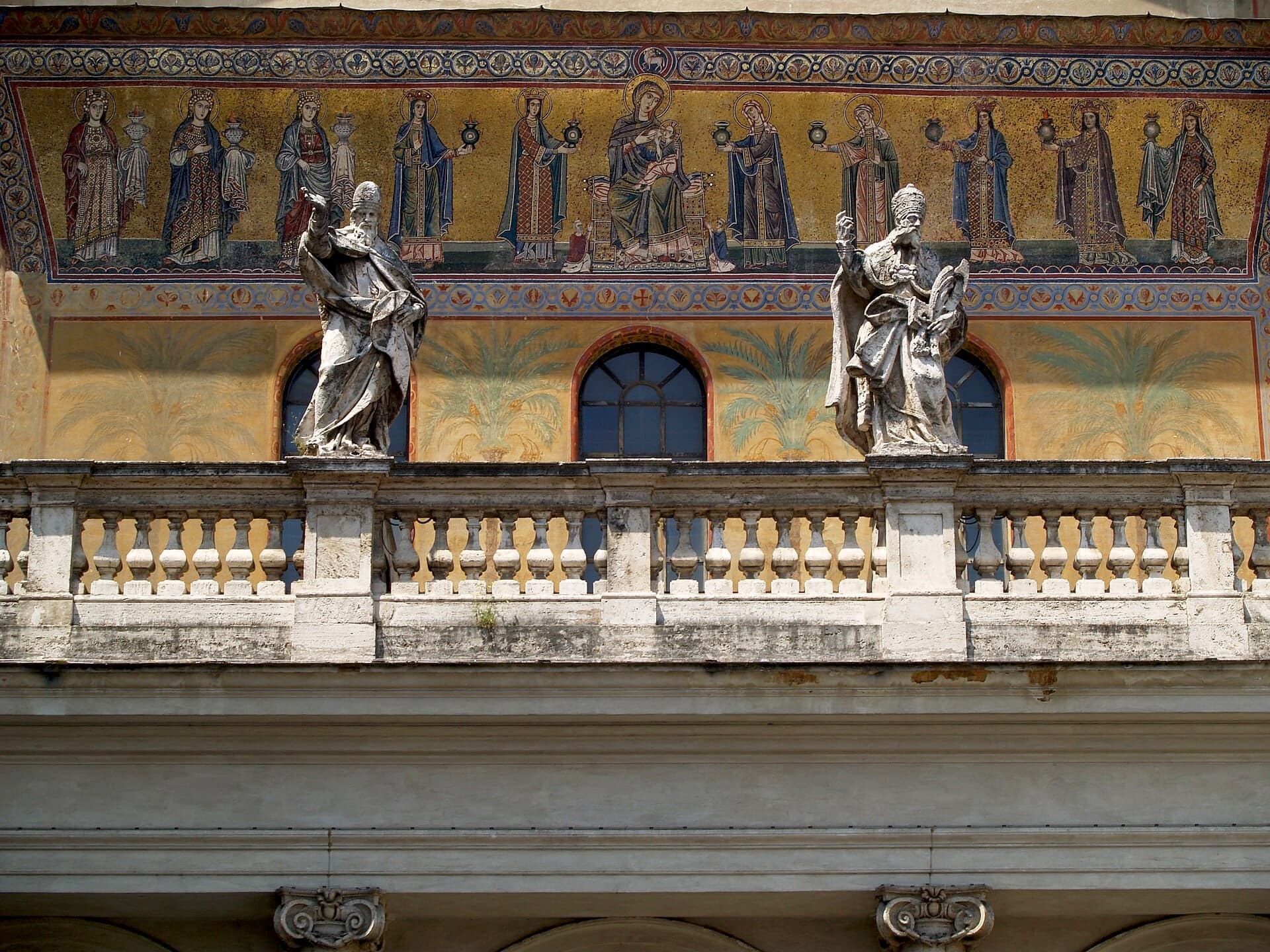
Most visitors meet the church from outside, and the gold is on the front. High on the gable, under the roofline, a medieval mosaic shows the Virgin nursing the Child on a throne, with ten women carrying lamps, five on each side. Sources date it anywhere from the twelfth century to the first quarter of the thirteenth, so call it medieval. Below it, a porch remodeled in 1702 by Carlo Fontana carries a balustrade with four statues of popes, and the twelfth-century bell tower stands to one side. Look up: the mosaic is high, and the café tables and crowds in the square are a good reason to find a place to stand.
Inside, the apse holds the great mosaic that gives the church its fame. Its scenes, around 1140, include Pope Innocent II holding a small model of the church, the patron written into his own commission. Innocent II died in 1143 and the basilica was largely rebuilt in his time. Below the vault runs a band of scenes from the life of the Virgin by Pietro Cavallini, made in 1291. That gap of roughly a century and a half, stacked one above the other in the same apse, is a lesson in how Rome accumulates rather than replaces. The coffered ceiling is the work of Domenichino, from 1617.
There is a claim worth holding gently. Rome's tourism office says the basilica was probably the first official place of Christian worship in Rome, and that by tradition it was built by Pope Callistus I in the third century and finished by Julius I in 340. Treat that as tradition rather than settled history, since the city itself says only "probably". Rome loves a superlative, and the honest pleasure is in the ambiguity.
The fountain in the middle of the piazza
Hear a stop from this walk
Ponte Sisto: A Pope's Bridge for Pilgrims
The square in front of the church has its own layers. The fountain at its center is one of the oldest monumental fountains in Rome, shown on Pietro del Massaio's map of 1471, and for a long time it was the only public fountain in Trastevere. It was restored under Alexander VI in the late fourteen hundreds and again in the early sixteen hundreds by Girolamo Rainaldi. Under Alexander VII, between 1655 and 1667, it was moved to the center of the square and given more water, with Bernini carving the pope's arms and four double shells. In the 1690s Carlo Fontana enlarged the basin and replaced Bernini's shells with larger ones turned inward, which gave the fountain the look it has now. In 1873 it was rebuilt in bardiglio marble with a large S.P.Q.R. One artist correcting another, in a splashing thing you can sit beside for free.
Two claims you may read elsewhere are not supported by the city's own account: that Bramante rebuilt this fountain around 1500, and that it is the oldest in Rome. The record shows Rainaldi, Bernini and Fontana, and "one of the oldest."
Where the church sits on the walk
Trastevere and the Ghetto: The River Walled In is a twelve-stop walk of about 1.7 kilometres, and Santa Maria is stop 8. The walk begins on the other bank, at the Portico d'Ottavia in the former Jewish Ghetto, which Pope Paul IV established in 1555 and which lasted until 1870. It passes the Theatre of Marcellus and crosses the Tiber Island before it winds through the lanes of Trastevere, whose name means across the Tiber.
The idea running through it is the river. After the great flood of December 1870 Rome built the high stone embankments that were finished in 1926, and in the same years the city drove a wide avenue through Trastevere, cut down an old bridge and demolished the Ghetto. Look for it where the walk crosses Viale di Trastevere: the lane called Via della Lungaretta once ran straight to the river road, and in 1888 the Viale del Re, today's Viale di Trastevere, cut it in two.
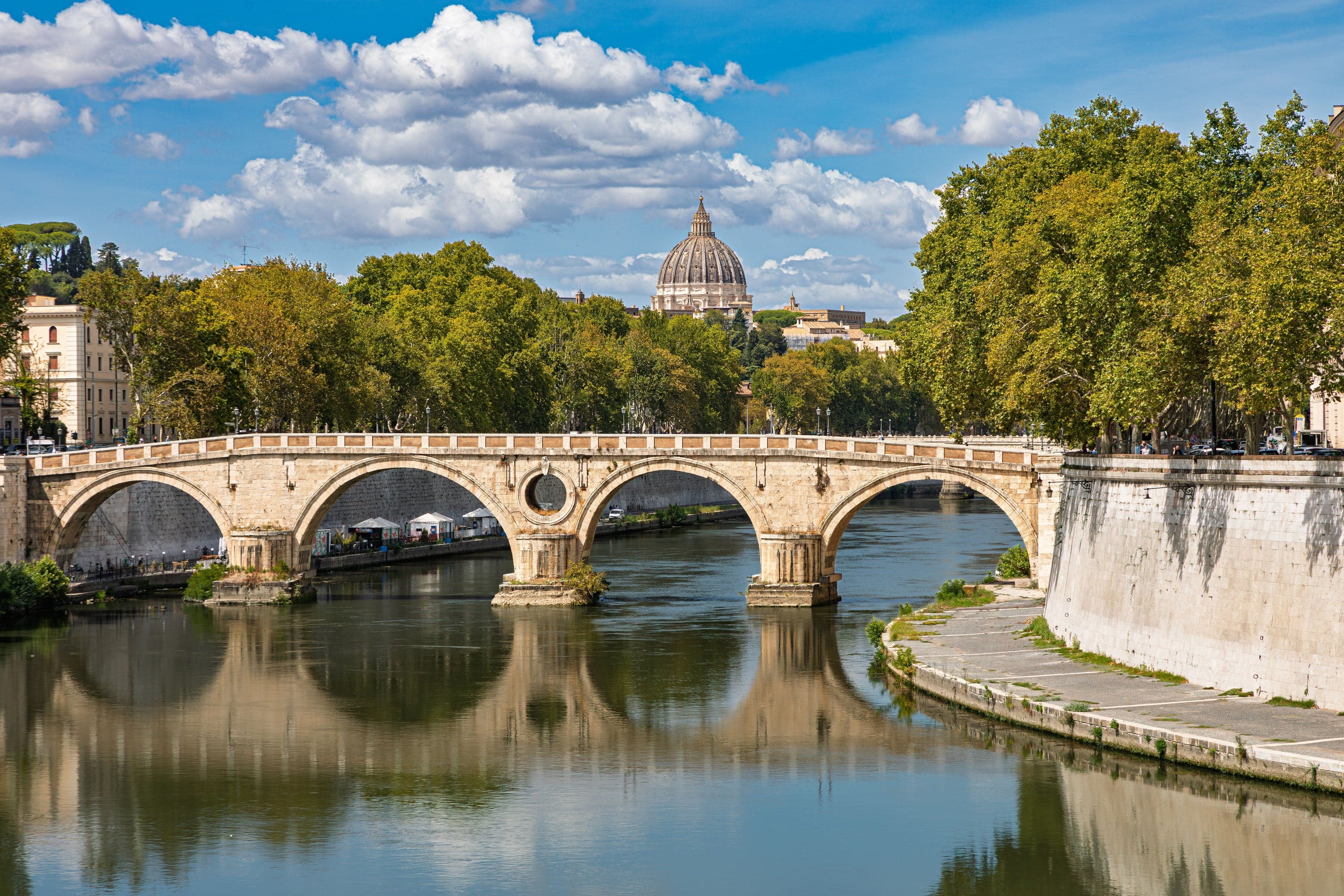
After the church the route goes to Piazza della Scala, where a Carmelite church was built around a painted Madonna above a stair, then through the gate at Porta Settimiana, rebuilt in 1498 to look like a medieval fortress. It ends at Piazza Trilussa and Ponte Sisto. The fountain in Piazza Trilussa belongs to the same story as the embankments: the Acqua Paola fountain began life in 1613 at the end of Via Giulia on the opposite bank, was taken apart after the 1870 flood, lost almost half its pieces, and was put back together here in 1898. Ponte Sisto, built by Sixtus IV for the Jubilee of 1475, has no known architect; the old attribution to Baccio Pontelli has been dropped.
Visiting
The walk stays outside the church. If you go in, cover your shoulders and knees; the city does not publish visiting hours for the church, so ask at the door or check the parish contacts. The piazza is a nightlife square, so keep your phone and wallet to hand there in the evening.
Santa Maria in Trastevere is where the walk's whole idea becomes visible: gold catching the light where an emperor's marble once stood, holiness set quietly into working parish life rather than staged for an audience. If you want to plan the route or pair it with the rest of the city, start with the Rome walking tours hub or the Rome city page. Then cross the river and let the neighborhood get smaller and older with every step.
Sources
- Roma Capitale, Turismo Roma: the Basilica of Santa Maria in Trastevere and the fountain of Piazza Santa Maria in Trastevere. The columns, the apse mosaics, the porch of 1702, the history of the fountain.
- Roma Capitale, Turismo Roma: Piazza Trilussa, Ponte Sisto, Porta Settimiana and Santa Maria della Scala.
- Museo Ebraico di Roma: the founding of the Ghetto in 1555, its end in 1870 and the demolition after the 1888 plan.
- Roamer tour dossier for "Trastevere and the Ghetto: The River Walled In" (rome-trastevere), fact-checked October 2026.
Ready to experience it?
Trastevere and the Ghetto: The River Walled In
75 min · 1.7 km · easy
More from Rome
Explore more at your own pace.
Best Architecture Walking Tours in Rome (2026)
St. Peter's Square and the Surprise Rome Demolished: Borgo, the Spina and Via della Conciliazione
The Aventine's Orange Garden and Keyhole: A Fortress That Became a View
The Water Behind the Trevi Fountain: Following the Acqua Vergine to the Pincio
Palatine Hill: Where Rome Says It Was Born