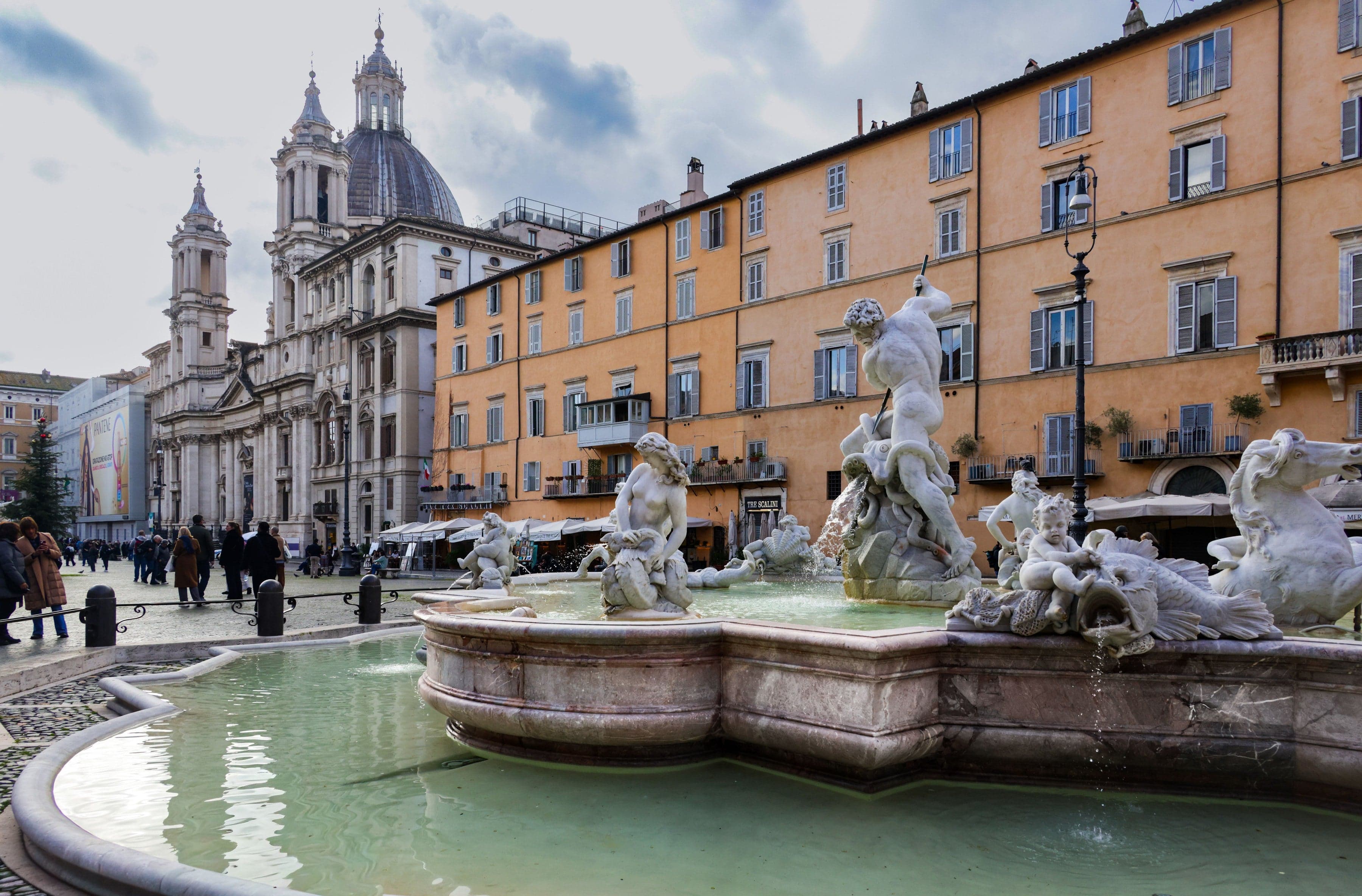
The Pantheon is best read not as a ruin but as working source code. Stand in Piazza della Rotonda and you are looking at an ancient concrete dome, precisely proportioned and lit through a single open hole in its crown, that the architects of Baroque Rome studied, measured, and answered for centuries. The one thing to understand standing in front of it is this: almost nothing else in the city solved the problems it solved first. The later squares, fountains, and facades a few streets away are variations. This is the original.
A dome that is still a record
Start with the number that matters. Marcus Agrippa commissioned the first Pantheon in 27 BC, but the building you see is Hadrian's, rebuilt between AD 118 and 125 with its orientation reversed and a large square and portico added. Nearly two thousand years later its dome is still claimed as the world's largest unreinforced concrete dome. That phrase carries the whole engineering story. No steel runs through it. No hidden ribs of iron take the load. The dome stands because its geometry and its material do the work, and because the Romans understood both better than anyone would again for a very long time.
The proportions are exact and deliberate. The interior height and the interior diameter are the same measurement, just over forty-three metres, by Rome's own tourism office. That equivalence is not decoration. It means a perfect sphere would fit precisely inside the space, its bottom resting on the floor and its top touching the crown of the dome. The building is, in effect, a hemisphere sitting on a cylinder, and once you see that you cannot unsee it. The room is a diagram of itself.
How the Romans kept a casting that wide from collapsing under its own weight is the interesting part. The dome is not uniform. Engineering studies describe it thinning from about 6.4 metres at the base to about 1.2 metres around the oculus, while the stone mixed into the concrete gets lighter as it rises. A heavy bottom, a light top and a hole at the very crown. The dome is thickest where the stress is greatest and thinnest where the sky comes through. This is load management by recipe, decided during the pour, and it is why the structure has outlasted almost every masonry building attempted since.
The hole in the roof is doing work
Hear a stop from this walk
Sant'Ignazio: The Dome That Isn't There
At the very top, the oculus opens straight to the sky. It is a circular opening 8.92 metres across, with no glass, no grille, and no cover of any kind. When it rains, the rain comes in, and 22 drainage holes in the floor take it away. Most visitors read the oculus as a symbol, a link between the temple floor and the heavens, and that reading is fair. But the opening is also structural. The crown of a dome is its most vulnerable point, the place where compression forces converge, and cutting a clean round hole there and finishing its rim removes weight from exactly the spot that can least afford it. The oculus is the building's only natural light source and one of the reasons the dome still stands. Symbol and structure are the same decision.
The ceiling is divided into coffers in five rings of 28, and the sun moves as a bright disc across them through the day. Rome's tourism office notes that on the summer solstice a disc of light the size of the oculus falls on the floor. The building is a very large, very slow instrument for reading the sky. That is what the Baroque architects who came later were chasing when they bent facades to catch raking light and cut openings to drop it onto an altar. The Pantheon had already made light a material you could design with.
Why it is still standing at all
Most ancient Roman temples did not survive. They were quarried for their stone and their metal across the medieval centuries, taken apart piece by piece to build churches and palaces. The Pantheon escaped that fate for a single administrative reason. In the year 609, Pope Boniface the Fourth had it consecrated as a Christian church, dedicated to Santa Maria ad Martyres. Once it was holy ground, it was no longer a quarry. The conversion is why you can stand inside a nearly intact Roman interior at all, and it is the first move in a very long game the papacy would keep playing: absorb the ancient city rather than erase it.
Inside, under that dome, the painter Raphael is buried, along with two kings of Italy, Vittorio Emanuele the Second and Umberto the First, and Queen Margherita. Going in now takes a ticket. Press reports put the adult price at 7 euros from 1 July 2026, with reductions for 18 to 25 year olds and free entry for under-18s and Rome residents, and entry is booked ahead, so check the current price before you go. You do not need a ticket to read the square out front, though. In front of the portico stands a fountain by Giacomo della Porta of 1575, and rising from it a genuine ancient Egyptian obelisk of Ramesses the Second, set on the fountain in 1711 under Clement XI. That pairing is the entire Baroque method compressed into one gesture. Take a two-thousand-year-old temple, plant a real Egyptian monument in front of it, and caption the whole ancient world as a prologue to Christian Rome. The popes did not invent the Pantheon. They framed it.
The original the Baroque kept answering
This is the reason the Pantheon anchors a walk about Baroque Rome rather than sitting off to the side as an older curiosity. The seventeenth-century architects who reshaped the city center were in a constant argument with this building. When they built domes, they were measuring themselves against a dome that had never been beaten. When they staged light, they were working with a tool the Pantheon had mastered. When a pope planted an obelisk to caption a square, he was repeating a move already made in Piazza della Rotonda. The Baroque is loud, theatrical, and persuasive. The Pantheon is quiet, exact, and structural. Seeing them in the same afternoon is the point, because the contrast is the lesson.
The city as a whole rewards this kind of reading, and the Pantheon is the clearest place to learn the grammar. If you want to see how the ancient source code gets quoted, amplified, and turned into open-air theatre a few streets in every direction, that is exactly what Historic Center: The City That Reuses Everything sets out to decode: a walk that arrives at the Pantheon from Piazza Navona and leaves it for Piazza di Pietra, where eleven columns of Hadrian's temple are built into a modern front. You can find that route and the rest of the city's tours on our Rome walking tours hub, and more about the city itself on the Rome page.
Stand in the square and read the inscription across the front: it names Agrippa, even though the building behind it is Hadrian's, which is itself a small act of reuse. Note that from the portico side the dome is only a low cap behind the front, so its real drama is inside. Then walk the rest and watch how often the newer city is answering this one.
Sources
- Roma Capitale, Turismo Roma: the Pantheon. Agrippa's commission, Hadrian's rebuilding of 118 to 125, the dimensions of the dome and oculus, the coffers, the drainage, the consecration in 609 and the tombs.
- Mark and Hutchison's engineering study of the dome, as summarised in encyclopedic reference: the thinning of the dome and the lighter aggregate toward the crown.
- Wanted in Rome, July 2023 and 2026 reports: the entry fee and the 1 July 2026 price.
- Obelisk of the Pantheon fountain, encyclopedic reference: the Heliopolis obelisk of Ramesses II and its 1711 placement.
- Roamer tour dossier for "Historic Center: The City That Reuses Everything" (rome-piazza-navona-baroque), fact-checked October 2026.
Ready to experience it?
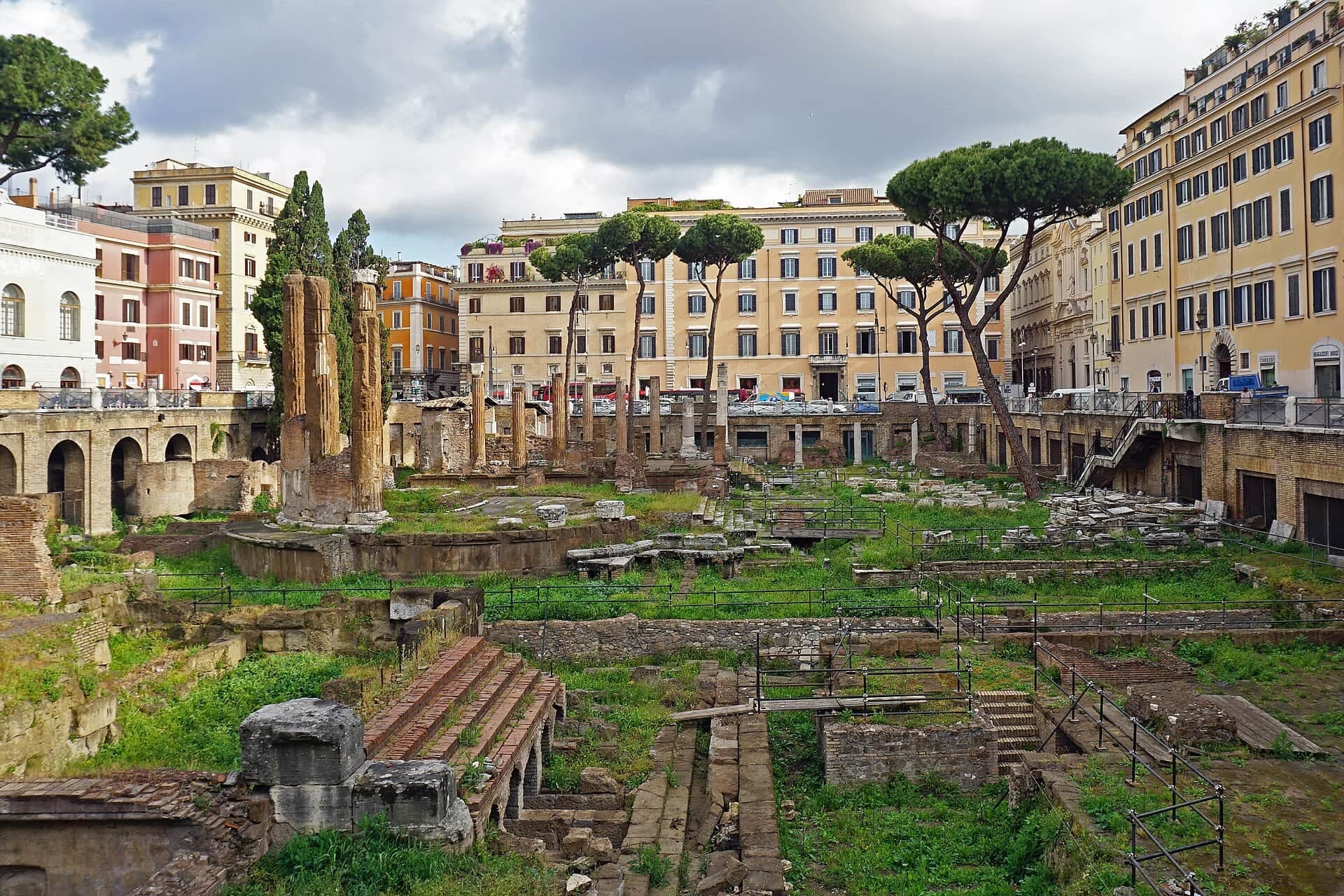
Historic Center: The City That Reuses Everything
90 min · 2.4 km · easy
More from Rome
Explore more at your own pace.
Best Architecture Walking Tours in Rome (2026)
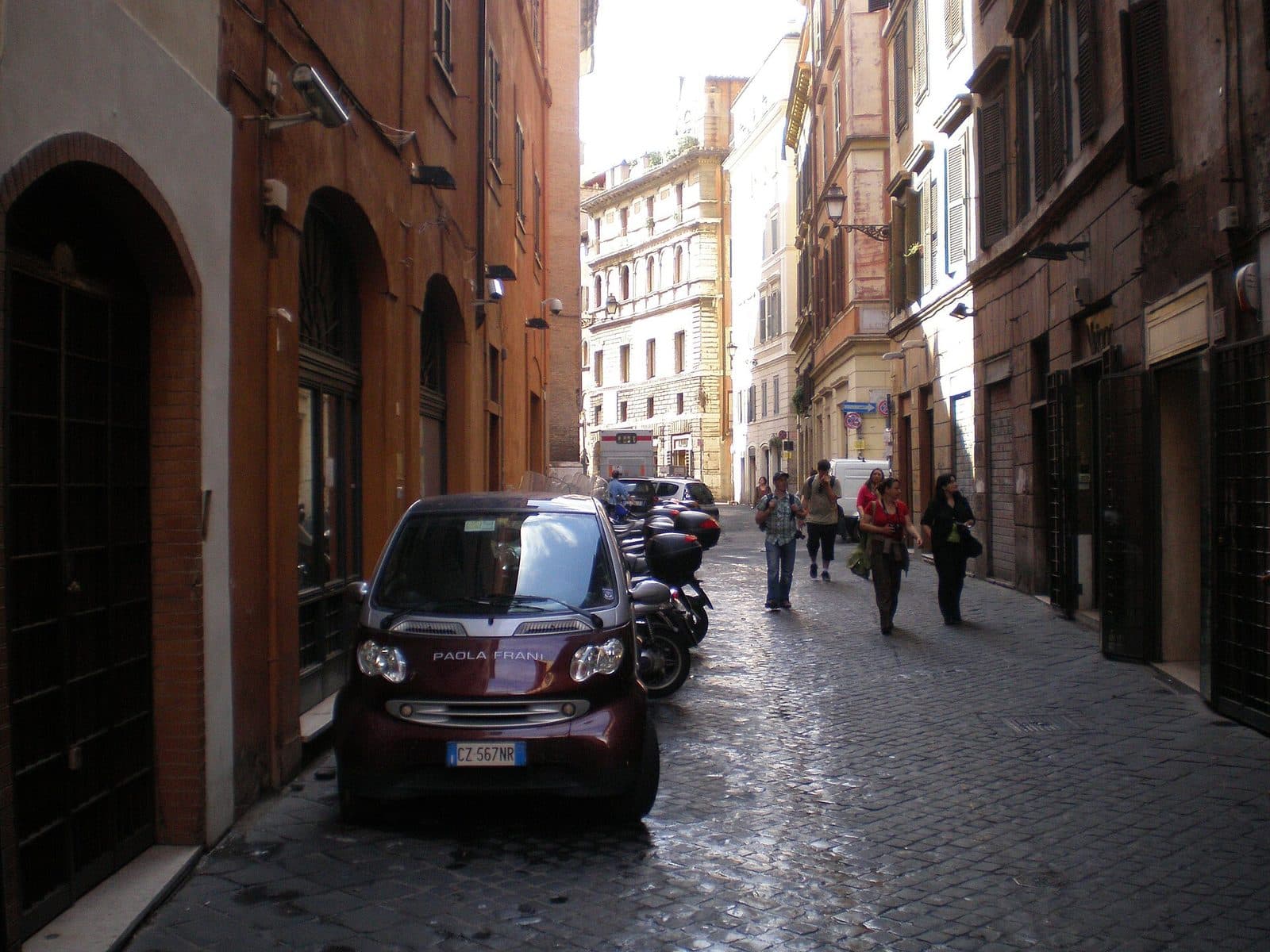
St. Peter's Square and the Surprise Rome Demolished: Borgo, the Spina and Via della Conciliazione
The Aventine's Orange Garden and Keyhole: A Fortress That Became a View
The Water Behind the Trevi Fountain: Following the Acqua Vergine to the Pincio
Palatine Hill: Where Rome Says It Was Born