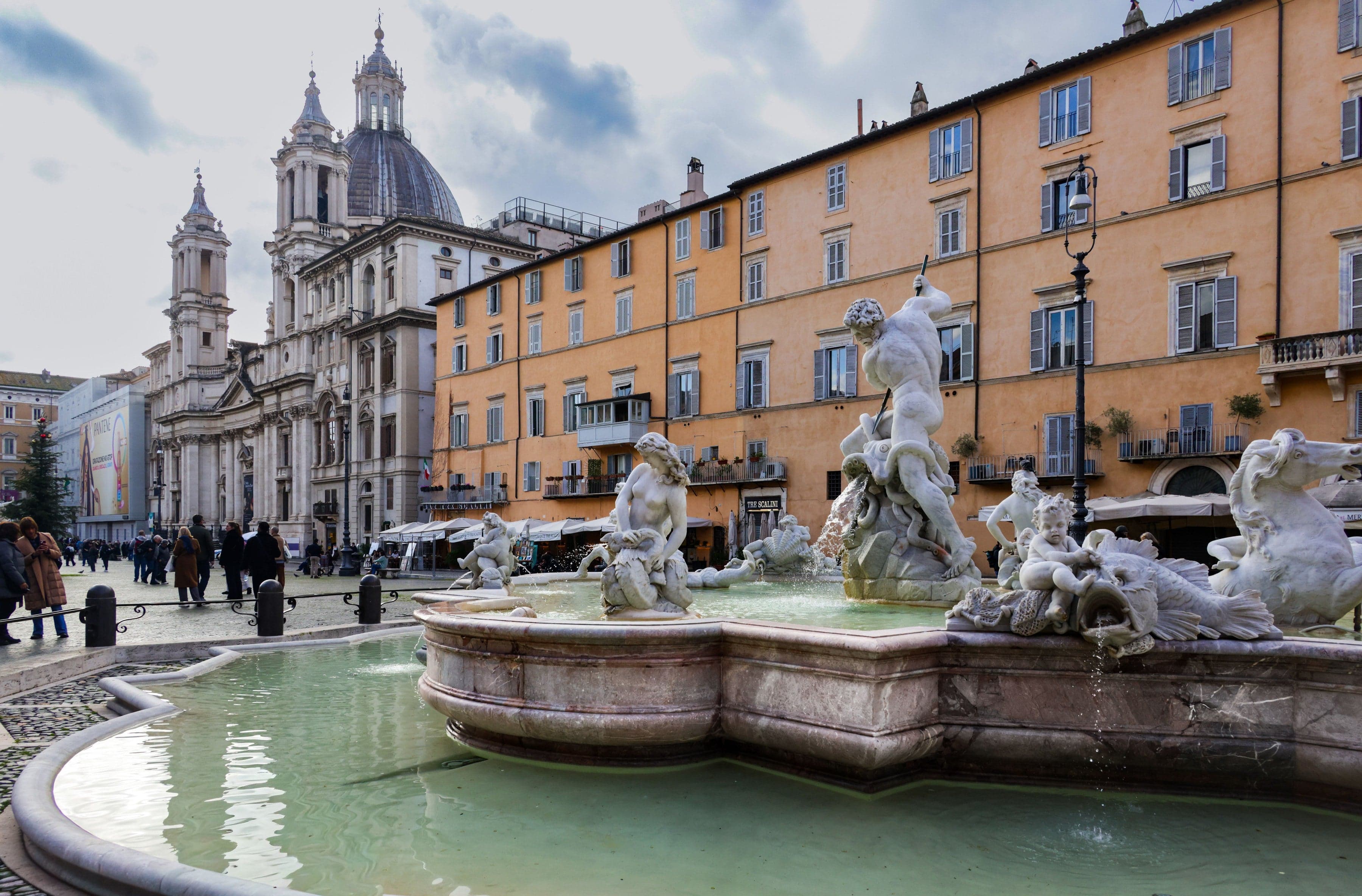
Bernini's Fontana dei Quattro Fiumi is a sentence carved in travertine and water. Four marble river gods sit around a single obelisk, and once you learn to read that arrangement as a statement about power, the square it stands in stops being a pretty piazza and becomes a designed argument. The fountain in Piazza Navona is the clearest place to learn the grammar, because every part of it does a job, and every job points at the same author: a pope who wanted the world to understand who had made this square.
A stadium under your feet
Start with the shape. Piazza Navona is long and narrow with one rounded end because it is the outline of a stadium. The emperor Domitian opened it in AD 86 for athletics, not chariot racing: running, wrestling, boxing and the pankration, with room for about 30,000 people, in a building 275 metres long. Its ruins lie about four and a half metres below the paving, so you are standing on the roof of the seats. The houses around the piazza stand on the stadium's old arcades, which is why the square kept the arena's footprint. The city market moved here from the Capitoline in the last years of the fifteenth century, and in the sixteen hundreds the pope whose family palace faces the square, Innocent X of the Pamphili, made it a Baroque showpiece.
What the parts do
Hear a stop from this walk
Sant'Ignazio: The Dome That Isn't There
Look at the four figures. They are usually read as four rivers for four continents: the Nile for Africa, the Danube for Europe, the Ganges for Asia and the Rio de la Plata for the Americas. That is not decoration. It is a claim of reach. Gian Lorenzo Bernini's fountain was unveiled on 12 June 1651, and the arrangement puts a viewer in the middle of a papacy whose authority is meant to span the globe.
Then look up. The obelisk looks Egyptian, and it is not. It is a Roman-made work of Domitian's time, with hieroglyphs composed in Rome to name Domitian and his family. In the fourth century it was moved to the circus of Maxentius on the Appian Way, where it was dug up and brought to Piazza Navona and raised on the fountain. At the top is the Pamphili family badge, a dove holding an olive twig. Follow the logic from base to tip: four continents at the corners, a monument rising from the centre, and the family's own dove on top. The sentence is complete: global reach, gathered around a monument the Romans themselves carved, signed by the family that paid for it.
A traditional story says one river god throws up a hand to shield himself from the church of Sant'Agnese in Agone across the square, the work of Bernini's rival Francesco Borromini. The legend cannot be true, and the reason is a matter of sequence: the fountain was unveiled in 1651, and Borromini only began to reshape the church in 1653. Sant'Agnese was begun in 1652 by Girolamo and Carlo Rainaldi, and Borromini worked on it from 1653 to 1657, reshaping the front into the inward curve you see beside the dome and twin towers. A fair, true version is shorter: the church front curves inward to show off its dome, while the fountain pushes outward to a crowd.
Three obelisks, three captions
The Baroque method is to take a monument from the old world and caption it. Piazza Navona's obelisk is a Roman copy. The obelisk in front of the Pantheon is genuinely Egyptian, of Ramesses II, from Heliopolis, and was set on its fountain in 1711. The little obelisk on the elephant in Piazza della Minerva is genuinely Egyptian too, of the pharaoh Apries. Three obelisks, three different histories, one Roman habit.
Reading the rest of the route
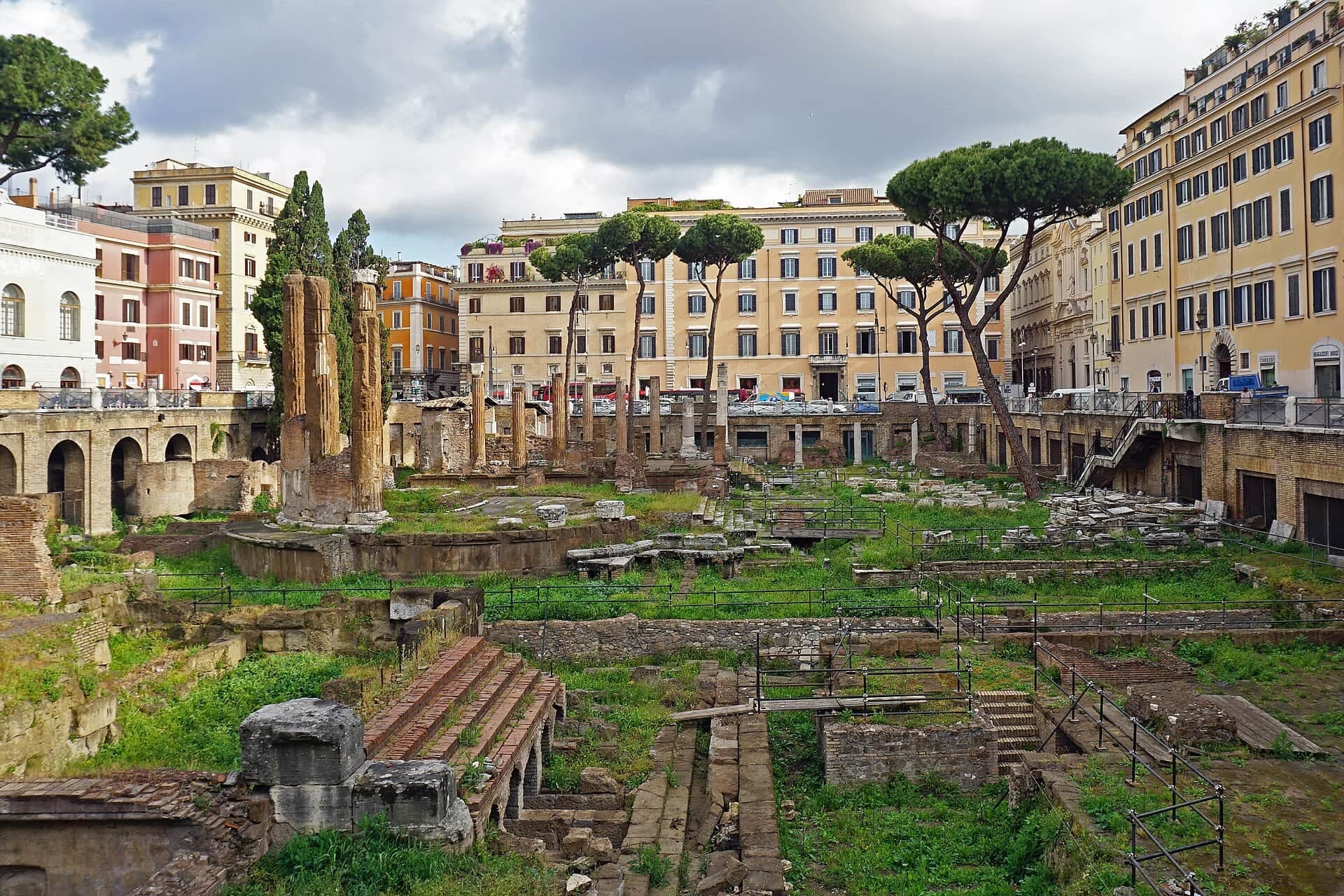
The fountain teaches you the vocabulary, and the other stops become legible fast. The walk this article belongs to, Historic Center: The City That Reuses Everything, starts in the pit of temples at Largo di Torre Argentina and runs through Campo de' Fiori, Piazza Farnese and Pasquino before it reaches Navona. After the fountain it goes to Sant'Eustachio and Borromini's spiralling lantern at Sant'Ivo alla Sapienza, then Bernini's elephant, the Pantheon, Piazza di Pietra and Sant'Ignazio. Notice the method repeating: a stadium becomes a square, a temple becomes a church, a courtyard becomes a state archive. It is eleven stops over about two and a half kilometres of flat historic-centre streets, and all of it, including the piazzas and fountains, can be enjoyed from the outside without a ticket.
If you want the full stop-by-stop reading, with the audio cued to each fountain and facade, the tour is part of our Rome walking tours, and you can find it alongside everything else we cover in Rome. The grammar then goes operatic at the Trevi Fountain, which belongs to a second walk, Trevi Fountain and Spanish Steps: Upstream to the Pincio, that begins about five minutes' walk from where the Historic Center walk ends. Come for the fountain. Stay for the grammar.
Sources
- Roma Capitale, Turismo Roma: the Stadium of Domitian, Sant'Agnese in Agone and the Pantheon. The stadium's size, its AD 86 opening, athletics only, the depth of the ruins and Borromini's work on the church from 1653.
- Fontana dei Quattro Fiumi and the Obelisco Agonale, encyclopedic reference. The 12 June 1651 unveiling, the four rivers, the Pamphili dove and the Roman origin of the obelisk.
- Roamer tour dossier for "Historic Center: The City That Reuses Everything" (rome-piazza-navona-baroque), fact-checked October 2026.
Ready to experience it?
Historic Center: The City That Reuses Everything
90 min · 2.4 km · easy
More from Rome
Explore more at your own pace.
Best Architecture Walking Tours in Rome (2026)
St. Peter's Square and the Surprise Rome Demolished: Borgo, the Spina and Via della Conciliazione
The Aventine's Orange Garden and Keyhole: A Fortress That Became a View
The Water Behind the Trevi Fountain: Following the Acqua Vergine to the Pincio
Palatine Hill: Where Rome Says It Was Born