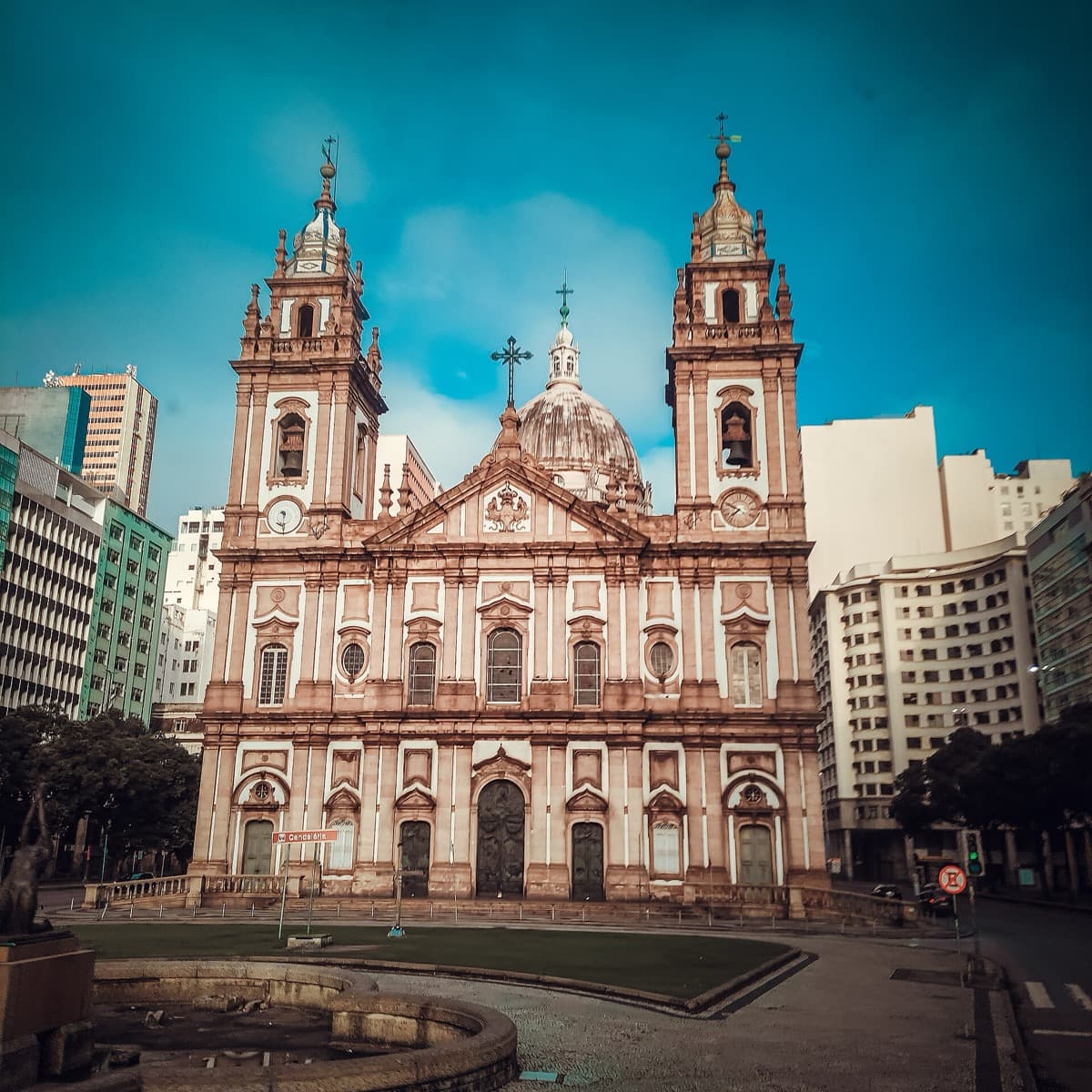
The dome that crowns the Candelaria church in central Rio de Janeiro was not built in Brazil. It was carved from white stone in Lisbon and carried across the Atlantic by ship, and understanding it as an imported object is the key to reading the whole building. When it was finished, that dome was the tallest structure in the city. It sat at the head of the harbor like a signature, and around it, for two centuries, Rio came to celebrate, to grieve, and to protest. This is a church that begins with a shipwreck legend and ends up at the center of modern Brazilian history.
The ship that gave the church its name
The Candelaria's story starts, by tradition, with a storm at sea. A ship named Candelaria was caught in bad weather and nearly went down, and its passengers, a Portuguese couple named Antonio Martins Palma and Leonor Goncalves, made an oath: if they reached land alive, they would build a chapel in thanks. They survived, came ashore at Rio, and around 1609 they raised a small chapel to fulfill the vow. That modest first chapel is the seed of everything that followed. The great church you see today is its enormous replacement, and it kept the name of the ship that nearly sank.
A church built across a century
Hear a stop from this walk
Mosteiro de Sao Bento: The Gilded Root
The building that stands now was a long project. Construction of the present church began in 1775, directed by the Portuguese military engineer Francisco Joao Roscio. Progress was slow, and the church was inaugurated in 1811, still unfinished, in the presence of King John the Sixth of Portugal, whose court had recently arrived in Rio after fleeing Napoleon. That royal presence at the opening is a reminder of how tightly this church is woven into the imperial moment that reshaped the downtown. The transplanted crown that turned Rio into an imperial capital was in the room when the Candelaria opened its doors.
The work then continued for decades. The stone roofs of the aisles were completed in 1856, and the dome, the church's crowning feature, was not finished until 1877. From 1878 onward the interior was redesigned in a Neo-Renaissance manner, so the building as a whole reads as a Portuguese colonial baroque facade carrying later neoclassical and neo-renaissance elements. It took roughly a century to move from foundation to finished dome.
The dome that crossed an ocean
Here is the detail that changes how you look at the church. The dome was made of white Lioz stone, cut in Lisbon and brought to Brazil by ship, and it carries eight statues around it. Lioz is a pale Portuguese limestone, the same stately stone used across imperial Lisbon, and shipping a dome's worth of it across the ocean was a deliberate statement. Brazil had its own stone and its own carvers, but the Candelaria's crown was made of the mother country's material, hauled three thousand miles to sit at the top of the colonial capital. When it was completed, that imported dome was the tallest structure in Rio.
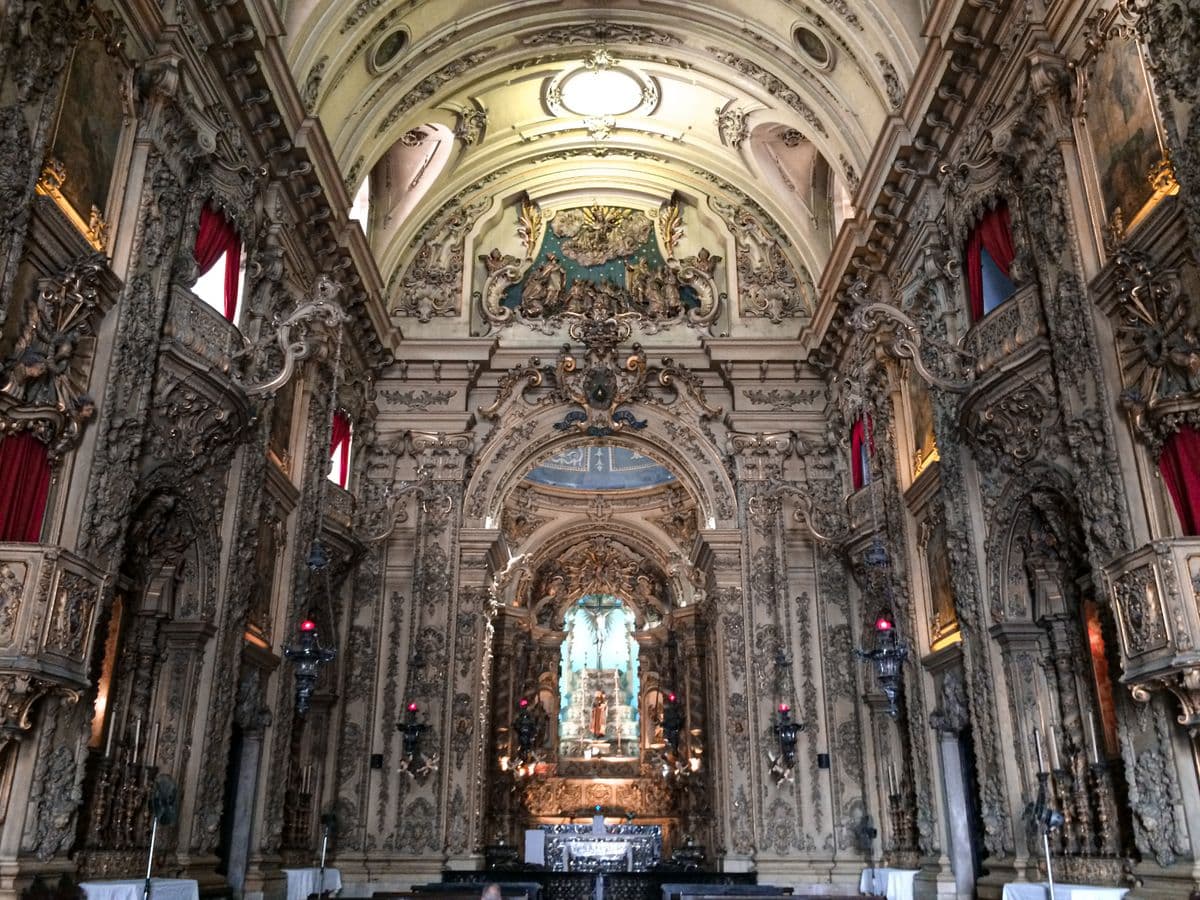
The importing did not stop at the dome. The interior walls and columns are faced with Italian marble in a range of colors, the nave and dome carry paintings by Joao Zeferino da Costa, and the great bronze doors, cast around 1901, are the work of the sculptor Antonio Teixeira Lopes. The Candelaria is, in a real sense, an assembled object, a Brazilian church built of European stone, marble, and bronze, brought together at the head of the harbor. It belongs to the same imperial Centro as the Mosteiro de Sao Bento, whose gilded interior was carved on the spot, and the two churches make an instructive pair: one glowing with local gold, the other crowned with imported stone.
The square where the nation gathered
Because the Candelaria sat so prominently at the center of the city, it became more than a church. It became a stage for Brazilian public life. In 1984 it was a gathering point for the Diretas Ja campaign, when huge crowds pressed for direct presidential elections at the end of the military dictatorship. And in the early hours of the twenty-third of July 1993, the plaza in front of the church was the site of the Candelaria massacre, when a group of homeless children and young people sleeping outside the church were shot, an atrocity that drew worldwide attention to police violence against street children. The same steps that had hosted a coronation-era opening and a democracy rally also witnessed one of the city's darkest nights. To stand in front of the Candelaria is to stand where Brazil has come to mark its highest and lowest moments.
Reading it in place
Approach the Candelaria from the water side, the way its builders intended, so the dome rises ahead of you against the downtown. Notice that the pale dome and the darker facade are different stones from different places, and remember that the crown was carved an ocean away. Step inside for the colored marble and the painted vault, and then look at the plaza itself, an ordinary traffic island that has carried extraordinary weight. The church is usually open around services and on weekdays; dress modestly and keep your voice low, since it remains an active place of worship.
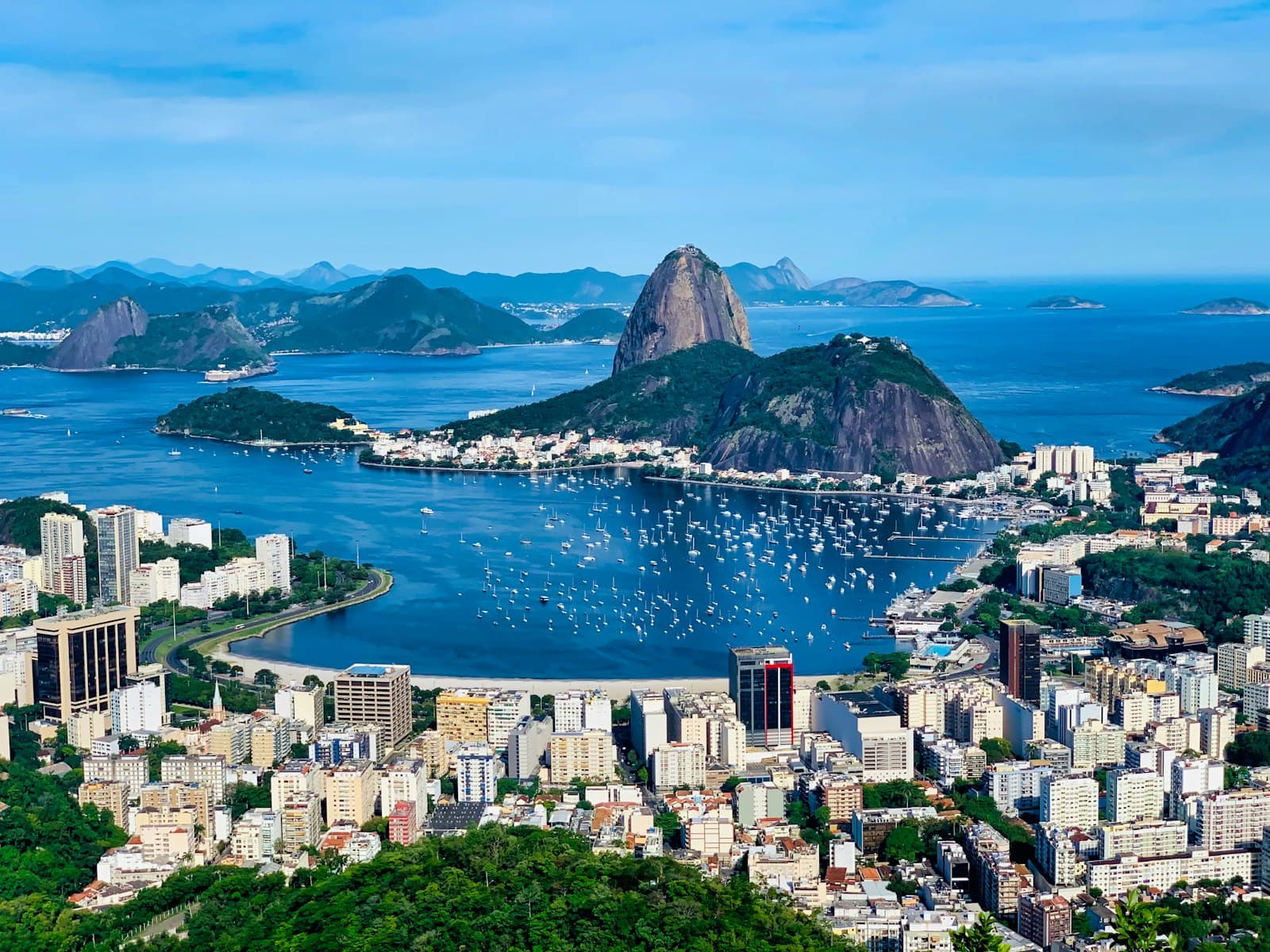
The Candelaria is one stop on Roamer's Imperial Rio: The Colonial Centro, which reads the whole downtown from the palace square upward, and it makes most sense once you understand the Rio behind the beach, the inland origin of the whole city.
Sources
- Wikipedia, Candelaria Church (Rio de Janeiro): the founding legend of the ship Candelaria and the couple Antonio Martins Palma and Leonor Goncalves, the chapel built around 1609, construction of the present church from 1775 under Francisco Joao Roscio, the 1811 inauguration before King John the Sixth, the aisle roofs completed in 1856, the dome completed in 1877 and made of white Lioz stone carved in Lisbon and shipped to Brazil, the eight statues on the dome, the Italian marble interior, the paintings by Joao Zeferino da Costa, the bronze doors by Antonio Teixeira Lopes around 1901, and the church as the tallest structure in the city on completion.
- Wikipedia, Candelaria Church: the 1984 Diretas Ja campaign gathering and the Candelaria massacre of 23 July 1993.
- Roamer tour transcript, Imperial Rio (rio-centro-imperial), fact-audited: the Candelaria as the imported dome of the colonial Centro.
Brazil eSIM· 10% off with ROAMER10
Ready to experience it?
Imperial Rio: The Colonial Centro
90 min · 2.2 km · moderate
More from Rio
Explore more at your own pace.

One Day in Rio de Janeiro: A Walkable City-and-Views Itinerary (2026)
Rio de Janeiro Travel Guide: How Many Days, Getting Around, Safety, When to Go (2026)
The Rio Behind the Beach: Why the Old Centro Is the City's Real Origin
What to Eat in Rio de Janeiro: A Food Guide (2026)
Arcos da Lapa: The Rio Aqueduct That Became a Tram Bridge