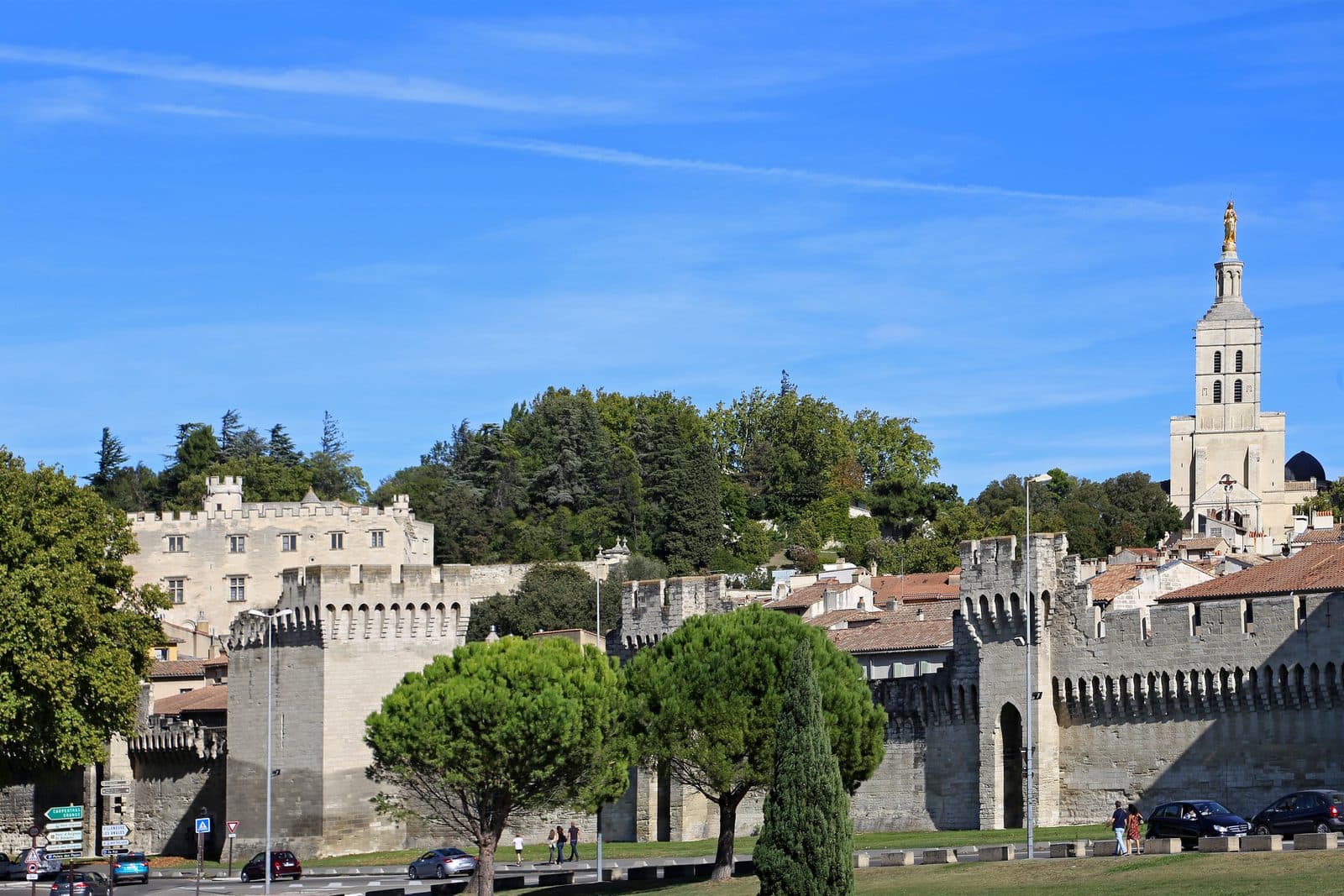
Most visitors treat the walls of Avignon as a picturesque backdrop and walk through a gate without a second glance. That is a missed lesson, because this is one of the most complete medieval defensive circuits left standing in Europe, roughly 4.3 kilometres of it, and it was built quickly, for a named threat, by an institution with money. The tour takes seven specimens along part of the circuit. This guide gives you the vocabulary so each one reads as engineering rather than atmosphere.
Why the wall exists at all
The ramparts were begun in 1355 under Pope Innocent VI and finished around 1370 under Urban V. The date matters. This was the Hundred Years' War, and its worst side effect for a town like Avignon was not a besieging royal army but the routiers, the free companies: bands of unpaid, unemployed soldiers who roamed France between campaigns and made their living by pillage and extortion. A papal capital stuffed with curial wealth was exactly the kind of target that drew them. Innocent VI's wall was insurance against irregular raiders, which is why it emphasises a complete, continuous, quickly built enclosure over the very latest in siege-proof engineering. The full story of why so much wealth was concentrated here is in how a provincial town became the capital of Christendom.
The five words that unlock the wall
Hear a stop from this walk
Porte Saint-Lazare: The Literacy Completes
Learn these and you can read any stop on the tour.
- Curtain wall: the long stretch of wall running between two towers. The "field" of the defence.
- Chemin de ronde: the walkway along the top where defenders moved and fought.
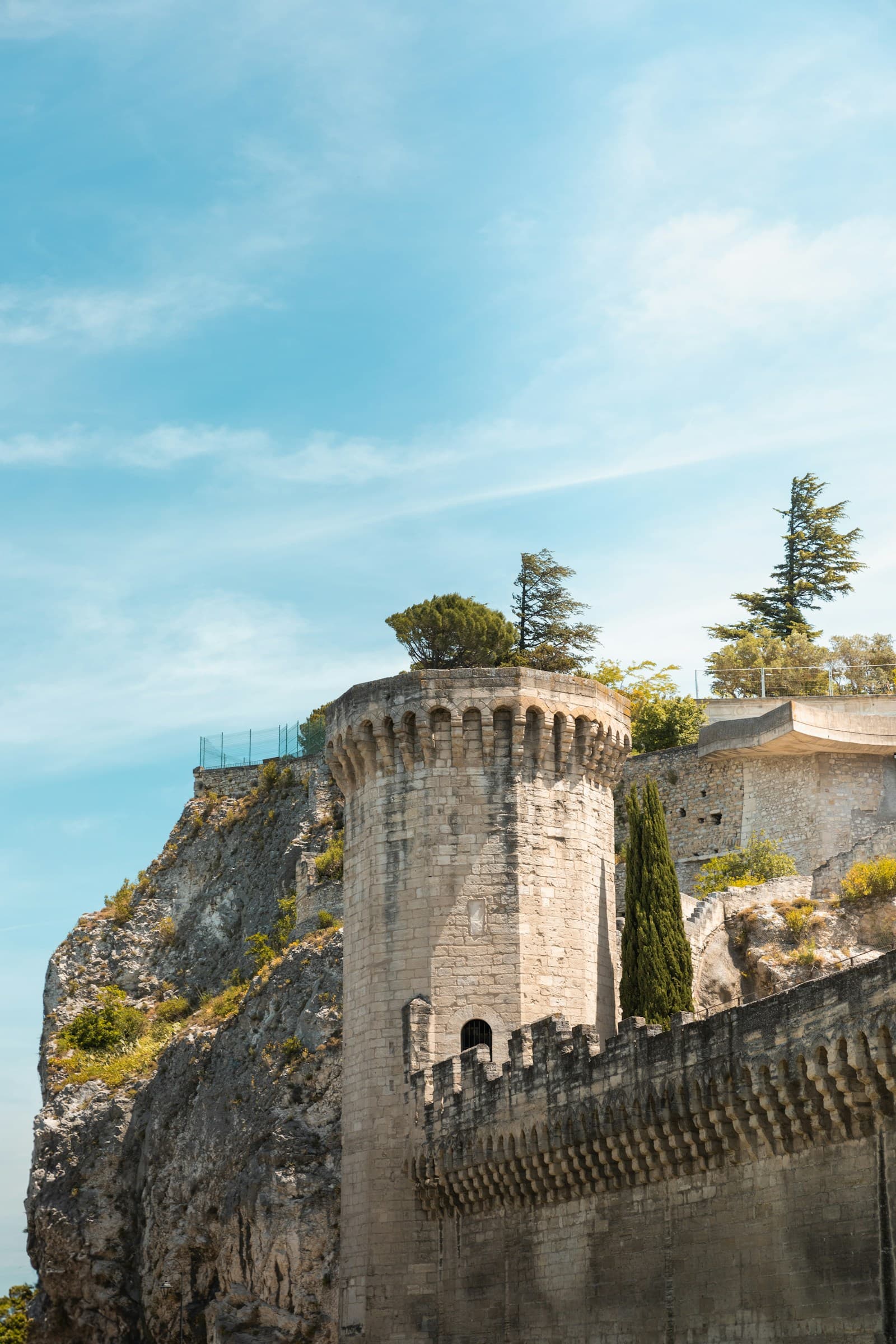
- Merlon and crenel: the alternating solid blocks (merlons) and gaps (crenels) along the parapet. A defender shelters behind a merlon and shoots or looks through a crenel. Together they make the toothed "crenellation" everyone pictures.
- Machicolation: an opening in a projecting floor above a gate or wall, so defenders can drop things straight down onto attackers pressed against the base. The defence for the one blind spot directly below.
- Postern: a small, discreet secondary door, easy to defend and easy to seal, for sorties and quiet movement, as opposed to the great public gates.
That is the whole alphabet. The tour is essentially a walk through the letters.
The seven specimens, read
Porte Saint-Roch teaches the gate-tower typology: how a full-dress entrance combines the passage, flanking towers, and overhead defence into one machine, because a gate is the weakest point in any wall and therefore the most heavily engineered.
The Western Wall Curtain is the primer on the parapet itself: merlon, crenel, machicolation, and chemin de ronde all in one legible stretch. If you learn the vocabulary anywhere, learn it here.
Porte de l'Oulle teaches by absence. It is a gate that is not the medieval original, a reminder that a "medieval" wall you see today is also a document of nineteenth-century restoration and modern traffic, when arches were widened and openings pierced to let carts and then cars through.
Porte du Rhône (Châtelet) shows the river gate: the special problem of defending the side that faces the water and the approach from the bridge, where a small fortified châtelet guards the weak point.
The Tour des Chiens on the Rocher des Doms ties the flat circuit to the high ground. The wall is not uniform; where it climbs the rock above the palace it exploits the natural cliff, and the tower marks the join between built defence and geological defence.
The Northeast Postern is the small door, the counterpoint to the grand gates: how a defended enclosure still needs quiet ways in and out that a handful of men can hold.
Porte Saint-Lazare closes the walk with another full gate on the opposite side of the city, letting you compare how the same problem was solved at a different point on the ring.
What the wall does and does not tell you
The honest thing to say about Avignon's ramparts is that they were never state-of-the-art siege architecture. The walls originally stood only around eight metres high, lower than a wall built to stop a determined royal army with siege engines. That was a deliberate trade. Against routiers, against opportunistic raiders and extortion gangs, a complete continuous enclosure with defended gates was enough, and it could be finished in fifteen years rather than fifty. The wall answers its actual enemy, not a textbook one.
There is one more layer to read. From 1860 the ramparts were restored under Eugène Viollet-le-Duc, the great and controversial nineteenth-century restorer, whose crews rebuilt, re-crenellated, and in places idealised the medieval original. So when you photograph a crisp merlon, you are often looking at a fourteenth-century idea executed with nineteenth-century masonry. That double authorship is part of the truth of the wall, not a flaw in it.
Where to go next
The ramparts are the papal capital defending itself. The Palais des Papes is the same fortress logic concentrated into a single building, and worth reading against the wall. For the opposite bank's answer to all this defensive stone, the French crown's citadel and rival town at Villeneuve is a short walk and a completely different point of view.
Ready to experience it?
Remparts d'Avignon: Reading a 14th-Century Walled City
90 min · 2.4 km · moderate
More from Avignon
Explore more at your own pace.
Avignon Travel Guide: How Many Days, Getting Around, When to Go (2026)
How a Provincial Town Became the Capital of Christendom: The Avignon Papacy
Two Popes, One Palace: How to Read the Palais des Papes

The Bridge to Nowhere: Why the Pont Saint-Bénézet Stops in the River

The Grande Chapelle: A Cathedral Hidden Inside a Palace