The Avignon Papacy: When Christendom Moved to Provence
90 min · 1.4 km · moderate
The single fact that explains Avignon is this: for sixty-seven years, the head of the Roman Catholic Church did not live in Rome. He lived here, on the left bank of the Rhône, in the largest Gothic palace in Europe. Everything you walk past in the old city is downstream of that one displacement.
The answer first
Between 1309 and 1376, seven successive popes governed Western Christendom from Avignon rather than from Rome. All seven were French. They did not visit; they resided, built, taxed, adjudicated, and ruled. In doing so they converted a modest riverside town of a few thousand people into the administrative capital of Latin Europe, complete with a fortified palace, a curia of thousands of clerks and lawyers, foreign embassies, banking houses, and eventually a four-kilometre defensive wall. When you stand in the Place du Palais today, you are standing in a purpose-built seat of government that a displaced institution assembled in two generations.
That is the thesis of this whole city, and it is worth holding onto: Avignon is not a town that happens to contain a famous palace. It is a capital, and the palace is its statehouse.
How it happened
Hear a stop from this walk
Rocher des Doms: The Synthesis View, the Return to Rome, and the Schism
Pope Clement V, the former Archbishop of Bordeaux, was elected in 1305. He was a Frenchman, elected in the aftershock of a bruising conflict between the papacy and the French king Philip IV, called Philip the Fair. Clement never travelled to a Rome that was, at the time, chaotic and dangerous, its noble families feuding and the Papal States in revolt. In 1309 he moved his court to Avignon.
The choice was clever. Avignon itself belonged to the Angevin Counts of Provence, who were papal allies, and it sat directly across the river from the Kingdom of France and adjacent to the Comtat Venaissin, territory the papacy already held. It was close to France without being in it, defensible, and served by the Rhône, the great commercial artery of the south. What was meant to be temporary hardened into permanence. In 1348 Clement VI simply bought the town outright from Queen Joanna I of Naples. The popes now owned their capital.
What a capital requires, and what got built
A capital is not a mood. It is a set of functions, and each function left a monument. To read Avignon is to read those functions off the stone.
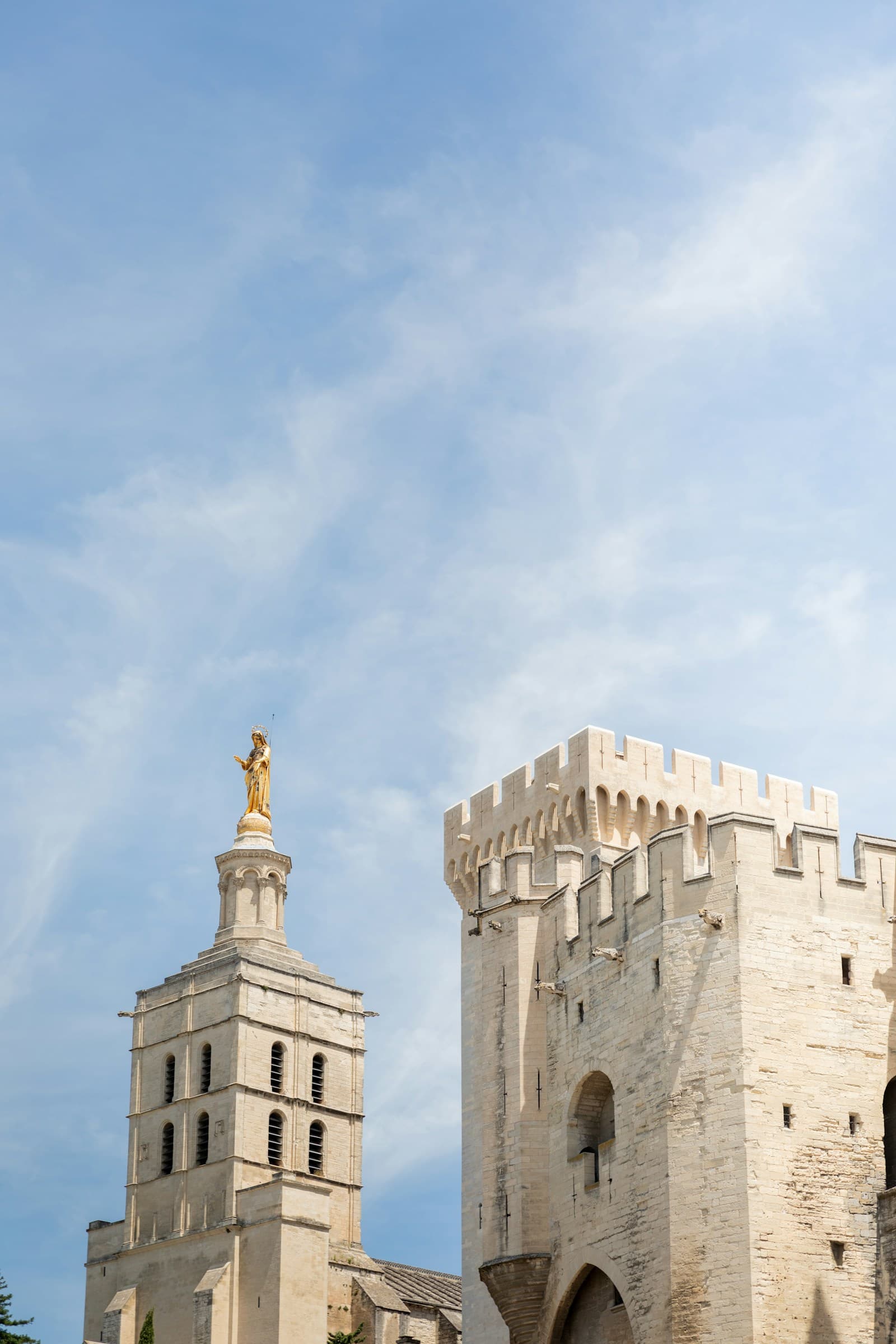
Government needs a seat. Benedict XII, a former Cistercian monk of austere temper, began the palace in 1335 with the architect Pierre Poisson. His successor Clement VI, a prince of the Church who spent lavishly, roughly doubled it with the architect Jean de Louvres. The result, finished around 1364, is the Palais des Papes: some fifteen thousand square metres, walls up to several metres thick, the largest Gothic building of the Middle Ages. The companion guide to the palace tour reads the building as four simultaneous statements about money, defence, alliance, and legitimacy.
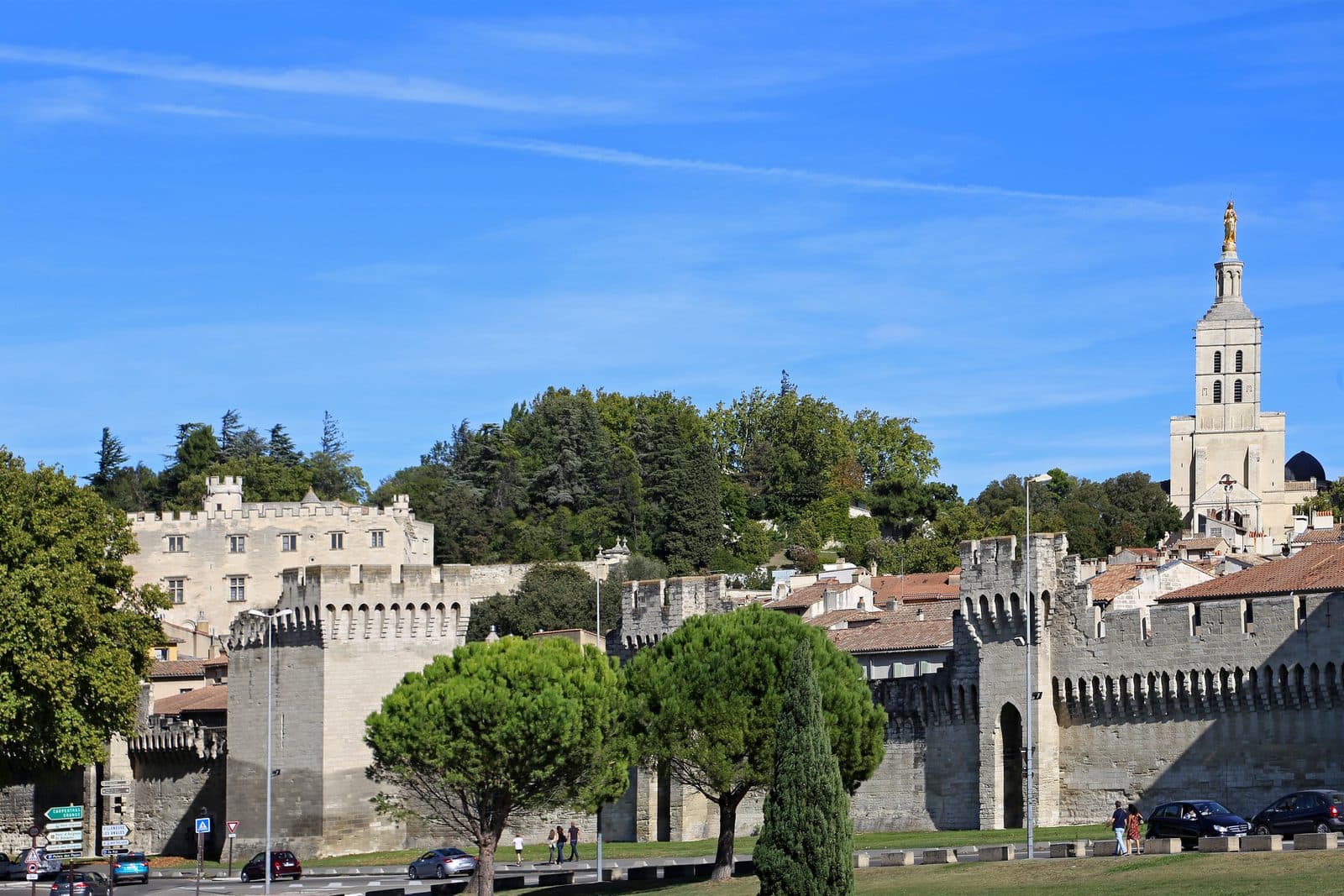
A capital under siege needs walls. The Hundred Years' War had loosed bands of unpaid mercenaries, the routiers, across the French countryside. In 1355 Innocent VI began a full circuit of ramparts, finished around 1370 under Urban V: roughly 4.3 kilometres of curtain wall, towers, and gates that still ring the old city almost intact. The ramparts tour treats them as a legible textbook of fourteenth-century military engineering.
A rival state watches from across the river. The Rhône was a border. The far bank was the Kingdom of France, and the French Crown answered the papal capital with a capital of its own at Villeneuve-lès-Avignon: Philip the Fair's tower at the bridgehead, the royal Fort Saint-André on the hill, and Innocent VI's own charterhouse. The Villeneuve tour walks the diplomatic geography of two sovereigns staring at each other across one river.
A court needs to eat and drink. The second Avignon pope, John XXII, built a summer castle in the hills upriver and planted its slopes with vines. That estate gave its name to a wine that ended up on the papal table and, centuries later, to one of the most famous appellations in France: Châteauneuf-du-Pape.
Why the label "Babylonian Captivity" is a slur, not a fact
Italians hated the exile. Rome without the pope was a city that had lost its reason to exist, and the loss of curial spending was ruinous. The poet Petrarch, who lived near Avignon and loathed it, coined the phrase that stuck: the Babylonian Captivity of the Church, likening the popes' stay to the ancient Israelites' exile in Babylon. It is memorable, and it is propaganda. The Avignon popes were not captives. They ran a solvent, efficient, centralised administration, reformed Church finance, and made Avignon a genuine cultural centre where Italian painters like Matteo Giovanetti frescoed the papal chapels. The polemic tells you how Rome felt, not what Avignon was.
The ending, and the wound it left
Gregory XI, the seventh and last of the line, finally led the papacy back to Rome, entering the city on 17 January 1377. He died a year later. The election of his successor was disputed, the College of Cardinals split, and a rival pope was chosen who returned to Avignon. For the next several decades the Western Church had two competing popes, one in Rome and one on the Rhône, an institutional civil war called the Western Schism. Avignon housed the Avignon line until 1403. The papacy the city had hosted did not just leave; it fractured, and the fracture is part of why the palace afterward stood empty, was used as a barracks, and only in the twentieth century became the monument you visit.
How to read the city on the ground
Every tour in Avignon is a slice of this one story. Walk the palace to see the seat of government. Walk the ramparts to see the capital defending itself. Cross to Villeneuve to see the rival crown answering. Whatever order you take them in, you are reading the same sentence: a provincial town on a river became, for sixty-seven years, the capital of the Western world, and then had to live for six hundred more with the stone that ambition left behind.
If you only have time for one, start with the self-guided walking tours of Avignon overview and pick the thread that pulls you.
Frequently asked questions
Ready to experience it?
The Avignon Papacy: When Christendom Moved to Provence
90 min · 1.4 km · moderate
More from Avignon
Explore more at your own pace.
Avignon Travel Guide: How Many Days, Getting Around, When to Go (2026)
One Bridge, Two Sovereigns: The France That Watched Avignon Across the Rhône
Two Popes, One Palace: How to Read the Palais des Papes

The Bridge to Nowhere: Why the Pont Saint-Bénézet Stops in the River

The Grande Chapelle: A Cathedral Hidden Inside a Palace