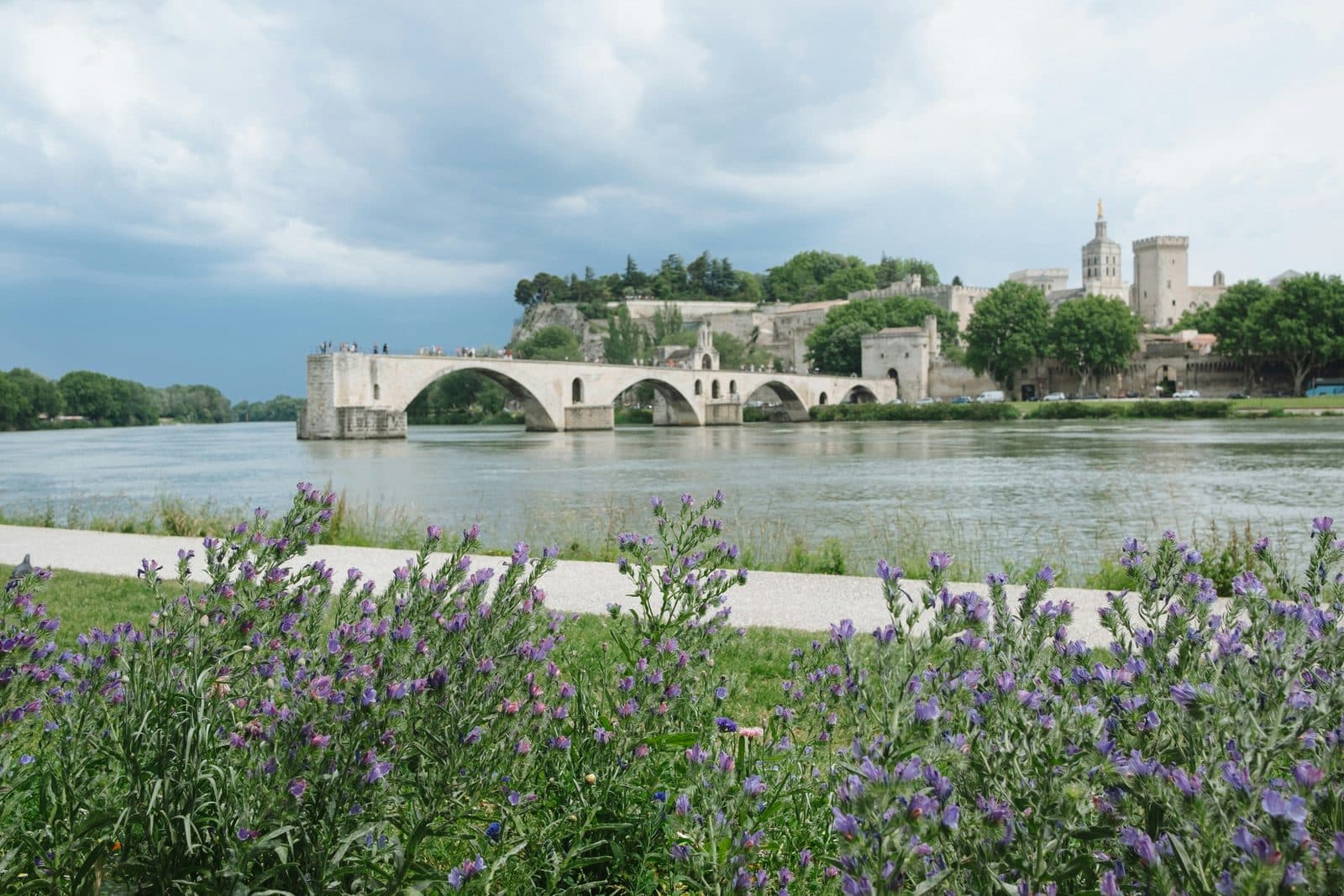
Everyone knows the song. "Sur le pont d'Avignon, l'on y danse, l'on y danse." What almost nobody knows until they stand in front of it is that the bridge in the song no longer reaches the far side. It has four arches. It runs a little way out over the Rhône and then simply stops, ending in open water. The most famous bridge in France is a bridge to nowhere, and the reason it broke is bound up with the reason it was built.
The answer first
The Pont Saint-Bénézet, the "bridge of Avignon," was begun in 1177 and once ran roughly 900 metres across the Rhône to the far bank at Villeneuve, carried on 22 stone arches. It was repeatedly damaged by the river's floods over the following centuries and eventually abandoned as a crossing; only four arches survive today, ending in mid-stream. It was not destroyed in a single event. It was worn out by the Rhône, one flood at a time, and never fully rebuilt. To understand why nobody rebuilt it, you have to know what the bridge connected: two rival states. That story is the Villeneuve tour.
The legend, verified as a legend
Hear a stop from this walk
Collegiate Church of Notre-Dame: The Spillover Made Permanent
The bridge has a founding story, and it is worth telling straight, as the legend it is. In 1177, according to tradition, a young shepherd named Bénézet came down from the mountains and announced that God had sent him to build a bridge at Avignon. The townspeople mocked him. Challenged to prove his divine mission, he is said to have lifted an enormous stone that ordinary men could not move and cast it into the Rhône to lay the first pier. He founded a bridge-building brotherhood, the work was done, and he was later venerated as a saint; his remains were kept in a chapel on the bridge itself.
That is the story the town has told for eight centuries. It is a legend, not a documented biography, and it is honest to present it as one. What is solid history underneath it is that a major stone bridge really was built at Avignon in the late twelfth century, an extraordinary feat for its day, and that it carried a chapel dedicated to Saint Nicholas, patron of the Rhône boatmen, on one of its piers, where you can still see it.
Why a bridge here was a political fact, not just a convenience
A bridge is infrastructure. This one was also a frontier. The Rhône was the border: the Avignon bank was papal, the far bank at Villeneuve was the Kingdom of France. A permanent stone crossing between the two was therefore never neutral. It is exactly why the French king Philip IV, called Philip the Fair, built the Tour Philippe-le-Bel at the far end, a tower and gatehouse completed in its first form in 1302 that controlled and taxed everyone crossing from the papal side onto French soil. The bridge joined two sovereigns who did not entirely want to be joined, and each end of it was watched by the other side.
That tension helps explain why, when the river kept breaking the bridge, it was never worth the enormous cost of a full rebuild. A structure that spanned a contested border, benefited two governments unequally, and was ruined again by every serious flood was always going to lose the argument with the Rhône eventually.
How to read the four arches
Stand at the surviving stub and do three things.
Look at the chapel, the small structure on the second pier. This is the Chapelle Saint-Nicolas, the boatmen's chapel, and the traditional resting place of the bridge's legendary founder. It tells you the bridge was a sacred object as much as a practical one; crossing it was partly an act of devotion.
Look at the line the arches make and imagine it continued. The bridge did not run straight across; it angled toward Villeneuve, aiming at the Tour Philippe-le-Bel on the far bank. Trace that imaginary line to the tower and you are looking at the exact axis of the papal-royal border.
Look at the water. The Rhône here is wide, fast, and prone to violent floods. That river is the whole explanation. It gave Avignon its wealth as a trade artery and its defensibility as a moat, and it is also the force that, patiently, took the bridge apart.
And the dancing?
The song says people danced "on" the bridge. Most scholars think the original words were "sous le pont," under the bridge, where people gathered on an island beneath the arches, and that "sur," on top, is a later, cheerier corruption. Either way the song has made a broken medieval bridge one of the most recognised structures in the world, which is a strange and fitting afterlife for something built by a shepherd who heard a voice.
Where to go next
The bridge is the hinge of the one bridge, two sovereigns tour, which walks the whole rivalry across the water. For the power that sat on the near bank and made the crossing worth fighting over, read how a provincial town became the capital of Christendom.
Ready to experience it?
One Bridge, Two Sovereigns: Avignon and Villeneuve
150 min · 3.4 km · moderate
More from Avignon
Explore more at your own pace.
Avignon Travel Guide: How Many Days, Getting Around, When to Go (2026)
How a Provincial Town Became the Capital of Christendom: The Avignon Papacy
One Bridge, Two Sovereigns: The France That Watched Avignon Across the Rhône
Two Popes, One Palace: How to Read the Palais des Papes

The Grande Chapelle: A Cathedral Hidden Inside a Palace