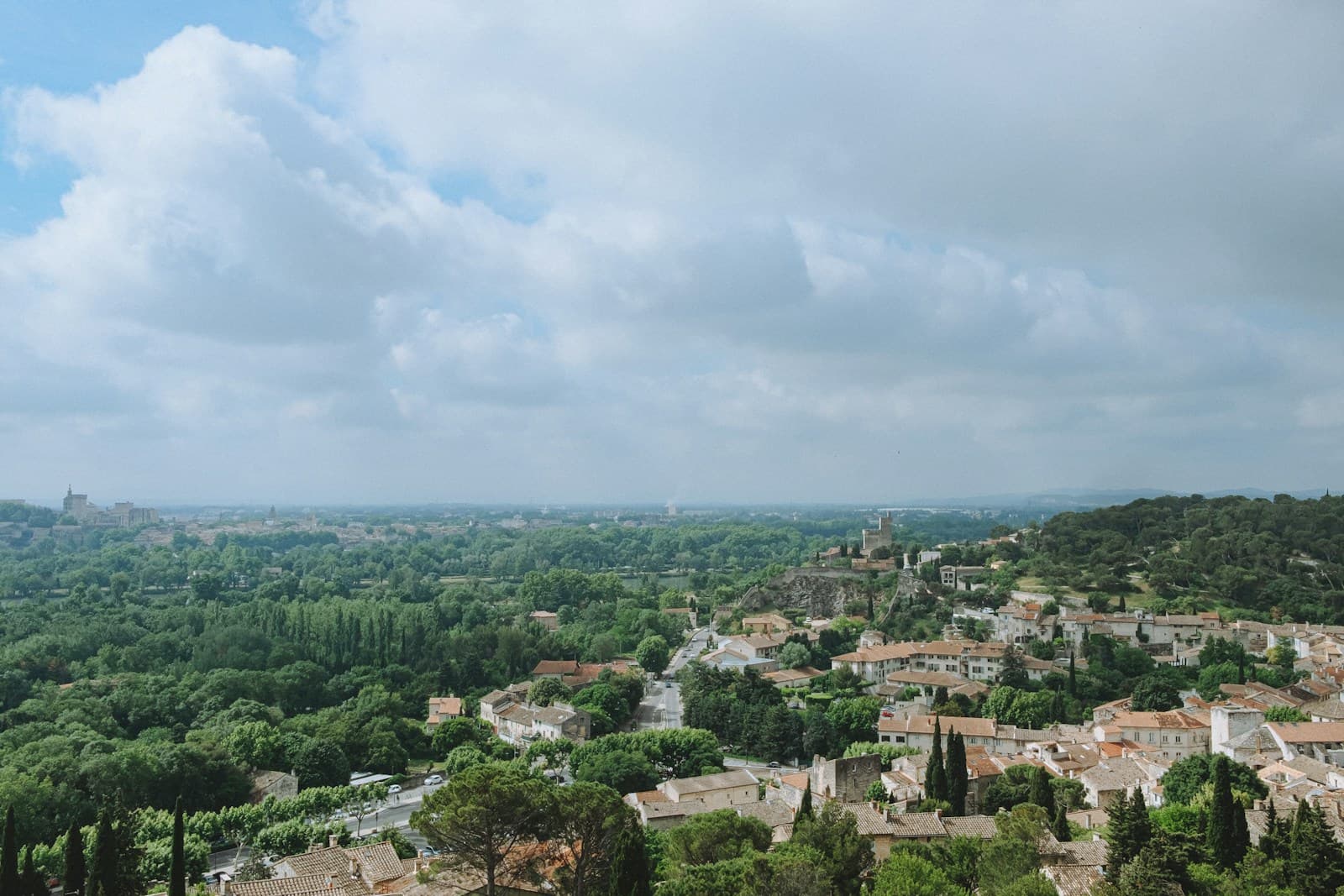
Seven stops. About two and a half kilometres. The right bank of the Rhône, in Villeneuve-lès-Avignon, with the Palais des Papes visible across the water. Villeneuve-lès-Avignon, across the Rhône from papal Avignon, is the paradox that the broken Pont Saint-Bénézet half-spans. One bridge, two states, two competing sovereigns. Fort Saint-André and the Chartreuse du Val-de-Bénédiction are the French Crown's architectural counter-statement to the papal court, and the tour walks the diplomatic geography of fourteenth-century Europe across a single river.
Start · Tour Philippe-le-Bel: The French Crown's First Statement on the Rhône
DirectionsStops
- 1

Tour Philippe-le-Bel: The French Crown's First Statement on the Rhône
Western terminus of the Pont Saint-Bénézet, on the Kingdom of France bank. Commissioned by Philip the Fourth of France under the twelve ninety-two paréage with the Abbey of Saint-André. Two-storey tower completed by thirteen oh two; gatehouse from thirteen oh seven; third storey added around thirteen fifty. Total height thirty-nine metres. Wikidata Q three five three three one five five.
- 2

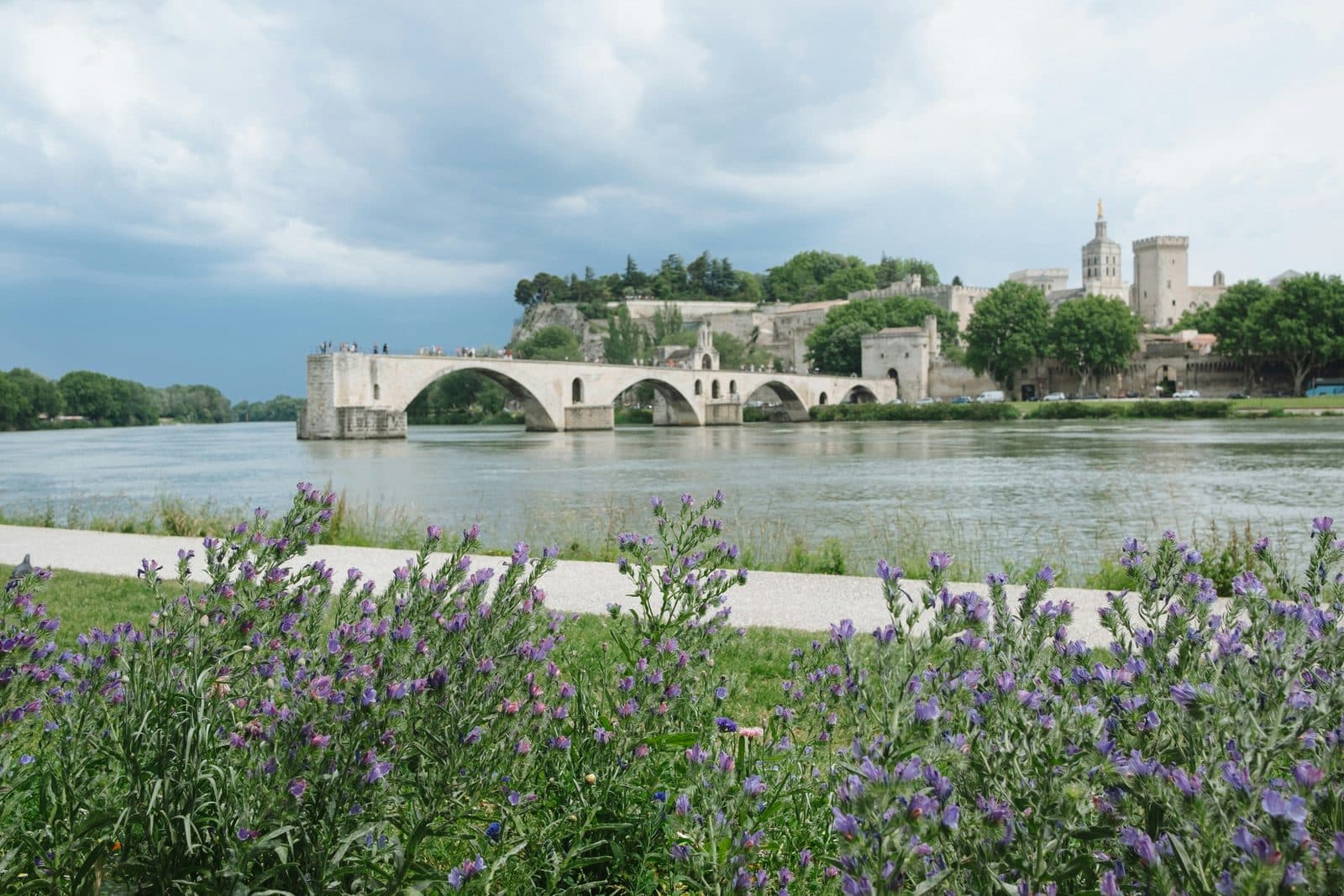
Pont Saint-Bénézet: The Political Severance Made Physical
View across the Rhône from the Villeneuve bank to the four surviving arches of the medieval bridge on the Avignon side. Wooden bridge eleven seventy-seven to eleven eighty-five, traditionally credited to Bénézet. Destroyed twelve twenty-six in the Albigensian Crusade siege under Louis the Eighth. Stone reconstruction begun twelve thirty-four with twenty-two arches. By sixteen forty-four four arches were missing; a sixteen sixty-nine flood swept away more; bridge abandoned in the mid-seventeenth century. Wikidata Q three seven four one three six.
- 3

Fort Saint-André: The Royal Citadel Above
Royal fortress on Mont Andaon, a rocky outcrop rising about fifty metres above the Rhône floodplain. Authorised by the twelve ninety-two paréage but the major military construction did not begin until thirteen sixty under John the Second; the campaign was finished in the reign of Charles the Fifth. The carved crest above the entrance arch is dated twentieth of July, thirteen sixty-seven. Encloses the late-tenth-century Benedictine Abbey of Saint-André. Wikidata Q three oh seven eight oh one nine.
- 4

Abbaye Saint-André: The Sightline Across the Rhône
Benedictine abbey founded in the late tenth century on Mont Andaon, predating both the royal fortifications and the papal period. The twelve ninety-two paréage was negotiated between Philip the Fourth's representatives and the abbey. The abbey was enclosed by the fortifications in the thirteen sixties. Offers the most direct sightline to the Palais des Papes across the Rhône. Wikidata Q two eight two oh three four nine.
- 5

Chartreuse du Val-de-Bénédiction: The Pope Crosses the Other Way
Carthusian monastery founded by Pope Innocent the Sixth in thirteen fifty-six, in his former cardinal's palace on the Kingdom of France side of the Rhône. Initial church thirteen fifty-three to thirteen fifty-six. Enlarged thirteen sixty to thirteen sixty-one to house Innocent the Sixth's tomb. Renamed Val-de-Bénédiction in thirteen sixty-two. Completed under Pope Urban the Fifth. Wikidata Q two nine six one two four nine.
- 6

Musée Pierre de Luxembourg: The Cardinal Patronage Made Portable
Municipal museum installed in a seventeenth-century mansion arranged within the former fourteenth-century palace of Cardinal Annibal de Ceccano, one of the village's cardinal-palaces. Holds Enguerrand Quarton's Couronnement de la Vierge, painted fourteen fifty-three to fourteen fifty-four for Pope Innocent the Sixth's funerary chapel at the Chartreuse. Museum on this site since nineteen eighty-six. Building bears the name of Cardinal Pierre de Luxembourg, traditionally said to have died there in thirteen eighty-seven at age seventeen.
- 7

Collegiate Church of Notre-Dame: The Spillover Made Permanent
Gothic church on Place Meissonier in Villeneuve-lès-Avignon, completed in thirteen fourteen and consecrated in thirteen thirty-three by Cardinal Arnaud de Via, bishop of Cahors and nephew of Pope John the Twenty-Second. Arnaud de Via founded a chapter of twelve canons inside his cardinal-palace and bequeathed his property to them in thirteen thirty-six. Cloister and belfry adjacent thirteen fifty; bell tower thirteen sixty-two. Protected as a French historical monument since eighteen sixty-two.
Details
Best Time to Visit
Mid-morning to early afternoon, Tuesday through Saturday. The Tour Philippe-le-Bel, the Rhône bank, and the eastern viewpoint at the Abbaye Saint-André all read most clearly in side-light, when the sun is over Avignon and the four surviving bridge arches across the water cast a defined shadow line. A nine-thirty or ten o'clock start at the Tour Philippe-le-Bel gets you through Mont Andaon and into the Chartreuse before the early-afternoon visitor peak. Sundays the Chartreuse and the Musée Pierre de Luxembourg may run reduced hours; Mondays both can close. Summer afternoons in Provence are hot and the Mont Andaon ascent is exposed; in July and August, shift to an eight-thirty start or to an evening walk from five in the afternoon when the stone has cooled and the western light hits the Palais des Papes across the river.
Pro Tips
- •Book the Fort Saint-André and the Chartreuse du Val-de-Bénédiction online in advance through their official sites. Both are ticketed and both can develop short queues at the door in high season. The audio anchors at stops three and four are inside the Fort Saint-André grounds; stop five is inside the Chartreuse. Walk-up tickets are usually available, but online booking saves the queue.
- •The Tour Philippe-le-Bel at stop one has a seasonal interior climb to the top of the tower, a small additional fee. The exterior anchor for the audio is at the tower's base and works without paying. If the tower is open and you have an extra fifteen minutes, climb it: the platform gives you the bridge view and the Palais des Papes across the river in one frame before you start the walk.
- •Stop four, the Abbaye Saint-André sightline to the Palais des Papes, is the visual climax of the tour. The clearest view is from the abbey's eastern terrace, the highest point on Mont Andaon. Field-walk vegetation can occasionally obscure the sightline in late summer; if so, walk twenty metres along the curtain wall to find an unobstructed angle.
- •The Chartreuse du Val-de-Bénédiction at stop five is now also home to the Centre national des écritures du spectacle, a national arts centre and writers' residency. Contemporary exhibitions sometimes occupy the cloister and the chapter rooms. Innocent the Sixth's tomb, in the church, is the load-bearing object for the stop and is normally accessible during opening hours.
- •The Musée Pierre de Luxembourg at stop six is small and quiet. Quarton's Couronnement de la Vierge is in the main gallery and is the only object you need to find for the audio to resolve. The museum is closed Mondays year-round and may run shorter hours from November to March.
- •The total walk is two and a half kilometres including one moderate ascent and one moderate descent on Mont Andaon, roughly fifty metres of vertical gain. Including stop dwell and interior visits, plan two and a half to three hours. If the Fort Saint-André interior queue is long and your time is short, the exterior anchor at the twin-towered gate is sufficient for stop three; skip the interior and continue to the abbey east viewpoint at stop four.
- •If you are also walking the sibling Avignon tours on the Palais des Papes and the city ramparts, do Villeneuve on a separate half-day. The cross-river argument lands hardest when you have not just left the Palais. The river crossing is part of the discovery.
Safety & Precautions
- •The Mont Andaon ascent from the Rhône bank to Fort Saint-André gains about fifty metres on stone steps and uneven paving. Wear flat closed shoes with grip. There is no step-free alternative for the climb itself; visitors with reduced mobility can drive or taxi up to the fort's upper entrance and join the route at stop three.
- •Summer heat in Provence is intense and Mont Andaon is exposed, with very little shade between the Rhône bank and the abbey. Carry water. From June to September, plan an early-morning or late-afternoon start; midday on the hill can be punishing.
- •The Rhône bank between the Tour Philippe-le-Bel and the point opposite the bridge is paved but sometimes shared with cyclists on the riverside path. Keep to the pedestrian side and watch for traffic when crossing access roads at either end of the bank stretch.
- •Fort Saint-André, the Chartreuse, and the Musée Pierre de Luxembourg all charge admission and all keep their own seasonal hours. The audio at stops three, four, five, and six is anchored inside ticketed areas; if any one of these is closed on the day you walk, that stop will need to be heard outside the gate or skipped.
- •Stop two, the bridge view, requires you to look across the Rhône to the Avignon bank. The Pont Saint-Bénézet itself is on the Avignon side and is the subject of a different sibling tour. This tour does not cross the river. If you want to walk onto the bridge itself, plan it separately.
- •Villeneuve-lès-Avignon is a quiet provincial village. Most cafés and shops close between two and four in the afternoon. Plan your lunch and rest accordingly. The Chartreuse and the Musée Pierre de Luxembourg may also close for a midday window in winter.
Travel advisory: Exercise Increased Caution (Level 2).
Gallery
Related Reading
Go deeper on what you'll see, hear, and walk through.
Overview
Avignon Travel Guide: How Many Days, Getting Around, When to Go (2026)
5 min
Overview
Best Self-Guided Walking Tours in Avignon (2026)
4 min
Overview
One Day in Avignon: A Walkable Walled-City Itinerary (2026)
6 min
Thematic
Best History Walking Tours in Avignon (2026)
2 min
Thematic
How a Provincial Town Became the Capital of Christendom: The Avignon Papacy
6 min
Thematic
What to Eat in Avignon: A Provençal Food Guide (2026)
4 min
Companion
One Bridge, Two Sovereigns: The France That Watched Avignon Across the Rhône
5 min
Deep dive
The Bridge to Nowhere: Why the Pont Saint-Bénézet Stops in the River
5 min
Read the walk
The full story of One Bridge, Two Sovereigns: Avignon and Villeneuve, in words. Prefer to listen? Play it narrated, from home or on location.
Introduction
One Catholic Church. Two competing political states. A single nine-hundred-metre stone bridge across the Rhône, now broken to four arches. This is the paradox the Pont Saint-Bénézet half-spans.
Villeneuve-lès-Avignon, on the right bank of the Rhône, is the Kingdom of France's architectural counter-statement to the papal court across the water. The walk reads the diplomatic geography of fourteenth-century Europe across a single river.
The river was the medieval boundary. Avignon on the far bank, the County of Provence held by the Angevins of Naples, then sold by Queen Joanna I to Pope Clement VI in June thirteen forty-eight for eighty thousand florins. The near bank, Kingdom of France. Two competing sovereigns. Philip IV, Philippe le Bel, projected royal authority across the Rhône via the Tour Philippe-le-Bel between twelve ninety-two and thirteen oh seven, before the papacy ever arrived under Clement V in thirteen oh nine. The king's claim on this river is the older claim. Fort Saint-André was raised between thirteen sixty and around thirteen sixty-eight under Jean II and Charles V as the French Crown's architectural answer to the thirteen thirty-five to thirteen fifty-two Palais des Papes opposite. The paradox-within-the-paradox is the Chartreuse du Val-de-Bénédiction, founded in thirteen fifty-six by Pope Innocent VI on the French bank, not on his own Comtat Venaissin.
Seven stops, about three and a half kilometres, one hundred and fifty minutes. When you arrive at the foot of the Tour Philippe-le-Bel, begin with stop one.
1. Tour Philippe-le-Bel: The French Crown's First Statement on the Rhône
You are standing at the foot of the Tour Philippe-le-Bel. Thirty-nine metres of stone, three storeys, set at the western end of where the Pont Saint-Bénézet once met the Kingdom of France.
The documentary spine, per Wikipedia's entry on the Tour Philippe-le-Bel and per the architectural database Structurae. Philip the Fourth of France, called Philippe le Bel, reigned from twelve eighty-five to thirteen fourteen. In twelve ninety-two, per Wikipedia's record of Fort Saint-André, his representative Adam de Montcéliard, seneschal of Beaucaire, signed a paréage with the Benedictine Abbey of Saint-André, which sat on the hill behind you. A paréage is a medieval treaty of shared jurisdiction. This one authorised the king to build a fortress at the bridge's western end, with a permanent royal garrison, and to fortify the abbey's hill.
The two-storey tower at your back was finished by thirteen oh two. The gatehouse started in thirteen oh seven. A third storey was added around thirteen fifty, probably under Philip the Sixth or John the Second. Wikidata Q three five three three one five five.
Now hold the date. Twelve ninety-two. The papacy did not arrive in Avignon until thirteen oh nine, under Pope Clement the Fifth. The Avignon papacy that you came across the river to see, the one whose palace is visible behind the bridge from where you are standing, came LATER. The French Crown's footprint on this river is the older claim. Philippe le Bel was here first.
Now look east. The Rhône is at your shoulder. The four surviving arches of the bridge are five hundred metres along the bank. Walk that way. That is stop two.
2. Pont Saint-Bénézet: The Political Severance Made Physical
You have walked along the Rhône bank from the tower. Stop at a point where you can see clearly across the water to the four surviving arches of the bridge on the Avignon side.
Look at what is in front of you. Four arches of stone, ending in mid-river. The bridge does not reach you. It stops about a third of the way across.
Per Wikipedia's record of the Pont Saint-Bénézet, the documentary spine of this bridge runs as follows. The first wooden bridge was built between eleven seventy-seven and eleven eighty-five, traditionally credited to a young shepherd called Bénézet, who is buried in a small chapel set on one of the piers. The wooden bridge was destroyed in twelve twenty-six during Louis the Eighth's siege of Avignon, in the Albigensian Crusade.
The stone reconstruction began in twelve thirty-four. Twenty-two arches. Twenty-one piers. Approximately nine hundred metres long. The largest segmental arch measured thirty-five point eight metres. When it was whole, per Wikipedia, this was the only fixed Rhône crossing between Lyon and the Mediterranean Sea. By sixteen forty-four, four arches were missing. A flood in sixteen sixty-nine swept away more. The bridge was abandoned in the mid-sixteen hundreds, when repair became more expensive than the use the river crossing could justify. Four arches survive. The four you are looking at.
Now hold what those four arches meant when there were twenty-two. The bridge crossed two sovereign states in a single structure. The eastern end touched papal Avignon. The western end, behind you, touched the Kingdom of France. Per Wikipedia's note on the bridge, it was, in their phrase, closely guarded on both sides, with fortifications including the Tour Philippe-le-Bel you just left.
A bridge between two states is also a working alliance. As long as both ends had a reason to maintain it, the bridge stood. The seventeenth-century floods finished it. Look at the four surviving arches one more time. The shape of the river crossing is the shape of the medieval frame closing.
Now turn away from the river. Walk uphill, north and west, into Mont Andaon. The rocky outcrop rises about fifty metres above the floodplain. At the top is a curtain wall and twin towers. That is stop three.
3. Fort Saint-André: The Royal Citadel Above
You have arrived at the twin-tower entrance of Fort Saint-André. Stand below the carved crest above the arch. The two cylindrical towers rise to either side of you. The curtain wall runs east and west along the ridge.
Per Wikipedia's entry on Fort Saint-André, and per the official site at fort-saint-andre.fr, the documentary spine of this fortress is the following. The twelve ninety-two paréage you heard about at stop one authorised the fortification of Mont Andaon. But the major military construction did not begin until thirteen sixty, under King John the Second of France, called Jean le Bon, who reigned from thirteen fifty to thirteen sixty-four. The campaign continued through the thirteen-sixties and, in the consensus phrase of fort-saint-andre.fr, was finished in the reign of Charles the Fifth, who reigned from thirteen sixty-four to thirteen eighty. The carved crest above the entrance arch you are standing under is dated the twentieth of July, thirteen sixty-seven. Wikidata Q three oh seven eight oh one nine.
Now hold the dates against the bank opposite. Per the same source, the Palais des Papes that is visible across the Rhône to the east, the building this tour does not enter and which is the subject of the sibling Avignon tour on the Palais, was built between thirteen thirty-five and thirteen fifty-two, under Pope Benedict the Twelfth and Pope Clement the Sixth. Fort Saint-André was built one generation later, in the thirteen sixties, by the French Crown. Per fort-saint-andre.fr, the fort was raised, in their phrase, to demonstrate French royal power at the border with the Papal State. The Palais opposite is the papal architectural statement of the thirteen forties. The fort under your hand is the French Crown's thirteen-sixties answer.
Now run your hand along the curtain wall to your right. The stone is laid in courses. Mont Andaon is a rocky plateau of about three and a half hectares, fifty metres above the Rhône floodplain, with the Benedictine Abbey of Saint-André on its highest point. The two buildings, fort and papal palace, can see each other across the water from their own ramparts.
The abbey at the top of the hill is the older religious community the king built his fortifications around. That is stop four.
4. Abbaye Saint-André: The Sightline Across the Rhône
You have walked into the abbey grounds inside the fort. Find the east-facing edge of the plateau, with the abbey gardens at your feet and the Rhône below to the east. Look across the river. The Palais des Papes is directly in front of you, across the water. The block of stone…
Full narration for this stop unlocks with the tour.
5. Chartreuse du Val-de-Bénédiction: The Pope Crosses the Other Way
You are at the entry court of the Chartreuse du Val-de-Bénédiction. The Carthusian cloister opens beyond. The walls are quiet in a way the curtain wall at the fort was not. This is a contemplative space, set deliberately apart. Per the French Wikipédia entry on the Chartreuse…
Full narration for this stop unlocks with the tour.
6. Musée Pierre de Luxembourg: The Cardinal Patronage Made Portable
You have arrived at the Musée Pierre de Luxembourg. Look at the building before you go inside. The seventeenth-century façade is arranged inside the older fourteenth-century shell. The fabric is layered. Per the official municipal site villeneuvelezavignon.com and per…
Full narration for this stop unlocks with the tour.
7. Collegiate Church of Notre-Dame: The Spillover Made Permanent
You are standing on Place Meissonier, in front of the Collegiate Church of Notre-Dame. Look at the Gothic façade. The bell tower above the roofline. The cloister beside the church. Per Wikipedia's entry on the Collegiate Church of Notre-Dame, Villeneuve-lès-Avignon, and per the…
Full narration for this stop unlocks with the tour.