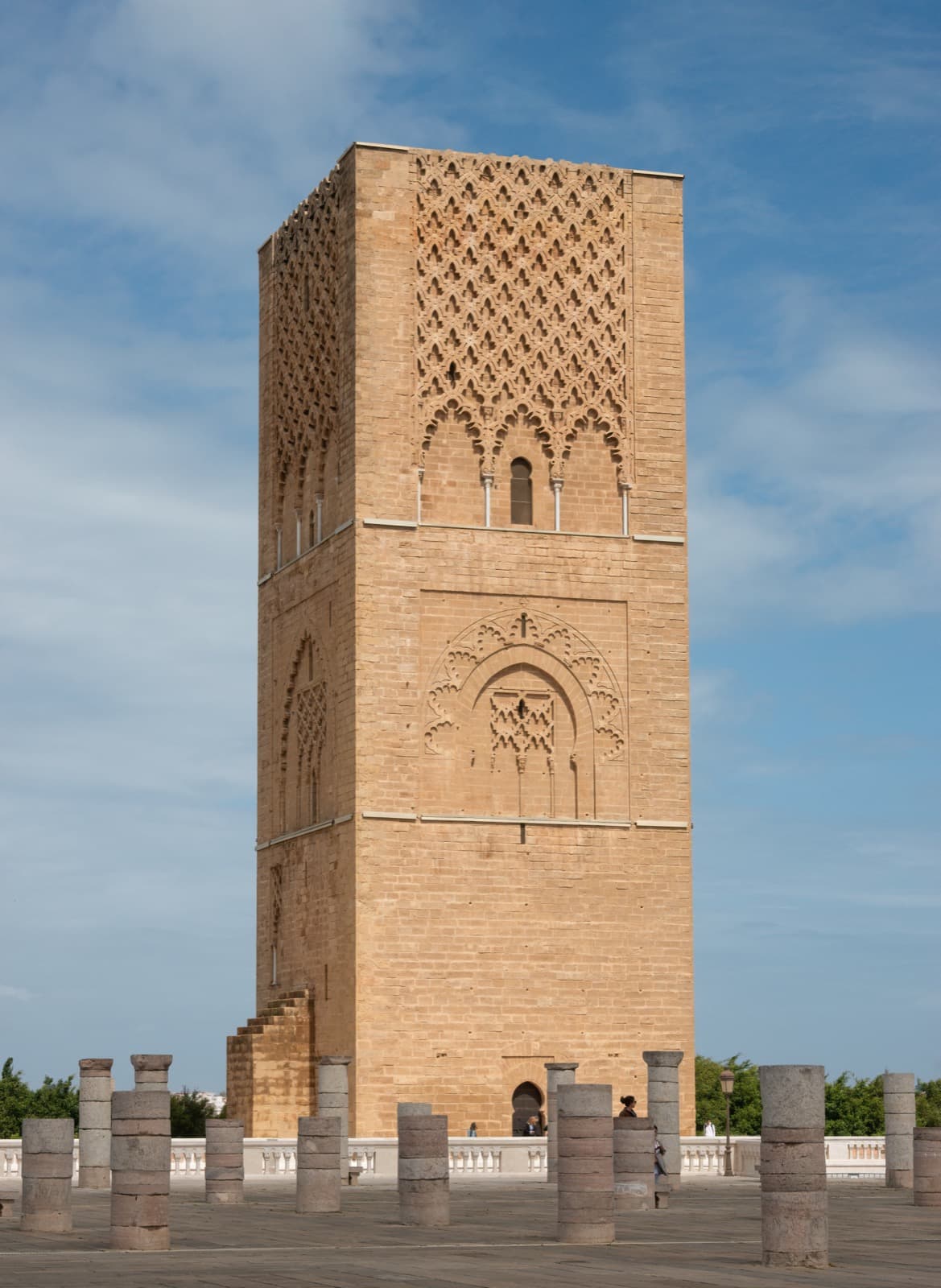
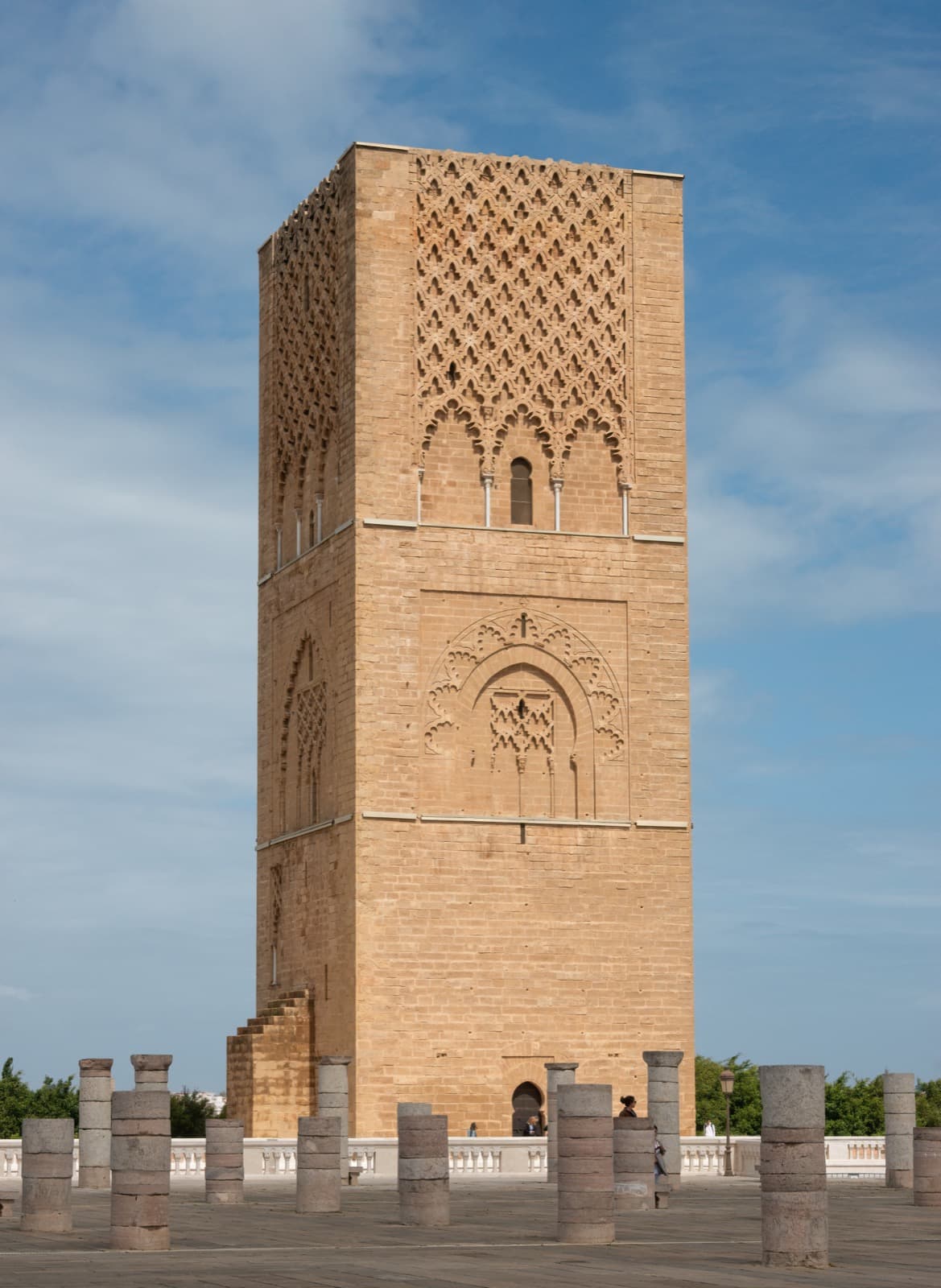
The Hassan Tower is an unfinished minaret. It rose to 44 metres of red sandstone above the Bou Regreg river and then stopped, because the caliph who ordered it died before the mosque beneath it could be built. That single halt, ambition frozen mid-climb, is the argument the whole imperial Rabat walk is built to read. Once you understand why the tower is short, you understand a city that measures its grandeur by what never rose rather than what stands complete.
A minaret that stopped climbing
The Almohad caliph Yacoub el-Mansour commissioned the tower, beginning work around 1191, a date sometimes given as 1195, and its early history is linked to his victory at the Battle of Alarcos. He meant it to crown the largest mosque in the western Muslim world, the centerpiece of a monumental new capital. Then, in 1199, he died. His successors lacked the resources or the will to continue, and the mosque and the capital were both left incomplete.
The tower reached 44 metres. Its full planned height is an estimate rather than a settled fact, put at least at 64 metres and possibly around 80 metres once a lantern-tower and finial were added. So what you see from the esplanade is less than half of an intended structure. That is not a flaw in the monument. It is the monument. The tower was modeled on the Koutoubia minaret in Marrakech and would have been slightly taller than the Giralda in Seville, three related Almohad towers spread across two continents by the same dynasty. Standing below the red shaft, you are looking at the ceiling of an empire's reach, marked forever by the exact point where the reach failed.
The esplanade is wide, free to enter, and the interior cannot be climbed, so this is a monument you read from the ground and at your own pace. There is no group waiting on you, which matters here more than usual. This is a stop that rewards standing still and doing the arithmetic: 44 up, and roughly as much again never built.
The floor that proves the point
Hear a stop from this walk
The Chellah: A Roman Town Turned Into a Garden of Tombs
Walk south from the tower and the argument gets more literal. A wide platform is ranked with some 348 columns and re-erected column stumps, the floor plan of an enormous hypostyle prayer hall, the kind of mosque where a forest of pillars carries the roof. Had it been finished, this would have been the largest mosque in the western Muslim world. It was not. After the caliph's death the work simply stopped, and what had been built stood half-made for centuries.
Then, in 1755, the great Lisbon earthquake reached across the Atlantic and shook Rabat, damaging what remained and leaving these ranks of stumps. So the unfinished floor of the unfinished mosque was later shaken further apart by a disaster that struck from across an ocean. It is one of the quietest and most eloquent ruins in Morocco, and it is the thesis of this route rendered as a photograph you can walk through: a dynasty's grandest mosque as a field of broken pillars.
The imperial story, finally completed
At the southern end of the esplanade the walk turns. A mausoleum of white marble under a green pyramidal roof holds the kings who won the country back. Construction began in 1961 and was completed in 1971, when the body of King Mohammed the Fifth was transferred here. He led Morocco to independence from the French Protectorate in 1956. Beside him lie his son King Hassan the Second, who died in 1999, and Prince Abdallah, who died in 1983. The Vietnamese architect Cong Vo Toan designed it, blending Moroccan tradition with modern craft: interlacing sebka motifs on the white exterior, and within, zellij tilework, chased brass, a carved dome of cedar and mahogany lit through colored glass, and a cenotaph of white onyx watched by a royal honour guard.
This is the imperial narrative finally brought to a close, a completed shrine standing between two great ruins. It is also a rare thing in Morocco. Unlike active mosques, which non-Muslims may not enter, this mausoleum welcomes respectful visitors of any faith, free of charge, provided you dress modestly, lower your voice, and treat the guard with respect.
A Roman town that became a garden of tombs
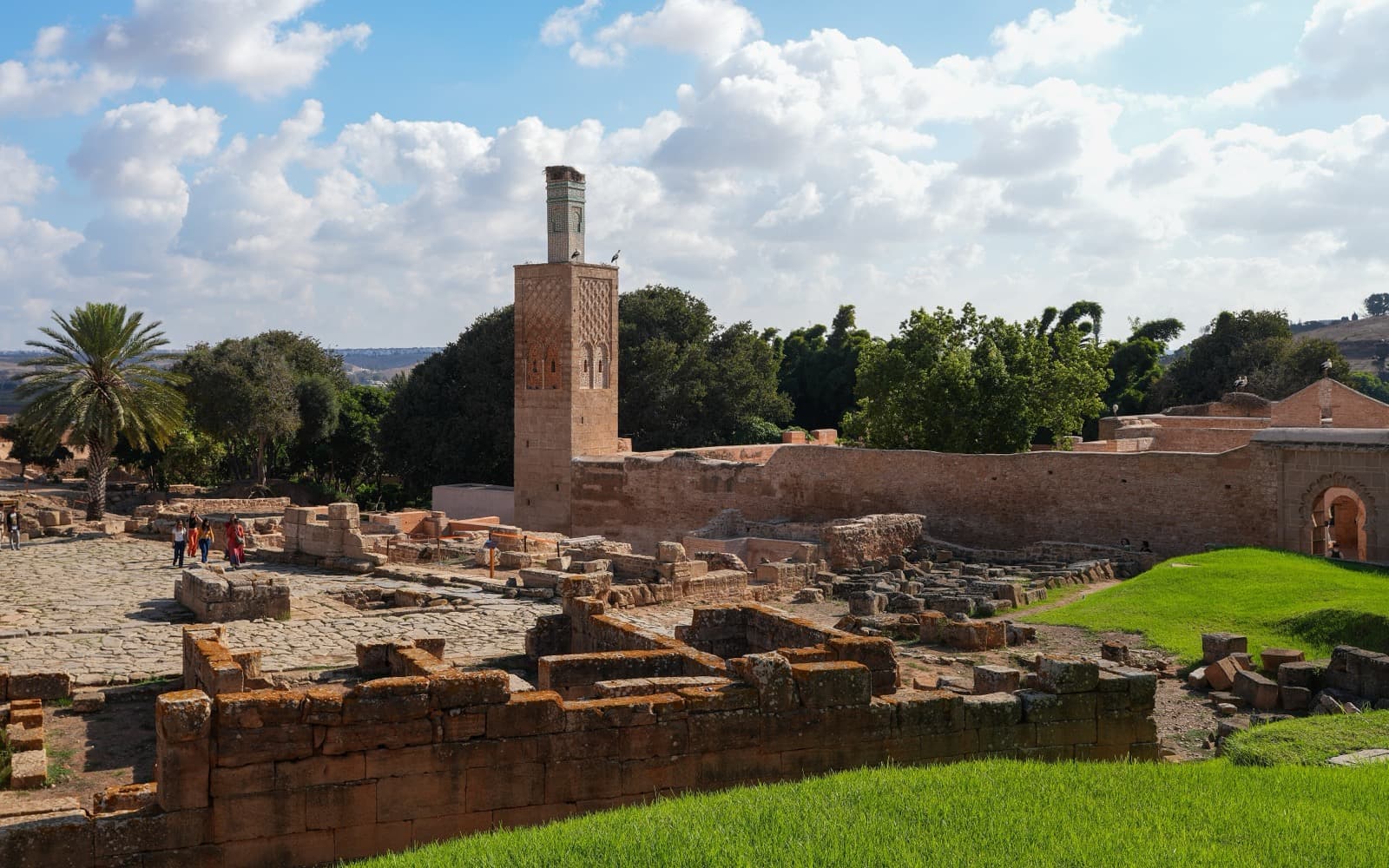
A short taxi hop south-east brings the payoff. The Chellah is a walled garden of ruins where a Roman town became a Muslim garden of tombs. It sits on Sala Colonia, a Roman city in the province of Mauretania Tingitana that reached the rank of municipium by the middle of the second century and served as an Atlantic port. Among the greenery you can still trace the Roman forum, the decumanus maximus that was the main street, a capitoline temple, and Roman baths. Then, in the thirteenth and fourteenth centuries, the Marinid sultans enclosed the hillside and turned it into a royal necropolis.
Deeper inside stand the ruins of the Marinid royal mosque and its square minaret, roughly 15 metres tall and often crowned by a stork's nest. The necropolis was chiefly built under Abu al-Hasan, sometimes called the Black Sultan, whose tomb is the most richly carved in the complex. Near the tombs sits a spring-fed pool where, by local legend, feeding the resident eels is believed to aid fertility. That is folklore, a story people tell, not documented history, and worth carrying as exactly that.
Why the gate is the closing argument
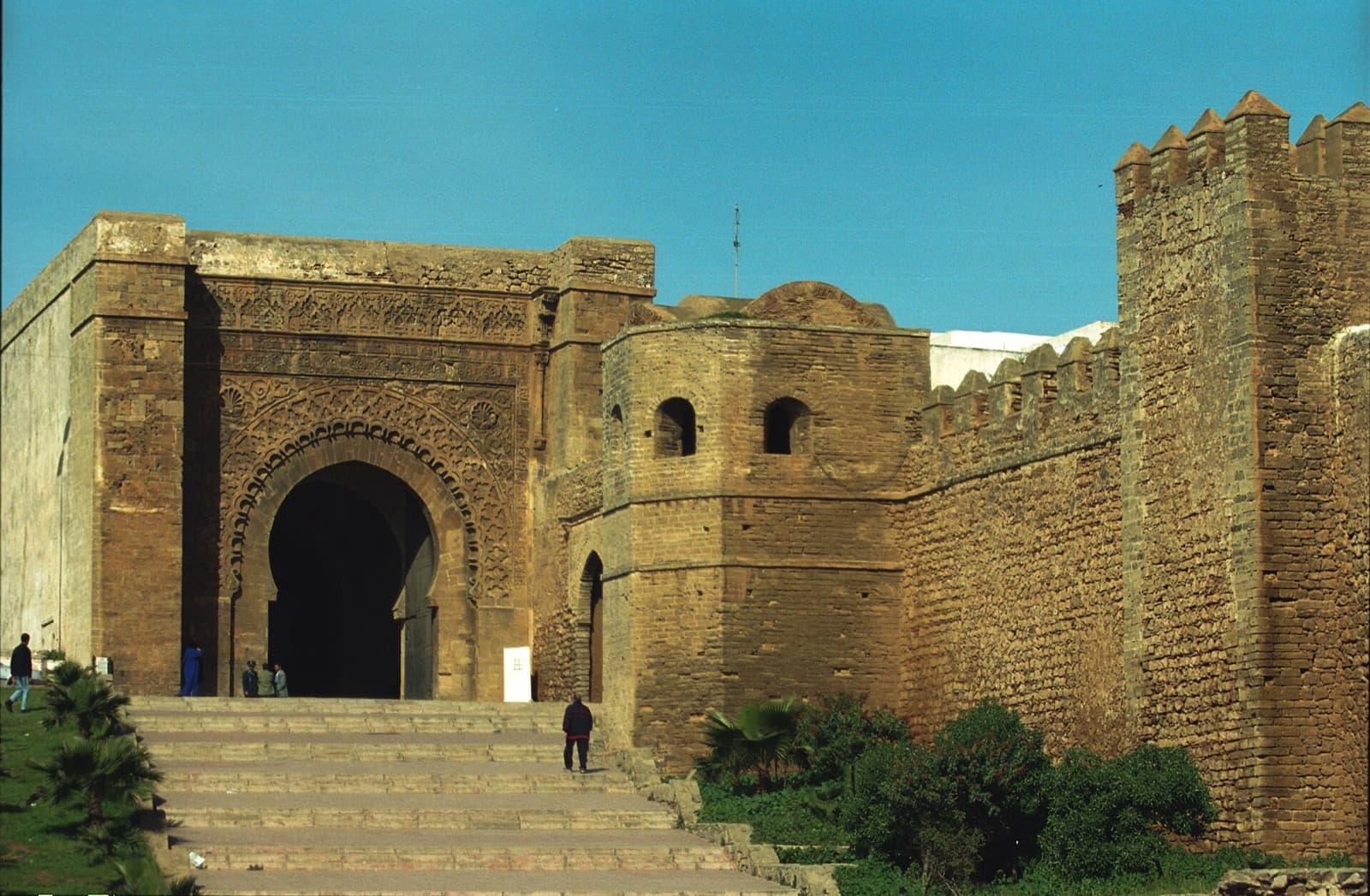
The route ends at Bab er-Rouah, the Gate of the Winds, commissioned by the same caliph Yacoub el-Mansour and completed by about 1197. Its passage bends through four right-angle turns, a defensive design meant to trap and expose attackers, and one chamber was left open above so defenders could drop projectiles on anyone forcing it. Here is the closing line of the whole walk. The great mosque this caliph began was never finished, yet the gate he built stands whole, complete in every carved seashell. The Almohad gate outlasted the Almohad dream.
If you want the full picture before you go, browse Rabat walking tours or the wider Rabat city page. The tour runs about two hours across six stops, most of it open ruin or a shrine that welcomes respectful visitors, and every stop is yours to linger over or move straight past. Start at the base of the tower, look up, and count what is missing.
Sources
- Hassan Tower, Wikipedia: 44-metre current height, 1191 (sometimes 1195) start under Yacoub el-Mansour, planned height of at least 64 and possibly 80 metres, the Koutoubia and Giralda sibling minarets, 348 columns, and 1755 earthquake damage.
- Rabat, Modern Capital and Historic City, UNESCO World Heritage: the shared-heritage inscription covering the tower, mausoleum, Chellah, and Bab er-Rouah.
- Mausoleum of Mohammed V, Wikipedia: 1961 to 1971 construction, the interred kings, architect Cong Vo Toan, and the cedar-and-mahogany dome above a white onyx cenotaph.
- Sala Colonia and Chellah, Wikipedia: the Roman municipium of the mid-second century, the Marinid necropolis of the thirteenth and fourteenth centuries, and the roughly 15-metre minaret.
- Bab er-Rouah, Archnet: the 1197 completion under Yacoub el-Mansour and the four-turn bent defensive passage.
Ready to experience it?
Hassan Tower and the Chellah: Imperial Rabat
120 min · 6 km · moderate
More from Rabat
Explore more at your own pace.
One Day in Rabat: A Walkable Itinerary From Kasbah to Chellah
Rabat Travel Guide: How Many Days, Getting Around, Safety, and Cost
Rabat: The Ocean-Facing Capital That Was Never Filled
Bab Oudaia: The Almohad Gate That Explains All of Rabat
The Andalusian Gardens and Jewellery Museum: A Colonial Garden Inside a Medieval Fort