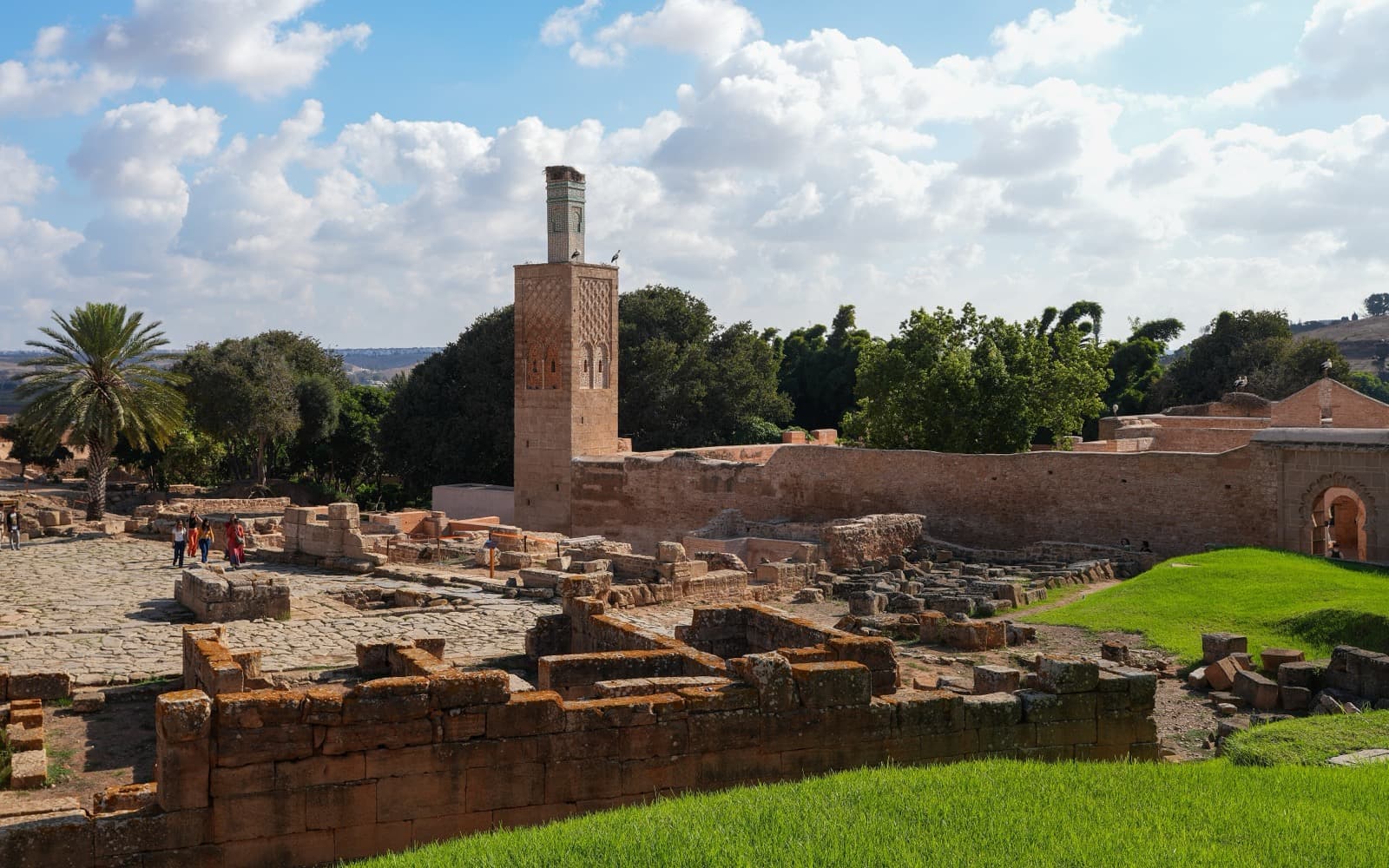
The Chellah in Rabat is a single walled enclosure where a Roman port called Sala Colonia and a medieval Marinid royal necropolis survive together, so one gate takes you from a classical forum to a Muslim garden of tombs. You walk in past fallen columns, and within a few hundred metres the ground shifts from a Roman main street to a fourteenth-century graveyard, all of it green, overgrown, and loud with storks. Most cities layer their history vertically, one era buried under the next. The Chellah lays two of them side by side in the open air, and that is the one thing to understand while you stand at the gate.
From Sala Colonia to a Roman municipium
The oldest layer here is Roman. The Chellah sits on Sala Colonia, a town in the Roman province of Mauretania Tingitana, the province that covered the north-western corner of Africa. Sala reached the rank of municipium by the middle of the second century A D, and it served as an Atlantic port, which is a useful thing to remember when you look at the hillside: this was not a frontier outpost but a functioning coastal town with civic status. There may have been an earlier Phoenician presence on the site before the Romans, which would make the classical town itself only one chapter in a longer story of the river mouth.
What survives is legible if you know where to look. Among the greenery you can still trace the Roman forum, the open civic square at the heart of the town. You can follow the decumanus maximus, the main street that ran through it. Nearby stand the remains of a capitoline temple dated to around the reign of Hadrian in the second century A D, the foundations of a triumphal arch, and Roman baths. These are not reconstructions or signposted replicas. They are the actual worn footings of a Roman town, threaded now with wild figs and flowers.
The Marinids build a necropolis on the ruins
Hear a stop from this walk
The Chellah: A Roman Town Turned Into a Garden of Tombs
The second layer is what makes the Chellah unusual. After the Roman town declined, the site was not reoccupied as a city. Instead, in the thirteenth and fourteenth centuries, the Marinid sultans, the dynasty that succeeded the Almohads in Morocco, enclosed the ruins with a wall and turned the hillside into a royal necropolis. They added a mosque, a minaret, and a zawiya, which is a shrine and religious lodge. Rather than clearing the old stones and starting fresh, they made a dynastic burial ground inside the shell of a classical port.
The necropolis was built chiefly under Abu al-Hasan Ali ibn Othman, who reigned from thirteen thirty-one to thirteen forty-eight and is sometimes called the Black Sultan. He died in thirteen fifty-one, and his tomb is the most richly decorated in the whole complex, carved with Kufic and Naskhi inscriptions and verses from the Quran. His wife, Shams al-Duha, who died in thirteen forty-nine, lies in a ruined mausoleum nearby. A popular legend links her to Lalla Chella, the figure said to give the site its name, though that connection belongs to folklore rather than to the documented record.
Deep inside the walls you reach the ruined Marinid royal mosque and its square minaret, roughly fifteen metres tall and often crowned by a stork's nest. Near the tombs is a pool, originally the ablution basin of the thirteenth-century mosque, now fed by a spring called Ayn al-Janna. Eels live in the water, and by local tradition, feeding them is believed to aid fertility and childbirth. That is a story people tell at the site, not a fact about it, and it is worth carrying that distinction with you. Overhead a large colony of storks nests in the trees and on the ruined minaret, so the soundtrack of the deepest, quietest part of the Chellah is the dry clatter of stork bills above a roofless fourteenth-century mosque.
Why this place matters more than its parts
Plenty of cities have Roman ruins, and plenty have medieval royal tombs. What the Chellah offers is the rare case of both inside one enclosure, sharing a single wall. That combination is the reason it is worth the short trip out from the Hassan esplanade. Standing between a Roman forum and a sultan's grave, you are reading two empires at once, without a museum wall or a change of ticket between them.
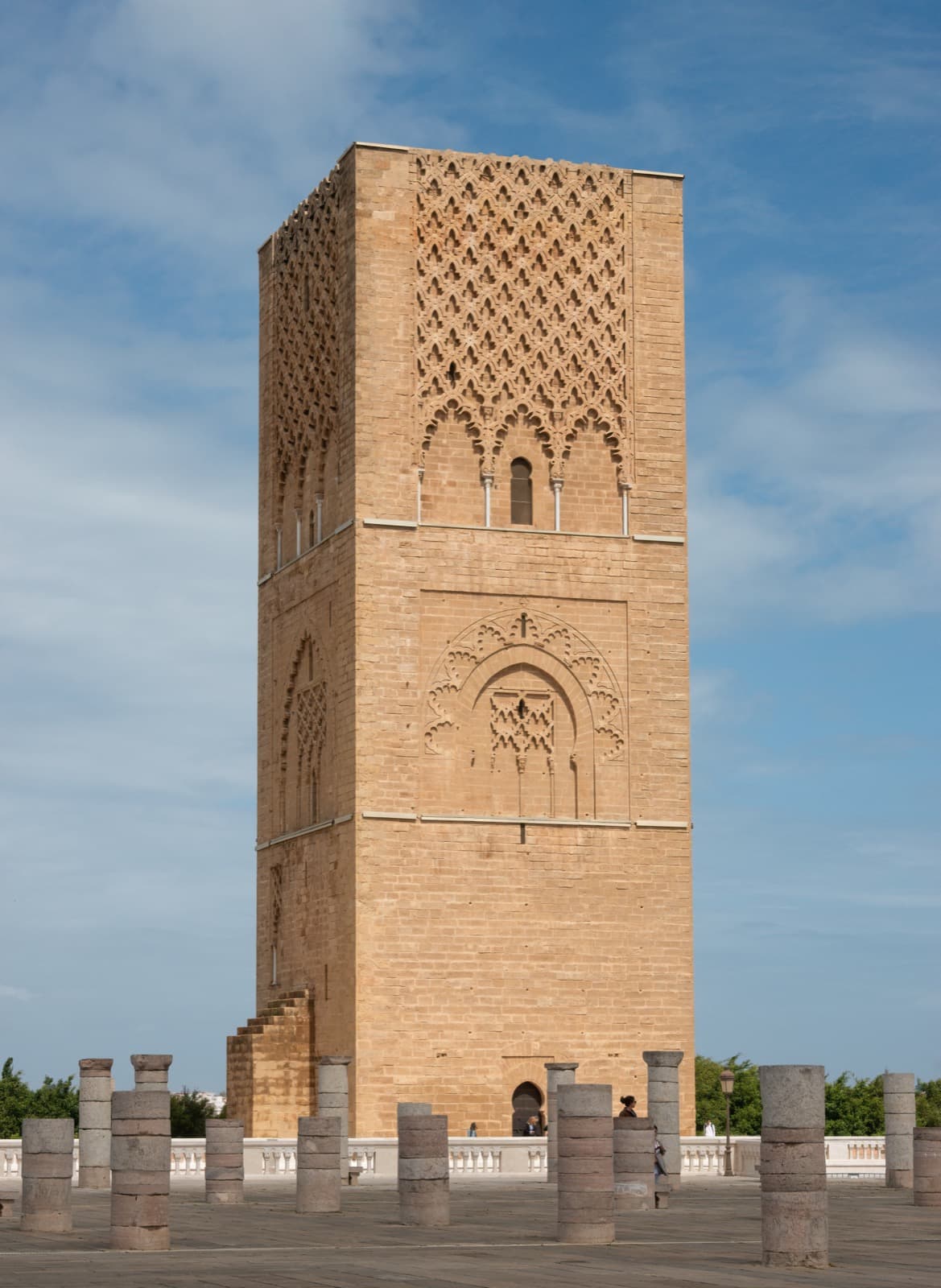
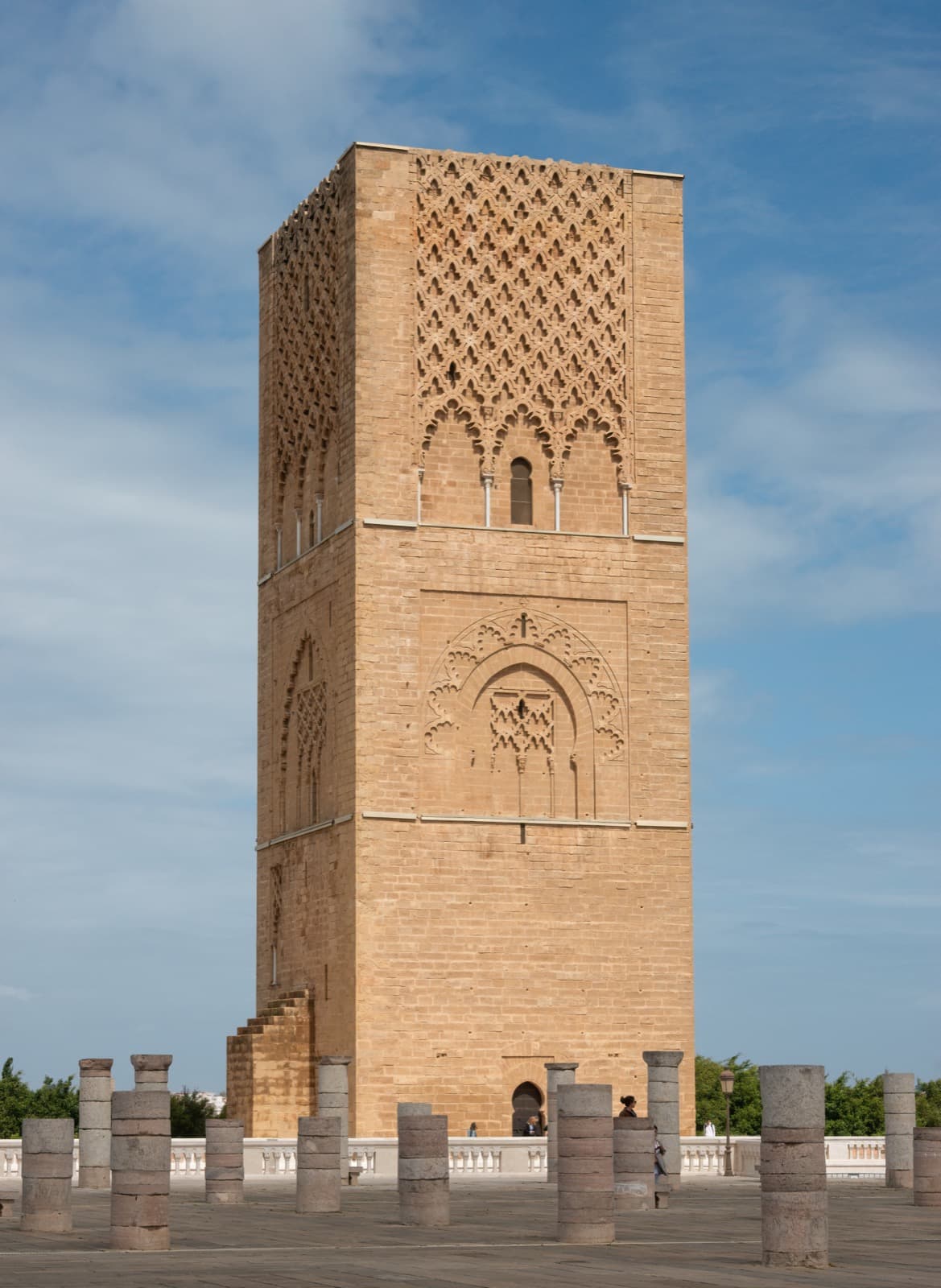
The Chellah is also part of a larger story that the whole Rabat itinerary tells. UNESCO inscribed the site within its shared heritage ensemble for the city. A short distance north stands the Hassan Tower, the lone square minaret of a mosque begun by the Almohad caliph Yacoub el-Mansour around eleven ninety-one and left unfinished at his death in eleven ninety-nine, its floor now a field of some three hundred and forty-eight column stumps. Between the ruins and the Chellah sits the modern white Mausoleum of Mohammed the Fifth, holding the kings who led Morocco to independence. Read together, the Almohad dream that was never finished, the Roman town that was repurposed instead of rebuilt, and the shrine that completes the imperial arc make a single argument about ambition and what outlasts it.
Standing in front of it
Practically, the Chellah is a ruin rather than an active mosque, so you can walk in and roam freely with no threshold barring your way. There is a ticket at the gate, and it is wise to carry a small amount of cash in Moroccan dirham since cards are not always taken. The footing is uneven, with fallen stone, steps, and slopes, and the gardens offer little shade, so bring water and take the ruins at an unhurried pace. Follow the fallen columns down toward the necropolis, or sit under a fig and simply watch the storks work the ruined minaret. There is no group and no schedule here, so linger where a stop rewards it and move on where it does not.
The Chellah is stop four on a self-paced route that also takes in the Hassan Tower, the columns of the unfinished mosque, and the Mausoleum of Mohammed the Fifth. If you want the full imperial arc, from the Almohad minaret that never rose to this Roman town turned into a garden of tombs, walk the Hassan Tower and the Chellah tour at your own pace. You can browse more Rabat walking tours or start from the Rabat city page.
Sources
- Sala Colonia, Wikipedia: overview of the Roman town, its status as a municipium, and its identification with the Chellah site.
- Chella, Archnet: architectural and archaeological documentation of the Roman ruins and the Marinid necropolis inside the walls.
- The Marinid Necropolis, Site archeologique de Chellah (official site): detail on Abu al-Hasan, the royal mosque and minaret, and the burial complex.
- Rabat, Modern Capital and Historic City, UNESCO World Heritage: inscription of the Chellah within the wider Rabat heritage ensemble.
Ready to experience it?
Hassan Tower and the Chellah: Imperial Rabat
120 min · 6 km · moderate
More from Rabat
Explore more at your own pace.
One Day in Rabat: A Walkable Itinerary From Kasbah to Chellah
Rabat Travel Guide: How Many Days, Getting Around, Safety, and Cost
Rabat: The Ocean-Facing Capital That Was Never Filled
Bab Oudaia: The Almohad Gate That Explains All of Rabat
Hassan Tower: Reading Imperial Rabat Through Its Grandest Ruin