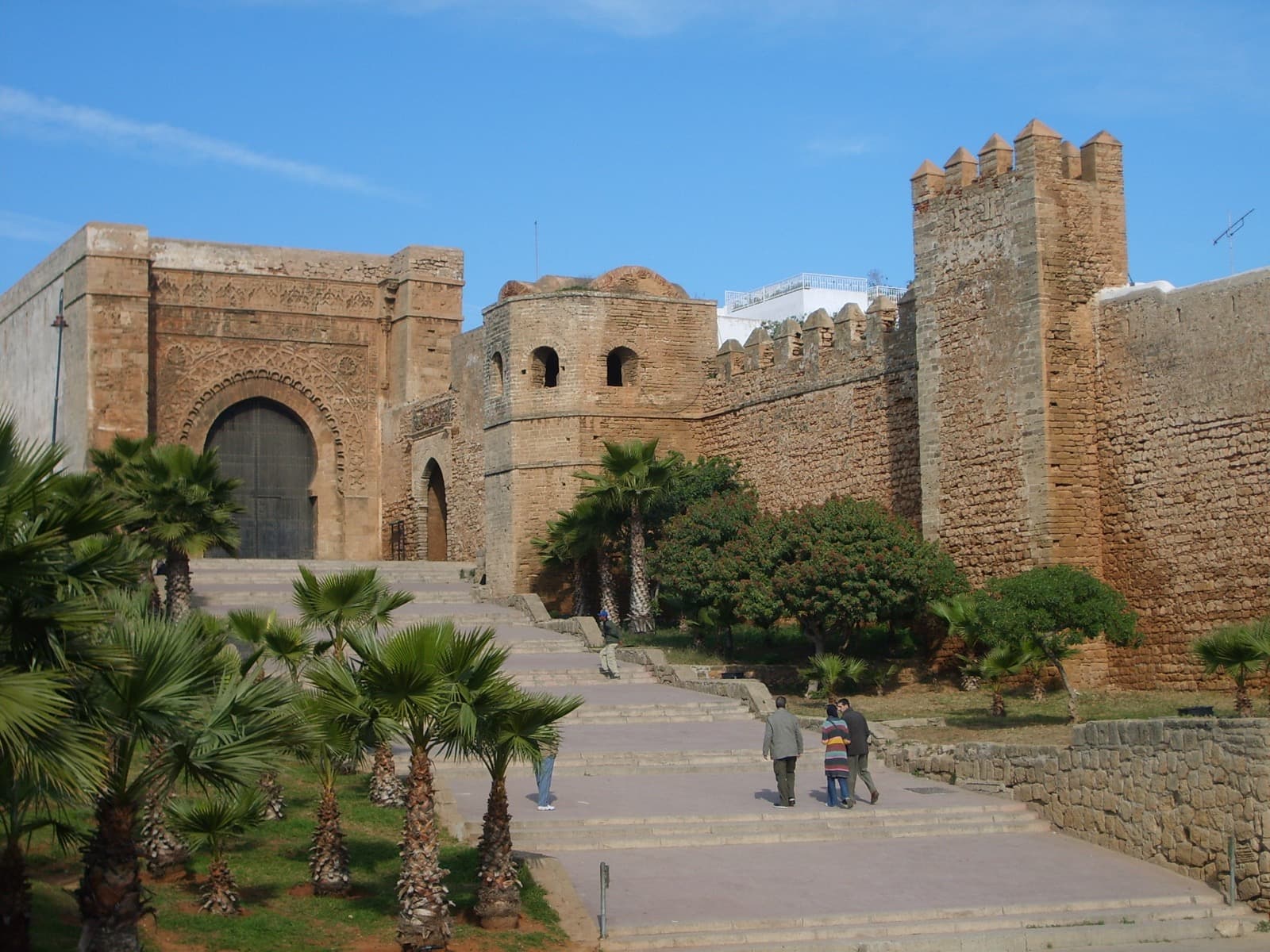
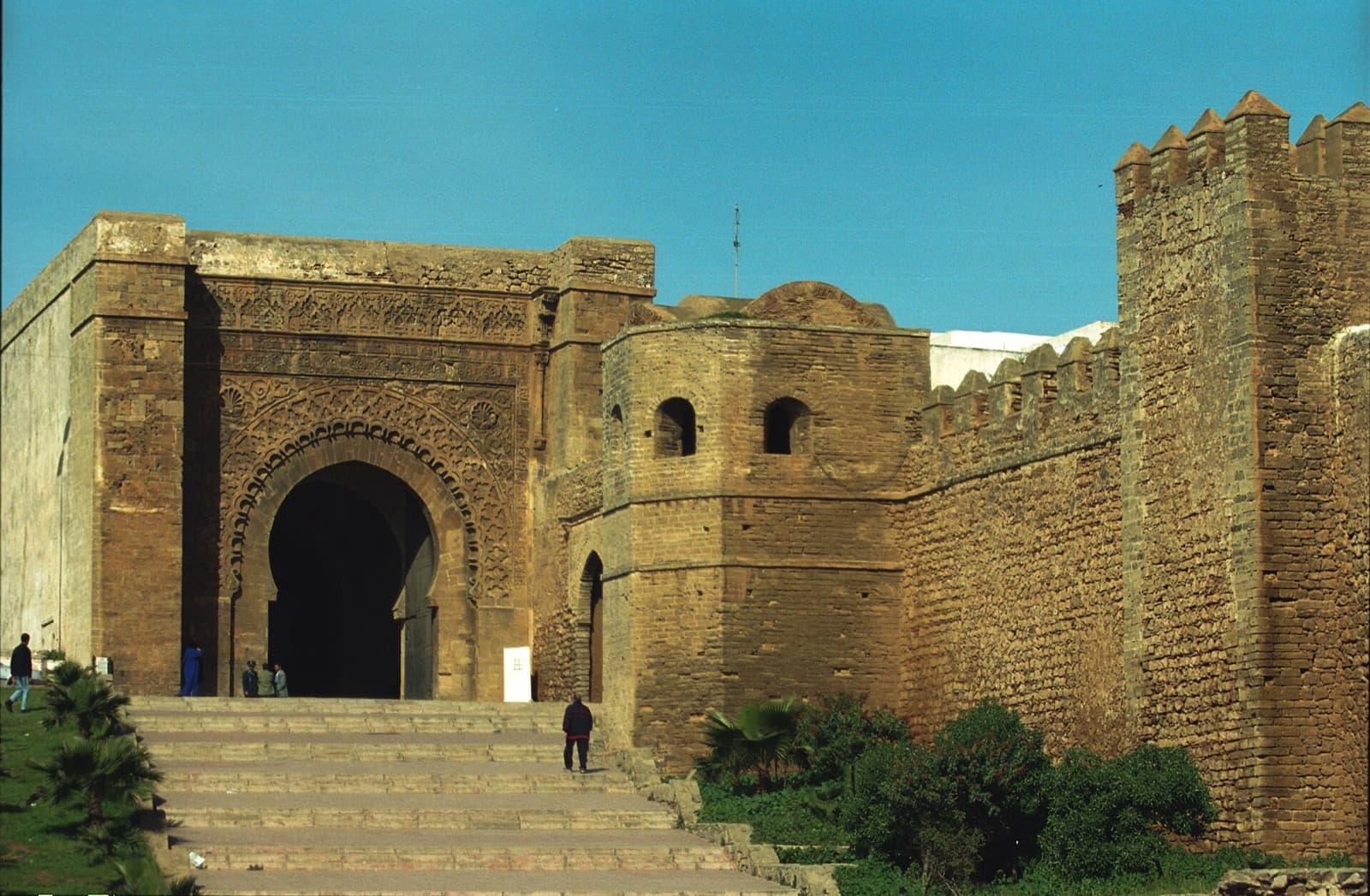
Bab Oudaia is a monumental Almohad gate on a cliff where the Bou Regreg river runs out to meet the Atlantic, and its arch layers three different centuries into one carved face: a tenth-century frontier post, a twelfth-century empire, and a nineteenth-century tribe. Stand in front of it and you are not just looking at a gate. You are looking at the whole logic of Rabat compressed into stone, and reading that compression is the best way to understand why the rest of this walk exists. The kasbah on the cliff, the blue lanes behind the gate, the pirate harbour below, the refugee medina downhill, and the ramparts of a capital that was never filled all follow from what happened at this one threshold.
Three histories in one arch
The gate belongs to the Almohads, the dynasty that gave Rabat the title Ribat al-Fath, the stronghold of victory, and made it a naval base around the year eleven seventy. The word ribat means a fortified frontier monastery, and a small one stood on this bluff as early as the tenth century, long before any empire noticed the spot. That older word is where both the country's name and the city's name descend from. So before you have walked a single step, the gate has already given you the origin of the word Rabat.
The arch itself was raised under the Almohad caliph Yacoub el-Mansour, who reigned from eleven eighty-four to eleven ninety-nine, in the final years of the twelfth century. Look closely at the carved stone bands framing the opening. There are interlacing geometric forms, Quranic inscriptions, scallop and shell motifs, and a rare detail worth hunting for: serpentine S-shapes that are probably meant to be eels. That eel motif is a very rare thing to find in Almohad or Moroccan architecture, and it is the kind of specific detail you notice only when you have the time to stand and stare, which on a self-guided walk you do. The gate is often cited as one of the most beautiful gates of Almohad and Moroccan architecture, and it costs nothing to approach, because the kasbah and its gate are open to everyone.
Now the third layer, and the one that quietly overturns a common assumption. The name Udaya does not come from the medieval builders at all. It became attached to the kasbah only in the nineteenth century, when the Udaya tribe was resettled here after its expulsion from the region of Fez. So the fort is Almohad, the gate is twelfth century, and the most famous name attached to both is the newest thing about them. That is Rabat in miniature: older bones, a later empire, and a still-later population who gave the place its name.
Why the gate is the right way in
Hear a stop from this walk
The Ramparts and the Almohad Wall: Walls for a Capital Never Filled
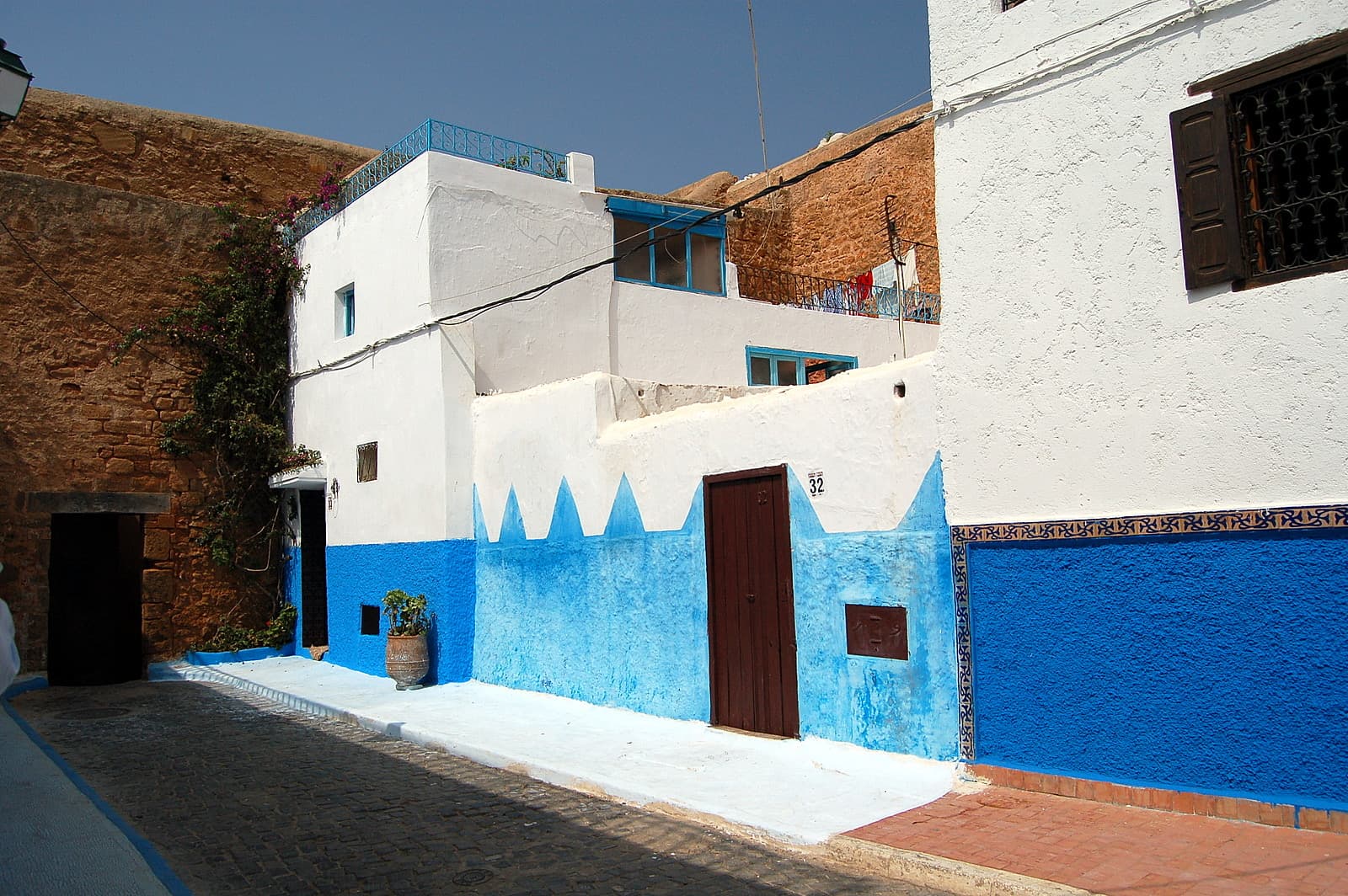
A gate is a promise about what is behind it, and this one keeps its promise immediately. Pass through and the kasbah becomes a village of narrow lanes washed white below and painted blue above. The blue-and-white scheme is popularly tied to Andalusian refugees and to later local custom, though it is tradition rather than documented record, and it loses nothing by being told that way. At the heart of the lanes sits Jamaa al-Atiqa, the Old Mosque, dating from the Almohad construction around eleven fifty and the oldest mosque in Rabat, later largely restored in the eighteenth century by an English corsair known as Ahmed el-Inglizi. It is an active mosque, so non-Muslims view it from outside, which is reward enough: a plain, strong minaret rising over blue walls.
Keep moving and the same walls hold a surprise from a completely different era. The Andalusian Gardens, all citrus, bougainvillea and clipped box, feel medieval but were actually planted between nineteen fifteen and nineteen eighteen during the French Protectorate. Beside them stands a genuine seventeenth-century pavilion built by Sultan Moulay Ismail, converted to an ethnographic museum in nineteen fifteen and reopened as the National Jewellery Museum on the seventh of January, twenty twenty-three. Unlike the mosque, this one you can enter.
Then the lanes open onto a platform, and the geography that the gate has been hinting at finally arrives all at once. Below you the Bou Regreg pours into the Atlantic, with the white town of Sale across the water and old signal cannons pointed out to sea. This river mouth was a pirate harbour. In sixteen twenty-seven, Rabat and Sale came together as the Republic of Bou Regreg, and its corsairs were known in English as the Sale Rovers. The people at the core of that seafaring state were Moriscos, Muslims expelled from Spain, many of them from the town of Hornachos. Driven out of one country, they built a raiding republic at this river mouth.
Those same refugees explain the last stretch of the walk. Below the kasbah lies a medina that does not tangle like other Moroccan old towns. Its streets run in near-straight lines because they were laid out all at once, in the early seventeenth century, by Moriscos and Hornacheros arriving around the Spanish expulsion decrees of sixteen hundred and nine. Rue des Consuls runs through it, named because foreign consuls were once required to live on that single street, among them the French consul Louis Chenier, who served from seventeen sixty-eight to seventeen eighty-two. It was also where captives taken by the corsairs were ransomed, and today it is a working craft and carpet street.
The walk ends at the ramparts, and they close the circle the gate opened. These great red rammed-earth Almohad walls, raised under the same Yacoub el-Mansour, were drawn to enclose an imperial capital. UNESCO records that they are the only surviving parts of the project for a great capital city of the Almohad caliphate, a circuit far larger than the town that ever grew inside it. The dynasty fell before it could fill them. So you finish at a frame around an absence, with a refugee town and a corsair harbour settling into one corner of an empire's unbuilt ambition.
Walk it at your own pace
The whole route runs roughly two and a half kilometres across six stops, about ninety minutes to two hours depending on how long you linger over a blue lane or the view of Sale. Morning light is softest on the walls, and the gardens and the seaward platform are coolest before midday. Nothing here runs on a schedule but you: no group forming up, no guide checking a watch, and a firm, polite no keeps the touts on Rue des Consuls at a distance. Start at the gate, read its three centuries, and let the rest of Rabat unfold from there.
For the full route and more context, see Rabat walking tours and the city page for Rabat.
Sources
- Bab Oudaia, Wikipedia: the Almohad gate's late twelfth-century construction under caliph Yacoub el-Mansour, its carved decoration including the rare eel motifs, and its standing as one of the most beautiful gates of Moroccan architecture.
- Kasbah of the Udayas, Wikipedia: the tenth-century ribat, the Old Mosque dating from the Almohad construction around eleven fifty, the nineteenth-century Udaya tribe resettlement, and the Andalusian Gardens of the Protectorate era.
- Rabat, Modern Capital and Historic City, UNESCO World Heritage List (site 1401): the Almohad ramparts and gates as the only surviving parts of the planned imperial capital, and the shared Almohad, Andalusian, and Protectorate-era heritage.
- Republic of Sale, Wikipedia: the sixteen twenty-seven corsair republic of the Bou Regreg, the Sale Rovers, and its Morisco founders from Hornachos who arrived around the sixteen hundred and nine expulsion.
- National Jewellery Museum (Morocco), Wikipedia: the Moulay Ismail pavilion, its conversion to an ethnographic museum in nineteen fifteen, and its reopening on the seventh of January, twenty twenty-three.
Ready to experience it?
Kasbah of the Udayas: Rabat's Old Town Above the Sea
110 min · 2.5 km · easy
More from Rabat
Explore more at your own pace.
One Day in Rabat: A Walkable Itinerary From Kasbah to Chellah
Rabat Travel Guide: How Many Days, Getting Around, Safety, and Cost
Rabat: The Ocean-Facing Capital That Was Never Filled
Hassan Tower: Reading Imperial Rabat Through Its Grandest Ruin
The Andalusian Gardens and Jewellery Museum: A Colonial Garden Inside a Medieval Fort