Wenceslas Square is not really a square. It is a boulevard about seven hundred and fifty metres long, sloping gently uphill toward the National Museum, and it was laid out by Charles the Fourth in 1348 as a horse market. That single fact resets how you read it. You are standing on a piece of medieval city planning, a long open trading ground, that later generations widened, paved, lined with facades, and loaded with meaning. The square only took the name of Saint Wenceslas, the patron of Bohemia, in 1848, exactly five hundred years after Charles founded it. Everything else here, the gilded facades and the grave memorials, sits on top of that original commercial spine.
A market that became a stage
To understand why this place carries so much weight, start with its shape. A conventional square is a container: buildings on four sides, a middle you cross. Wenceslas Square is a corridor. It funnels people up and down its length, past shop windows and hotel fronts, toward the museum that closes the top like a full stop. A corridor gathers crowds differently than a plaza does. It gives a march somewhere to go, a rally a natural front and back, a statue at the head a commanding sightline down the whole slope. The equestrian figure of Saint Wenceslas near the top is not decoration alone. It became the focal point that every large public gathering in modern Czech history has organized itself around.
The horse market of 1348 was practical infrastructure. By the twentieth century that infrastructure had become the country's most important open-air room, the one place large enough and central enough to hold a nation when the nation needed to assemble. If you are on the [prague-art-nouveau-cubist] walk for the architecture, this is the stop where architecture and history stop being separable.
Reading the facades
Hear a stop from this walk
Prague Main Station: The Gateway Wearing the Grammar
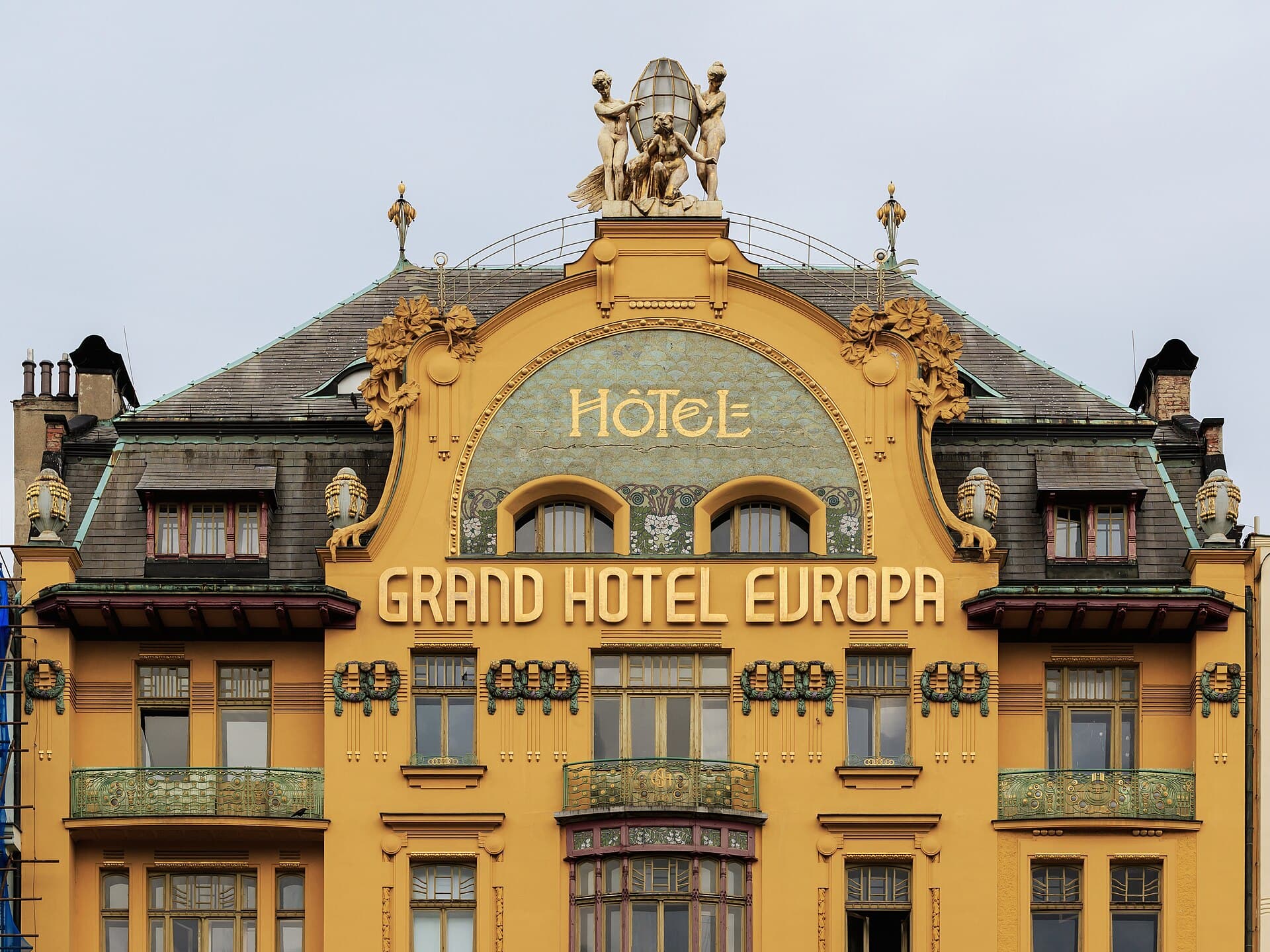
The reason this square belongs on a modern-architecture walk is the line of facades along its sides. This is where Prague's Art Nouveau grammar returns after the Cubist experiments earlier in the route. Look part way up on one side for the former Grand Hotel Evropa. Its Art Nouveau front was rebuilt around 1905 to 1906 by the architects Alois Dryak and Bedrich Bendelmayer, and its face is crowned with gilded female figures. Those figures are the same visual family you meet at the Municipal House: curving lines, flowing ornament, sculpture worked into the surface, gold catching the light. The hotel reopened recently, so the facade reads best from the street, which is where it was always meant to be read.
What makes the square instructive is the collision on a single wall. The gilded nymphs sit high on the Evropa front. Below them, in the ordinary paving of the same boulevard, are the markers of the twentieth century's hardest chapters. Beauty and memory occupy the same address. The Art Nouveau ornament was built to announce a confident, self-inventing culture. The pavement below it records what that culture had to survive. Hold both in the same glance and the square teaches you something no single building can: that a facade and the ground beneath it can tell opposite stories at the same time.
The graver layer
Near the statue of Saint Wenceslas on horseback, the independence of Czechoslovakia, proclaimed in 1918, was celebrated by crowds. Fifty years later the mood reversed. In 1968 the reforms known as the Prague Spring were crushed when Soviet-led forces invaded. In January 1969 a student named Jan Palach set himself on fire here in protest against the occupation, and died of his injuries. Twenty years after that, in 1989, enormous crowds filled this same slope during the Velvet Revolution that ended the Communist dictatorship.
Four dates, one boulevard: 1918, 1968, 1969, 1989. A proclamation, an invasion, a death, and a peaceful revolution, all staged on the ground that started as a place to trade horses. This is why the square asks for a different kind of attention than a photo. The memorial to the victims of Communism near the top of the square is not a spectacle. It is a quiet marker in the paving that most visitors walk over without noticing. Slow down enough to find it, and the whole corridor changes character.
The one thing to understand standing here
If you take a single idea away from Wenceslas Square, make it this: the shape is the meaning. A medieval horse market, seven hundred and fifty metres of open corridor, became modern Czech history's stage precisely because of how it was built. Its length gave crowds room to gather and marches room to move. Its central position made it the natural place to assemble. Its statue gave every gathering a focal point. Charles the Fourth was not planning revolutions in 1348. He was planning commerce. But the geometry he laid down outlived the market and became something else, the room where a nation repeatedly decided what it would be.
So do not treat this as a passing photo stop between the Cubist lamppost and the Lucerna passage. Stand at the head of the slope, look down its length, and read it as a single long sentence. The gilded figures above tell you what the culture aspired to. The paving below tells you what it endured. Both are true, and the square holds them together without contradiction.
Wenceslas Square is stop four on the [prague-art-nouveau-cubist] self-guided audio walk, positioned between the Cubist lamppost near Jungmann Square and the reinforced-concrete engineering of the Lucerna Palace. On the walk, the narration times itself to your pace so you can stand in front of the Evropa facade, find the memorial in the paving, and read both without juggling a guidebook. If you want the full sequence, browse other Prague walking tours, or start planning from the Prague city page.
Sources
- Wenceslas Square, Wikipedia: founding as the Horse Market by Charles the Fourth in 1348, the 1848 renaming, dimensions, and the square's role in 1918, 1968, 1969, and 1989.
- Wenceslas Square, Prague City Tourism (prague.eu): official overview of the boulevard, its facades, and its place in modern Czech public life.
- Roamer tour transcript, "Prague Art Nouveau and Cubist" (prague-art-nouveau-cubist), stop four: fact-audited details on the Grand Hotel Evropa facade rebuild of 1905 to 1906 by Alois Dryak and Bedrich Bendelmayer, and the layered memory of the square.
- House of the Black Madonna and Lucerna Palace, Wikipedia: context for the adjacent Cubist and reinforced-concrete stops that bracket Wenceslas Square on the route.
Ready to experience it?
Art Nouveau and Cubist Prague: The City's Modern Grammar
90 min · 3 km · easy
More from Prague
Explore more at your own pace.
One Day in Prague: A Walkable Morning-to-Evening Itinerary
Prague's Layered City: The Coronation Route, Josefov, and a Modern Grammar
The House of the Black Madonna: How Prague Built Cubism Into a Wall
The Old Jewish Cemetery Reads Prague's Whole Confined Quarter
Charles Bridge: The Crossing Charles the Fourth Built to Last