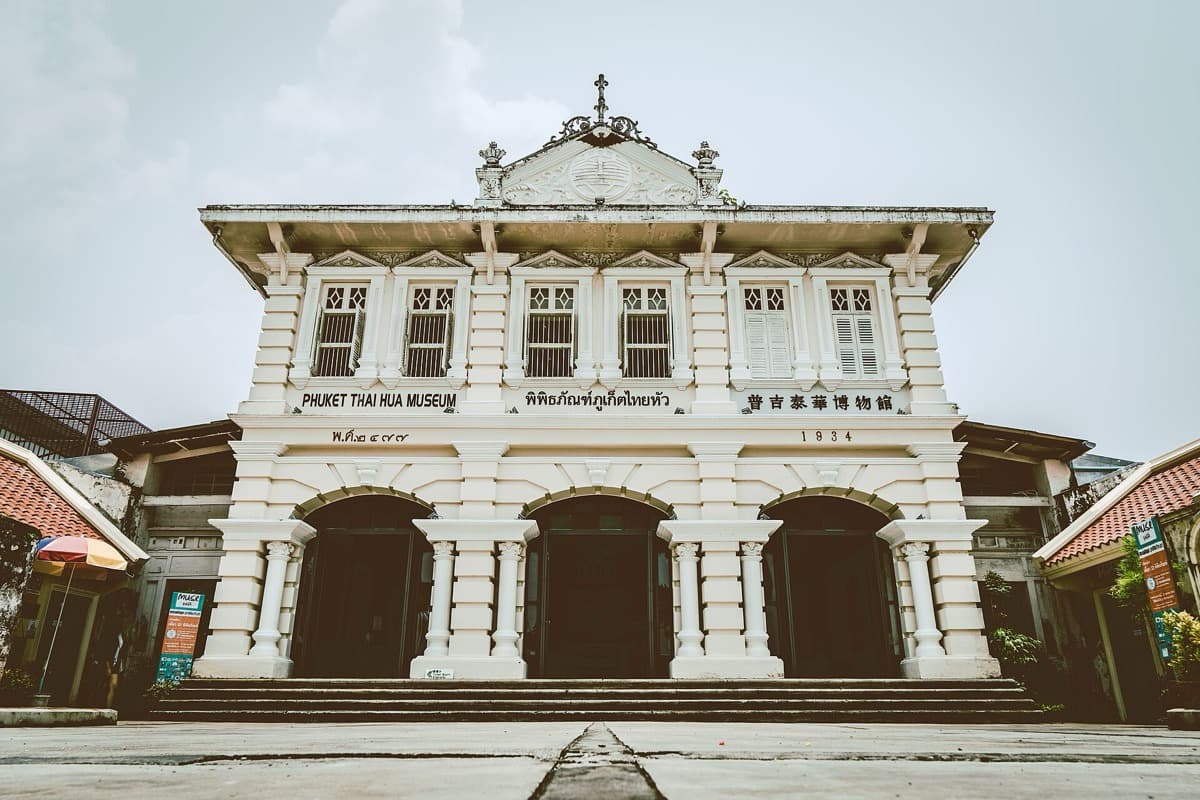
Phuket's Peranakan history begins in a schoolhouse, not a mansion. Before the tin fortune took architectural form in the grand houses along Krabi Road, a migrant Hokkien Chinese community decided who it was in a classroom, and that classroom still stands. The Thai Hua Museum on Krabi Road, opened in nineteen thirty-four as a Chinese-language school, is where you should start reading the whole story of the Baba-Nyonya world, because the community that built the mansions first taught itself to read, trade, and write a contract right here. Everything else on this walk follows from that decision.
The classroom before the fortune
A community usually decides who it is in a classroom before it decides anywhere else. The building on Krabi Road opened in nineteen thirty-four, built by Phuket's Hokkien Chinese community. Sources including the local guide Phuket101 describe it as the first Chinese-language school on the island, teaching Hokkien and Mandarin alongside Thai. The name says the ambition in two words. Thai Hua means Thai and Chinese, side by side, and that dual identity is the thread the entire tour pulls on.
Look up at the front gable and you will find a red bat. In Chinese tradition the bat is a symbol of good fortune, and there is a quiet joke in putting one on a school. For a migrant community, the greatest fortune was literacy. The ability to read, to trade, to hold your own on paper is what turned laborers into merchants and merchants into a landed elite. The architecture is Sino-Portuguese, two storeys, the same hybrid grammar you see across the old town, so the building itself argues the point: Chinese by ancestry, Thai by soil, European in its borrowed grandeur.
The school did not have an easy life. It closed for a time in nineteen forty-one, when Chinese-language school licenses were revoked in Thailand during the Second World War era. It reopened, outgrew the building, and moved to a new campus in nineteen ninety-five. In twenty ten the old building became the Phuket Thai Hua Museum, with themed rooms on migration, on tin mining, and on the food this community made its own. Two words to carry from here: Baba are the men of this Peranakan community, Nyonya are the women. Both names begin, in a sense, in the place where the community first sat down to teach itself.
Following the tin money outward
Hear a stop from this walk
The Baba Wedding and Peranakan Cuisine: Heritage Without a Building
From the schoolhouse the walk moves to the money. The Phra Pitak Chinpracha Mansion at ninety-six Krabi Road was built in nineteen oh three, a governor's residence from the tin-mining era, and it reads better as a statement than as a house. Phuket's wealthy families did not invent this look. They spent years in Penang, across the water, where they traded and educated their children, and they carried a style home. Locally it earned a Hokkien nickname, Ang Mor Lao, roughly the house of the red-headed people, the red-heads being Europeans. It is a knowing phrase, a Chinese-Thai family wearing borrowed European grandeur like a well-cut coat. The mansion stood derelict for decades before the Blue Elephant restaurant group, a Thai fine-dining company founded in nineteen eighty, rented it from Chinpracha descendants and restored it over about two years, keeping the green-and-white chequered tile floors and the teak fittings.
A few doors along, at ninety-eight Krabi Road, the story moves indoors at Baan Chinpracha, built in nineteen oh three during the reign of King Chulalongkorn, Rama the Fifth. It was raised by Phrapitak Chinpracha, Thai name Tan Ma Siang, born in Phuket in eighteen eighty-three. His father, a Hokkien immigrant, had arrived in Thailand in eighteen fifty-four to work in tin. Three generations in stone: a migrant father, a locally born son, and a fortune large enough that the son could build a mansion at roughly twenty. It is regarded as the first Ang Mor Lao mansion in Phuket, the template the others copied. At its center is a courtyard open to the sky, a Chinese domestic idea adapted to a tropical island, catching light, breeze, and rainwater. The descendants still live upstairs, so only the ground floor is open, where you find daily utensils, furnishings, and Nyonya dresses that visitors can try on.
Naming the culture, then living it
Everything so far is implied. At the Peranakannitat Museum it is finally named. The sun-yellow Sino-Portuguese building at the corner of Phuket Road and Phang Nga Road was the Chartered Bank, described as the first foreign bank in Phuket, which opened in nineteen oh seven. There is a neat logic in housing a culture's museum inside a bank: tin money flowed through walls like these, and now the same walls hold the account of the people who made it. The museum opened in May twenty seventeen, presided over by Princess Maha Chakri Sirindhorn. Entry is free and the galleries are air-conditioned, a real mercy after a warm walk. One display sums the whole identity in a single outfit: a Nyonya bride in a lace dress, a Malay batik sarong, and layered Chinese gold jewellery. Chinese ancestry, Malay dress, Thai home.
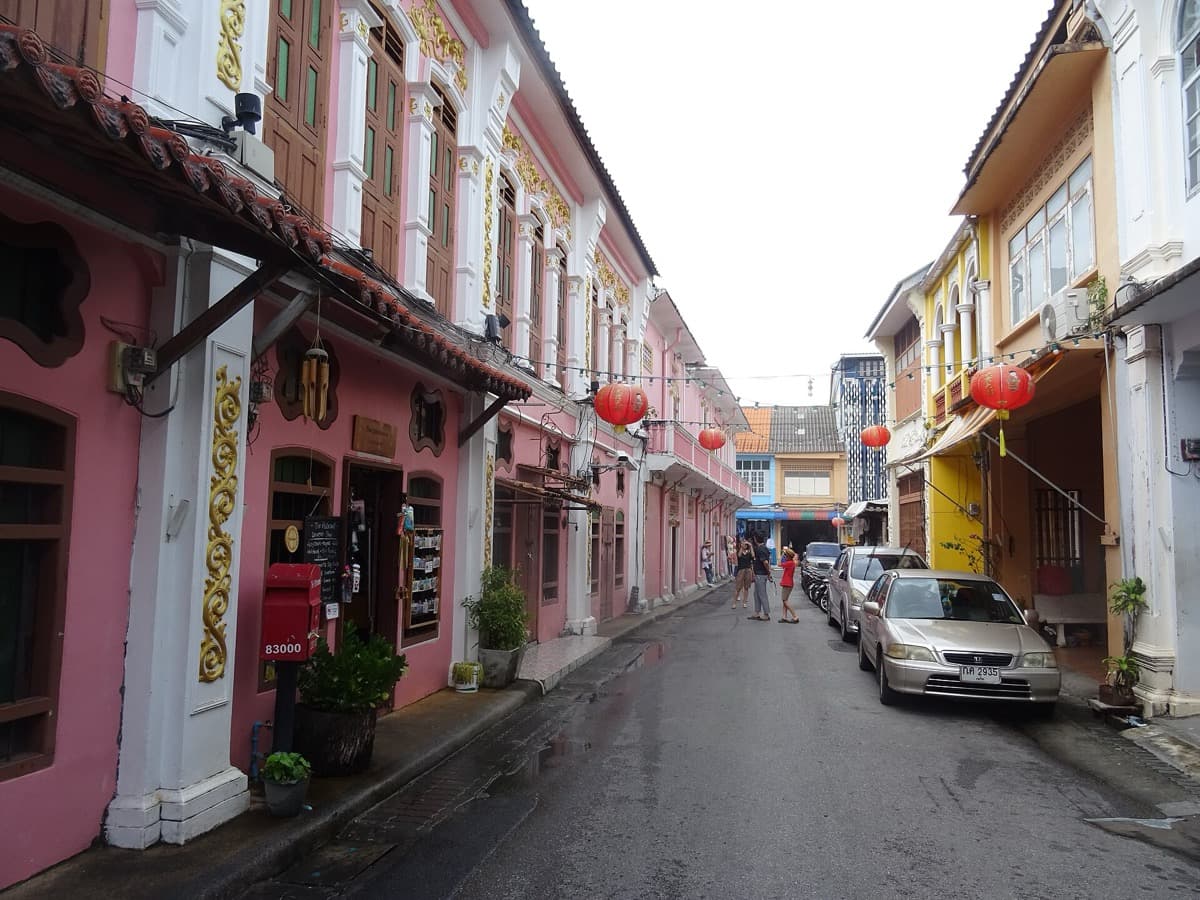
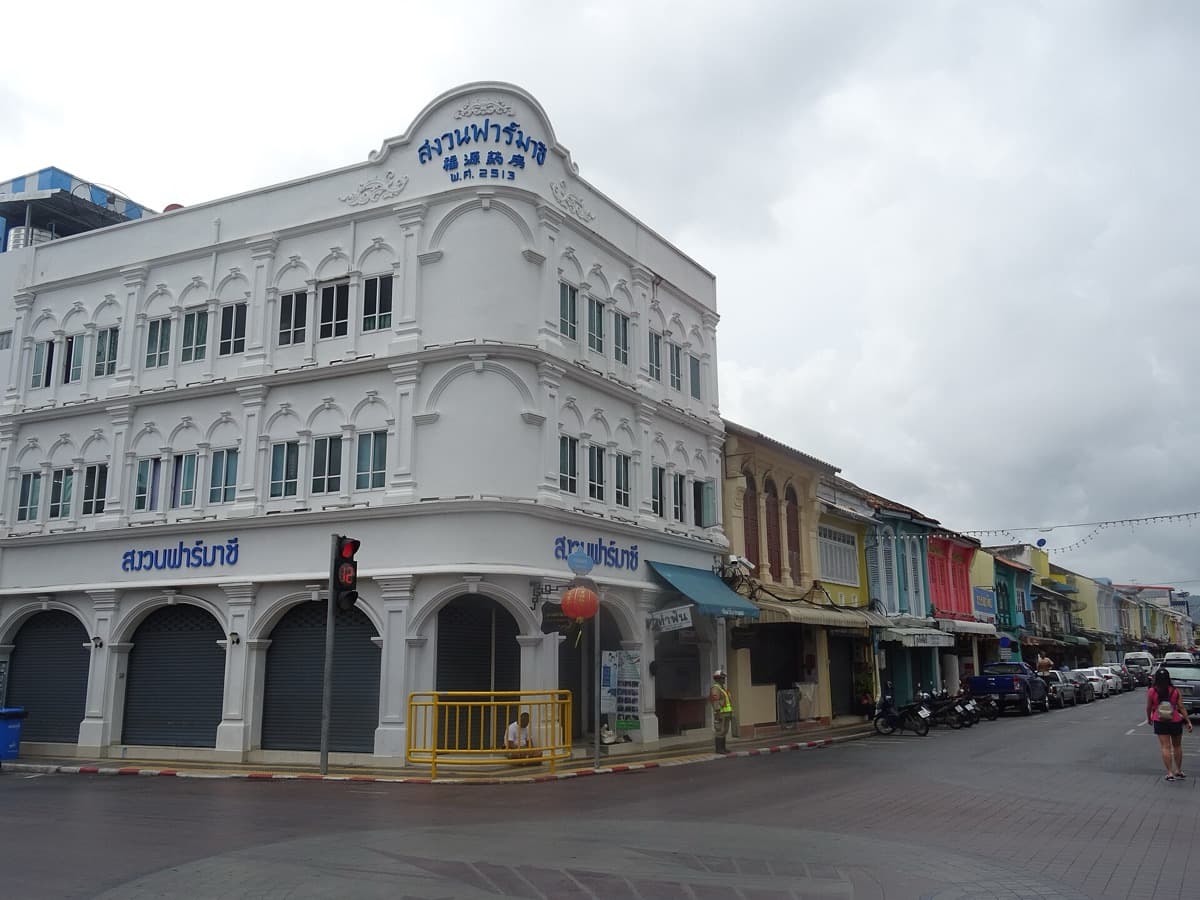
The walk then widens onto Thalang Road, about three hundred fifty metres of restored pastel shophouses where Hokkien migrants first settled and traded during the tin boom, beside Thai-Muslim and Indian shops, a small record of who actually built this town together. In twenty ten Thalang became the first street in Phuket to bury its electric cables underground, and its Sunday Walking Street Market began in late twenty thirteen. At one end sits Queen Sirikit Park, a modern municipal square of about fifteen thousand square metres, built in twenty oh four for the queen's seventy-second birthday, with a golden sea-dragon fountain nodding to a legend that the island itself is a dragon named Hai Leng Ong. The point of the stop is honesty: the heritage here is not frozen. It trades, it fills on Sundays, it gathers.
The final stop has no building at all. The Phuket Baba Wedding is a staged annual revival, with a reported twelfth edition in May twenty twenty-five, unfolding over two or three days of tea ceremonies, a costumed parade, and gala dinners at landmark homes. In one earlier edition, eighteen couples took part, some travelling from Hong Kong, Taiwan, and China. Yet organizers themselves note that fewer young people connect with the traditions each year, so the wedding is a community deliberately performing its own memory to keep it. The other living thread is on the plate: moo hong braised pork belly, mee hokkien noodles, o-aew shaved-ice jelly, yum som o pomelo salad. By some estimates around seventy percent of Phuket's population carries some Peranakan ancestry, so this food is simply what many families cook.
Start at the Thai Hua Museum, and the arc from schoolhouse to supper makes plain sense. See it on the map alongside the other Phuket walking tours, or browse everything in Phuket before you go. The walk is under one and a half kilometres and stands on its own at every stop, so linger where something catches you.
Sources
- Phuket101, Thai Hua Museum: opening date, first Chinese-language school claim, and museum conversion.
- Tourism Authority of Thailand, Phuket Thai Hua Museum: official attraction listing and Sino-Portuguese context.
- Phuket101, Sino-Portuguese Heritage Mansions and Baan Chinpracha: build dates, Ang Mor Lao naming, Blue Elephant restoration, Chinpracha family history.
- The Phuket News, Peranakannitat Museum: former Chartered Bank building, twenty seventeen opening, and gallery contents.
- Phuket.Net and Phuket101, Baba Wedding and Peranakan cuisine: annual event editions, participant figures, and heritage dishes.
Ready to experience it?
Peranakan: The Baba-Nyonya World
80 min · 1.5 km · easy
More from Phuket
Explore more at your own pace.
One Day in Phuket Old Town: A Walkable Morning-to-Evening Plan
Phuket Travel Guide: How Many Days, Getting Around, Best Time, and Safety (2026)
Phuket Before the Beaches: The Tin Island's Straits Chinese Port
Jui Tui Shrine: The Ceremonial Engine Behind Phuket's Vegetarian Festival
Thalang Road: How Tin Money Built Phuket Old Town