The real power in Osaka never lived inside the castle walls. It sat on a merchant trading floor in a district called Dojima, about three kilometers west of the great keep, where rice dealers built what is widely called the world's first organized futures exchange. While warlords fought and died over the ramparts of Osaka Castle, the traders of Dojima were quietly inventing modern finance more than a century before Chicago or New York had markets of their own. The samurai fought over stone. The merchants wrote the future.
The Kitchen of the Nation
To understand why Osaka mattered, follow the rice. In the Edo period, feudal lords across Japan collected their taxes not in coin but in rice. To turn that grain into cash, they shipped it to Osaka to be warehoused, sold, and settled. So much of the country's wealth passed through the city that Osaka earned a nickname that survives to this day: tenka no daidokoro, the kitchen of the nation. It was not a poetic flourish. It was a description of function. A domain in the far north or the deep south depended on Osaka's warehouses and dealers to convert its harvest into money it could actually spend.
That flow of grain created a class of merchants who handled staggering volumes of the country's most important commodity. They were not warriors and held no formal rank in a society that placed the sword above the ledger. Yet they controlled the mechanism that fed the samurai economy, and out of that control came an idea that the sword-carrying class never imagined.
A Market for Rice You Did Not Yet Have
Hear a stop from this walk
Aoyamon: The Arsenal and the Last Raid
The ordinary version of a rice market is simple. You bring rice, you sell it, a buyer carries it away. The Dojima merchants went further. They created a market not only for rice you could hold in your hands, but for rice you would receive later, at a price agreed today. A lord expecting a harvest months away could lock in a price now. A dealer could buy and sell claims on future grain without ever touching a single sack.
To make that work, the traders needed things a modern trader would recognize instantly. They standardized their contracts so that everyone knew exactly what was being bought. They built a membership system, so that only trusted parties could deal. They developed clearing functions, so that debts could be netted and settled cleanly. And they ran a live price network across the rooftops of the district, signaling the moving price with flags and lanterns so that news of a change traveled faster than any messenger could walk. This was speculation with rules, a genuine exchange rather than a crowd of hagglers.
Licensed by the Shogun
The authorities were uneasy about all this. Trading in contracts for grain that did not yet exist looked to many officials like gambling, and it was blamed for driving rice prices up and down. For a time the practice was tolerated rather than blessed. Then economics forced the issue. When rice prices fell to record lows in the late 1720s, the samurai, whose stipends were paid in rice, watched their real income collapse while the merchant class grew richer. A functioning, orderly market was suddenly in everyone's interest.
The exchange traces its origins to a license from the shogunate around 1697, and it was then formally sanctioned in 1730 under the eighth Tokugawa shogun, Tokugawa Yoshimune. That official stamp is why the Dojima Rice Exchange is remembered as the moment an organized futures market first existed anywhere in the world. The Japan Exchange Group, the company that operates Japan's stock and futures markets today, calls the site the forerunner to organized futures exchanges in the world, and the exchange is widely described as the first commodity futures exchange anywhere. Harvard Business School has taught the Dojima market as the origin point of futures trading. This was not a rough precursor that historians later dressed up. It had membership, standardized contracts, and clearing, the load-bearing pieces of every futures exchange since.
The market ran for two centuries and was finally dissolved in 1939, as wartime Japan pulled commodity trading under state control. The trading floor is gone, but the idea it pioneered now underpins global markets in oil, metals, currencies, and grain.
A Grain of Light
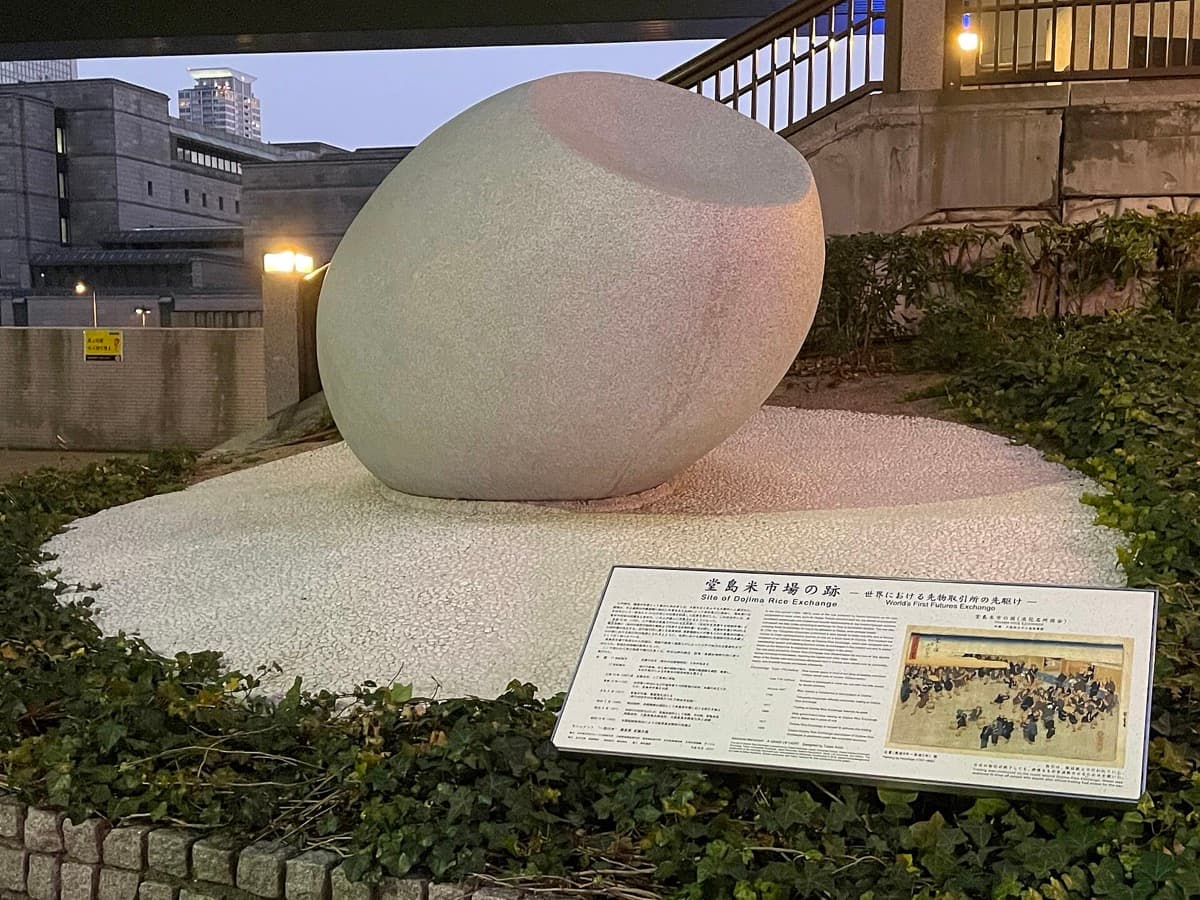
For a long time almost nothing marked the spot where this began. That changed in 2018. To commemorate the thirtieth anniversary of Japan's equity index futures market and to draw attention to Dojima's role as the forerunner of organized futures trading, the Osaka Exchange unveiled a new memorial at the historical site. It was designed by the Osaka-born architect Tadao Ando, one of the most celebrated architects alive, and unveiled on October 24, 2018. The monument is a stone marker roughly three meters long, shaped like a single grain of rice, titled A Grain of Light. It sits near the Nakanoshima area of the city, a short walk from Yodoyabashi Station.
The choice of form is exact. Not a statue of a merchant, not a plaque about finance, but a grain of rice rendered in stone. The whole invention grew from that single unit, standardized and traded until it became something abstract enough to change the world.
Why This Belongs After a Castle Walk
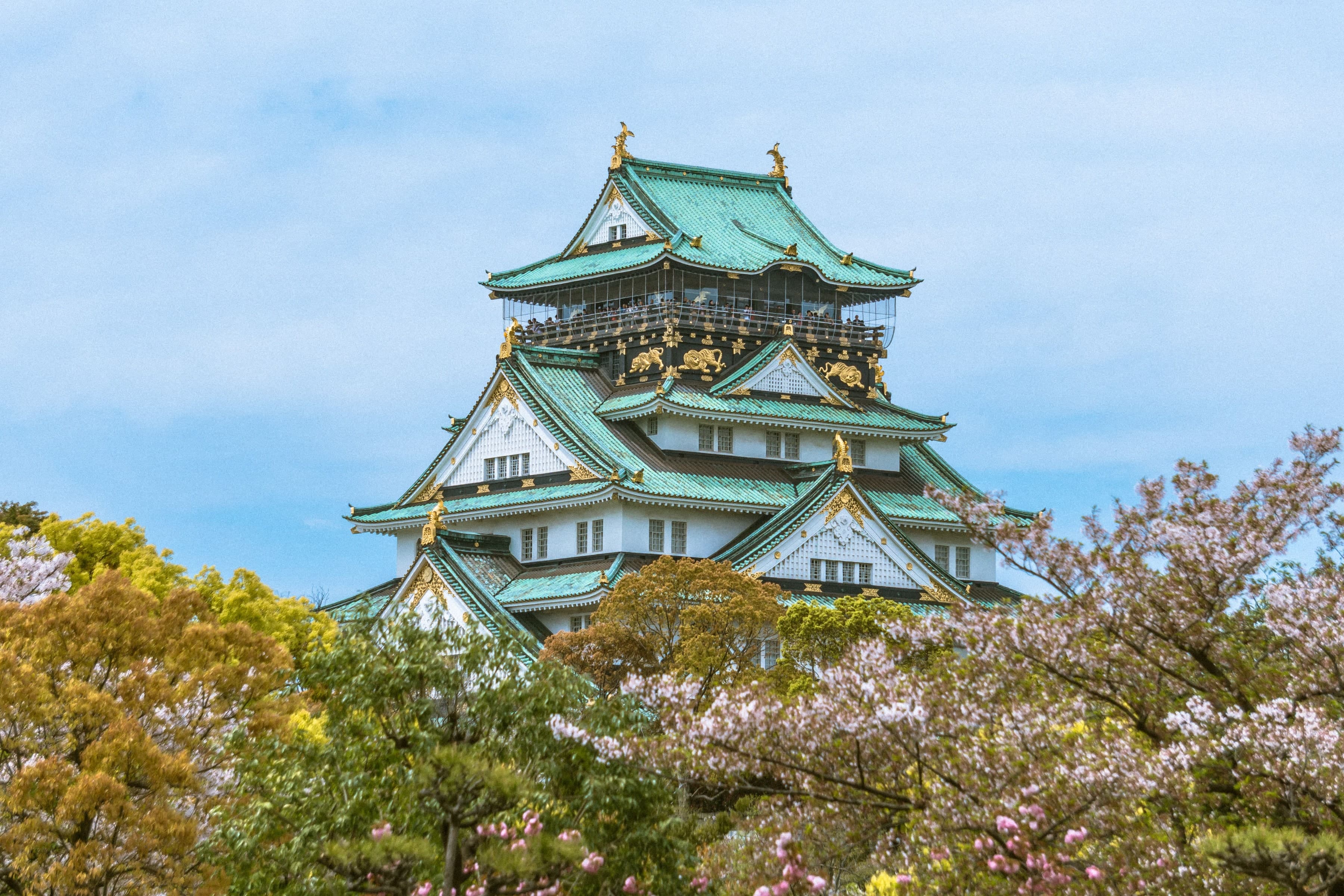
Stand at the western edge of Osaka Castle Park and face away from the keep, toward the modern towers, and the geography tells the argument. Behind you rises an enormous monument to warlords, its keep rebuilt in steel and concrete in 1931, honoring men who won famous battles. In front of you, invisible from here, lies the ground where the city's durable power actually grew, not from swords but from ledgers, rice, and price. The Toyotomi and Tokugawa clans spent lives and fortunes deciding who ruled the castle. The merchants of Dojima built the thing that outlasted every one of them.
That merchant appetite is also why Osaka still calls itself a city that lives to eat, a spirit locals name kuidaore. The wealth that flowed through the kitchen of the nation stayed in its kitchens. To feel the full shape of this reversal, walk it: from the castle stones raised by the winners to the rice-grain monument marking where the losers of that war were, in the long run, beside the point. Start with the castle walk, Osaka Castle: The Castle Beneath the Castle, then follow the appetite about three kilometers west along the river.
Sources
- Japan Exchange Group, "New Memorial Monument Unveiled at the Site of Dojima Rice Exchange" (October 24, 2018). The market operator's account of the site as the forerunner to organized futures exchanges in the world, and details of the 2018 memorial.
- Wikipedia, "Dojima Rice Exchange." Overview of the 1697 licensing, the shogunate's involvement under Tokugawa Yoshimune, and the 1939 dissolution.
- Harvard Business School, "The Dojima Rice Market and the Origins of Futures Trading." Teaching case treating Dojima as the origin of organized futures markets.
- Osaka-Info, "Dojima Rice Exchange." City tourism entry on the site, its history as the world's first organized futures market, and the Tadao Ando monument near Nakanoshima.
- Nippon.com, "Ahead of the Times: Flag-Waving Communication and Japan's Dojima Rice Exchange." On the rooftop flag-and-lantern price network used by Dojima traders.
Ready to experience it?
Osaka Castle: The Castle Beneath the Castle
75 min · 1.4 km · easy
More from Osaka
Explore more at your own pace.
One Day in Osaka: A Walkable Castle-to-Kitchen Itinerary (2026)
Osaka Travel Guide: How Many Days, Getting Around, When to Go (2026)
What to Eat in Osaka: A Food Guide (2026)
Osaka Castle: The Warlord's Fortress That Is Now a Concrete Museum
The Billiken: How an American Lucky Doll Became the God of Osaka's New World