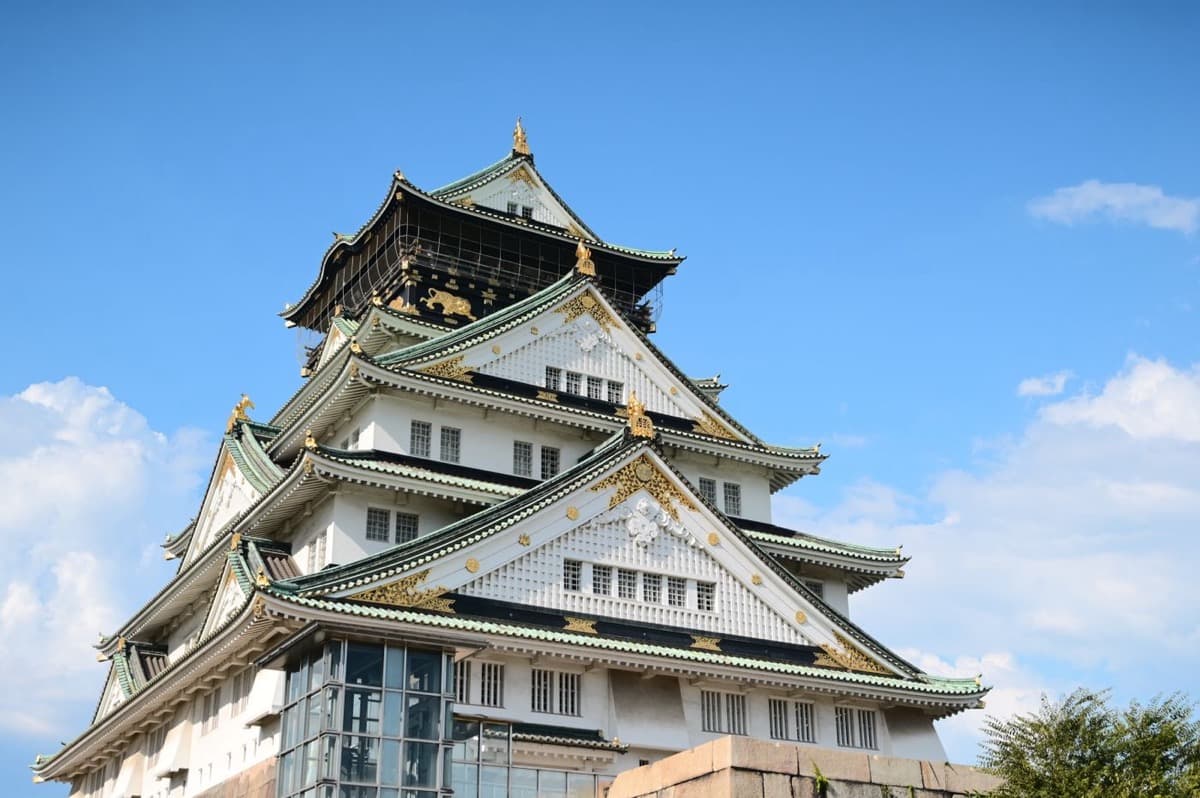
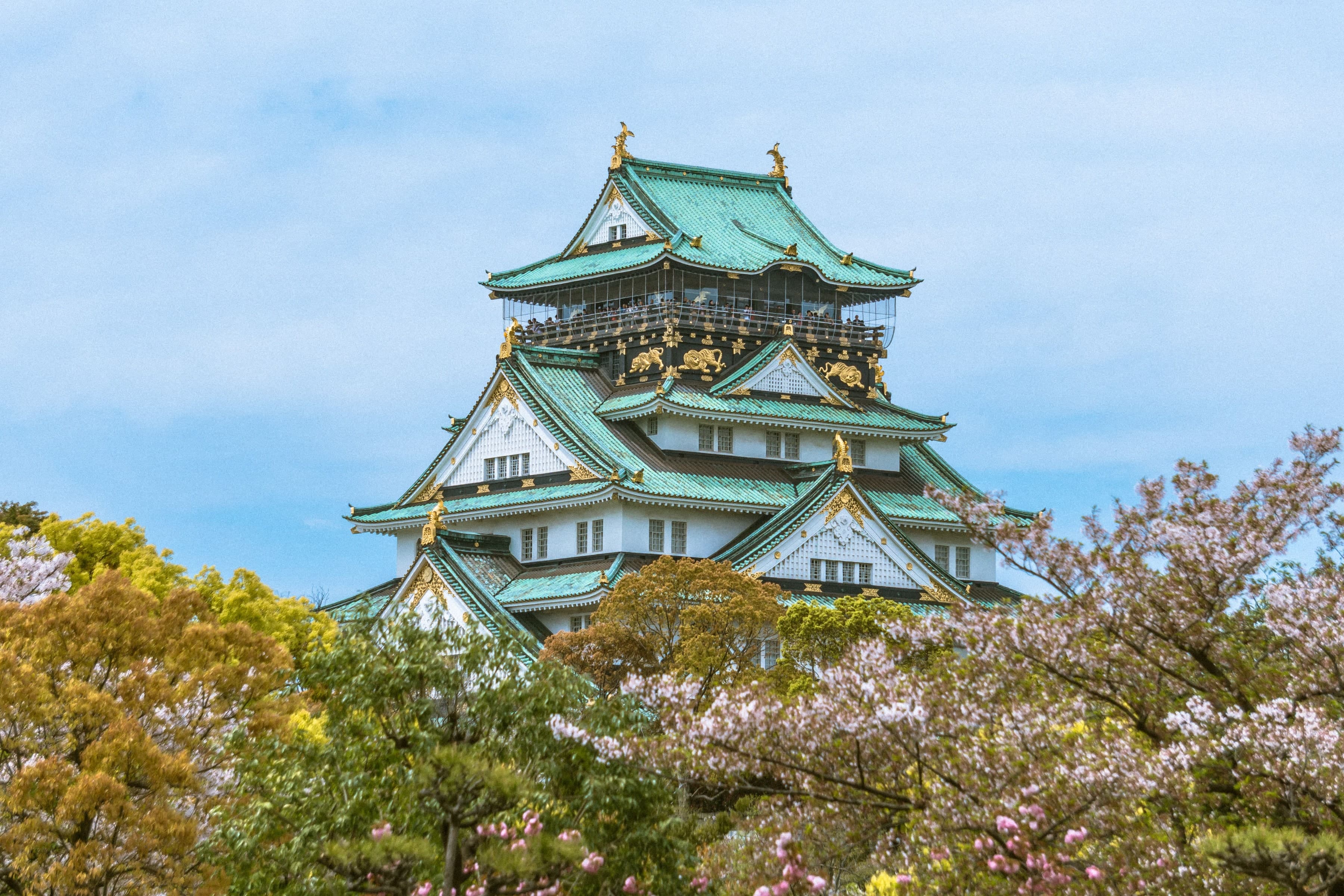
Osaka Castle is the image of a samurai stronghold: a soaring white and gold keep on a hill of massive stone. But it comes in three layers, and the trick is to read them apart. Osaka Castle's keep is a 1931 tower, paid for by the city's citizens and built in steel-framed reinforced concrete. The colossal granite walls and moats around it are the Tokugawa rebuild of the 1620s. And the first castle on this hill, Toyotomi Hideyoshi's, never left: it lies buried beneath them, and since 2025 you can go underground to see it. Separate the layers, and the castle tells a far richer story than its silhouette suggests.
The warlord who built it
Hideyoshi, the warlord who rose from obscurity to rule Japan, began the castle in the autumn of 1583 on the site of Ishiyama Hongan-ji, a fortified temple that had burned in 1580 after a decade of war. His keep was standing by 1585, and painted screens show it roofed with gold-leaf tiles, pieces of which have been dug up on the hill. No document records its size, so its height and floors are known only from modern reconstructions. Hideyoshi died in 1598, at Fushimi Castle near Kyoto, and Osaka passed to his young son Hideyori. The castle's greatest drama is the story of how the Toyotomi lost it.
The siege that ended a dynasty
Hear a stop from this walk
Aoyamon: The Arsenal and the Last Raid
Power shifted to Tokugawa Ieyasu, and in the winter of 1614 he brought his armies against Hideyori's castle. The peace that ended that first campaign, in January 1615, had every moat except the inner citadel's filled in, and when fighting resumed that summer the stripped castle could not hold. It fell and burned on 3 June 1615. Hideyori and his mother Yodo-dono lived through that night and took their own lives the next day, 4 June, with about thirty of their people, by the leading account in a turret of the Yamazato-maru. The Toyotomi line as a ruling house ended there.
The stone that is really old
In 1620 the second Tokugawa shogun, Hidetada, began to rebuild the castle over the top of Hideyoshi's, and it is the Tokugawa work that survives in stone. The castle museum says it plainly: every wall, moat and old building you can see dates from the Tokugawa era or later. Over the rebuild, from 1620 to 1629, sixty-four lords, most of them from western Japan, built the walls, staking their prestige, in the words of a Japanese government feature, on the quality of their workmanship. The Honmaru's east face stands about 32 meters high counting the part below the water, the tallest castle wall in Japan. Inside the Sakuramon gate, the Takoishi, the Octopus Stone, covers about 59 square meters and weighs an estimated 108 tonnes. Set in 1624 by Ikeda Tadao, lord of Okayama, it is the largest stone in the castle and, by Osaka City's count, the largest by surface area in Japan. A new Tokugawa keep was finished in 1626.
Roamer's Osaka Castle: The Castle Beneath the Castle begins among these stones at Otemon, the main gate, where Osaka University showed in 2016 that two giant stones in the courtyard beyond were once a single boulder, split at the quarry.
The keep Osaka paid for
Hideyoshi's keep burned in the siege. The Tokugawa keep burned after a lightning strike in 1665 and was never rebuilt: for 266 years there was no keep at all. Then in 1928 the mayor, Seki Hajime, proposed a new one. About 78,250 donations, from 250,000 yen down to 10 sen, reached the target of 1.5 million yen in about six months, though more than half of it went on a new headquarters for the Army's 4th Division, the price of opening the Army-held inner citadel to the public. That building is now MIRAIZA OSAKA-JO.
The keep, completed on 7 November 1931, was designed from a painted screen of the 1615 siege, the Osaka Summer Campaign screen, and built in steel-framed reinforced concrete: the first modern reconstructed keep in Japan. It does not even rest on the old stones. Its outer columns stop about 13 centimeters short of the Tokugawa base, so when a bomb shifted the base stones in 1945, the tower was unharmed. It is the castle's third keep, it has now stood longer than the two before it put together, and inside it is a museum, complete with elevators and an observation deck. Know what it is and enjoy it: a twentieth-century tower on a seventeenth-century base, telling the story of a sixteenth-century warlord whose own keep stood a little to the north-east.
The castle beneath the castle
The Tokugawa did not just build over Hideyoshi's castle. They buried it, under fill from about a meter deep near his old summit to more than 25 meters over his filled moats. The castle museum says they buried it as if to erase the Toyotomi; one of its own columns suggests they simply needed one wide, level platform. In 1959 a survey drill struck granite about nine meters down, and a Toyotomi-era plan found in Tokyo in 1960 identified it as Hideyoshi's wall. In October 1984, water-main works beside the Kinzo, the shogunate's old treasury, hit another wall only about a meter below the lawn: the wall of the innermost citadel, where Hideyoshi's family lived. After a handful of brief public showings, the Toyotomi Stone Wall Museum opened beside the Kinzo on 1 April 2025. Inside, you go down into the ground to Hideyoshi's wall, its stones still scorched by the fire of 1615. The keep ticket (1,200 yen for adults) covers it, and both are open 9:00 to 18:00, last entry 17:30 (checked 18 September 2026).
The merchant city beyond the walls
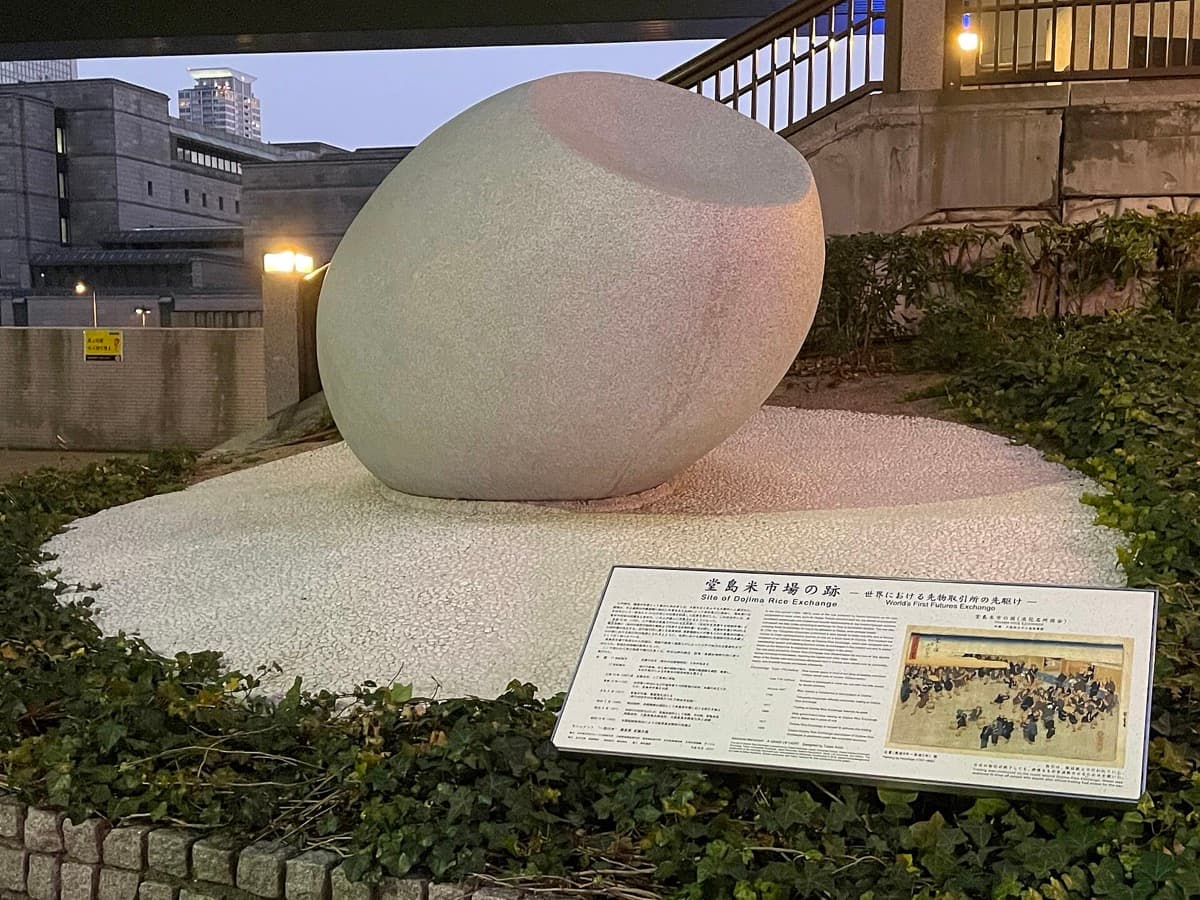
The castle was never the whole of Osaka. Dojima, where the city's merchants ran the Edo-period rice exchange, is a detour about three kilometers west along the river, and the story of the world's first futures market makes a good companion for an afternoon there.
Reading it in place
At Osaka Castle, spend as much attention on the ground as on the tower. Find the giant stones at Otemon and Sakuramon, then enter the 1931 keep knowing what it is, and go down into the Toyotomi Stone Wall Museum to stand beside Hideyoshi's wall. From there the walk drops into the Yamazato-maru, where Hideyori and Yodo-dono died, crosses Gokurakubashi over the north moat and leaves by Aoyamon. The park never closes and is at its calmest in early morning.
The castle anchors Roamer's Osaka Castle: The Castle Beneath the Castle, nine stops and about 1.4 kilometers inside the walls. To fit it into a day, see one day in Osaka, and for the full set of routes, browse Osaka walking tours.
Sources
- Osaka Castle Main Tower (osakacastle.net), home page, history page and visitor guide: every visible wall, moat and old building dates from the Tokugawa era or later; the present keep is the castle's third and has been a museum since it opened; hours and the 1,200-yen ticket that includes the Toyotomi Stone Wall Museum (checked 18 September 2026).
- Osaka Castle Main Tower, 90 years of the keep (osakacastle.net/90/history): Mayor Seki Hajime's 1928 proposal, the 1.5-million-yen citizens' fund and the 4th Division headquarters, the Army's hold on the inner citadel, completion on 7 November 1931, and steel-framed reinforced concrete in the first modern reconstructed keep.
- Amano Kozo and others, Foundation of the Main Tower of Osaka Castle in the Showa Period, in the Japan Society of Civil Engineers' journal of civil engineering history, vol. 17 (1997, on J-STAGE): the 78,250 donations, the design from the Osaka Summer Campaign screen, the columns that stop short of the Tokugawa base, the 1585 Toyotomi keep, and the 1626 and 1665 dates of the Tokugawa keep.
- Osaka Castle Main Tower, Toyotomi Stone Wall Museum pages and column series (osakacastle.net/toyotomi_stone_wall): the 1959 and 1984 finds, the burial "as if" to erase the Toyotomi and the levelling view (column 54), fill depths (column 89), the 32-meter east wall, the gold-leaf tiles, the site of Hideyoshi's keep, the Kinzo, and the museum's opening on 1 April 2025.
- Osaka Castle Main Tower, leaflet on the castle's stone walls (2024): the 1583 start on the Hongan-ji site, the peace of January 1615 that filled every moat except the inner citadel's, the fall of the castle on 3 June 1615 and the deaths of Hideyori and Yodo-dono the next day.
- Osaka City, plan for the Special Historic Site of Osaka Castle, chapters 3 and 4 (city.osaka.lg.jp): the 1620 to 1629 rebuild under Hidetada with 64 daimyo houses, and the Takoishi's 59 square meters and 108 tonnes.
- Japan Tourism Agency multilingual commentary database, Takoishi Stone (mlit.go.jp): Ikeda Tadao and the 1624 date.
- Cabinet Office, Highlighting Japan, The Stone Walls of Osaka Castle (October 2021): the lords staking their prestige on the quality of their workmanship.
- Osaka University research release (2016): the two Otemon courtyard stones split from a single boulder.
- The Osaka City memorial at the Yamazato-maru (1997) and its signboard: the leading theory of the turret and the thirty who died with Hideyori and Yodo-dono.
- Roamer tour transcript, Osaka Castle: The Castle Beneath the Castle (osaka-castle), fact-checked against the sources above in September 2026.
Ready to experience it?
Osaka Castle: The Castle Beneath the Castle
75 min · 1.4 km · easy
More from Osaka
Explore more at your own pace.
One Day in Osaka: A Walkable Castle-to-Kitchen Itinerary (2026)
Osaka Travel Guide: How Many Days, Getting Around, When to Go (2026)
What to Eat in Osaka: A Food Guide (2026)
The Dojima Rice Exchange: How Osaka Invented Futures Trading Before Wall Street Existed
The Billiken: How an American Lucky Doll Became the God of Osaka's New World