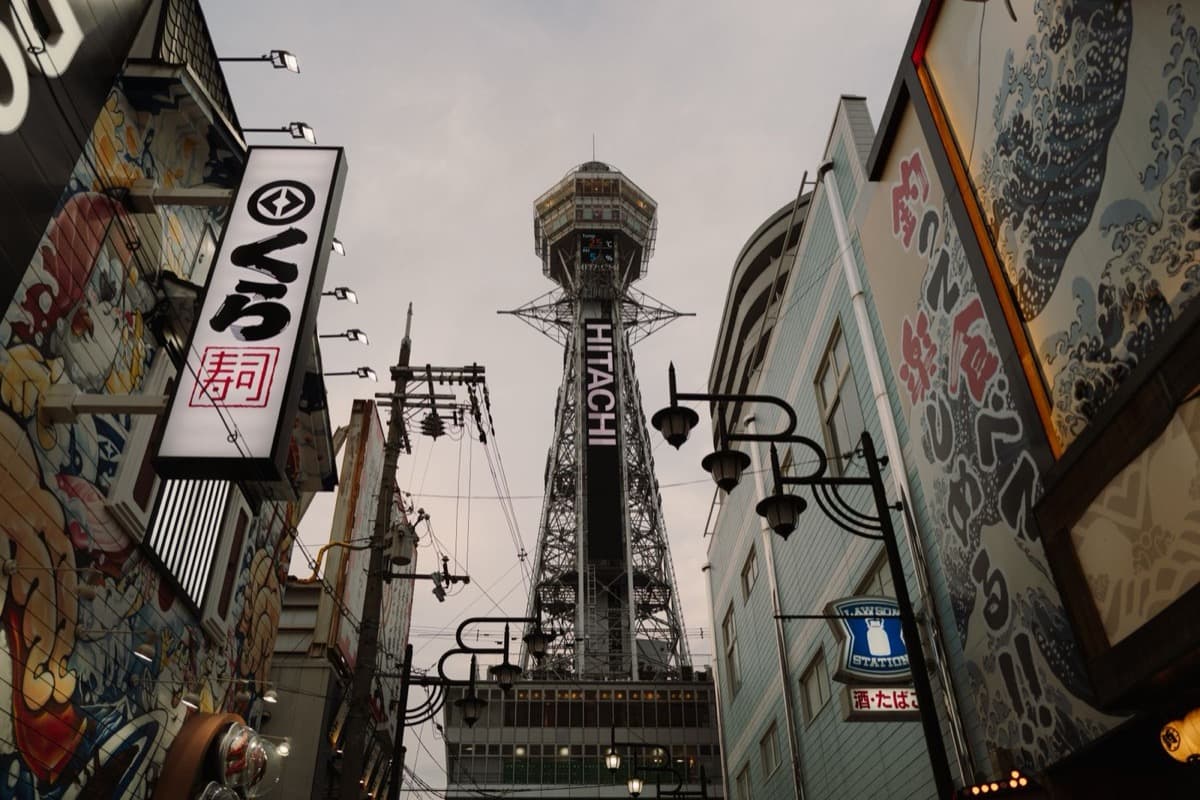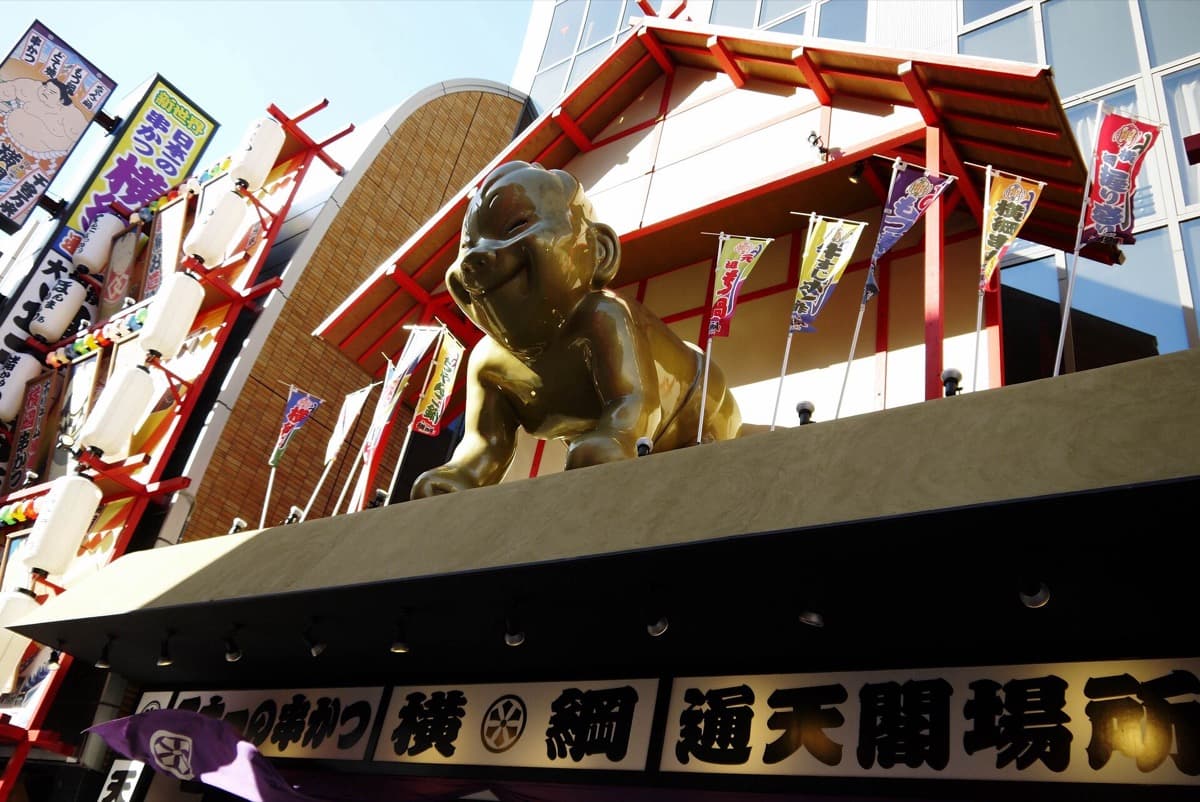
Walk south from the base of Tsutenkaku Tower in Osaka's Shinsekai district and you will meet a small grinning figure with a pointed head, narrow eyes, and a contented smile. Locals rub the soles of its feet for luck. It looks like it has sat there for a thousand years, some ancient guardian of the neighborhood. It has not, and it is not Japanese. The Billiken is an American good-luck doll, invented and patented in 1908 by a Kansas City illustrator and art teacher named Florence Pretz, and that single fact makes it the truest emblem of a district that named itself the New World and then borrowed its entire idea of the future from abroad.
An American god with a paper trail
The Billiken has something almost no folk deity can claim: a patent number. Florence Pretz filed a design patent for the figure in the United States, and it was granted on October 6, 1908, as Design Patent 39,603. She described her creation as the "god of things as they ought to be," a gentle, optimistic little charm meant to embody hope and contentment rather than fear or judgment. Pretz worked in Kansas City, Missouri, where she taught art, and by most accounts the figure grew out of a dream and out of the poetry she loved, its very name apparently borrowed from a verse of the era. She sold the rights, and the figure was mass-produced as chalkware statuettes, dolls, banks, and trinkets that swept across the United States as a short, intense craze in the years right after 1908.
So the Billiken is not carved out of Japanese tradition at all. It arrived in Osaka the way jazz records and Hollywood reels arrived, as a piece of fashionable Americana, at exactly the moment the city was building a district designed to package the foreign future for a paying crowd.
Why it landed in Shinsekai
Hear a stop from this walk
Shinsekai Streetscape: Billiken, Fugu, and the Frozen New World
To understand why an American charm doll ended up as Osaka's unofficial mascot, you have to understand the place that adopted it. Shinsekai, whose name literally means New World, was laid out in 1912 as a speculative pleasure district. Its planners split their inspiration in two. The northern half was modeled on Paris, and the southern half was modeled on Coney Island in New York, with a tall iron tower at the center quoting the silhouette of the Eiffel Tower up top and the Arc de Triomphe at its base. This was a neighborhood built to sell the sensation of abroad to Osakans who would never cross an ocean.
Alongside it opened Luna Park, an American-style amusement ground that ran from 1912 to 1923. Everything about the enterprise leaned into imported novelty, so an imported American good-luck god fit the theme exactly. The Billiken was enshrined in the park in 1912 as a symbol of that Americana, the smiling face of a manufactured future. When the park closed in 1923, the original wooden Billiken went missing. It simply vanished along with the rides and the halls, and for decades the New World's lucky god existed only in memory.
Lost, then rebuilt, like everything else here
Here is where the Billiken stops being a curiosity and starts being a key to the whole neighborhood. The figure you can visit today is not the 1912 original. A replica was installed in the second-generation Tsutenkaku Tower in 1980, and that worn statue was itself replaced with a fresh one in May 2012, because decades of hopeful hands had rubbed it dark and smooth.
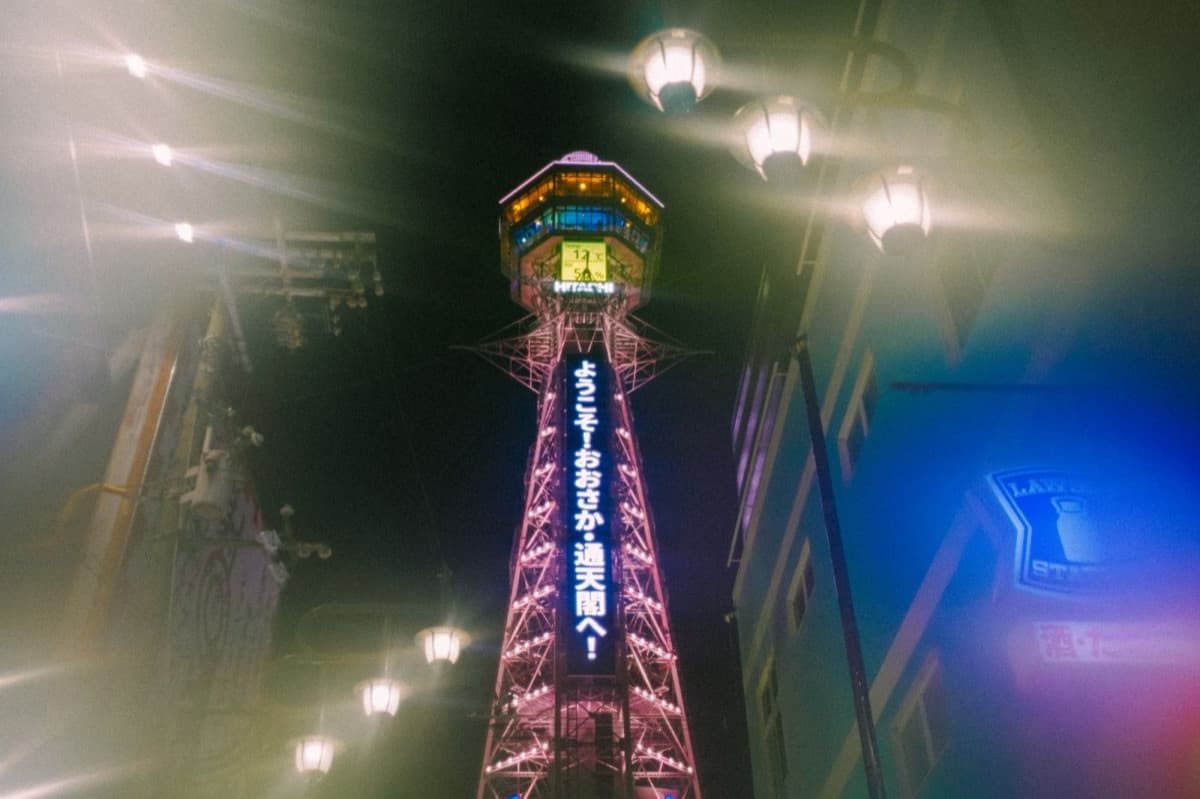
Look at that pattern next to everything around it. The tower itself is a rebuild. The slender iron original of 1912 was damaged by fire in 1943, then dismantled so its steel could go to the war effort, and the eight-sided tower standing now opened in 1956, engineered by Tachu Naito. The exaggerated signage, the giant pufferfish, the oversized lanterns, the colors turned up past good taste, all of it is a deliberately preserved Showa-era style, not the accidental residue of decay. Even the district's beloved cheap fried skewers, kushikatsu, survive as a tradition while the individual shops selling them come and go.
The Billiken belongs to that logic completely. It is an American doll, patented in 1908, lost in 1923, reinstalled in 1980, and refreshed in 2012. Nothing about it is old in the way it pretends to be, and yet the affection people feel for it is entirely real. That is the paradox of Shinsekai in a single grinning object: a hundred-year-old idea of the future, lovingly kept as a copy of a copy, cherished precisely because it never moved on.
What to do with it when you get there
You do not need a ticket to appreciate any of this. The streetscape reads best in late afternoon, when you can see the hand-painted faces in daylight and then watch the tower's neon and the arcade signs light up after dark. Find the Billiken, notice how worn the feet are compared with the rest of it, and let that tell you how many visitors have come looking for luck from an American charm patented in Kansas City.
One quiet note of respect. Shinsekai sits beside some of Osaka's poorer streets, and it is an ordinary lived-in neighborhood, not a stage set. Walk it with everyday courtesy, keep your camera off residents' doorways, and treat the whole New World the way it deserves: as a genuine and generous piece of the city, even when its most famous god turns out to have come from halfway around the planet.
If you want the full arc, from the rebuilt tower out to a temple founded in 593 and on to a real 300-meter skyline, the self-guided walk through Osaka starts right under Tsutenkaku, a few steps from where the Billiken sits.
Sources
- Billiken, Wikipedia: Confirms the 1908 design patent (D39,603, October 6, 1908), Florence Pretz's authorship as a Kansas City art teacher, the 1912 Luna Park enshrinement, the 1923 disappearance, the 1980 replica in the second-generation Tsutenkaku, and the May 2012 replacement.
- Tsutenkaku, Wikipedia: Background on the 1912 original tower, its 1943 loss, and the 1956 reconstruction that houses the current Billiken.
- Shinsekai, Wikipedia: The district's 1912 founding, its Paris north and Coney Island south, the 1912 to 1923 Luna Park, and the tower's Eiffel and Arc de Triomphe references.
- The Billiken is Much More Than the Strangest College Mascot, Atlas Obscura: On Pretz's creation, the "god of things as they ought to be" description, and the post-1908 American craze.
- Billiken History, Church of Good Luck: Details the June 12, 1908 filing and October 6, 1908 grant of the design patent.
Ready to experience it?
Shinsekai: The New World That Time Forgot
90 min · 3 km · easy
More from Osaka
Explore more at your own pace.
One Day in Osaka: A Walkable Castle-to-Kitchen Itinerary (2026)
Osaka Travel Guide: How Many Days, Getting Around, When to Go (2026)

What to Eat in Osaka: A Food Guide (2026)
The Dojima Rice Exchange: How Osaka Invented Futures Trading Before Wall Street Existed
Osaka Castle: The Warlord's Fortress That Is Now a Concrete Museum