Old Town: The Chapel Bridge and the Painted Squares
50 min · 1.1 km · easy
A walkable one-day itinerary in Lucerne runs the compact old town from morning to evening: cross the Chapel Bridge early, read the painted squares along the River Reuss, climb the Musegg Wall towers when they open, stand at the Lion Monument, then finish at the lakefront where the paddle steamers leave for the mountains. The whole loop covers roughly six to seven kilometers on foot, almost all of it flat and car-free, with one uphill stretch to the medieval ramparts. You can walk it in a day without rushing, and two self-guided audio tours cover the ground stop by stop at your own pace.
Lucerne rewards an early start because its landmarks sit within a few minutes of each other. The main railway station is about a four to five minute walk from the Chapel Bridge, and Zurich Airport is roughly an hour to an hour and a quarter away by direct train, so even arriving that morning leaves a full day. This guide walks you from the covered bridges through the painted merchant squares, up to the wall of towers, and down to the quay, and it hands off to the Lucerne walking tours that narrate each stop as you stand in front of it. For maps, tour details, and the city overview, see /switzerland/lucerne.
The short answer: your one-day route
Start at the Chapel Bridge at first light, follow the north bank quay to the Town Hall on the Kornmarkt and the painted Weinmarkt, cross the Spreuer Bridge and its Dance of Death, then follow the riverside path to the Jesuit Church. That morning loop is the ground of the first self-guided tour, roughly 1.1 kilometers and about 50 minutes of narrated walking, easy and flat.
After lunch, climb toward the Lion Monument and the Glacier Garden, walk the Musegg Wall while its towers are open, then come down through the Hofkirche to the lakefront quays and the carnival fountain at Kapellplatz. That afternoon arc is the second tour, about 4.7 kilometers and a little under two hours, with one genuine uphill to the ramparts. Together the two tours give you a full day that starts and ends within sight of the water.
Morning: the covered bridges and painted squares
Hear a stop from this walk
The Jesuit Church: Baroque Lucerne on the River
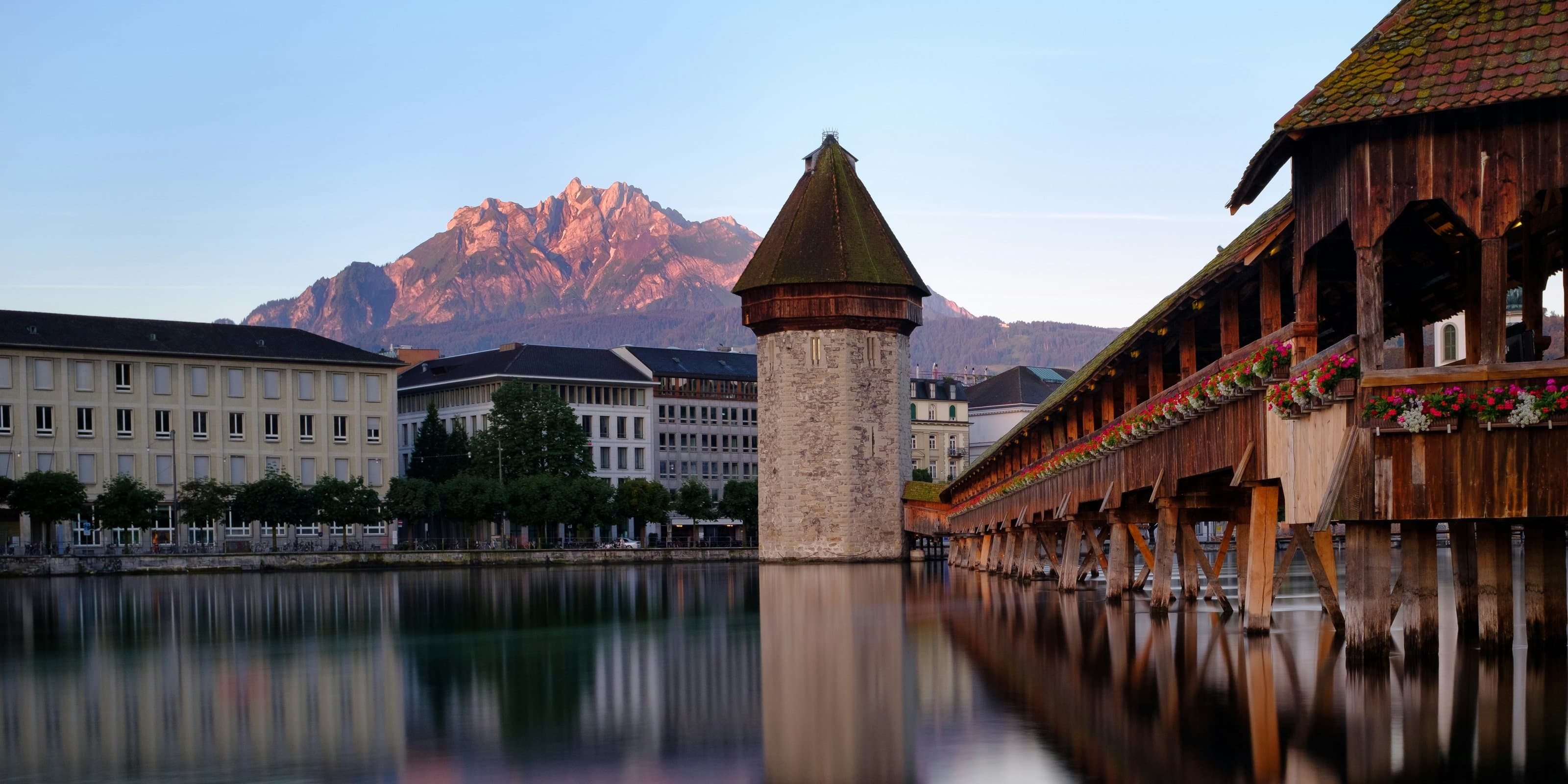
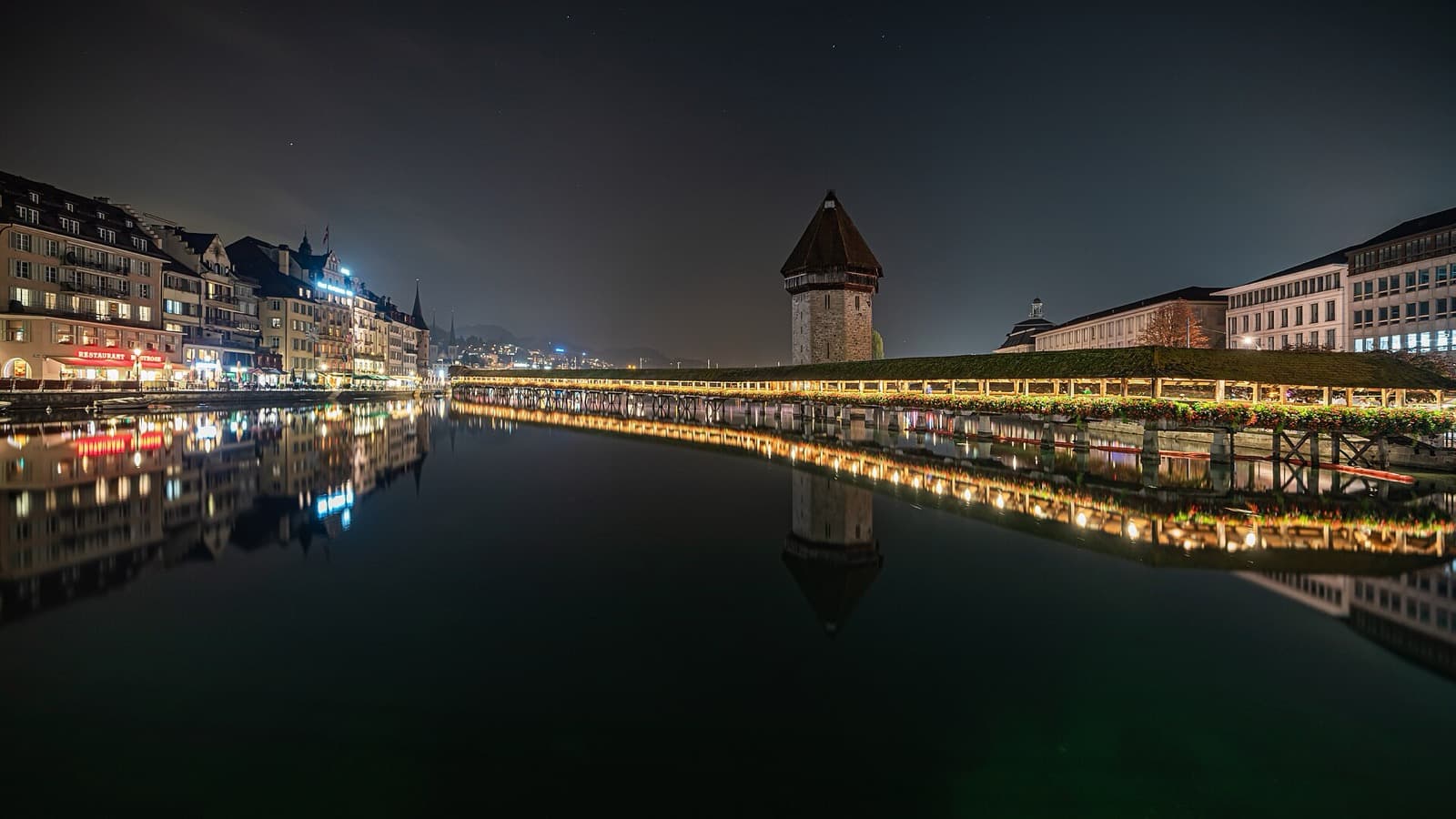
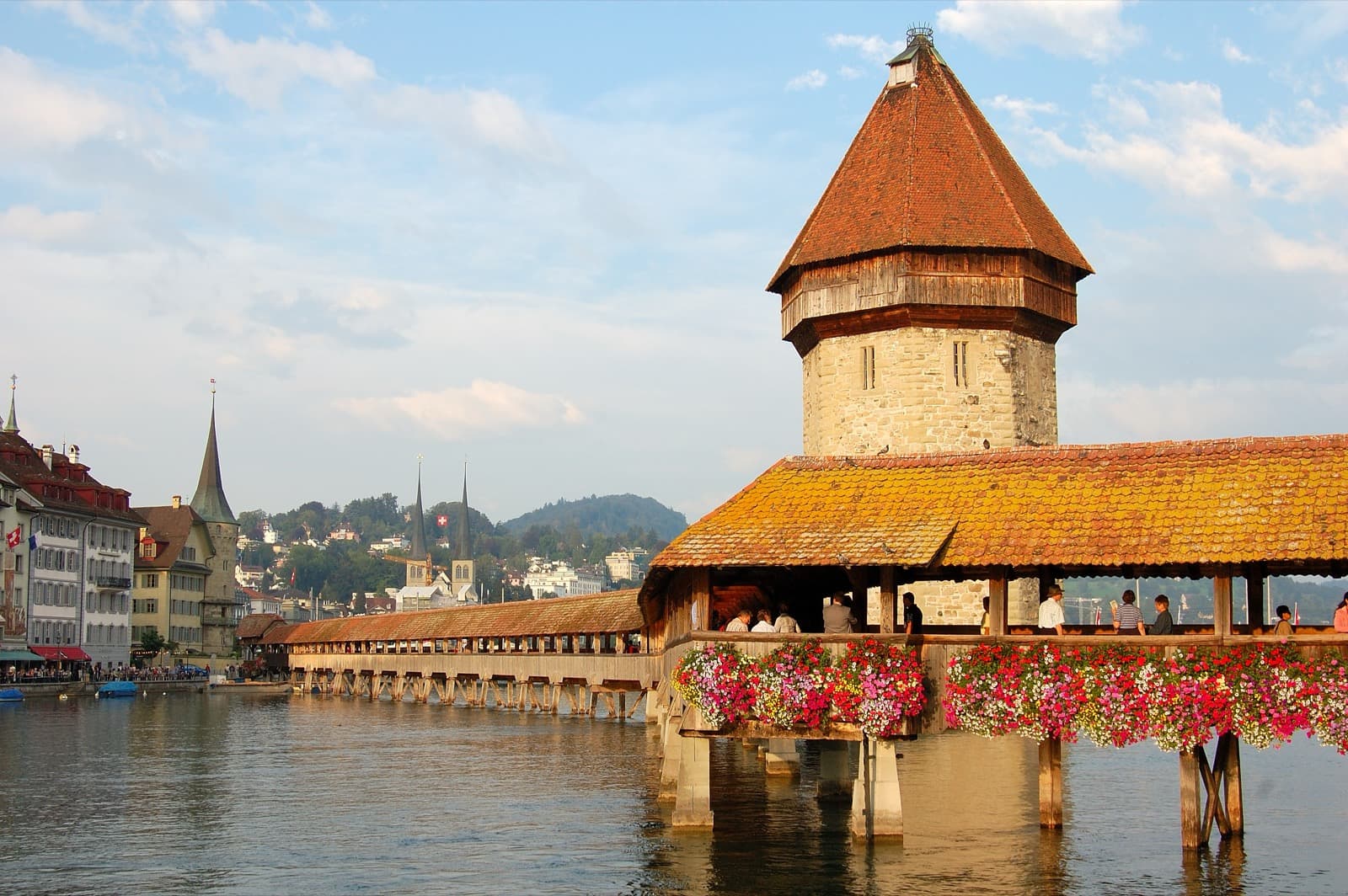
Begin at the Chapel Bridge (Kapellbruecke) and its stone Water Tower. The bridge is free and open air, and it is quietest in the first hour of the day before the tour groups arrive. Tree-ring dating shows the Chapel Bridge was built no earlier than thirteen fifty-six, and it is counted among the oldest wooden bridges in Europe. A fire on the eighteenth of August nineteen ninety-three destroyed much of it and most of its seventeenth-century painted panels; the two bridgeheads survived, and the Water Tower came through scorched but standing. The town rebuilt and reopened it in about eight months, on the fourteenth of April nineteen ninety-four, which is why the timber still looks so new against the medieval town behind it. The Water Tower stands about thirty-four and a half meters tall and is not open inside.
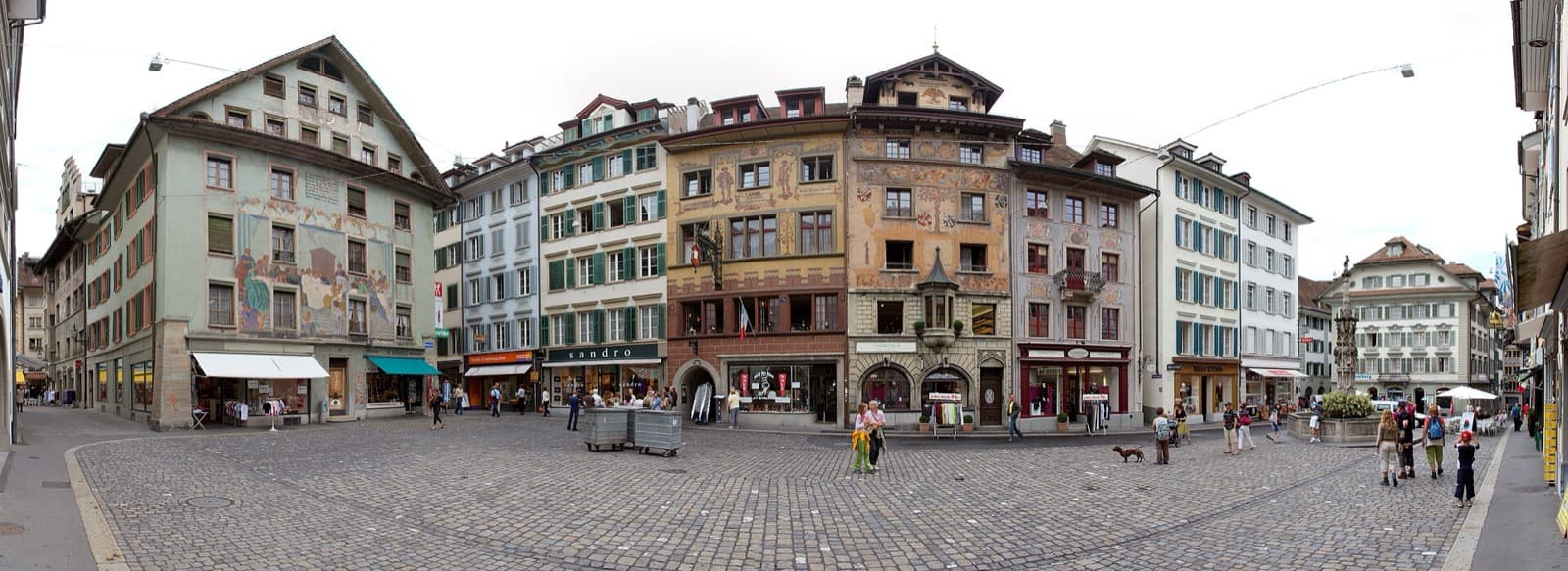
From the bridge, follow the north-bank quay into the old town squares. The Weinmarkt's fountain goes back to a commission given to the sculptor Konrad Lux in fourteen eighty-one (the one in the square today is a copy carved in the nineteen fifties), and Lucerne's citizens are recorded swearing allegiance to the Swiss Confederation on this square in thirteen thirty-two. The Kornmarkt, Hirschenplatz, and Weinmarkt link one into the next, so wander between them rather than treating each as a separate errand. The frescoed houses on the Hirschenplatz are protected as historical monuments, and the Town Hall on the Kornmarkt was rebuilt as the seat of Lucerne's government between sixteen oh two and sixteen oh six, combining Italian Renaissance walls with a low, broad roof in the Bernese farmhouse style.
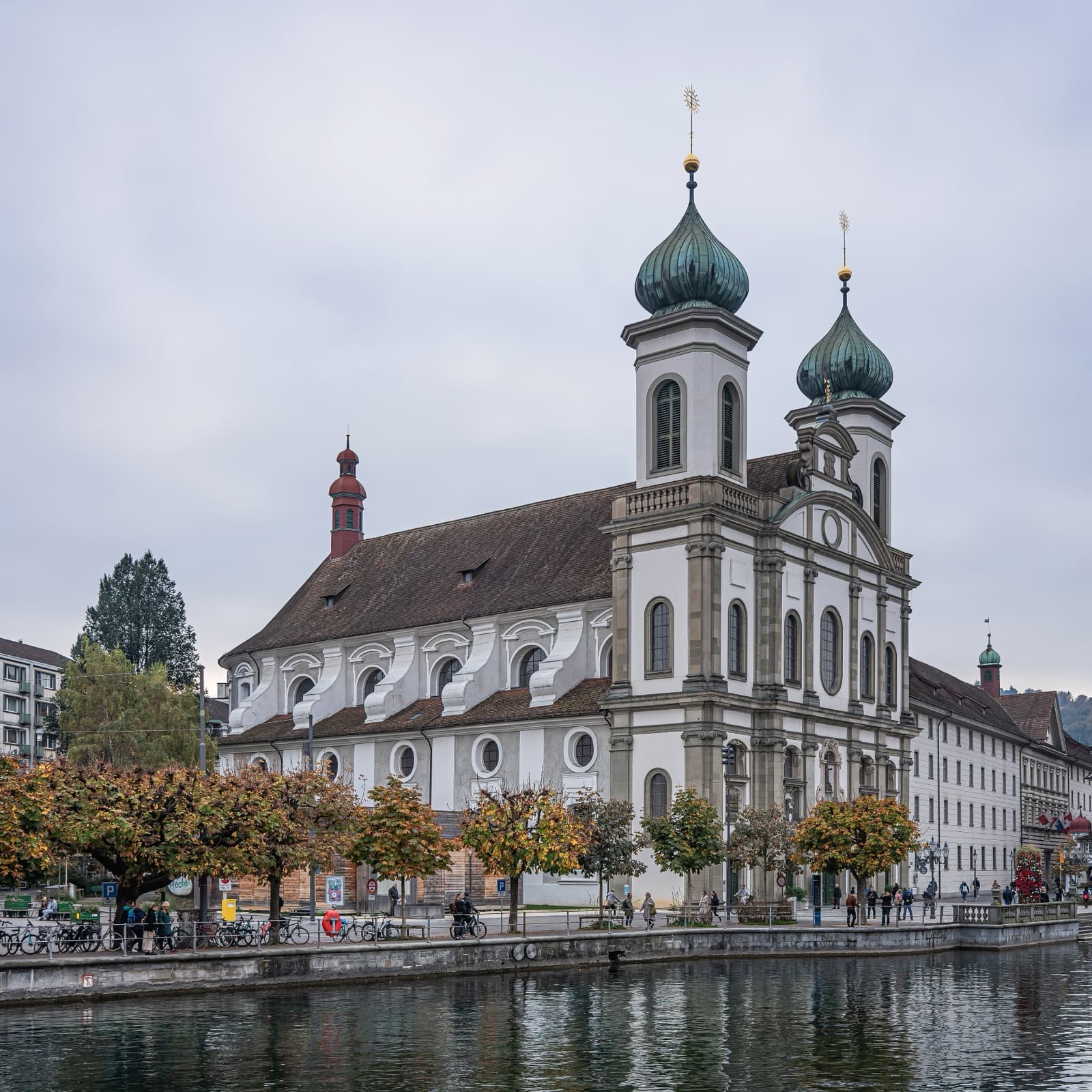
Walk west along the river to the Spreuer Bridge, the working, downstream crossing. It is first recorded as a full crossing in fourteen oh eight and was rebuilt after a flood in fifteen sixty-six. Under its roof runs Kaspar Meglinger's Dance of Death cycle, the largest known of its kind, with forty-five of its paintings surviving. From its far end, follow the riverside path upstream to the Jesuit Church (Jesuitenkirche), which is free to enter. It is recorded as the first large Baroque church built in Switzerland, modeled on the Gesu in Rome. It is a working church, so keep your voice low and dress modestly if a service is underway.
This whole morning is the ground the first self-guided tour narrates in order. The bridges, squares, and church are all free, which makes the morning the easy, no-ticket half of your day.
Afternoon: the dying lion, the wall of towers, and the lake
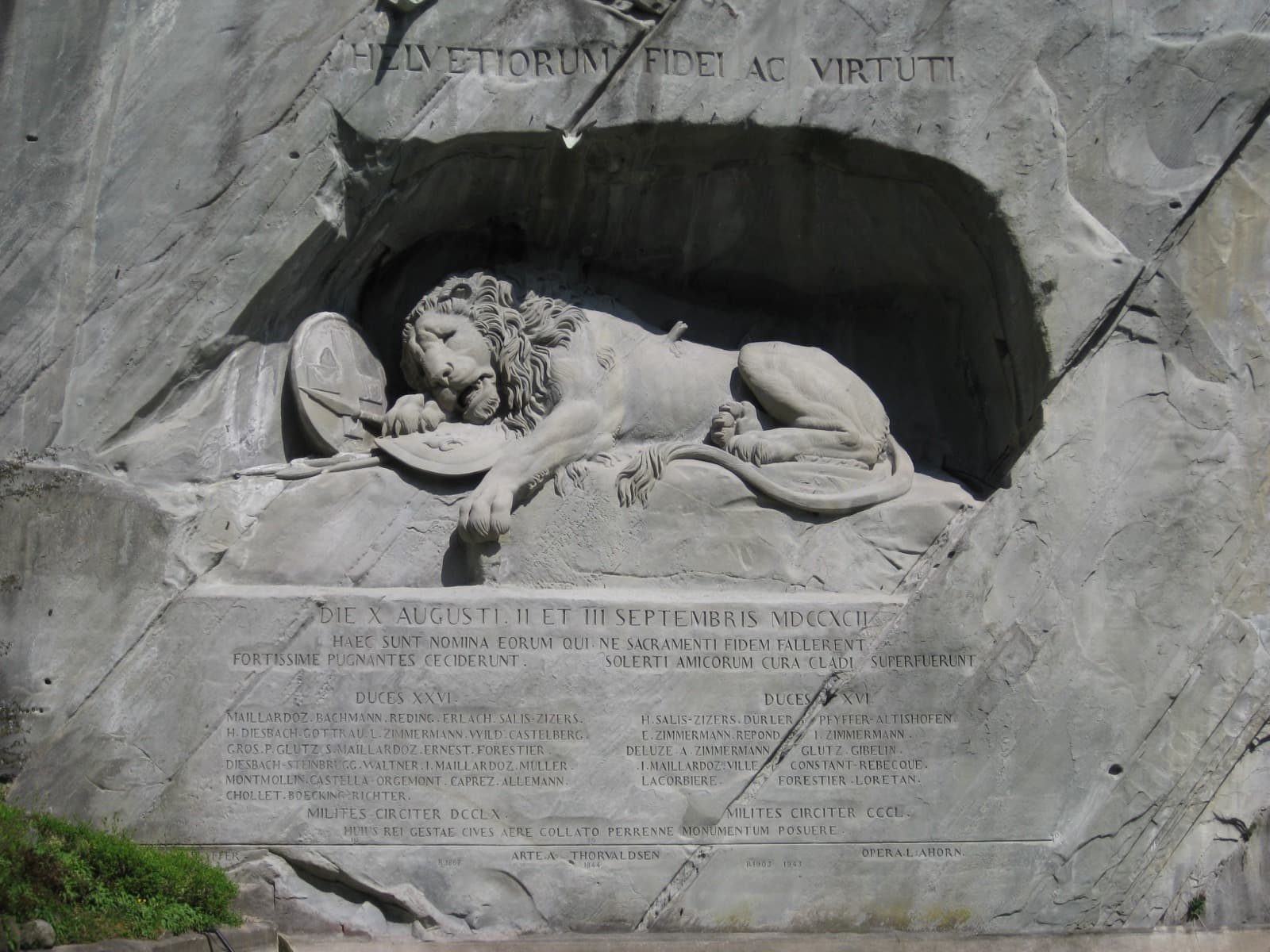
After lunch, walk up to the Lion Monument (Loewendenkmal), a colossal dying lion cut directly into a natural sandstone cliff. It memorializes the Swiss Guards killed in Paris, and Mark Twain called it the most mournful and moving piece of stone in the world, a description he wrote in eighteen eighty that has followed it in guidebooks ever since. The monument is free and open air, accessible at any hour, though daylight gives the best view of the carving. Beside it sits the Glacier Garden (Gletschergarten), where glacial potholes were uncovered by chance in eighteen seventy-two by a man digging to store his wine. The Glacier Garden is a paid museum: adult admission is CHF 24 and children six to sixteen pay CHF 12, and it is open daily, roughly ten in the morning to six in the evening in summer and to five in winter. Entry is free with the Swiss Travel Pass plus Museum Pass.
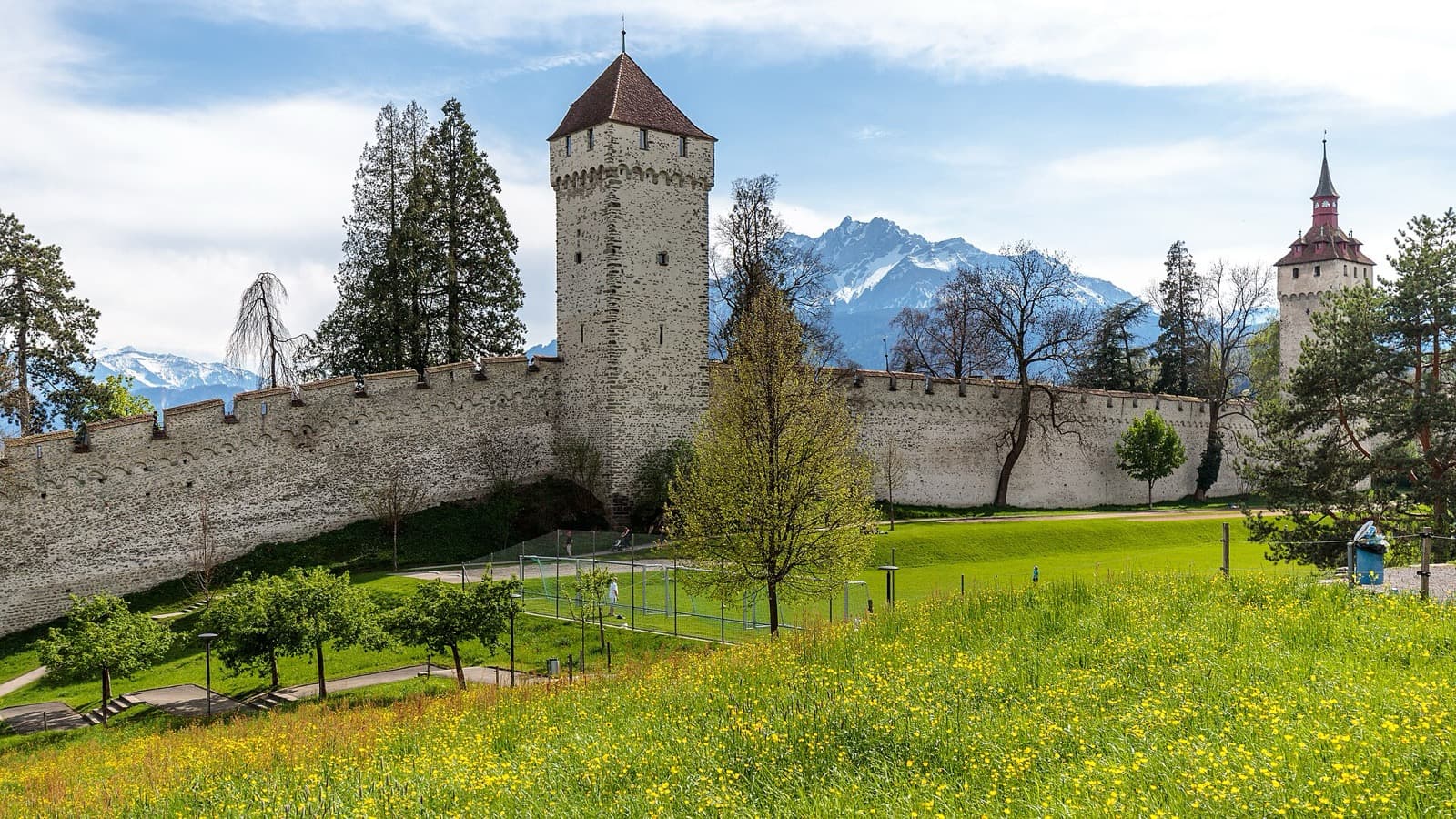
From there, climb to the Musegg Wall (Museggmauer), the outer defensive ring on the ridge. At about eight hundred and seventy meters it is the longest surviving town wall in Switzerland, and nine of its original towers still stand. Four towers are open to climb, and both the ramparts and the towers are free. The season matters: the wall and its towers are open from the first of April to the first of November, roughly eight in the morning to seven in the evening, and closed for the winter. If you are here in that window, do the wall in the middle of your afternoon when the light is good and the queues are short. The Zytturm holds the oldest clock in Lucerne, its mechanism dated fifteen thirty-five, and by local tradition it strikes each hour one minute before every other clock in the city, so time your climb near the top of an hour if you can.
Come down through the Hofkirche St. Leodegar, the twin-towered court church that is the oldest root of the town. Its two Gothic towers survived an Easter Sunday fire in sixteen thirty-three and were built into the church that stands today. It is free and active, so a quiet look is the right register. Finish at the lakefront quays, where the historic paddle steamers leave for the mountains. The first steamer on the lake, the Stadt Luzern, made its maiden voyage in eighteen thirty-seven, and the five restored steamers form the world's largest fleet of paddle steamers on an inland lake. The promenade is free to walk; scheduled cruises are ticketed in Swiss francs and are covered by the Swiss Travel Pass on regular sailings, though dining and charter cruises are not. End at Kapellplatz, where the Fritschi carnival fountain marks the meeting of the old town and the lake. That afternoon arc is exactly the second self-guided tour, so let it narrate the climb and the descent for you.
Practical notes: money, timing, and safety
Switzerland uses the Swiss franc, not the euro, so carry francs for tower kiosks, museum tickets, and steamer fares. Many of the day's best moments cost nothing: the Chapel Bridge, the Spreuer Bridge, the painted squares, the Lion Monument, the Musegg ramparts in season, the Hofkirche, and the Jesuit Church are all free. The paid options are the Glacier Garden and any lake cruise. If you plan to ride a steamer or add a museum, a Swiss Travel Pass can fold several of these into one ticket.
Time the day around two things: the Musegg towers, which only open April through early November, and the paddle-steamer timetable if you want to watch one leave. An early start at the Chapel Bridge buys you the quietest crossing, and the last hour of daylight doubles the towers in the river for photographs. On safety, Lucerne is a calm, walkable city, and the only real cautions are physical: the covered wooden bridges and stone quays get slippery when wet, and the path and stairs up to the Musegg towers rise on uneven ground with narrow, old steps, so wear shoes with grip. Alpine weather shifts fast, so pack a waterproof layer and sun protection even on a clear morning.
Both halves of this day are built as Lucerne walking tours you can start whenever you like, with GPS-triggered audio that plays the story of each stop as you reach it. There is no group to keep pace with and no fixed departure. Browse both routes and the city map at /switzerland/lucerne, then walk the old town on your own clock.
Sources
Frequently asked questions
- Can you see Lucerne in one day?
- Yes. Lucerne's main sights sit within a compact old town, most of it flat and car-free, so a single day covers the Chapel Bridge, the painted squares, the Lion Monument, the Musegg Wall, and the lakefront on foot. The full loop is roughly six to seven kilometers with one uphill stretch to the ramparts. Two self-guided audio tours split the day into a morning old-town arc and an afternoon wall-and-lake arc.
- How far is Lucerne's old town from the train station?
- The old town and the Chapel Bridge are about a four to five minute walk from Lucerne's main railway station. The station sits at the edge of the lake, so you walk straight into the historic center. Zurich Airport is roughly one hour to one hour and fifteen minutes away by direct train, which leaves a full day even if you arrive that morning.
- Is the Lion Monument free to visit?
- Yes. The Lion Monument (Loewendenkmal) is an open-air memorial carved into a sandstone cliff, free to visit and accessible at any hour. Daylight gives the best view of the carving. The neighboring Glacier Garden is a separate paid museum, with adult admission of CHF 24 and CHF 12 for children aged six to sixteen.
- Are the Musegg Wall towers open all year?
- No. The Musegg Wall towers are open seasonally, from the first of April to the first of November, roughly eight in the morning to seven in the evening, and they close for the winter. Four of the nine surviving towers are open to climb, and both the ramparts and the towers are free. Time your climb for the middle of the day when queues are shortest.
- Do you need euros or Swiss francs in Lucerne?
- Switzerland uses the Swiss franc, not the euro, so carry francs for museum tickets, tower kiosks, and lake-steamer fares. Many of the day's highlights are free, including the covered bridges, the painted squares, the Lion Monument, the Musegg ramparts in season, and the churches. The main paid options are the Glacier Garden and lake cruises.
- Are Lake Lucerne cruises covered by the Swiss Travel Pass?
- Regular scheduled sailings on Lake Lucerne, including the historic paddle steamers, are fully covered by the Swiss Travel Pass in 2026. Special products like dining cruises, brunch cruises, and charter boats are not covered and must be paid separately. The lakefront promenade itself is free to walk, so you can watch a steamer leave without buying a ticket.
Ready to experience it?
Old Town: The Chapel Bridge and the Painted Squares
50 min · 1.1 km · easy
More from Lucerne
Explore more at your own pace.
Lucerne Travel Guide: How Many Days, Getting Around, and When to Visit
The Painted Lake Town: How Lucerne Reads on Foot
The Chapel Bridge Burned in 1993. What Lucerne Rebuilt Tells You How to Read the Whole Old Town
The Dying Lion of Lucerne: What the Monument Really Mourns
The Jesuit Church of Lucerne: Switzerland's First Large Baroque Church, Built as an Argument