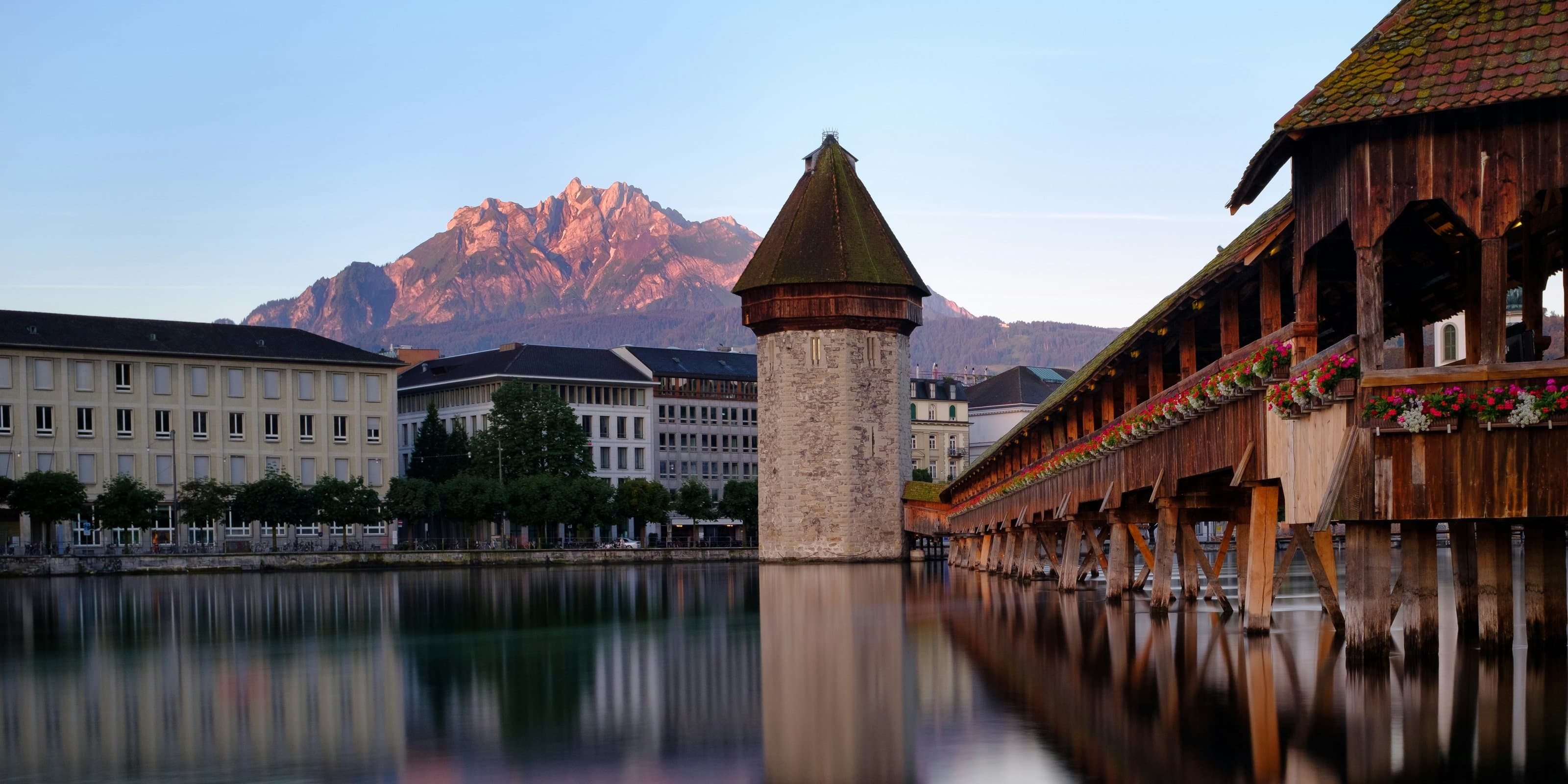
On the night of 18 August 1993, fire ran along the roof of the Chapel Bridge in Lucerne and destroyed much of the bridge, along with most of the painted panels that hung under its roof. The two bridgeheads survived, and the stone Water Tower beside it came through scorched but standing. Of the paintings hanging that night, only thirty could be fully restored. The people of Lucerne rebuilt their bridge in about eight months and walked across it again on 14 April 1994. That fact, a medieval townscape almost lost to flame and raised again inside a single year, is the key that opens the whole old town. Once you understand why a small alpine city rebuilt a wooden footbridge that fast, you understand how to read every stop on the walk that runs from this luminous bridge to the grave Dance of Death downstream, along both banks of the River Reuss.
Why the bridge, of all things
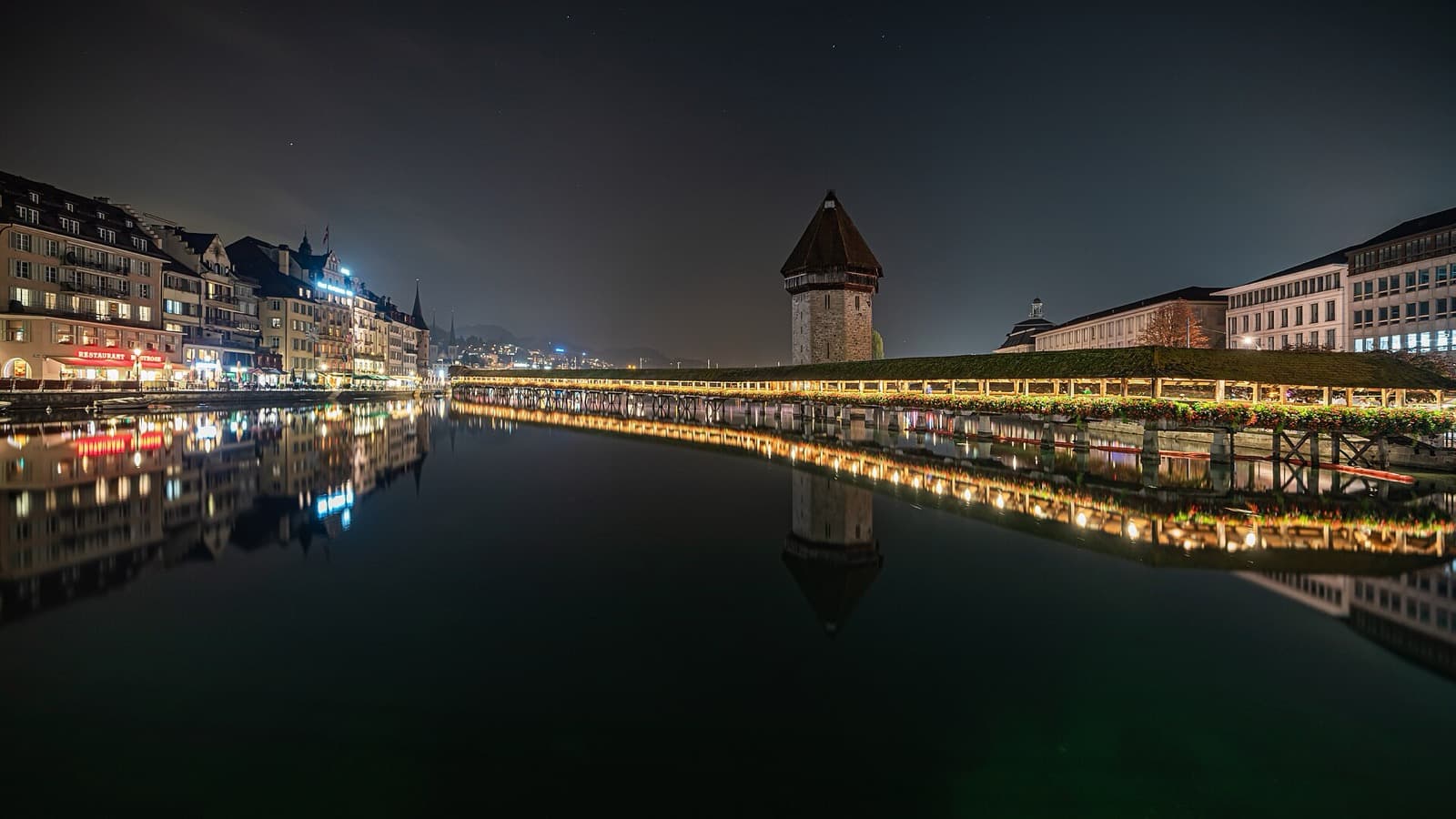
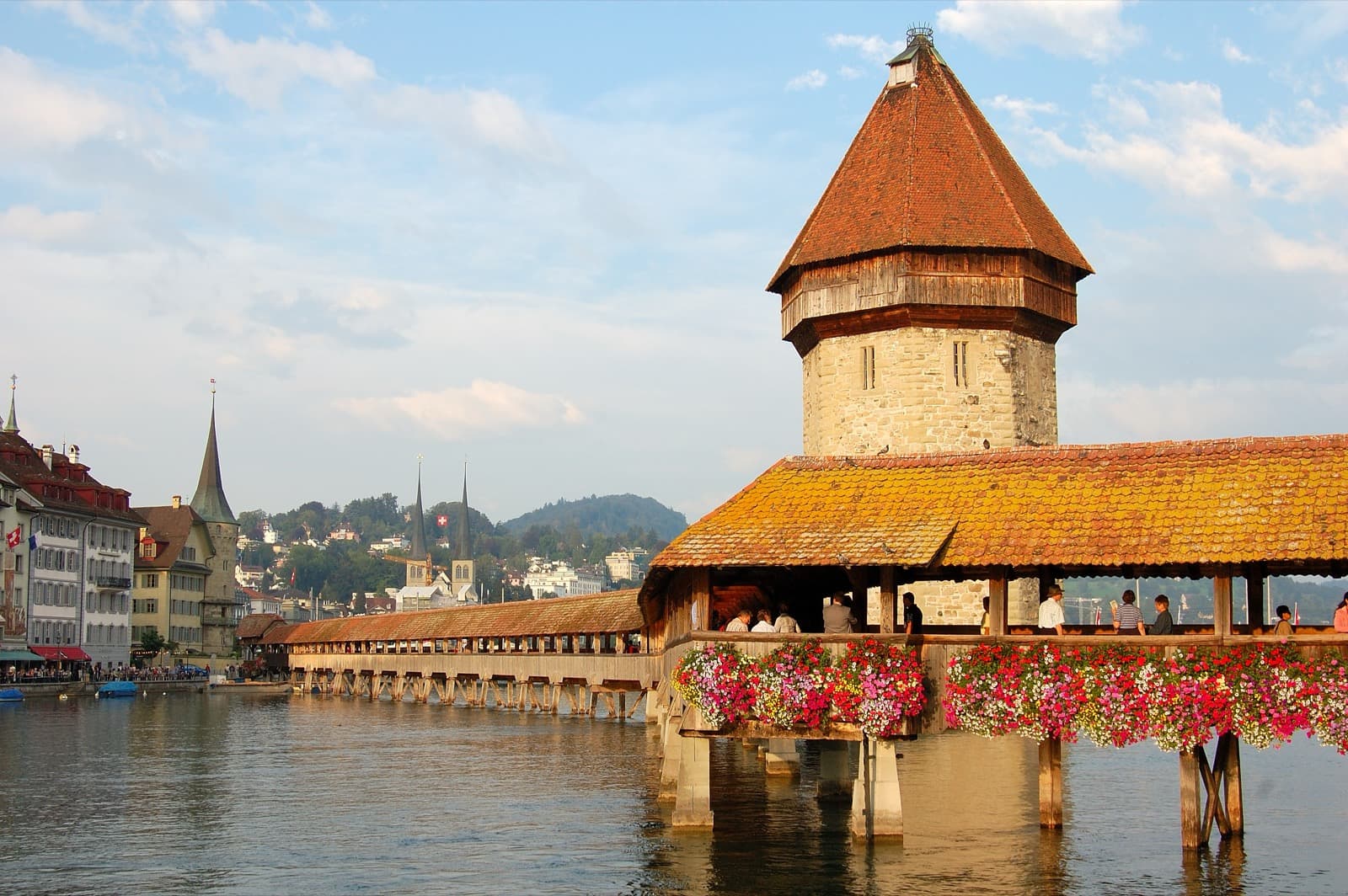
The Kapellbruecke, the Chapel Bridge, was built as part of the town's fortifications. Tree-ring dating shows it went up no earlier than 1356, and it is counted among the oldest covered wooden bridges in Europe. Today it runs about 205 metres, though it was once close to 280 before it was shortened in the nineteenth century. That length matters less than what hangs inside it. Set into the triangular gables of the rafters are painted panels. In 1611 the Lucerne apothecary and city councillor Renward Cysat finished the plan for a cycle of 158 of them, and the painter Hans Heinrich Waegmann carried it out over the following decade: scenes from the history of Lucerne and the Swiss Confederation, and from the lives of the city's patron saints, Leodegar and Maurice.
So the bridge was never only a way across the water. It was a public gallery of civic and religious memory, a place where the town told itself its own story every time a citizen walked to market. When the fire took most of those panels, Lucerne did not lose a tourist attraction. It lost a stretch of its memory. The eight-month rebuild reads, then, not as civic pride but as something closer to grief and repair. Cross it today and you are walking through something both very old and, in part, very new. That doubled reading, old plan and new timber held in one glance, is the habit the rest of the walk asks of you.
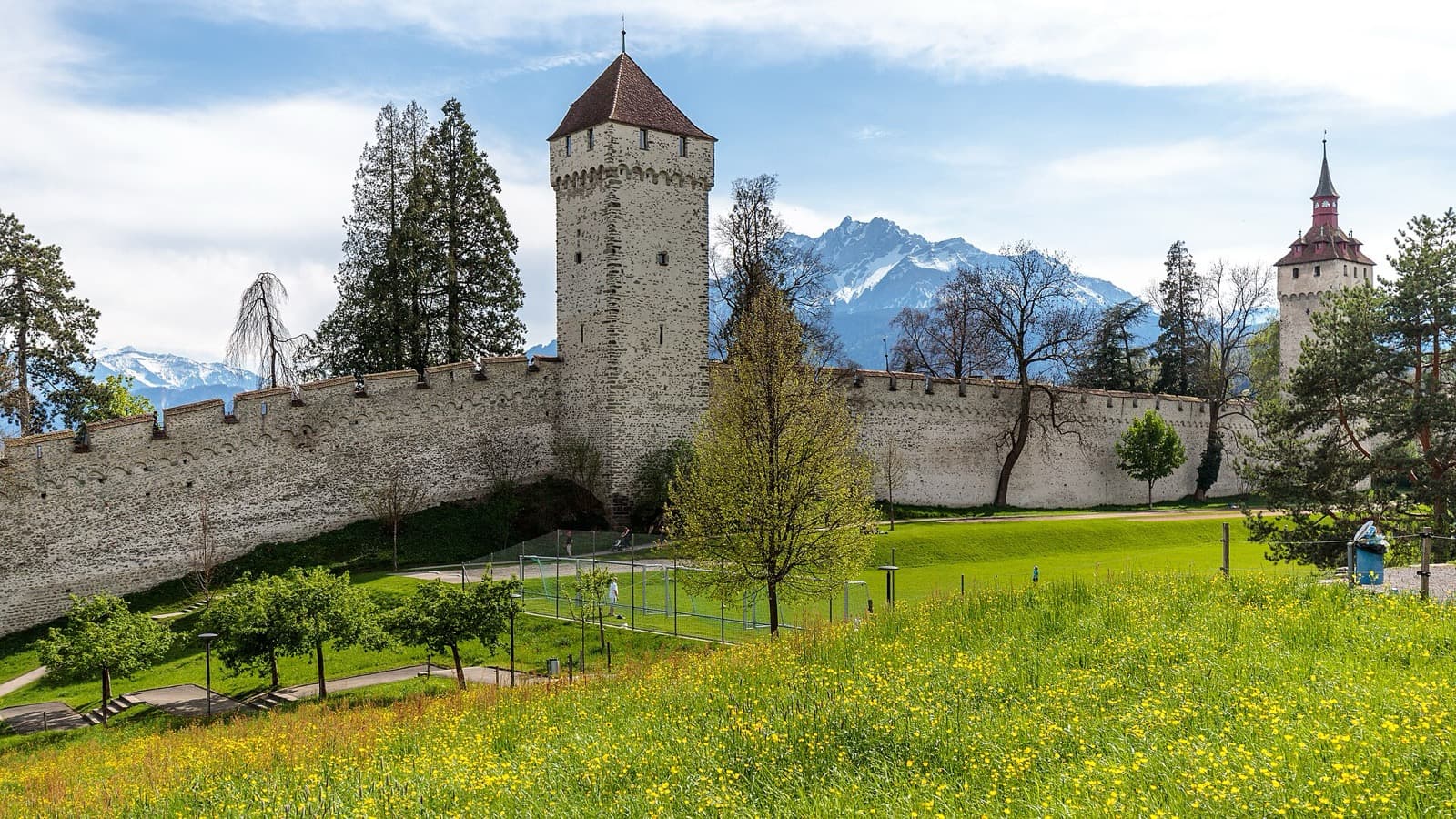
The fortress hiding inside the postcard
Hear a stop from this walk
The Jesuit Church: Baroque Lucerne on the River
The tower the bridge angles past sharpens the point. The Wasserturm, the Water Tower, is octagonal, built of stone, and stands directly in the Reuss. It is older than the bridge, raised around 1300, some decades earlier, as part of the town's fortifications. It rises about 34.5 metres, and its story is not a gentle one. Over the centuries this single tower held the town archives, kept here until 1919, and the treasury, and in its lower reaches a prison and torture chamber. Prisoners, the records tell, were lowered into the dungeon on a rope.
Switzerland Tourism calls the bridge and tower probably one of the most popular photo subjects in the country, and Lucerne Tourism calls the bridge the city's most photographed sight. Hold both readings at once, the lovely picture and the hard old fortress underneath it, and you have the interpretive stance for the entire route. Nothing in this old town is only what the postcard shows. The best place to take in both is the quay on the old-town bank, looking back across the water.
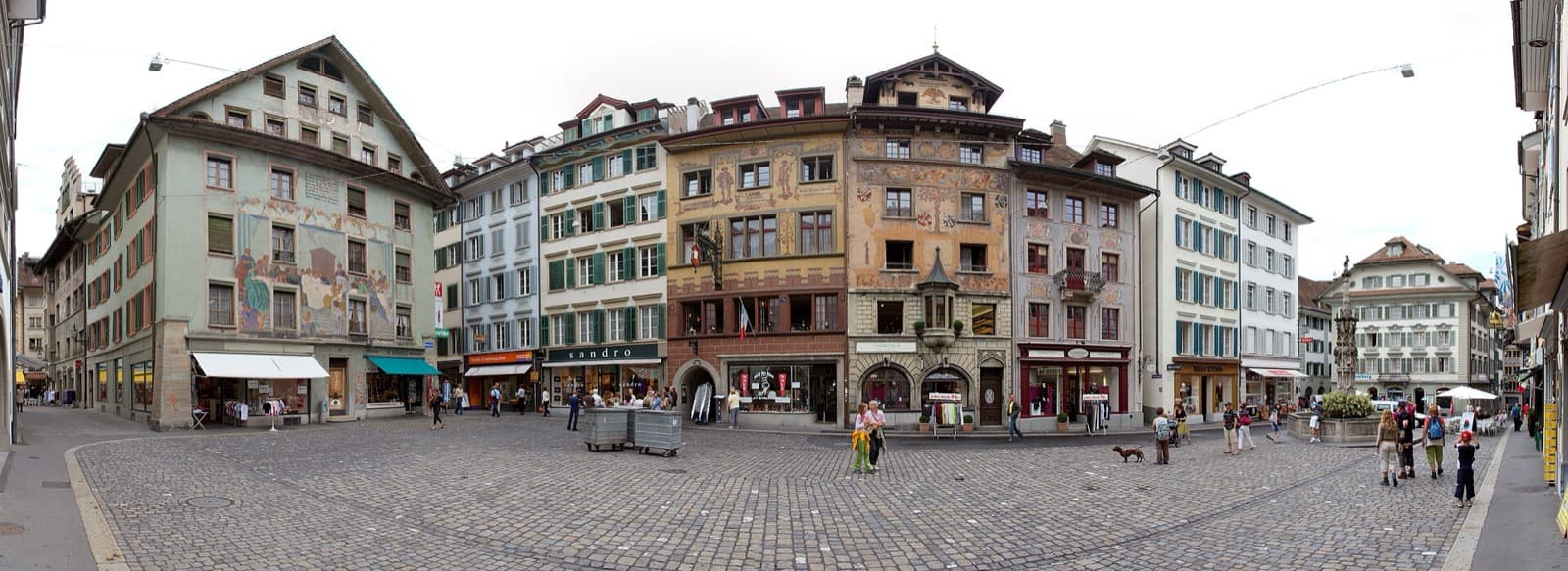
The painted squares: the town's living room
Follow the quay downstream and the walk turns into a chain of squares that gathered the life of the city for centuries. The Kornmarkt earned its name honestly: a public trading hall and granary was built here about 1370, and grain changed hands on the square. Beside it stands the Town Hall, rebuilt from the old hall between 1602 and 1606 by the architect Anton Isenmann. He gave it Italian Renaissance walls under a low, broad roof in the Bernese farmhouse style, one building holding Italy and the Swiss countryside at once. The Small and Grand Councils of Lucerne met here until 1798, and the city parliament still meets here today.
A short lane leads on to the Weinmarkt, the Wine Market, ringed by painted houses. Its history runs into the story of Switzerland itself: citizens of Lucerne are recorded swearing their oath to the Confederation on this square in 1332, the year the town allied itself with Uri, Schwyz and Unterwalden. From 1453 to 1616 the square doubled as the stage for the town's Easter play, and for the performance of 1583 the same Renward Cysat who later planned the Chapel Bridge panels drew the stage plan. The fountain at its centre goes back to a commission given to the sculptor Konrad Lux in 1481, with Saint Maurice at the top of the column; what stands in the square today is a copy carved in the 1950s, and the original is kept in the city's museum. A few steps away, the Hirschenplatz adds more painted houses, protected today as historical monuments. If you want to plan which squares to linger in, the Lucerne walking tours hub lays out how they connect.
The dark mirror downstream
The walk then crosses a bridge that answers the first one. Follow the Reuss downstream to the Spreuerbruecke, the Spreuer Bridge. A footbridge ran out to the river mills from the thirteenth century, the full crossing is first recorded in 1408, and a flood in 1566 tore away part of it before it was rebuilt. Its name is plain and working: chaff, Spreu, from the city mills could be tipped into the river only from this, the furthest-downstream bridge.
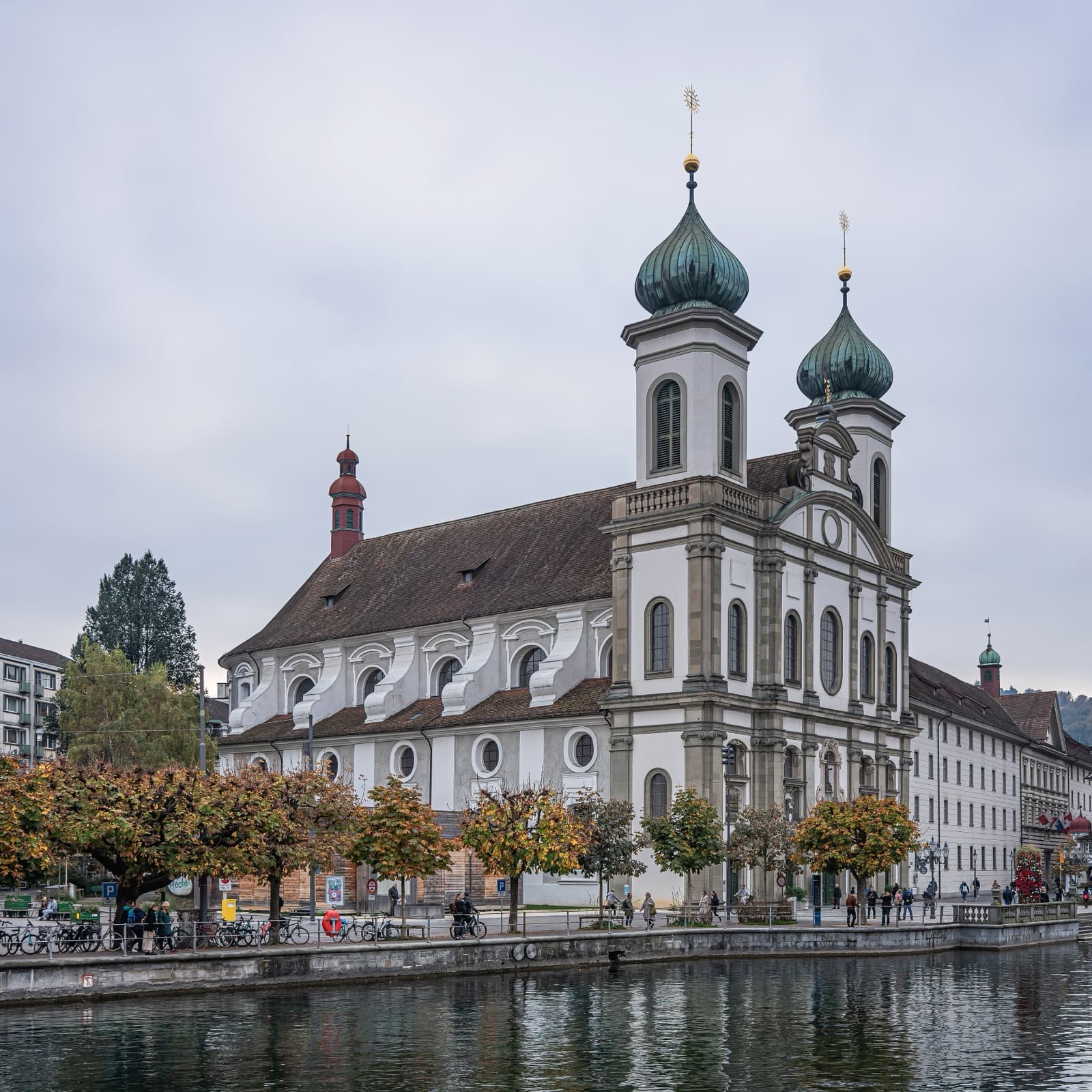
Look up under its roof and you find the reason the whole walk pulls in two directions. Hanging there is a Dance of Death, a Totentanz, painted between 1616 and 1637 under Kaspar Meglinger. It is the largest known cycle of its kind, and forty-five of its paintings survive. Panel after panel, Death comes for people of every rank in turn, and most panels carry the coat of arms of the family who paid for them. Where the Chapel Bridge is bright and reborn, this one is grave. Two wooden crossings over the same river, beauty and its shadow side by side. From its far end a riverside path leads upstream to the Jesuit Church, consecrated in 1677 and the first large Baroque church built in Switzerland, which gives the medieval town a Counter-Reformation face to look back at.
The full route is a loop of about 1.1 kilometres and six stops, roughly fifty minutes at whatever pace suits you, and it crosses each bridge once. Because it is self-guided, you can stay on the reborn bridge as long as you like, skip any stop that does not call to you, and read the Dance of Death panel by panel with no group waiting. Start at the southern end of the Chapel Bridge, on the station side of the river, and let the whole city of Lucerne open from there.
Sources
- Kapellbruecke, Luzerner Holzbruecken (kapellbruecke.com): tree-ring dating, original and current length, the painting of the panels, and the 1993 fire.
- Chapel Bridge, Lucerne Tourism (luzern.com): Renward Cysat's 1611 plan for the panel cycle and the bridge as Lucerne's most photographed sight.
- Kapellbruecke, German Wikipedia, and Switzerland Tourism (myswitzerland.com): the thirty fully restored panels and the eight-month rebuild.
- The Water Tower, Luzerner Holzbruecken, and Lucerne Tourism: the tower's dating around 1300, its 34.5-metre height and its use as archive, treasury and prison.
- Town Hall, Lucerne Tourism: the 1602 to 1606 rebuild by Anton Isenmann and its Bernese farmhouse-style roof; Kornmarkt granary from Lucerne Tourism's old-town squares page.
- Weinmarkt fountain, Museum Luzern: the Konrad Lux commission and the 1950s copy; Easter plays, Historisches Lexikon der Schweiz.
- Spreuer Bridge, Luzerner Holzbruecken and English Wikipedia: the 1408 record, the 1566 flood, and Meglinger's Dance of Death.
- Jesuit Church, Lucerne Tourism and jesuitenkirche-luzern.ch: consecration in 1677 and its standing as the first large Baroque church in Switzerland.
Ready to experience it?
Old Town: The Chapel Bridge and the Painted Squares
50 min · 1.1 km · easy
More from Lucerne
Explore more at your own pace.
Lucerne Travel Guide: How Many Days, Getting Around, and When to Visit
One Day in Lucerne: A Walkable Morning-to-Evening Itinerary
The Painted Lake Town: How Lucerne Reads on Foot
The Dying Lion of Lucerne: What the Monument Really Mourns
The Jesuit Church of Lucerne: Switzerland's First Large Baroque Church, Built as an Argument