A colossal dying lion carved into a Lucerne cliff mourns Swiss Guards killed in Paris in 1792, and understanding what those soldiers were is the key that opens the rest of the city. Most visitors read the Lion Monument as a sad and beautiful sculpture, pause at the still pool below it, and move on. The monument rewards a longer look. It is the front door to a harder Lucerne than the covered bridges and lake cruises suggest: a soldiers' town that sold its young men to foreign kings, and a walled town that ringed itself in stone because it knew it needed walls. Walk the Lion Monument and Musegg Wall tour and the memorial stops being an isolated postcard. It becomes the first line of an argument the whole route makes.
What the lion actually mourns
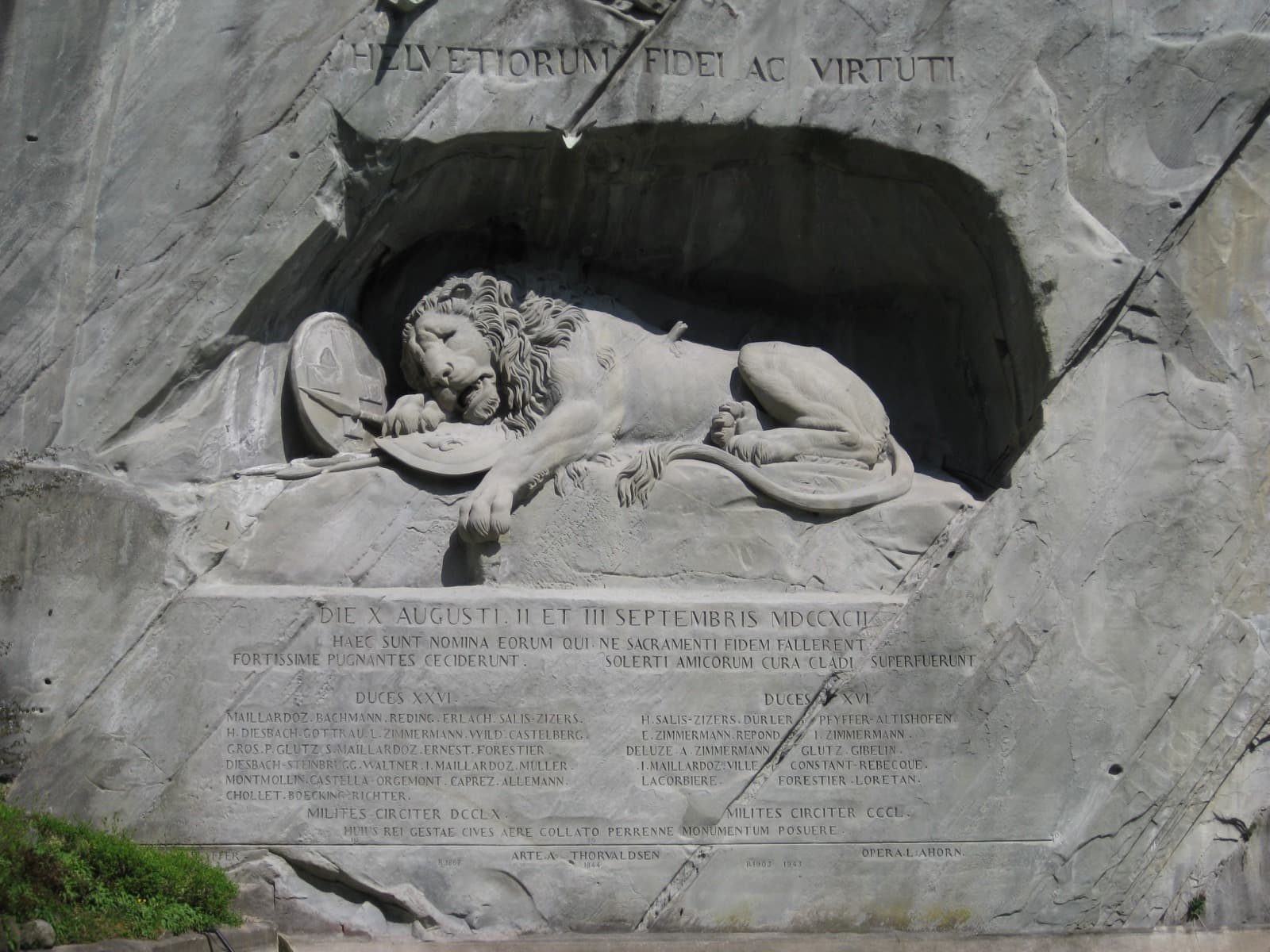
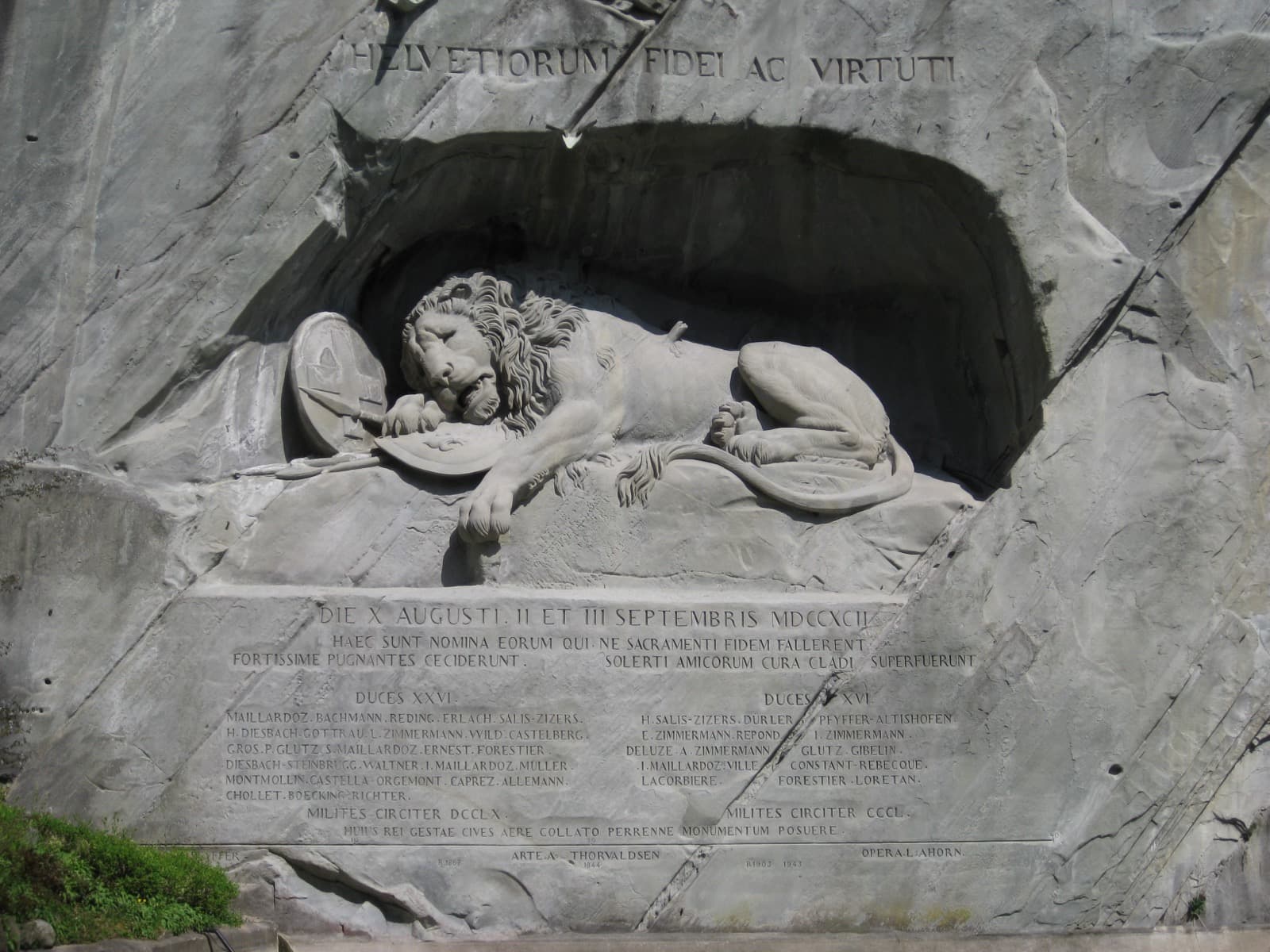
The figure is the Loewendenkmal, German for lion monument. Into the face of a sandstone cliff, above a pool of water, a lion lies dying with a broken spear buried in its side. The Danish sculptor Bertel Thorvaldsen designed it, and the stonemason Lukas Ahorn cut it directly into the rock between 1820 and 1821. It was unveiled in 1821. Because it was carved into a natural cliff rather than built as a freestanding statue, it can never be moved from this spot.
The lion mourns the Swiss Guards, mercenary soldiers of the French king, killed defending the Tuileries Palace in Paris on the tenth of August 1792, during the French Revolution. The inscription records roughly 760 of the Guard killed and about 350 survivors, though modern historians count considerably fewer dead. What matters is the practice behind those numbers. For centuries the poor cantons of Switzerland sent their young men abroad to fight as hired soldiers, a custom the Swiss called Reislauf. They died in the wars of foreign kings, hundreds of kilometres from the mountains they came from. The lion, about ten metres long and six metres high, shields a coat of arms marked with the French fleur-de-lis. It was placed under Swiss monument protection in 2006.
The American writer Mark Twain stood here in 1880 and, in his book A Tramp Abroad, called it the most mournful and moving piece of stone in the world. That is his phrase, not a verdict, but the line has followed the monument through guidebooks ever since. Stand at the pool and it is easy to see why. The dead here were real people, and the memorial asks only that you remember them.
Deep time, a step away
Hear a stop from this walk
Loewendenkmal: The Dying Lion
The monument does not stand alone. Beside it lies the Gletschergarten, the Glacier Garden, and the two make an unlikely pairing worth holding in your head. In 1872 a man named Josef Wilhelm Amrein-Troller was digging into the sandstone to build a wine cellar when he uncovered strange round hollows worn deep into the rock. He recognised they were remarkable and opened the site to the public in 1873. What he had found were glacial potholes, giant cavities ground out of solid rock by swirling meltwater at the end of the last Ice Age, roughly twenty thousand years ago. The largest is about nine and a half metres deep.
The symmetry is quiet but real. Steps from a memorial to men who died within the town's living memory, the ground itself records a far older time, when no town existed and ice covered everything. That range, from a soldier's death in Paris to twenty thousand years of geology, is the register the tour keeps returning to.
A crown of towers
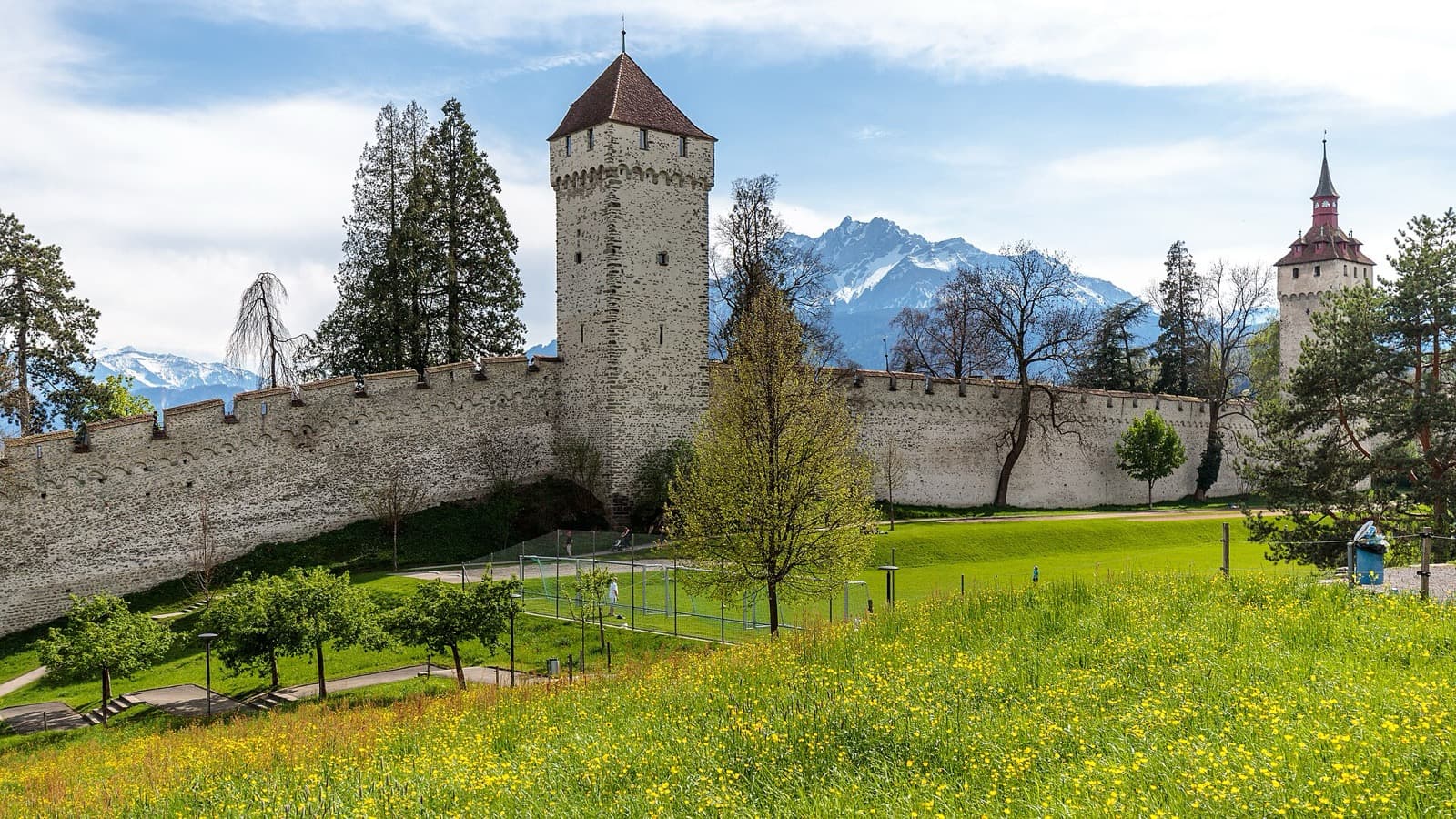
From the deep-time ground the route climbs to the Museggmauer, the Musegg Wall, Lucerne's second ring of fortifications, raised along the sandstone ridge from the fourteenth century. The stretch built around 1386 still stands almost completely intact, and that date carries weight. In 1386 the Swiss confederates fought the Battle of Sempach against the Habsburg Duke Leopold the Third, and it was in the years around that conflict that Lucerne strengthened this wall. A town fresh from war understood, plainly, why it needed stone.
At about 870 metres, this is the longest surviving town wall in Switzerland. Nine of its original towers still stand, and four of them, the Schirmer, the Zyt, the Wacht and the Maennli, are open to climb. The ramparts between them are free to walk from the first of April to the first of November. Most European towns tore their walls down as they grew. Lucerne kept its ridge of stone, and it is the other face of the resort town, the fortress that never quite forgot it was a fortress.
The frame where everything meets
The Zytturm, the clock tower, is the turn of the walk. From its rampart the painted old town, the covered bridges over the River Reuss, and Lake Lucerne all fall into one frame, with Mount Pilatus and Mount Rigi rising over the water on a clear day. The tower holds the oldest clock in Lucerne, a mechanism dated 1535, and by local tradition it strikes the hour one minute before every other clock in the city. The tower rises about thirty-one metres and has been open to the public since 1951.
The descent reaches the Hofkirche Sankt Leodegar, the court church whose twin spires rise about sixty-nine metres above the lake. A monastery was founded on this ground in the middle of the eighth century, older than the town itself, and it was around this religious house that Lucerne first gathered. A fire tore through the Gothic building on Easter Sunday 1633, but the two pointed towers survived the flames and were woven into the church rebuilt between 1633 and 1639. If you want the oldest root of the town, you are standing at it.
The walk closes at the lakefront, where the River Reuss leaves the Vierwaldstaettersee. The first paddle steamer here, the Stadt Luzern, made its maiden voyage in 1837. Five restored steamers still work these waters, the world's largest fleet of paddle steamers on an inland lake. The mountains that ring the lake drew the first great wave of travellers, and Lucerne became one of the birthplaces of Alpine tourism.
Read the monument first, then walk the wall above it, and Lucerne stops being a pretty face and starts telling the truth about itself. For more routes through the city, see our guide to Lucerne walking tours.
Sources
- Lion Monument, Wikipedia. Origin, sculptor, and the 1792 events the memorial commemorates.
- Lion Monument official site (loewendenkmal-luzern.ch). Dimensions, dating, and monument-protection status.
- Musegg Wall, luzern.com official tourism site. Wall length, towers, and public opening season.
- Church of St. Leodegar (Lucerne), Wikipedia. The 1633 Easter fire and the surviving Gothic towers.
- Lake Lucerne Navigation Company, Wikipedia. The paddle-steamer fleet and the 1837 maiden voyage.
Ready to experience it?
Lion Monument: The Dying Lion and the Wall of Towers
110 min · 4.7 km · moderate
More from Lucerne
Explore more at your own pace.
Lucerne Travel Guide: How Many Days, Getting Around, and When to Visit
One Day in Lucerne: A Walkable Morning-to-Evening Itinerary
The Painted Lake Town: How Lucerne Reads on Foot
The Chapel Bridge Burned in 1993. What Lucerne Rebuilt Tells You How to Read the Whole Old Town
The Jesuit Church of Lucerne: Switzerland's First Large Baroque Church, Built as an Argument