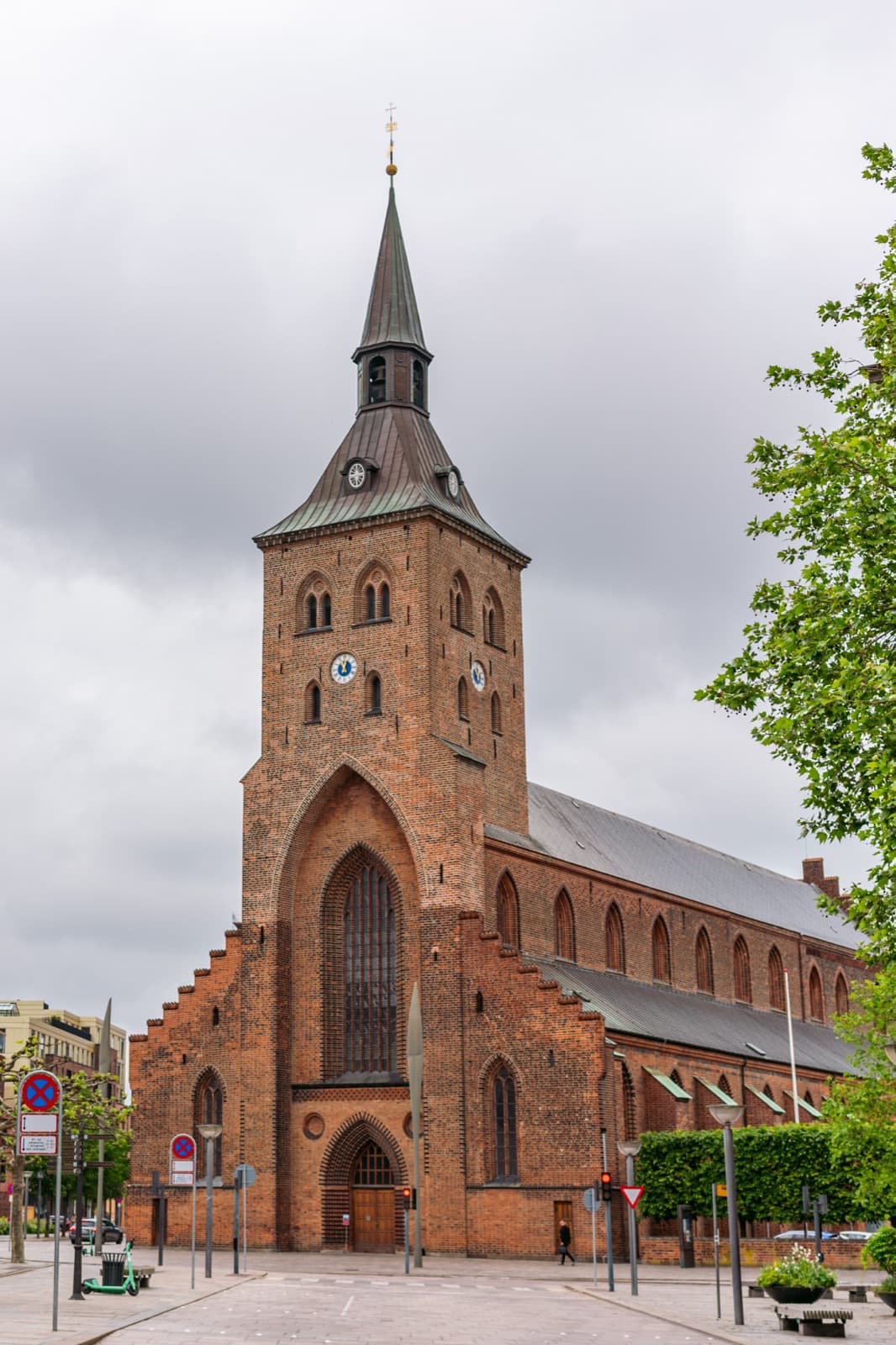
Saint Canute's Cathedral in Odense is a brick-Gothic church built over roughly two centuries to hold the bones of a king killed in this city in 1086, and standing in front of it means standing at the point where a real medieval murder became a national saint's shrine. The cathedral takes its name from Canute the Fourth, the Danish king slain during a revolt, and it keeps his relics in a crypt beneath the raised choir. Everything about the building's scale, its red brick, its long slow construction, follows from that one killing. On the Odense walking tour this is the sixth of the marquee stops, and it is the place where the fairy-tale town reveals its far older and much darker foundation.
The king in the crypt
The story the cathedral exists to tell is not a gentle one, and it deserves to be told plainly. Canute the Fourth reigned from 1080 to 1086. On the tenth of July 1086, during a revolt against him, rebels stormed the nearby church of Saint Alban and killed the king, his brother Benedict, and seventeen of his followers before the altar. This was a real killing of real men in this small Danish town, not a legend. What happened afterward is the part that built the cathedral. Canute was canonised on the nineteenth of April 1101 by Pope Paschal the Second, becoming the first Danish king made a saint and a patron of Denmark.
That canonisation changed Odense. A murdered king turned martyr draws pilgrims, and pilgrims need somewhere to come. An earlier stone church stood on this ground from about 1095, but as Canute's cult grew, the town needed something grander. Beneath the raised choir today, the crypt was expanded so that pilgrims could approach the reliquary directly. There, plainly and without spectacle, rest the relics of Canute the Fourth, known as Canute the Holy, together with his brother Benedict. When you go down into that crypt, you are following a path worn by nine centuries of visitors who came for exactly the same reason you did: to stand close to the bones of the saint the whole building was raised to honor.
Two hundred years in red brick
Hear a stop from this walk
Andersen's Childhood Home: The One Poor Room Where the Boy Dreamed
The cathedral you see was not built in one campaign. The present brick-Gothic church rose in phases from around 1300, when Bishop Gisico, who held the see from 1287 to 1300, began the reconstruction to replace the older stone church that had grown too small and too plain for the king's cult. It took roughly two hundred years to finish, and the cathedral was finally dedicated on the thirtieth of April 1499.
The material matters. This is Brick Gothic, the northern European tradition that used oversized red brick where softer building stone was scarce and expensive. The style gives Saint Canute's its tall pointed windows, its ribbed interior, and the sense of vertical lift that Gothic builders everywhere were chasing, achieved here in fired clay rather than carved stone. It is counted among the finest brick-Gothic churches in Denmark. Stand back far enough to take in the whole west front and you are reading two centuries of patient work, generation after generation of masons adding to a building whose purpose never wavered.
The Claus Berg altarpiece and the borrowed dead
Inside, the cathedral holds a second treasure that arrived by a different road. The great gilded altarpiece was carved by the sculptor Claus Berg around 1515 to 1525, commissioned by Queen Christine. It is a dense, glittering piece of late-Gothic woodwork, and for many visitors it is the single most memorable object in the building.
Here is the detail that reveals how churches actually accumulate their contents. The altarpiece was not originally made for this cathedral. It, along with several royal bodies, was moved here in 1807 when the old Franciscan friary church in Odense was demolished. Among those transferred dead is King Hans, who died in 1513. So the cathedral you visit is partly a rescue house, gathering into itself the burials and the art of a church that no longer exists. This is worth knowing before you go inside, because it explains why the royal graves and the masterpiece altarpiece feel almost too concentrated for one building. They were consolidated here when their first home came down.
That 1807 transfer is also the source of a common confusion the tour clears up at a neighboring stop. You will sometimes hear that King Hans is buried at Sankt Hans Kirke, the nearby church of Saint John. He is not. The similar names mislead people. King Hans lies here, in Saint Canute's Cathedral, moved with the altarpiece and the other royal remains in 1807.
The one thing to understand standing here
If you take only a single idea from this stop, let it be this: the cathedral is a monument built by memory working on grief. A king was murdered, the murder was reframed as martyrdom, the martyr became a saint, and the saint's shrine grew into one of Denmark's great churches over two hundred years. Everything visible, the brick, the crypt, the pilgrim paths, the borrowed royal tombs, flows downstream from that single violent day in 1086.
It also gives Odense its deeper timescale. The town is beloved as the birthplace of Hans Christian Andersen, the shoemaker's son born in 1805 who left at fourteen to write the tales the world would read. But Saint Canute's Cathedral was already four centuries old when Andersen was born a few streets away. The cathedral is the reminder that long before the fairy tales, this was a place where kings were killed and saints were made.
Walk it yourself
The cathedral is free to enter, with donations welcomed, and the crypt is open and accessible beneath the choir. Go early in the day, when the church is quietest, and keep your voice low: this is a working church, and the crypt holds real human remains. Give yourself time to find the Claus Berg altarpiece and to read the royal graves as what they are, a collection assembled from a demolished church in 1807.
Saint Canute's Cathedral is the sixth stop on the self-guided Old Town: Hans Christian Andersen's Odense walking tour, which threads the fairy-tale birthplace, the medieval merchant courtyards, and this cathedral of the murdered royal saint into one flat, easy loop of about one and a half kilometres. You walk it at your own pace, with no group and no schedule, lingering in the crypt as long as it holds you. For the full route and the other stops around it, see our guide to Odense walking tours.
Sources
- St. Canute's Cathedral, Wikipedia: construction phases under Bishop Gisico from about 1300, dedication on 30 April 1499, and the crypt reliquary of Canute beneath the raised choir.
- Canute IV of Denmark, Wikipedia: the 1086 killing at Saint Alban's church, the 1101 canonisation by Pope Paschal the Second, and Canute's status as Denmark's first royal saint.
- Museum Odense (museumodense.dk): the city museums that document Odense's Andersen sites and the old town's medieval layers.
- Roamer tour transcript, "Old Town: Hans Christian Andersen's Odense": fact-audited narration for the Claus Berg altarpiece (circa 1515 to 1525, commissioned by Queen Christine) and the 1807 transfer of the altarpiece and royal remains, including King Hans, from the demolished Franciscan church.
Ready to experience it?
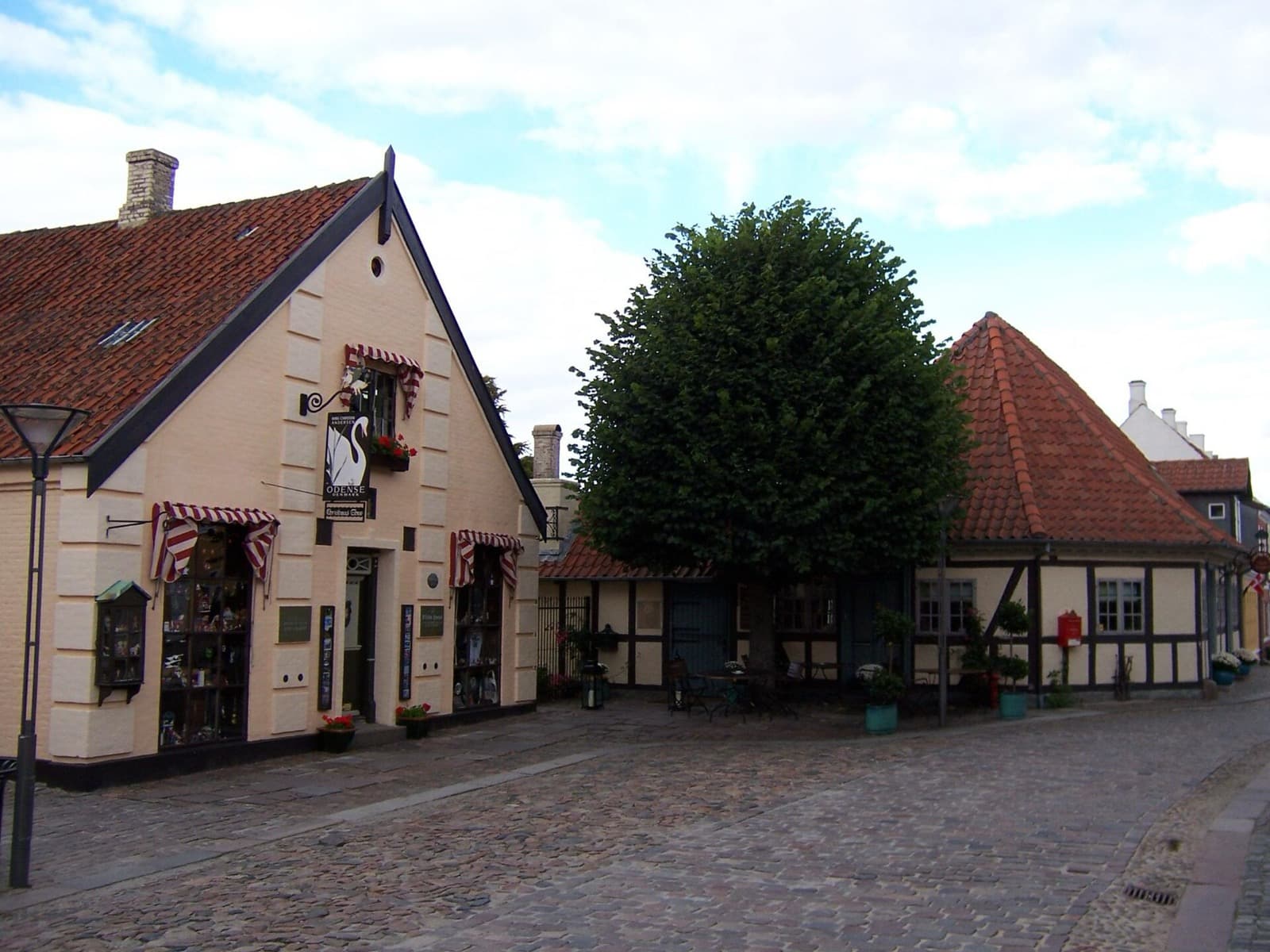
Old Town: Hans Christian Andersen's Odense
65 min · 1.9 km · easy
More from Odense
Explore more at your own pace.
Odense Travel Guide: Days, Transport, Safety, and Costs
One Day in Odense: A Walkable Morning-to-Evening Itinerary
Odense: The Fairytale City and the Viking Town Beneath It
Andersen's Birthplace and the Old Town of Odense: Where a Shoemaker's Son Became a Fairy Tale
Nonnebakken: The Buried Viking Fortress Under Odense