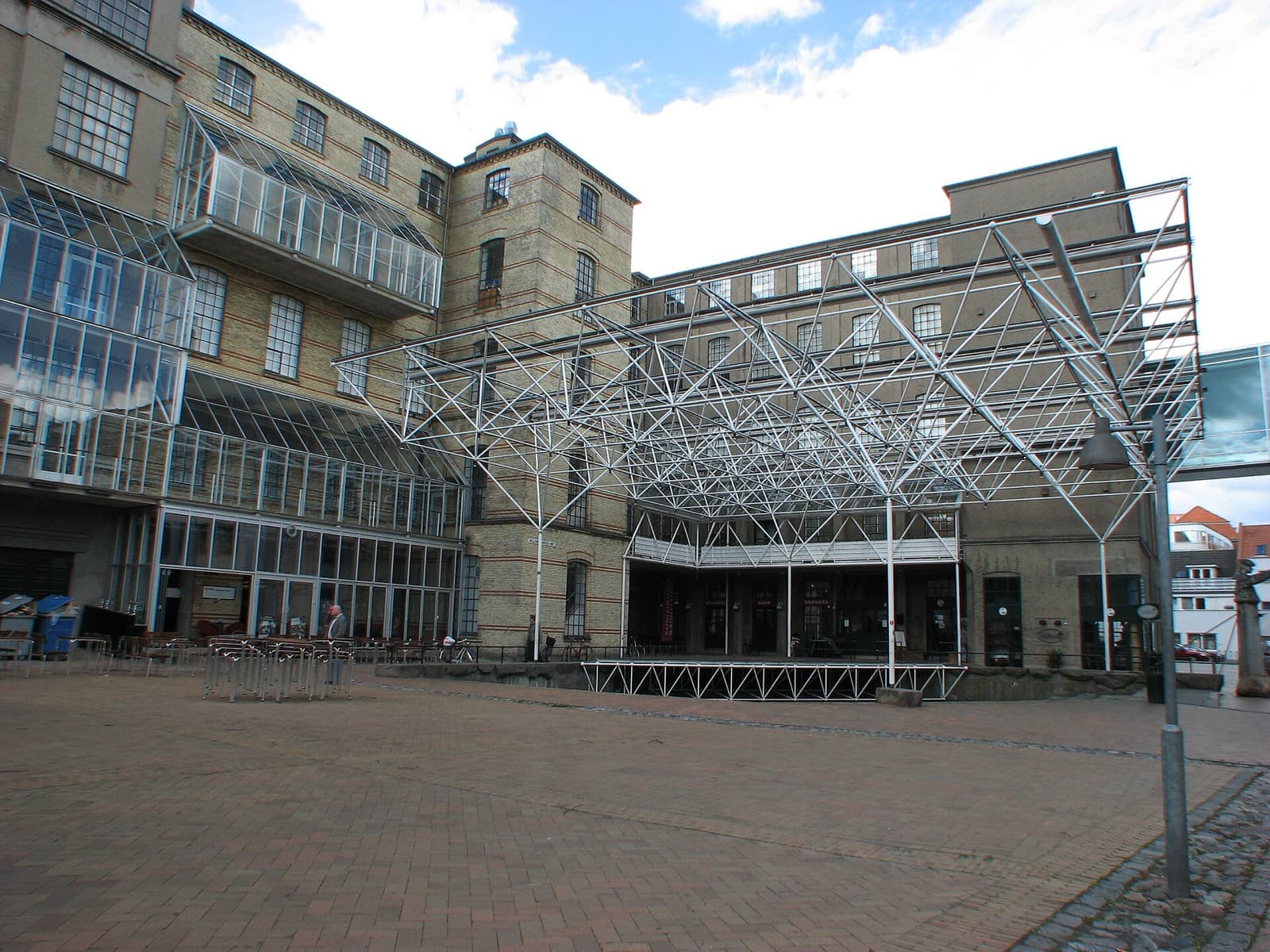
The great yellow-brick complex called Brandts Klaedefabrik began as a cloth mill in 1869 and now works as a quarter of art, and that double life is the one thing to understand standing in its courtyards. Odense did not tear the factory down when the looms went quiet. It converted the buildings, kept the honest industrial brickwork, and let a museum, a cinema, and artists' workshops move into the shells where wool was once spun and woven. The mill is still underneath. The art sits above it. Read both at once and you have read the way this whole town remakes itself without erasing what it was.
From ten employees to one of the town's biggest workplaces
Production at the Brandts cloth mill began in 1869 with just ten employees. That is a small, precise beginning, and it is worth holding in mind as you look up at the scale of the place, because the mill did not stay small. It grew into one of the biggest workplaces in all of Odense, a complex of looms and wool and shift-work that shaped the lives of many local families for generations. For decades this was not a cultural destination. It was a job. People came here at dawn, worked the machines, and went home. The rhythm of the town partly ran on the rhythm of these buildings.
The architecture still tells you that. The characteristic yellow brick with green-framed windows was built for industry, not for display. Tall factory windows let daylight onto the workroom floors. The brick is plain and structural. Nothing about the original design was meant to charm a visitor, which is exactly why it reads as honest today. When you stand in the yards and look up, you are reading a working building that was made to hold machines and workers, and that plainness is part of what gives the place its authority.
Then the textile industry faded, as it did across Europe through the twentieth century. Cheaper production moved elsewhere, the machines fell silent, and the great buildings emptied. This is the ordinary end of most industrial history: the mill closes, the site sits derelict, and eventually it is cleared for something new. What happened at Brandts instead is what makes it worth a stop on a walk about the deep town beneath Odense's fairytale surface.
The choice not to demolish
Hear a stop from this walk
Brandts: The Cloth Mill Reborn as a Quarter of Art
Beginning in the 1980s, the town converted the old mill rather than clearing it. This was one of Denmark's early examples of turning industrial heritage into something new and living, a decision that now looks obvious and at the time was not. The straightforward path would have been demolition. Instead the buildings were kept and repurposed, and a former factory became a cultural quarter. The art museum that anchors the complex, Kunsthallen Brandts, opened in 1987, giving the conversion its permanent public face.
The result today is a stack of institutions under one set of brick roofs. The old factory holds an art museum, the Brandts Museum of Art, along with a museum of fashion and interiors, a cinema, artists' workshops, a students' hall, and courtyards threaded with cafes and small shops. The surrounding streets, part of Odense's Latin Quarter, absorbed the same energy, so the mill did not become an isolated attraction but the center of a living district. You can spend an afternoon here without buying a single ticket, because the courtyards are free to wander at your own pace. They are open passages between the old brick walls, and the industrial character is fully legible from the yards alone.
This matters for how you approach the visit. The art museum charges admission in Danish kroner if you want to go inside, and the fashion and interior collections are worth the entry if art and design draw you. But the essential experience of Brandts is free and outdoors: walk into the yards, look up at the tall windows and the brickwork, and let the sequence of the place register. Working mill underneath, quarter of art above. That is the whole idea, and you can read it without spending anything.
The one thing to understand standing here
Most heritage sites ask you to imagine something that is gone. Brandts asks the opposite. The thing you are looking at is still here, still standing, still in daily use, just doing a different job than the one it was built for. That is rarer than it sounds. On this walk you have already passed places where the past survives only as absence: a Viking ring fortress buried invisibly beneath ordinary streets at Nonnebakken, a Dominican friary reduced to brass markers set into the paving at Sortebroedre Torv, a martyred king's priory replaced centuries ago. Those are ghost places. Brandts is the counter-example, a piece of the working past that was kept whole and given a second life instead of being demolished or left to decay.
Stand in one of the courtyards and let that settle. The families who worked the looms here would not recognize the galleries and cinema, but they would recognize the walls, the windows, the shape of the yards, the very brick they walked past every working day. The town chose continuity over erasure. It found a use for the past rather than a substitute for it. That is a quiet civic decision, made in the 1980s by people who could have chosen the bulldozer, and it is why a walk through the deep history of Odense ends up at a place that is emphatically alive rather than mournful.
When you have wandered the yards, look at where you are in the larger route. Brandts sits near the little Odense river, the Odense Aa, that threads this entire walk, and the path turns from here back toward the water for its final green stretch out toward the woods. The mill is the turning point between the town's stone history and its riverside calm.
Brandts is one stop on the self-guided audio walk Odin's Shrine: The Viking Town by the River, which follows the Odense river from the old royal palace and the King's Garden, past the buried ring fortress of Nonnebakken and the church that keeps a murdered king's memory, to this reborn mill and out to the green valley of Fruens Boege. If you want the full arc, from the god's shrine at the top of the town to the beeches leaning over the water, browse the Odense walking tours or start from the Odense city page. Walk it on your own clock: linger in the courtyards, skip what does not call to you, and let the mill tell you its two stories at once.
Sources
- Roamer tour transcript, "Odin's Shrine: The Viking Town by the River" (fact-audited): primary source for the 1869 production start, ten employees, 1980s conversion, yellow-brick and green-window architecture, and the institutions now inside the complex.
- VisitOdense, "Brandts Klaedefabrik": tourism-board overview confirming the yellow bricks and green mullioned windows, the current institutions (Art Museum Brandts, museum of everyday life, cinema, galleries, cafes), and the Latin Quarter setting.
- Guideservice Danmark, "Brandts Klaedefabrik, a Woolen Mill with a Surprising Story": history confirming the 1869 founding with ten employees, growth into Odense's largest workplace, closure in 1977, and the 1982 to 1986 conversion.
- The Danish Dream, "The Brandts Museum of Art": background on the industrial-to-cultural conversion and the preserved yellow-brick, green-window architecture, with the art hall opening in 1987.
Ready to experience it?
Odin's Shrine: The Viking Town by the River
125 min · 6.9 km · easy
More from Odense
Explore more at your own pace.
Odense Travel Guide: Days, Transport, Safety, and Costs
One Day in Odense: A Walkable Morning-to-Evening Itinerary
Odense: The Fairytale City and the Viking Town Beneath It
Andersen's Birthplace and the Old Town of Odense: Where a Shoemaker's Son Became a Fairy Tale
Nonnebakken: The Buried Viking Fortress Under Odense