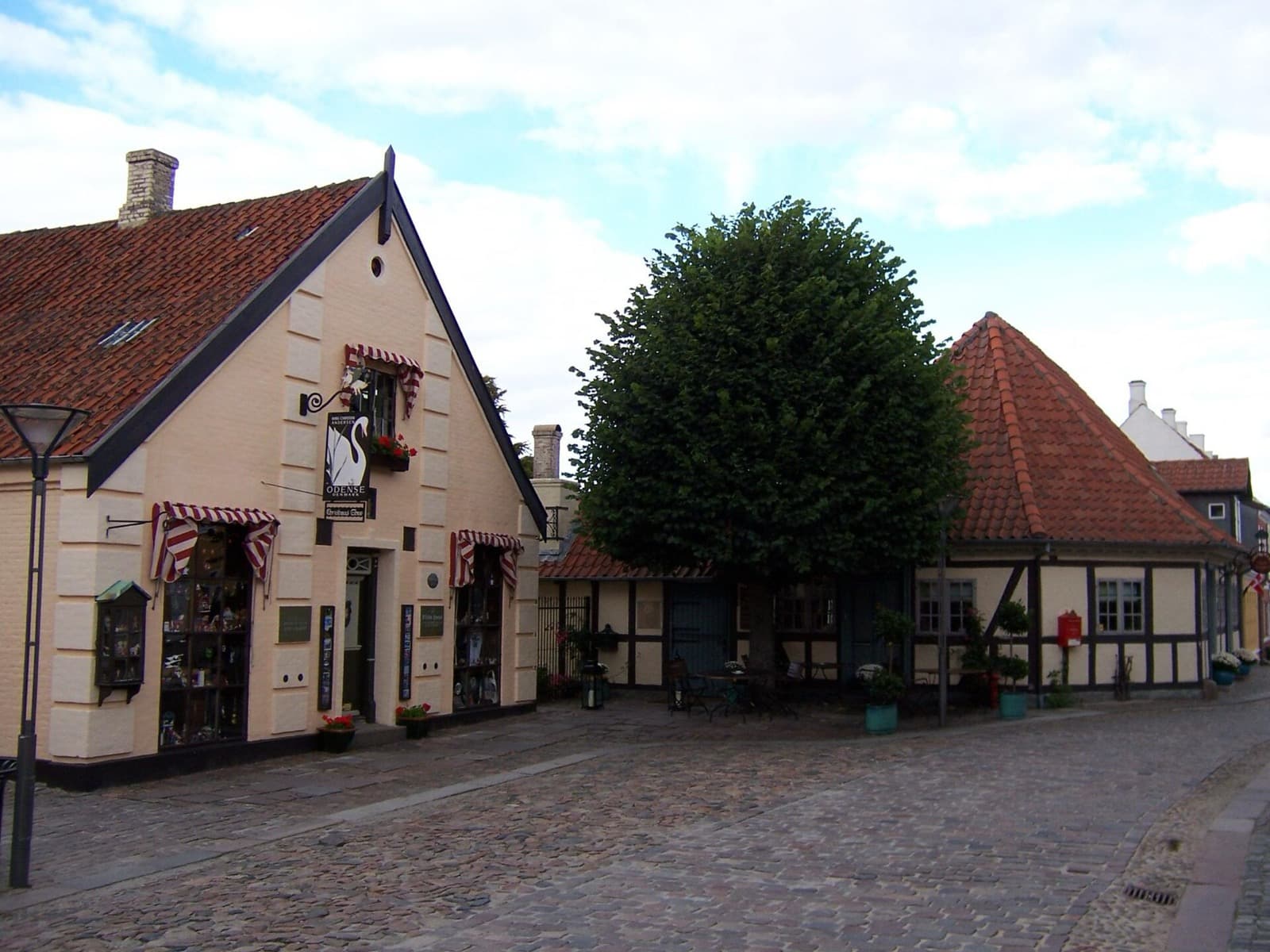
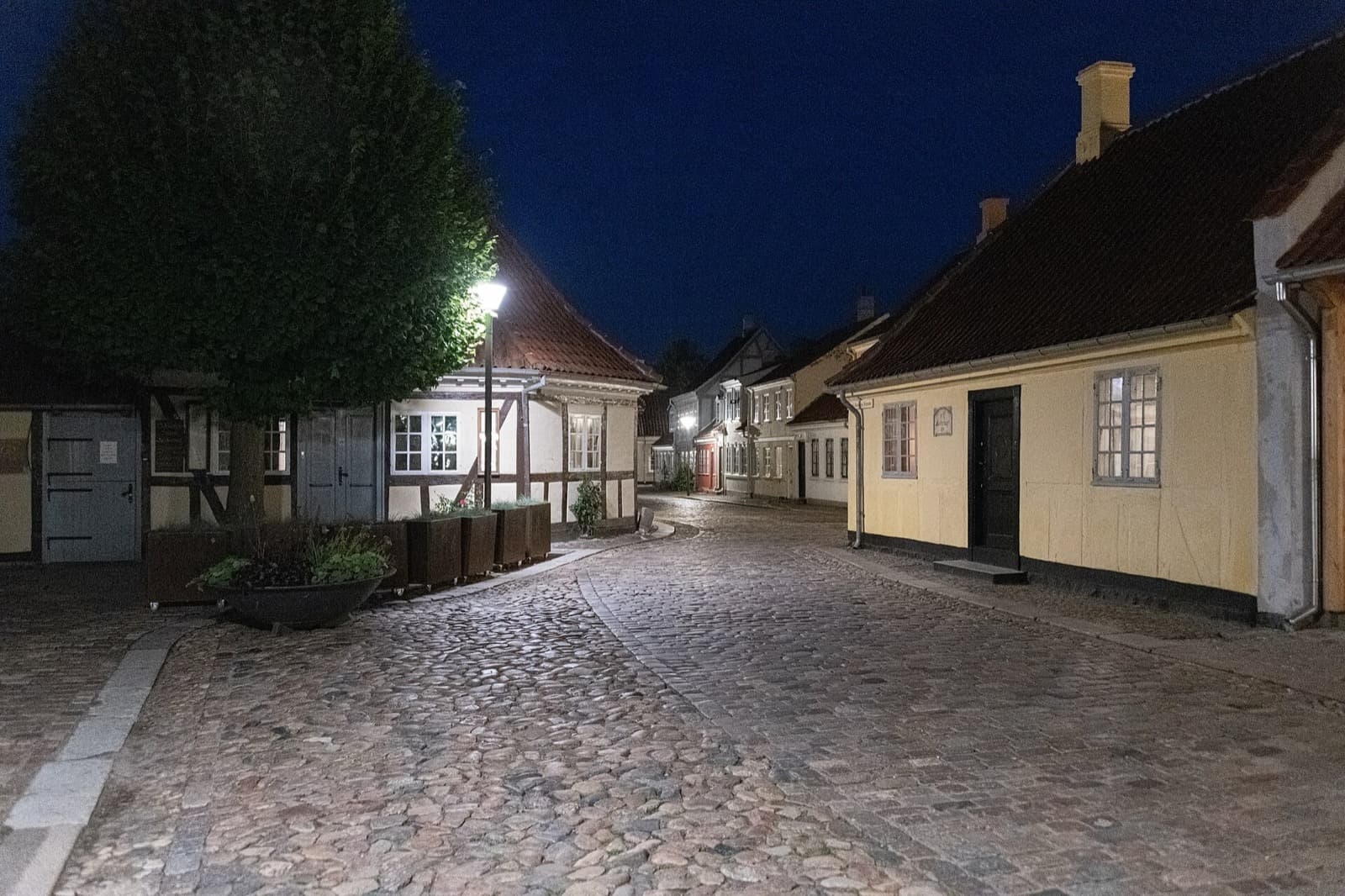
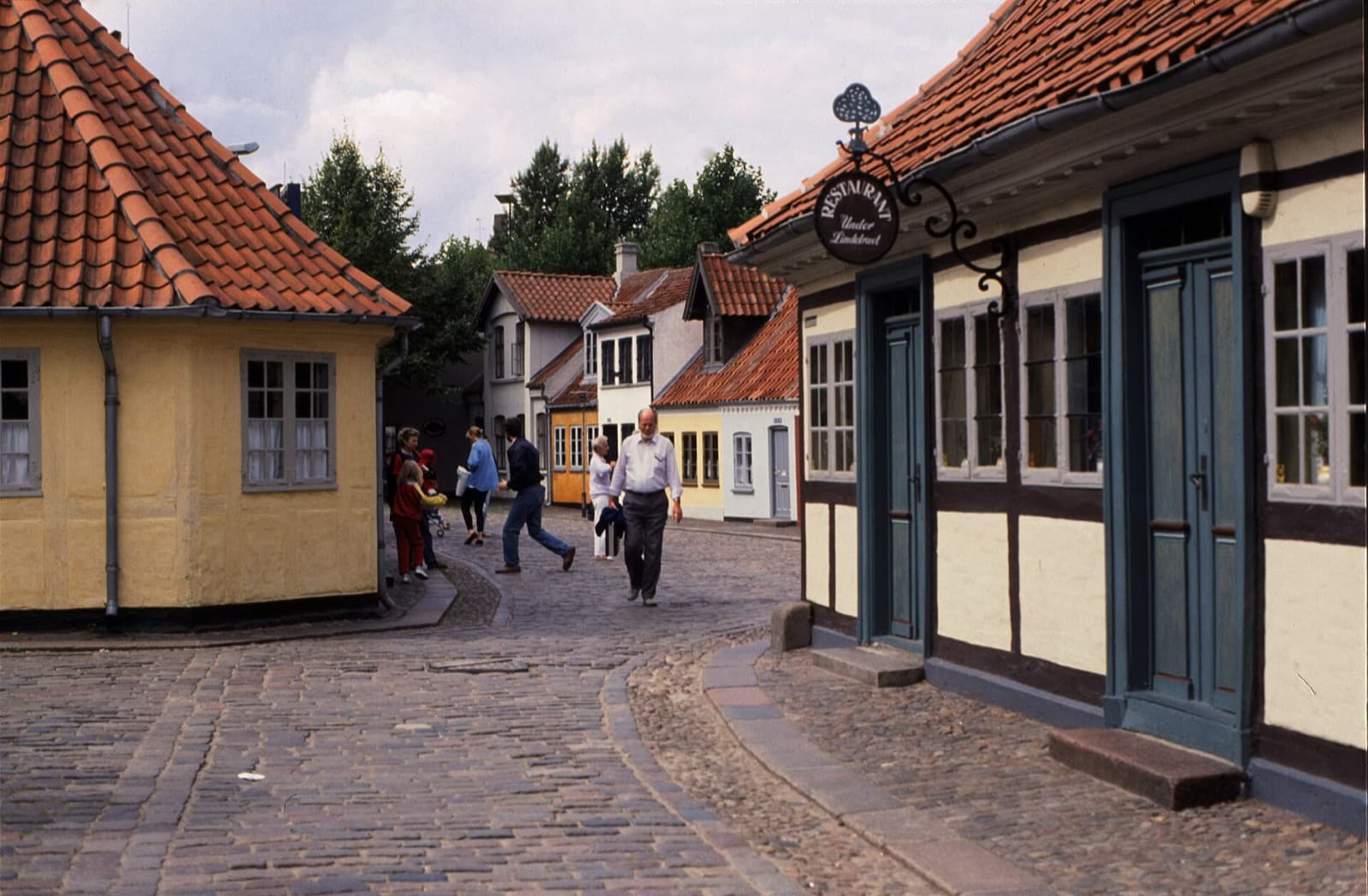
The little yellow corner house at Hans Jensens Straede 45, honored by tradition as the birthplace of Hans Christian Andersen, is the doorway into a walk that reads the whole old town of Odense. It stands at the point where the lane meets Bangs Boder, in the low cobbled quarter that was once crowded with washerwomen, shoemakers, and day laborers. Start here, at this one small house, and the rest of the route opens outward: a garden museum sunk into circular hedges, the courtyards of an ancient merchant town, a medieval church with its pulpit on the outside wall, a civic square, and finally the great brick cathedral that holds the bones of a king killed in this city in 1086. The birthplace is where the story begins, and the story is bigger than the boy.
The house that tradition remembers
Be honest about the word "tradition." The house dates from around 1799, and tradition holds that Andersen was born under this roof on the second of April 1805, the son of a poor shoemaker named Hans Andersen and a washerwoman named Anne Marie Andersdatter. It has been shown and honored as his birthplace, and it has formed part of a museum since 1908. But the record does not actually confirm that he was born here. Odense Bys Museer, the city museums that run the site, present it as the traditional birthplace rather than a proven one.
That ambiguity feels oddly right for a man who spent his life turning the ordinary into story. From these narrow means the boy rose to write The Little Mermaid, The Ugly Duckling, The Emperor's New Clothes, and The Steadfast Tin Soldier, tales now read in more languages than almost anything written by a single author (more than 125, by most counts). He left Odense at fourteen, in 1819, walking out toward Copenhagen with almost nothing. Standing at the corner, on your own clock, you are standing at the beginning of a very long climb.
Where the streets dissolve into story
Hear a stop from this walk
Andersen's Childhood Home: The One Poor Room Where the Boy Dreamed
Wrapped around the birthplace is H.C. Andersens Hus, the fairytale museum, which reopened in the summer of 2021. The Japanese architect Kengo Kuma and Associates won the competition for it in 2016, and rather than one grand block, the building is a scatter of low timber-and-glass pavilions with scooped green roofs, largely sunk into circular gardens and winding hedges. You step down into it the way a reader steps down into a story. VisitDenmark records that the design draws in part on Andersen's tale The Tinderbox, in which a hollow tree opens into an underground world of wonders. A fairy tale garden here gathers eleven of his stories among the hedges.
What makes it work is that the whole thing is stitched into the preserved old quarter, so the modern architecture never overwhelms the small human scale that made the boy. You can wander the gardens at your own pace, no group, no set path. If you are planning the wider route first, the Odense walking tours overview lays out how these stops connect.
The town that was already old
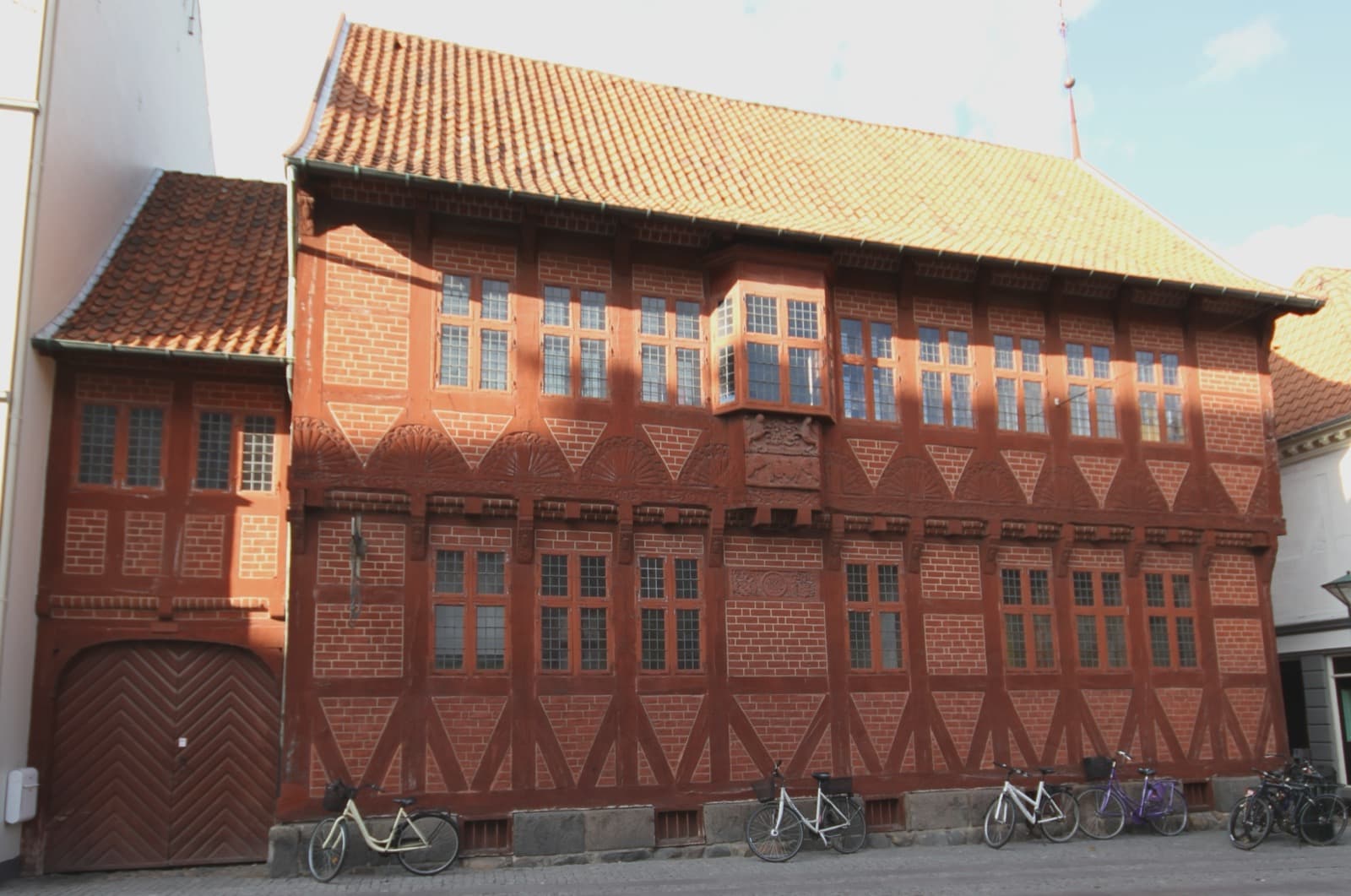
The next stop, Moentergaarden, is a useful counterweight on an Andersen walk. It is Odense's cultural-history museum, set in a knot of half-timbered renaissance merchant houses and courtyards at Overgade 48. The main two-storey house dates to 1646 and was built for a nobleman named Falk Goeye, who lived from 1602 to 1653. Inside, the collections carry Odense and the whole island of Funen from the deep past through the Viking age, the Middle Ages, and the Renaissance. The museum even holds the Koelbjerg remains, recorded as the oldest human remains known from Denmark, dated to roughly 8000 before Christ. The name itself recalls a former mint, a coin workshop that tradition places on or near this site. Long before a shoemaker's son was born a few streets away, this was a working town of merchants, coiners, and craftsmen with a thousand years already behind it.
That older Odense carries into Sankt Hans Kirke, Saint John's Church, a medieval brick church built by the Knights Hospitaller and first mentioned in the records in 1295. A bell in its stepped-gable tower is dated 1496. Its most unusual feature is on the outside: set into the south wall is an external pulpit, a preaching balcony facing the open air. Services were most likely held from it for people not allowed inside the church, lepers and outlaws kept beyond the door, so that even the excluded could hear a sermon. It is a quietly moving thing to stand below, a reminder of how sharply the medieval town drew its lines.
The square and the murdered king
Flakhaven is the old town-hall square, linking the town hall on one side with the cathedral on the other, so it has long joined civic power and church power in the city. The red-brick Odense Town Hall was built between 1881 and 1883 to designs by Johan Daniel Herholdt and Carl Lendorf, closely inspired by the Palazzo Pubblico, the medieval town hall of Siena in Italy. That model gives northern Odense an unmistakably Italian silhouette. It stands on the site of an older town hall recorded from 1480.
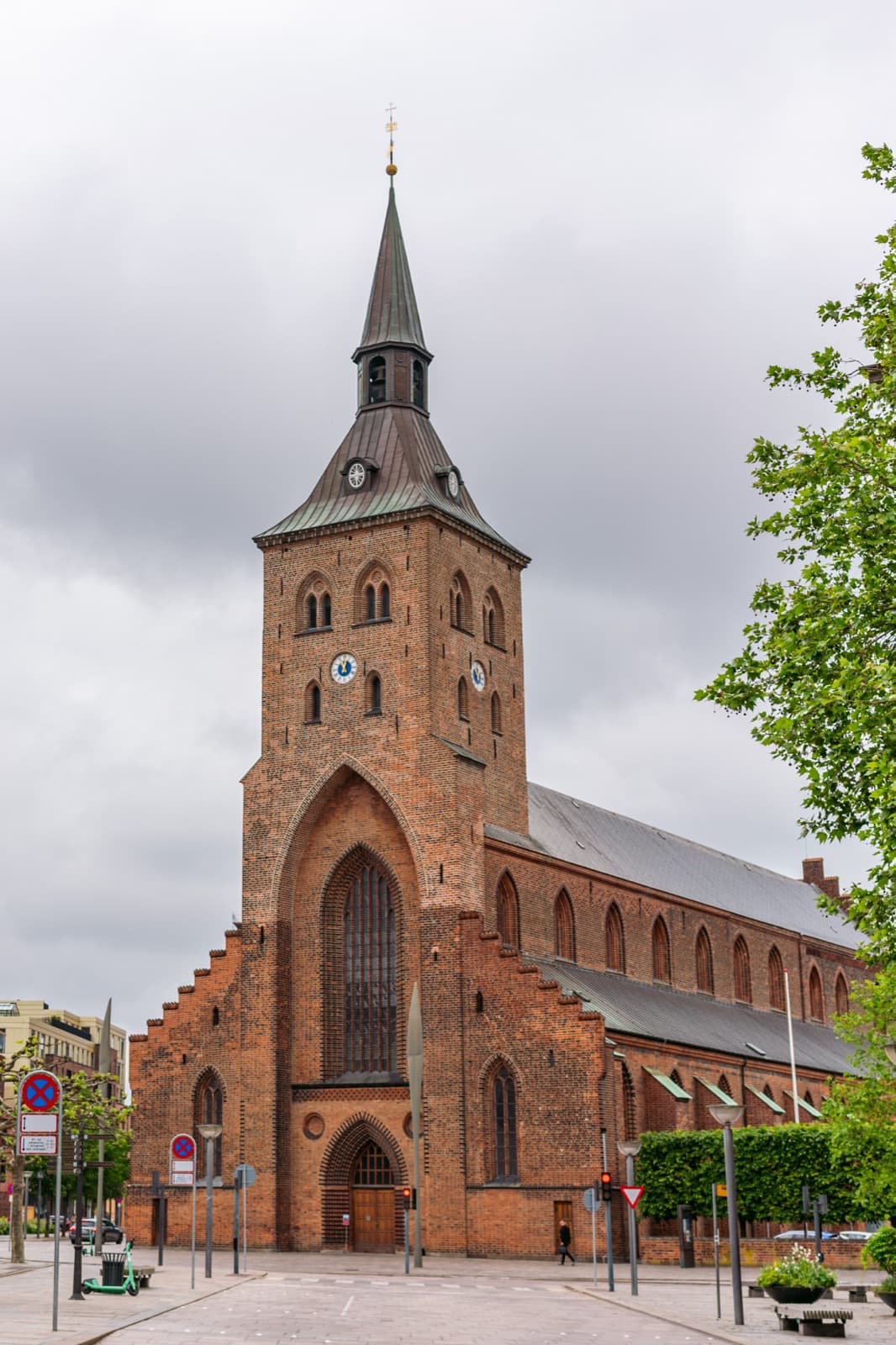
The walk climbs to its climax at Saint Canute's Cathedral, one of the finest brick-Gothic churches in Denmark. Beneath the raised choir is an accessible crypt, and there rest the relics of King Canute the Fourth, known as Canute the Holy, with his brother Benedict. The history is grave. On the tenth of July 1086, during a peasant revolt, rebels stormed the nearby church of Saint Alban and killed the king, his brother, and seventeen of his followers before the altar. He was later canonised, on the nineteenth of April 1101, by Pope Paschal the Second, the first Danish king made a saint. The cathedral also holds the gilded altarpiece carved by Claus Berg around 1515 to 1525, commissioned by Queen Christine.
Back to one poor room
The route ends where it is most human. Andersen's Childhood Home stands at Munkemoellestraede 3 to 5, about a fifteen-minute walk from the birthplace. Here the boy lived with his parents from May 1807, when he was two, until 1819, when he was fourteen and left for Copenhagen. It opened as a museum in 1930, and what it preserves above all is the single humble room and yard of his early years. Not the marble of a cathedral or the sweep of a garden museum, but one poor room where a shoemaker's son lay and dreamed. You have moved from a birthplace held in tradition, through the deep memory of an ancient town and the crypt of a murdered king, back to the smallest place of all. When you leave it, you leave Odense the way he did, carrying the story with you.
Ready to walk it? The full self-guided route through Odense runs about two kilometres, flat and easy, at whatever pace you set.
Sources
- Museum Odense, Hans Christian Andersen: Official account of the birthplace, presented as tradition, and the city museums that run the site.
- H.C. Andersens Hus (official): The Kengo Kuma garden museum, its 2021 reopening, and the fairy tale gardens.
- St. Canute's Cathedral, Wikipedia: The brick-Gothic cathedral, the crypt of Canute the Fourth, and the Claus Berg altarpiece.
- Canute IV of Denmark, Wikipedia: The killing at Saint Alban's in 1086 and the canonisation in 1101.
- Hans Christian Andersen, Britannica: Biography, the fairy tales, and their global translation reach.
Ready to experience it?
Old Town: Hans Christian Andersen's Odense
65 min · 1.9 km · easy
More from Odense
Explore more at your own pace.
Odense Travel Guide: Days, Transport, Safety, and Costs
One Day in Odense: A Walkable Morning-to-Evening Itinerary
Odense: The Fairytale City and the Viking Town Beneath It
Nonnebakken: The Buried Viking Fortress Under Odense
Brandts Klaedefabrik: The Odense Cloth Mill Reborn as a Quarter of Art